See-through aviation

After I saw this episode of Boing Boing TV...

...I of course had to check out Carl Rankin's Web site.

Wherein is prominently displayed The Mama Bear...

..."the largest radio-controlled plane constructed from plastic-wrap, drinking straws and tape ever built".

Super-light spindly radio controlled planes are not new. Gossamer concoctions of balsa, carbon fibre and Mylar film have been buzzing peacefully around in high-school halls for ages, and they're now even leaking into the commercial market.

Those indomitable little foam living-room planes and twin-motor helicopters (the original Picoo Z and its numerous, often inferior, knock-offs) are cheaper even than a plane made from take-out containers. But they're not actually very controllable - you can only kind of suggest where you'd like them to go, after which luck takes over.

Carl Rankin's creations, in contrast, are proper controllable aircraft made on a near-zero budget for everything except the electronics.

Lichtenbergia

The other day I was shining a dangerously bright green laser through a Lichtenberg figure, as I'm sure all of you have done from time to time, and I discovered something interesting.

What?

Oh, all right. I'll explain.

Lichtenberg figure

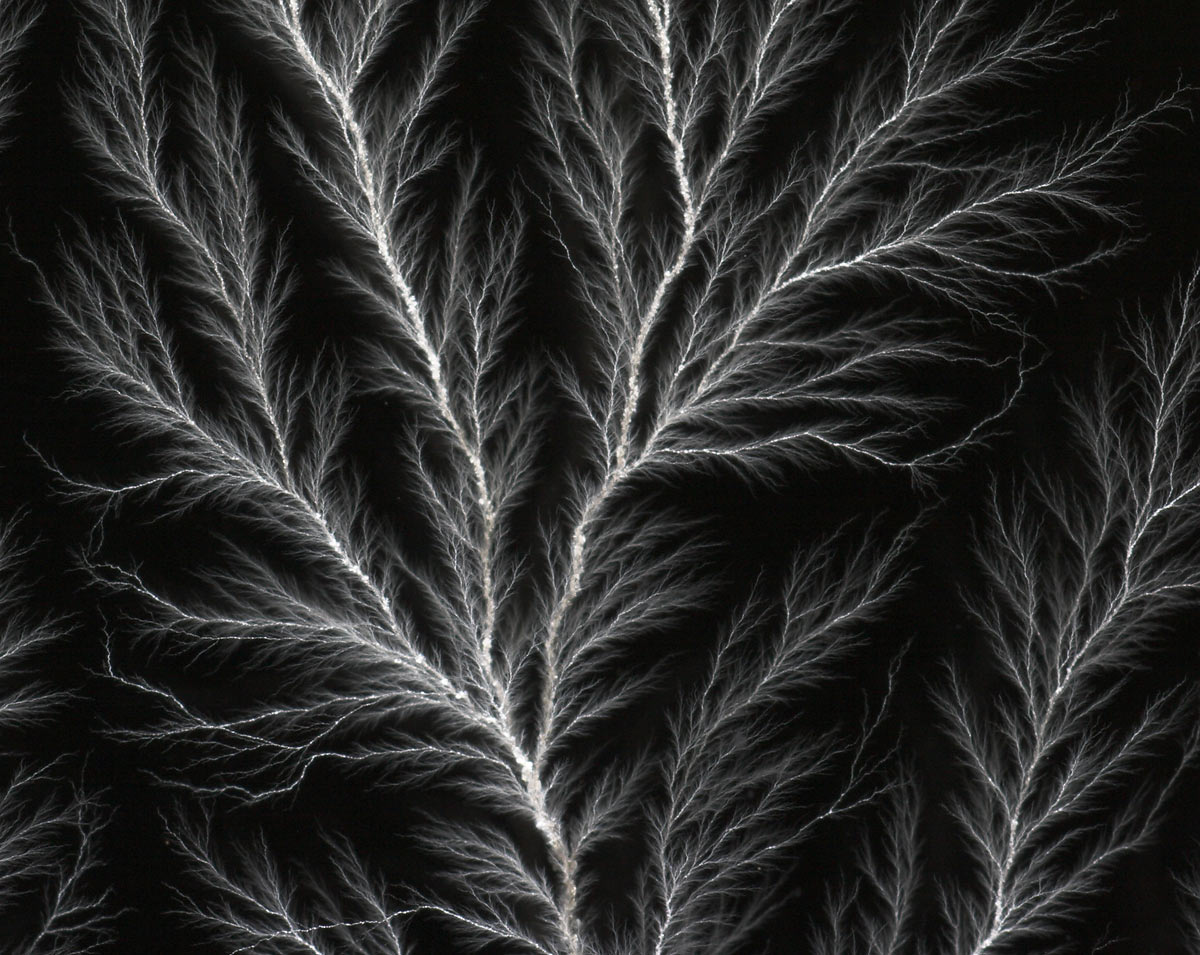
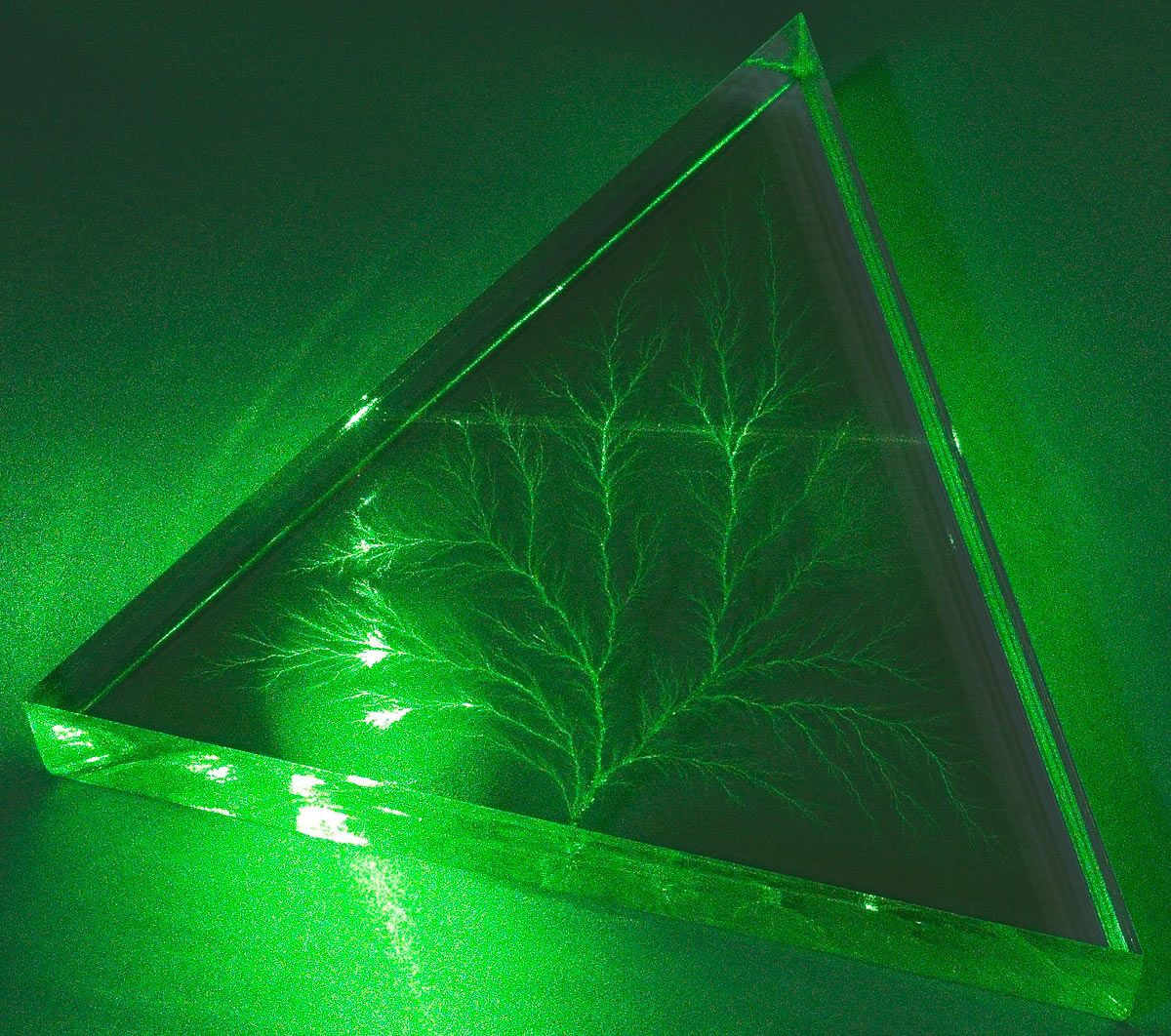
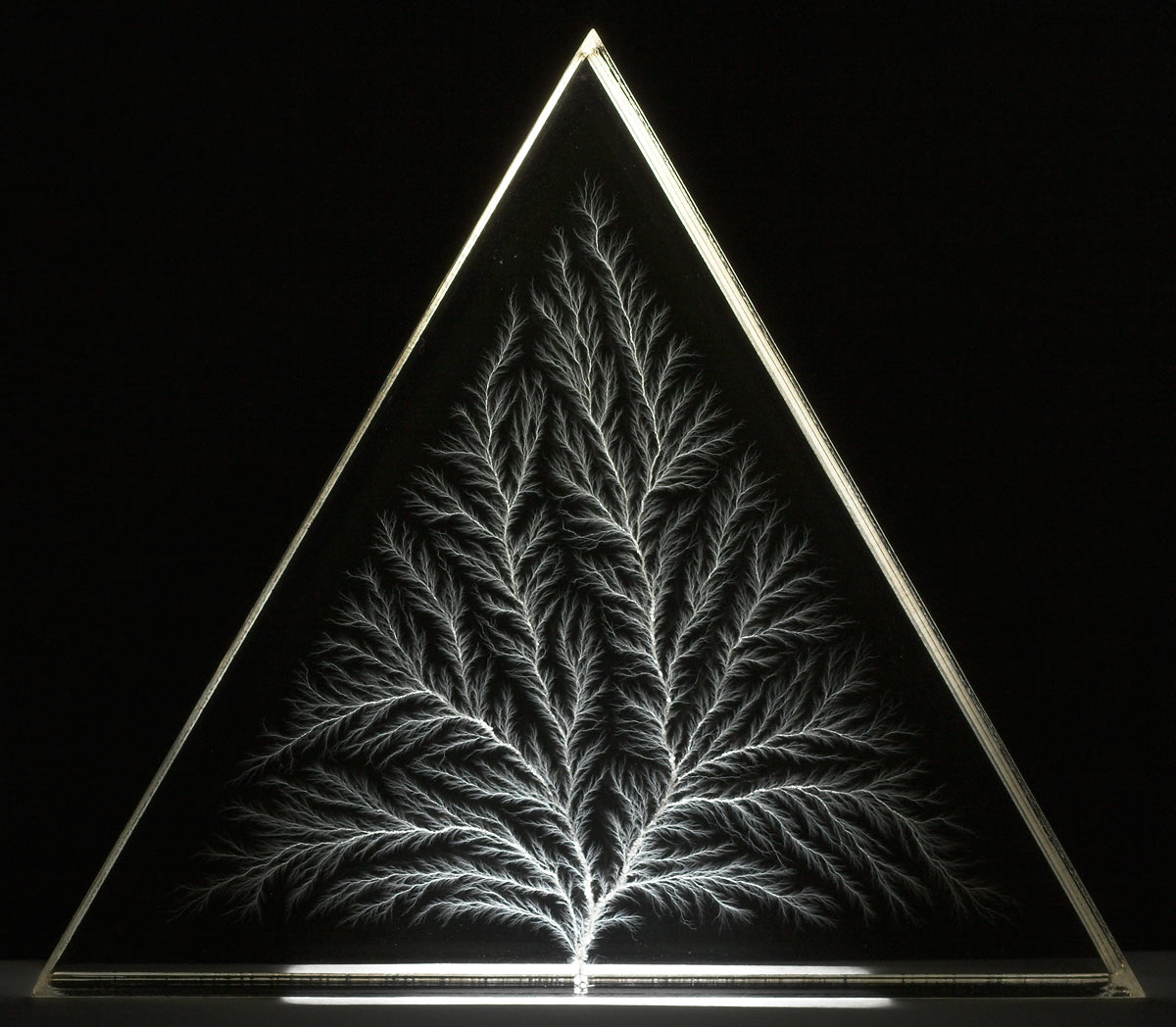
This is a Lichtenberg figure.

Well, technically, the Lichtenberg figure is the feathery ferny shape inside the block of clear acrylic. The shape is a void burned into the plastic by a powerful electric discharge.

A Lichtenberg figure is, in brief, the shape of an electrical discharge. Specifically, it's the shape of an electrical discharge from an area to a point - sometimes over time, but usually all at once.

The acrylic-block type of Lichtenberg ornament is definitely of the all-at-once variety. To make one, you have to shoot your acrylic with a fairly high powered electron beam, also known as a cathode ray.

The electron beam in a Cathode Ray Tube (CRT) television or computer monitor - which, yes, actually is a kind of particle accelerator - delivers electrons with maybe 20,000 or 25,000 electron volts (20 to 25keV) of energy.

That's quite enough to produce considerable X-ray radiation when the electrons strike the inside of the tube - which is why CRTs are made from leaded, radiation-blocking glass - but it's only 1%, at best, of the energy you need to drive electrons even a centimetre or so into a plastic target.

If your electron beam is powerful enough to do that, several seconds of exposure will cause the plastic to acquire a absolutely terrific level of charge. Up in the low megavolts, and with total stored energy ranging from that of a tiny to that of a quite large pistol cartridge.

Then you bring an earthed contact close to one side of the block.

And bang, there's your Lichtenberg figure.

Lichtenberg figure detail

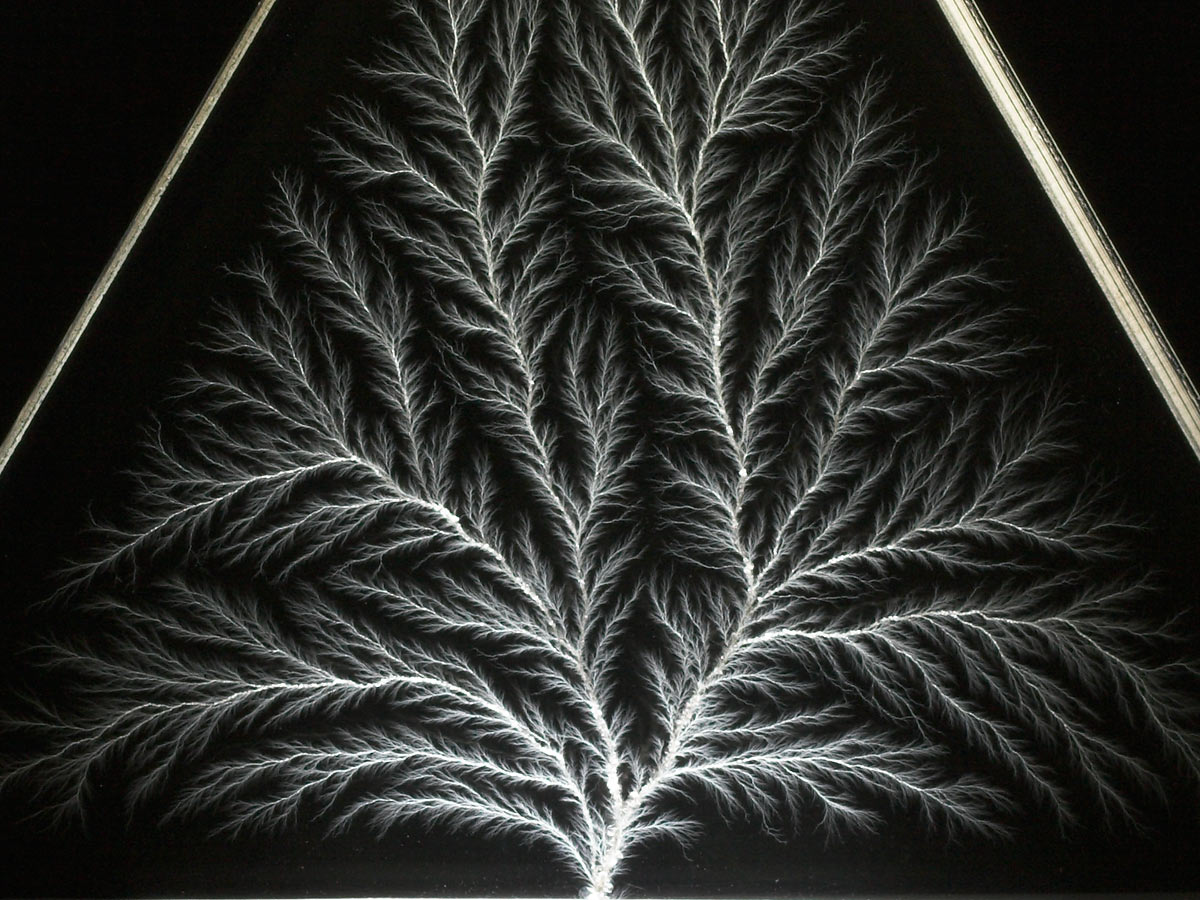
Close-up of Lichtenberg figure

It's been speculated that the feathery tips of the figure are present all the way down to the molecular level.

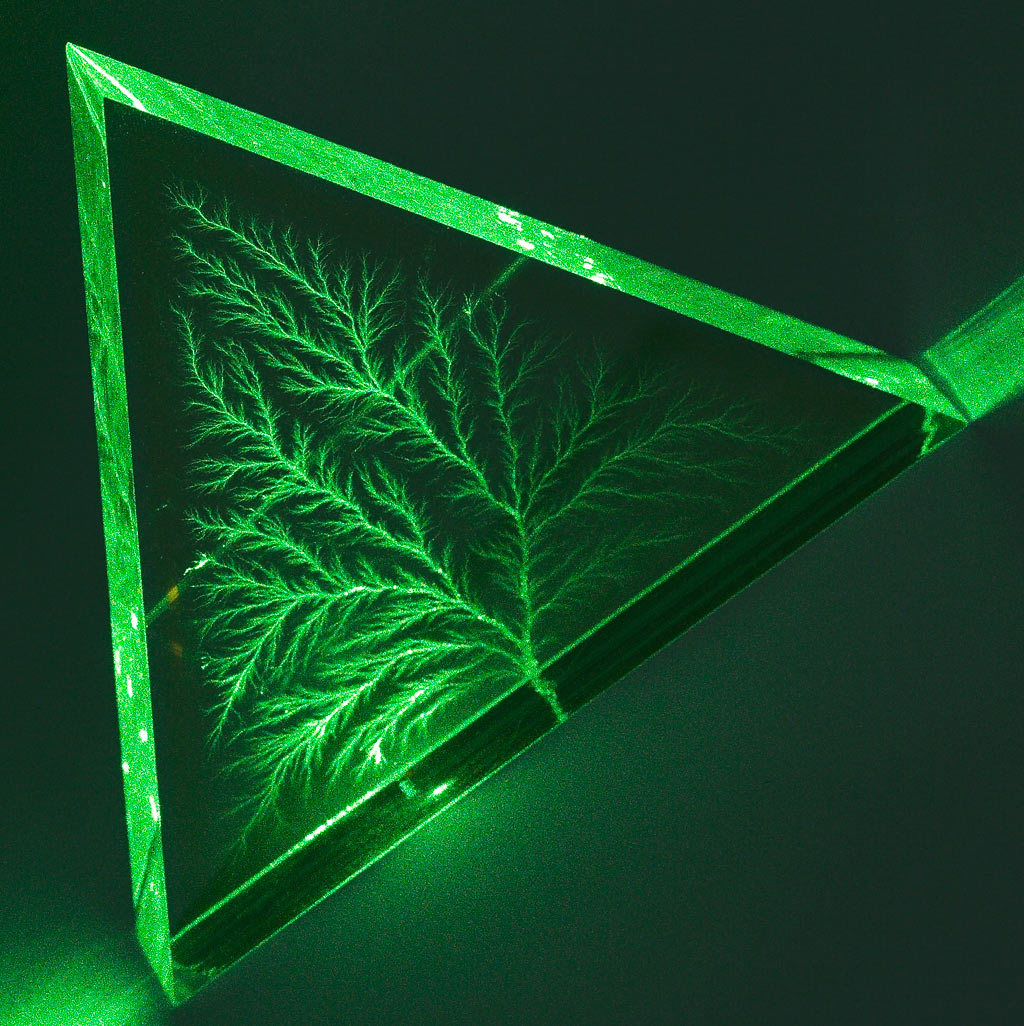
The world's premiere - actually, pretty close to the world's only - supplier of Lichtenberg figures burned into clear acrylic blocks is Bert Hickman's Stoneridge Engineering. That's one of Bert's in the video above, and I've bought a total of three smaller figures from him over the years, from his eBay store here. This equilateral triangle figure is four inches on a side, and cost me $US24.95 plus postage.

As acrylic Lichtenberg figures get bigger, the energy needed to make them rises, and is soon well beyond what your common-or-garden medical LINAC can manage. This sort of accelerator is not something you can make at home; it's very difficult to get even 1MeV out of a homebuilt unit, even if you're the kind of kid who is only bullied by the members of the football team who didn't know about all the jocks at your old school whose hair and teeth fell out before they died.

You need something like one of the big blighters used to irradiate food. This is why Bert's real monsters are rather expensive.

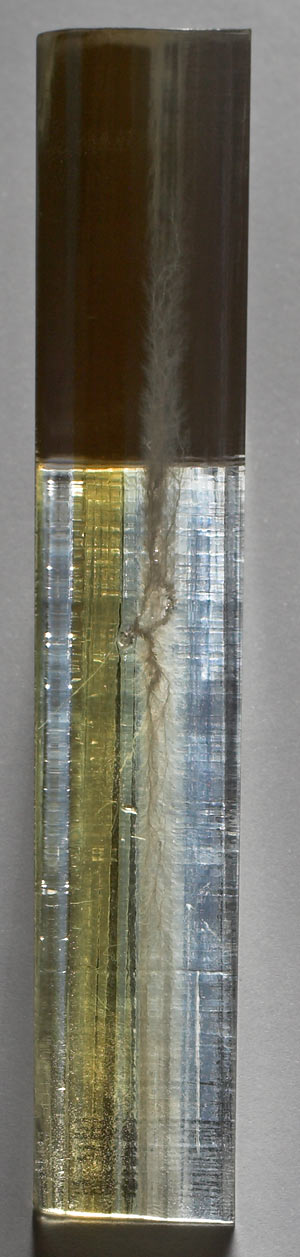
When high energy electrons hit acrylic, they don't just settle peacefully into the polymer matrix. They actually hit hard enough to discolour the plastic on the side on which the beam enters. This effect is known as "solarisation", because it looks not unlike the discolouration caused by long exposure to ultraviolet radiation (which only has energy of about ten electron-volts).

The electrons actually end up charging the plastic a bit beyond the discoloured deceleration zone. So if you look at an acrylic Lichtenberg figure from the side...

Solarisation of Lichtenberg figure acrylic

...you can quite clearly see the discoloration and the Lichtenberg figure itself as separate layers.

The solarisation nestles around the Lichtenberg figure like a little bathtub. It fades out around the edges, but those edges rise up around the lightning-shape on all sides.

And this is what I noticed when I was fooling around with my laser.

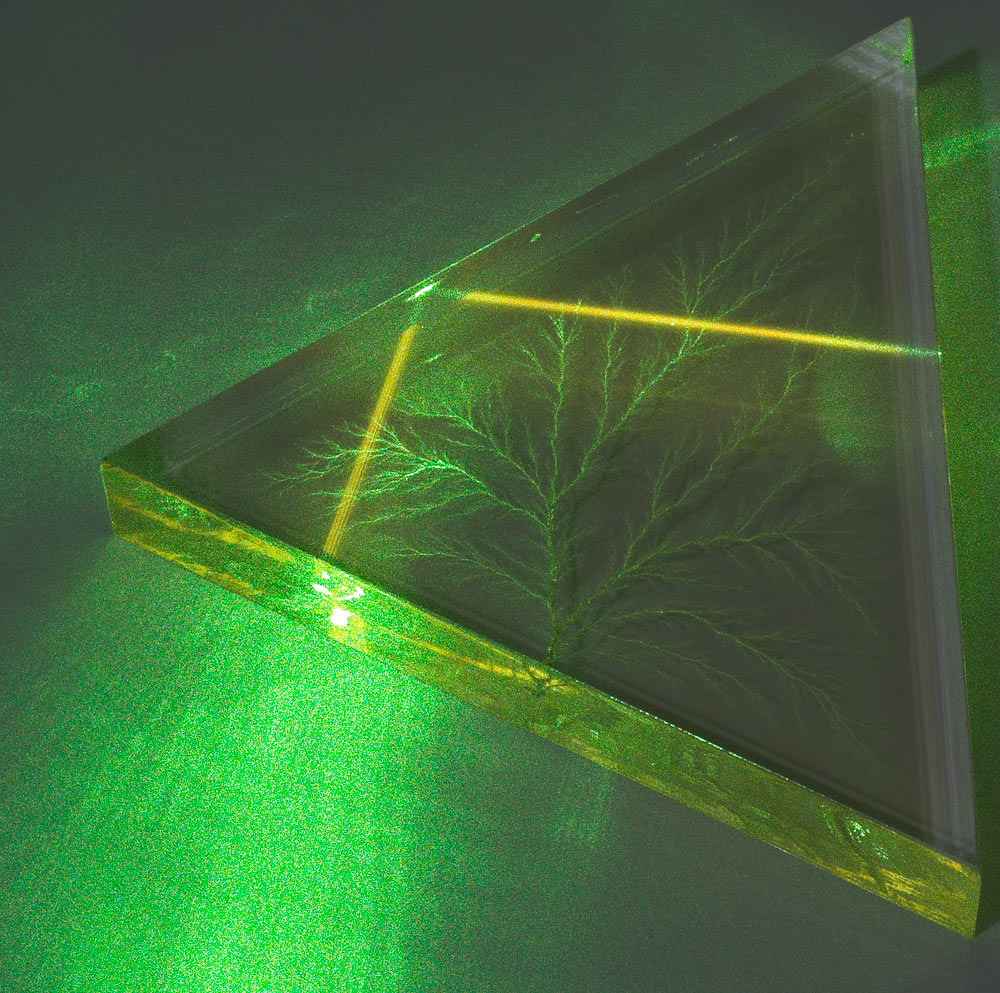
Shining the laser through the un-solarised part of the figure...

Laser beam through Lichtenberg figure

...produced pretty much the effect you'd expect.

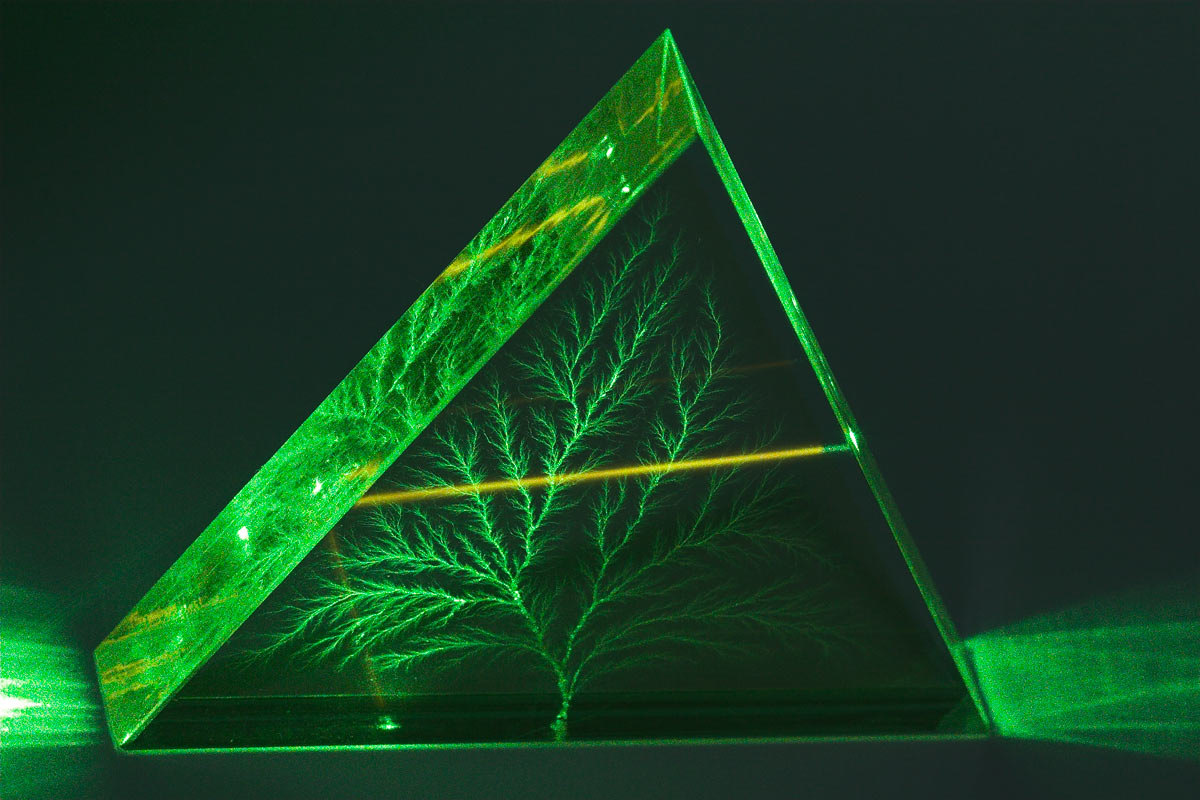
But shining it through the solarised portion...

Laser beam through Lichtenberg figure

...gave a, much brighter, amber diffusion glow. You can see the beam turning amber as it hits the solarised portion of the plastic.

There's no great mystery about why the beam looks brighter in the solarised area. That seems to simply be because it's travelling through damaged polymer that scatters more of the light.

Laser beam through Lichtenberg figure

But the distinct amber colour was a surprise.

Only the scattered light is amber; the main beam's the same colour coming out of the block as it was going in.

Laser beam through Lichtenberg figure

Here's the unsolarised side, again.

Another interesting thing about solarisation is that it heals. Over a few years, if you don't expose the acrylic to any more high-energy insults, the orange tint goes away.

The first Lichtenberg figure I bought from Bert was a little two-incher, which I purchased back in 2004. I can't remember whether it had visible solarisation when I got it, but it doesn't now - and a green laser beam stays green all the way through it.

UPDATE: Find some high-res video of acrylic Lichtenberg figures being made in this post!

God damn it

You know that DirectX problem, that I thought I'd fixed by buying a whole new video card?

Well, it looks as if what I actually need is a whole new computer. Isn't that great!

Yes, the problem is back again. Last night I watched a movie just fine; today I open a video file and as soon as I switch to fullscreen I've got three frames per second again, because DirectDraw acceleration has just turned its own self off again for no damn reason at all, and cannot be turned back on.

This is the way it always happens. It doesn't happen after I reboot, or after I install some particular piece of software, or in response to any actual change in the system configuration that I can see. DirectX acceleration just works one minute, and it doesn't work the next, and that's it.

From past experience, I am confident that rolling back to a previous system restore point, removing and reinstalling all video drivers, or even reinstalling Windows from scratch, will solve the problem for only a little while, at best.

I presume it's something wrong with the motherboard. Or something.

I don't need a new computer, I don't much want a new computer (more speed nice, lost day setting everything up again not), and I sure as hell don't want to pay for a new computer.

But since the memory and CPU in this computer won't work in a new one, I might as well get a whole new PC, lacking only a video card. Clearly, nothing else is going to fix this problem.

I feel stupid, contemplating a whole new computer just because a couple of graphics acceleration modes don't work on this one. Everything else works fine, and I can even cheat Direct3D into working, so I can play games if I want to. If I get a new computer, I'll be doing it just so I don't have to use crunchyvision low-res modes when I watch TV on my enormous monitor. How spoiled is that?

Kids are starving in Africa, et cetera.

God damn it.

A bit more lasing

Herewith, the previously mentioned 350mW laser, this time assaulting some plain brown paper. You don't have to hold the dot very carefully still to burn the paper away, or even get it smouldering.

The brown paper looks like red paper because I put a red gel (some of the large amount of Primary Red that I had left over after making a couple of pairs of Bill Beaty's IR goggles) over the lens.

Without the gel, the super-bright dot would have made it very difficult to see what was going on, just as it does in the match-lighting clip.

(Yes, at some point I'm actually going to finish a review of this alarming device, not to mention the two other models that Wicked Lasers/Techlasers sent me.)

Bug zapping

No video this time, but I have a provisional answer to the question I'm sure you've all been asking:

Can you kill an insect with a 350mW laser?

Well, I just managed to shoot a cockroach off the wall.

The bug clearly didn't like the beam on its body. It wasn't possible for me to hold the beam still enough to just burn the roach's head clean off (350mW will burn most plastic just about instantly, and is clearly powerful enough to incinerate a bug's head, but only if you hold the beam still on the target for a moment). But after I'd shot the roach for several seconds it fell off the wall, into the grasp of the rather intrigued cats.

(Who then probably juggled it for a bit and then lost it under the fridge, or something. They're not exactly killers.)

I don't think the beam had actually damaged the roach enough that it had to fall off the wall; I think its little flowchart brain had just decided that it was being exposed to fire, or something, and should therefore engage its emergency drop-to-somewhere-safer subroutine.

I await the arrival of a mosquito with interest.

My new favourite flashlight

There are quite a lot of flashlights in this house.

So, of course, I had to go and buy another one.
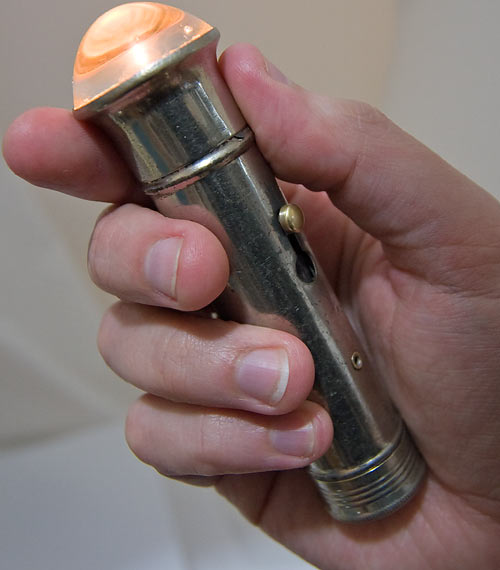
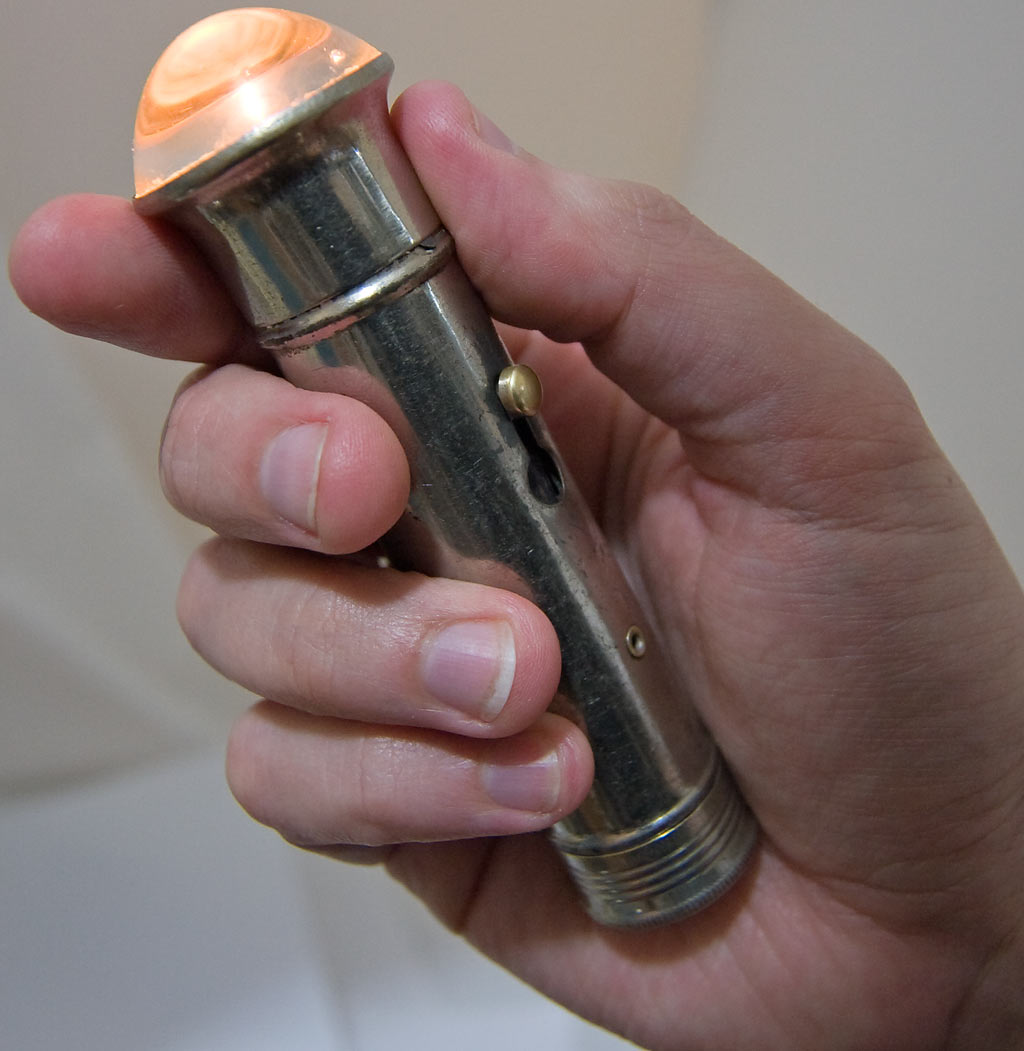
Old flashlight in hand

It only cost me ten bucks from this eBay seller. And it's possible that it's actually a genuine antique.

Which is a bit unusual, for an electrical device. Especially one that works.

The generally accepted definition of an antique is something at least a hundred years old, and flashlights that looked much like this one certainly were on sale a hundred years ago.

The first portable electric lamps appeared in the last few years of the nineteenth century. The first commercially successful one was the boxy Acme Electric Light, in 1896. But the easier-to-hold tubular flashlight was first sold commercially, by one Conrad Hubert's Ever Ready Company, in 1899.
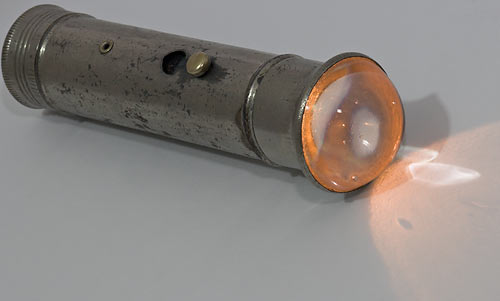
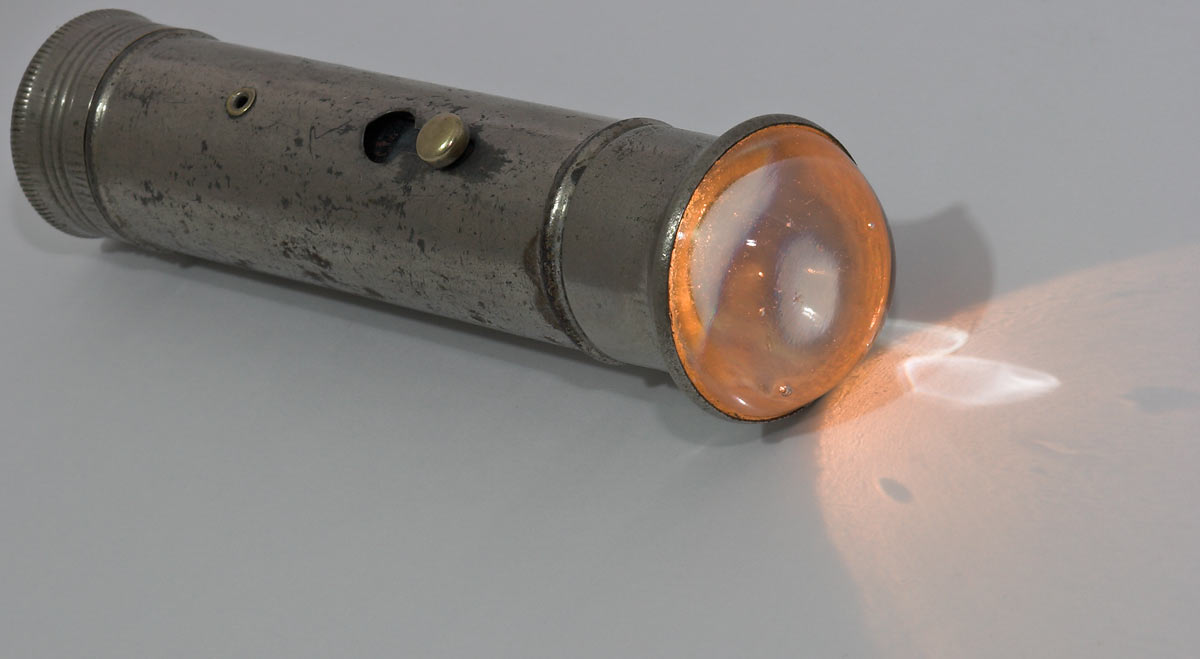
Old flashlight

This light probably isn't nearly that old, but it's still got the thick "bullseye" glass lens that all tubular flashlights had for the first decade or so of their existence.

(If you ask me, "bullseye lens" should only be the term for the concentric-circles fresnel lens, as seen in lighthouses and stage spotlights. This kind of flashlight lens could more correctly be called a "dome". But "bullseye" seems to be the most common term. "Walleye lens" seems to be another term for the same thing.)

The bullseye lens was not a good design.

It's either planoconvex (flat on one side, convex on the other) or, as in this case, slightly concave on the inside and much more convex on the outside. Either way, the lens gives the flashlight a very broad beam.

The beam width is at least 60 degrees, for this light, and it has no central "hot spot" at all. It's quite unlike the output of the more usual kind of incandescent-bulb flashlight, with a thin flat lens on the front and a relatively large reflector around the bulb.

A super-wide beam is great for seeing where you're going, but useless for seeing anything at a distance. This was quite disastrous for flashlights a hundred years ago, because they weren't very bright at the best of times.

This light was probably made to take a tungsten-filament bulb, but those weren't very efficient until the coiled-coil filament was introduced in 1936. Earlier still were the even dimmer, more fragile and rather inconsistent carbon-filament bulbs. And the old batteries had lousy capacity, and lousy current delivery, too.

So overall, old flashlights needed all the light-concentrating help they could get.

But instead, everything that wasn't big and boxy like the Acme Electric Light got a fish-eye lens.

It's been postulated that the bullseye lens was so popular for so long because consumers thought it concentrated, rather than dispersed, the light from the bulb. At a glance, you might think that - look at the bulb through the lens and it appears huge, just as it would if it were in the middle of a big reflector.

But with a bullseye lens, the bulb appears huge from every angle, because light's being thrown everywhere.

I suppose people were accustomed to wide-angle illumination from fuel-burning lanterns. The flame from a lamp with a wick is too large a light source to be effectively concentrated by a reflector of readily carryable size, and there are further problems with just getting a reflector in there, next to a hot and possibly smoky naked flame.

Directional lamps did have reflectors - miners' acetylene carbide lamps are an excellent, and surprisingly practical, example - but they still threw a very wide beam.

(Which, in the case of the carbide lamp, was quite respectably bright even by modern standards. A small "helmet" carbide lamp can easily throw as much light as a five-watt incandescent bulb, and it could do it for several hours. Five watts for five hours is 25 watt-hours; that's about the same amount of energy as you'd get from two modern C alkalines. Carbide lamps are little more than a hundred years old; they were quite revolutionary in their day, and far superior in light output and safety to kerosene or other oil lamps. Carbide lamps were still perfectly capable of burning your house down, though; you could only do that with the new-fangled electric lights if you really tried.)

Bullseye-lens flashlights hung around long after the common availability of modern large-reflector, flat-lens lights - note the Prohibition-era hip flask in the shape of a bullseye flashlight here. So it's quite possible my little light is only about seventy years old. That's still pretty impressive for a device that's still useful today, though.

A nice one of these lights would be an Eveready Daylo, or something. This one's a brandless version with no decoration, cheaply made from sheet metal, so it's probably worth nothing to a collector.

Like other lights of this size and vintage, this flashlight wants a weird battery - a 2R10 "Duplex" or "2B". That's a three-volt, two-cell battery that's apparently about 75 by 22 millimetres in size, and still available today, if you're really dedicated and/or willing to take apart another battery. The 2R10's dimensions make it quite magnificently incompatible with every common battery today.

A 75mm-long battery must have been a pretty tight fit in this light, though, because it turns out that a modern 18650-size (18mm wide, 65mm long) lithium cell fits very nicely, especially if I screwed the bulb all the way in.

But, to do that, I did need a bulb.

The bulbs this old light uses, fortunately, are quite standard. They're the same miniature Edison screw (MES) type that survive in small cheap lights today. (Though no doubt not for much longer, since LEDs are now clearly superior.)

An odd flattened-bulb vintage MES lamp came with the flashlight, but of course did not work any more. I had a cheap push-light doodad sitting around waiting to have some RGB LEDs put in it, so I harvested the bulb from that. It was meant to run from four 1.5V cells and so should have been reasonably bright from the roughly four volts of the 18650 cell, but it was actually quite dim, and died after not many minutes of use.

So I got an Eveready MES bulb for "5D" flashlights, rated at 0.3 amps at 6.2 volts, and tried that. The flashlight's much brighter now, though it's probably running its bulb at rather less than half of its 1.9 watt rating.
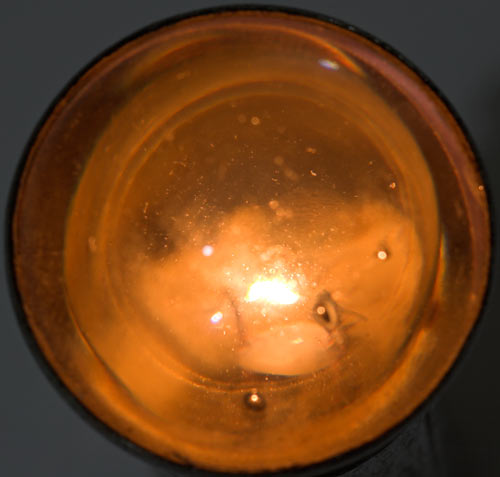
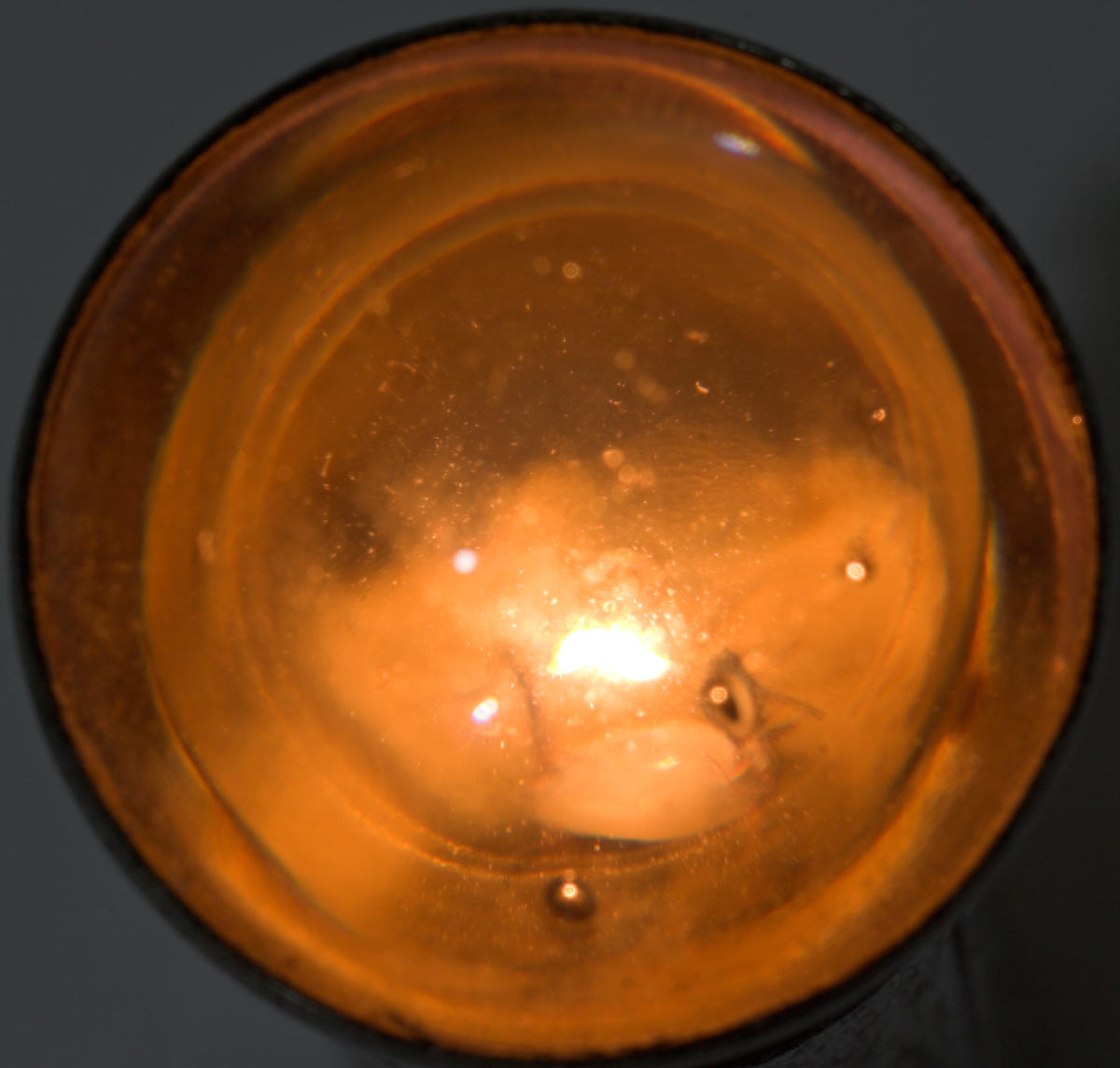
Old flashlight lens

The low voltage makes the flashlight's output very yellow, which I find quite pleasing in this age of blue-white LED flashlights. The light colour's probably quite similar in hue to the light from its original lamp, but brighter. It's perfectly usable as a night-time seeing-where-you're-going light.

I wasn't expecting it to be this easy to make this light work. I thought I'd have to hack some LEDs into it, or something. But it turned out to be easy to fix, in a more authentic manner.

It's been foggy, lately, and now it's getting dark. I believe I may procure myself a Webley revolver, and sally forth with my newly purchased "hand-torch" to investigate the night-cult that drunkard spoke of in the inn, before his fellows silenced him so brutally.

I'm told that a torch whose light is feeble may be a blessing.

There are things which are best not clearly seen.


Buying one

The eBay dealer I bought my bullseye-lensed flashlight from now seems to be dormant, but similar items show up on eBay pretty frequently. They can be a pain to find, though.

This search right here finds anything that could be a real old bullseye flashlight and filters out a lot of useless results, but it's not quite the same as the actual search I've got saved and sending me e-mails just in case a cheap light even prettier than the one I've got shows up. That's not because my search is a trade secret, but because there's a limit to the length of the search string you can link to via the eBay affiliate thing. The full search string, for your cutting and pasting pleasure, is:

(old,vintage,antique) (torch,flashlight) -paisley -"pipe lighter" -"torch green lighter" -"green flame" -"torch lighter" -blow -heat -kero -kerosene -kerosine -projector -patent -bulbs -pin -pins -bearers -guitar -spirit -blowtorch -cutting -bead -"ornamental lighter" -"ornamental gun"

To throw an even wider net, it's easy to search for flashlights in the eBay "collectibles" category (here on eBay Australia and here on eBay UK, both with the added search term "torch" to find Commonwealth-usage listings and clutter the results with ancient rusty dangerous blowtorches). But the results in that category aren't very good; you get a lot of brand-new LED lights and plastic crap from the Seventies. People selling bullseye-lensed lights unfortunately seldom describe them with a handy searchable word like "bullseye" or "dome", so you pretty much just have to scan the thumbnail pictures until you find one.

Do the same search in the "antiques" category (here on eBay Australia, here on eBay UK; I've left "torch" off the search string this time to avoid zillions of hits for tiki torches and candelabras) and and you'll find a lot more genuinely old flashlights. "Antique" bullseye-lens lights that aren't just a pile of rust with a lump of scratched glass in the middle, though, are generally pretty expensive.

Some of them are very beautiful, though. The "bicycle light" type that's a wooden box with a handle on top and a lens on the side is particularly appealing, especially after a dab of wood polish. Box-lights usually have plenty of room inside for modern batteries and lamps, too, so you probably won't even need to disturb the dreams of the world's flashlight collectors by destroying the old fittings in order to shoehorn in a pink LED and lithium battery.
e4b48fd541b3dcb99cababc87c2ee88f = elephant

This post on the Light Blue Touchpaper blog tells us all yet another thing we can do with Google:

Find a password, if our l337 h4XX0r skillz have already allowed us to harvest the MD5 hash for it.

The completely stupid way to store passwords, implemented by small children writing programs in BASIC and by $300-an-hour consultants writing enterprise software, is to just save all of the usernames and matching passwords as plain text in a file somewhere. If an attacker can read that file, they can now log in as anybody.

A much better, but still not as secure as it should be, method of saving passwords is to "hash" them using a "one way" or "trapdoor" algorithm, like MD5. A trapdoor algorithm runs very quickly in one direction (turning a password into an almost-unique string of seemingly random characters), but is almost impossible to run the other way, if you don't have access to cubic kilometres of sci-fi nanotech.

If someone gets hold of the file in which you store password hashes, the one-wayness of the hash algorithm means the attacker still can't figure out what passwords correspond to what hashes, and so cannot make use of his discovery.

Well, that's the theory.

In practice, attackers can take a dictionary of passwords, hash them all, then search for matches between their new hash dictionary and the password hashes. There are even helpful online tools that'll do it for you, like the long-established passcracking.com/ru, or md5oogle. When there's a match, you've got the password.

And this is what Google allows you to do in two seconds, if the password hash you're trying to "reverse" corresponds to a common word.

The word "elephant", for instance, hashes to e4b48fd541b3dcb99cababc87c2ee88f. Search for that in Google and you'll get a bunch of pages which, for reasons explained in the Light Blue Touchpaper post and its comments, often also have the word "elephant" on them, or right in their title.

(This post will probably be very high in those search results in a day or two. Check out the above-linked online reverse MD5 hash lookup tool if you'd like to explore other options - it lets you hash any string you like, then checks some databases for it. While it's checking, you can be Googling the same string. Md5oogle lets you generate MD5 hashes as well, but it converts everything to uppercase first - which many password systems also do.)

This technique only works for passwords that're common words - or, at least, have for some reason been hashed and stored in a Google-visible file. If your password is something nonsensical like dj347F, which hashes to 54041c87e2e431f3fc4c47e55d114ef3, the hash won't be found anywhere on the Web (except, again, on this page, once Google indexes it).

This technique also doesn't work if the passwords are "salted" with some extra data before being hashed. So if a user foolishly decides to choose "mypassword" as his password, the software actually hashes, say, 28391mypassword, and thus creates an un-findable hash.

Adding a simple fixed salt to every password still doesn't give you really industrial-strength security, but it's streets ahead of a lot of the junk that makes it to production. And it does stop dumb attacks like Google searching - well, at least until people find out that MurderDeathKill 3D's online gaming logon system just adds 28391 before hashing passwords, and start making tables of dictionary words with 28391 in front of 'em.

Lots of current popular software uses unsalted hashes, including the WordPress software that runs this blog.

So it's pretty lucky that I made my admin password "3hv78UEr", isn't it?

Bloodsuckin' fun

I've just finished watching the first, and only, series of the inventively-named "Blade: The Series".

The show's cancellation after 12 episodes was a lot less of a crime than the cancellation of Firefly, but I still quite enjoyed it. The feeling of foreboding you get when some rapper with a silly name gets cast in a nominally serious show is, in this case, unfounded. Blade is an absolutely relentless downer who avoids anything resembling dramatic acting at all costs, after all. He's easy enough for any schmuck to play.

Blade: The Series often doesn't quite make sense. You'd think, for instance, that the shutters on the windows of Vampire HQ would have anti-daylight interlocks that couldn't be defeated by anything short of a shaped charge, but apparently they prefer to give the good guys a sporting chance. And vampires are supposed to have superhuman senses, yet none of them ever seem to overhear anything, or even be able to smell a sweaty, bleeding human who seconds ago crossed their path, when to do so would be inconvenient for the plot.

The upper levels of the vampire hierarchy also appear to be reserved for the exceedingly pompous, but there's nothing new about soliloquising expository villains. And there's a good laugh based on this in the last episode.

The low-ish budget also shows through from time to time. When, late in the series, it becomes apparent that something important will be happening in Toronto, you can't help but laugh. The show's meant to be set in Detroit, a mere hop skip and jump from Toronto - but I live on the other side of the planet and could still see that everyone's actually been Rumbling in Vancouver all this time. So now Blade would appear to have to drive his Cool Car 2700 miles.

Oh, and in the Drinking Game for this series, "someone walks somewhere in slow motion" would only be one very small sip of your drink, and "someone who is actually still alive is confidently declared to be dead by someone who hasn't even checked" would not be very much bigger.

(I was also downright surprised when a vampire told a human employee "your well-deserved reward awaits you" and it turned out that, for once, the reward was not death.)

But the acting's pretty decent, the fight choreography is OK, and nobody decided to cut the guts out of the show by shooting for a PG-13 rating.

If you haven't seen the Blade series but you also haven't seen Ultraviolet (the British TV series, not the lousy movie), you should see Ultraviolet first.

If you've still got a hankering for vampire-based fun after that, check out Blade: The Series' movie-length pilot and see what you think.