The other day a reader contacted me (I'll identify him if he asks me to). He'd read my piece about collecting old technology, and in lieu of a donation sent me a Diamond Mako for free.
How cool is that?!

The Mako is a Psion Revo with different stickers on it. So it's a fold-open PDA, marginally bigger than a really humongous modern smartphone. It dates from those peculiar few years when having a phone-book on a digital device that couldn't make phone calls was normal.
The Mako/Revo is about the cutest thing ever to be decorated with a QWERTY keyboard. The battery in this one is pretty clapped-out, though; I'll need to replace it if I don't want to charge the thing, via this well-thought-out setup...

...pretty much daily.
Along with this PDA-I-might-take-notes-on-one-day-if-I-can-get-it-to-IrDA-to-a-modern-computer, though, also came that most earnestly offered and least frequently appreciated of gifts...
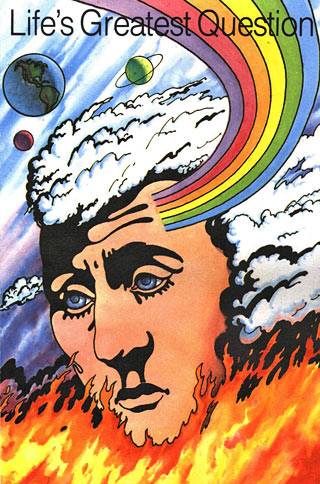
...a religious tract!
Fair enough.
New rule: I'm perfectly happy for anybody to proselytise at me, as long as their religious literature is accompanied by an interesting piece of superannuated technology.
I haven't quite worked out my full schedule of fees yet, but an Amiga 600 that can run Speedball II from a CompactFlash-card "hard drive" will earn you complete perusal of a volume of religious literature not exceeding 100 pages. Give me a working NeXT cube and I will attend any service, no matter how long, at any church you specify within 150 kilometres of my home.
This tract is pretty standard stuff, but my correspondent asked me to read it and tell him what I thought, so that's what I'm going to do, in my usual buys-ink-by-the-tanker-load style.
I can't imagine that I'll be telling him, or any of you, anything you've not heard or thought before. But the fact that he sent me this thing, presumably in the expectation that it might cause the scales to fall from my eyes and the majesty of Jehovah to sweep me away, bothers me more, the more I think about it.
Just saying why this tract, to spoil the ending, does not persuade me at all, may be worthwhile.
(I did Google and Tineye image searches on the rather gaudy cover picture, to see if this particular tract is online anywhere else; I didn't get any matches, though Google's "Visually similar images" are pretty darn spectacular, and probably include Captain Goodvibes somewhere. Searching for a chunk of the text of the tract, which I'll include in this post for the convenience of future searchers, turned up one hit, at "Evangelical Tract Distributors". They have this tract with a boring non-psychedelic cover, "on sale" for zero dollars and zero cents. They'll send me in Australia up to a thousand similarly free tracts for only a $US20 shipping fee. It's twenty bucks for one tract too, though.)
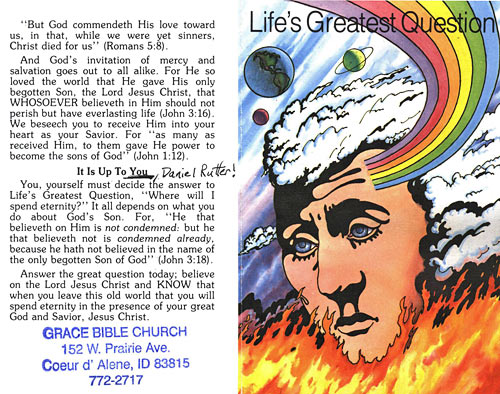
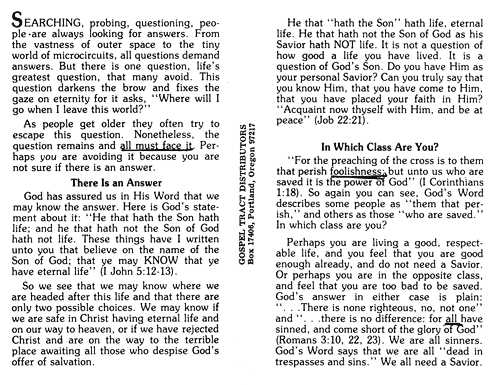
Mercifully, this tract has only four small pages, making the old-technology-gift to religious-enthusiasm ratio pretty darn favourable, if you ask me.
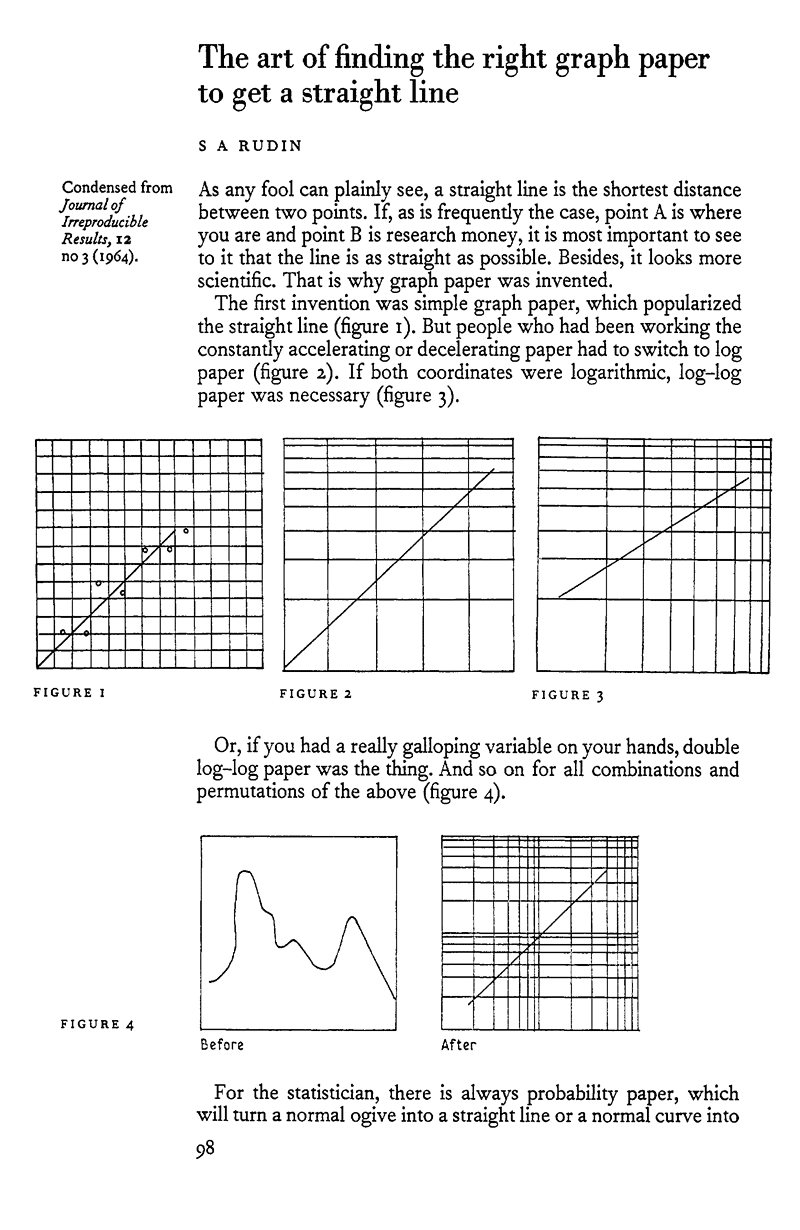
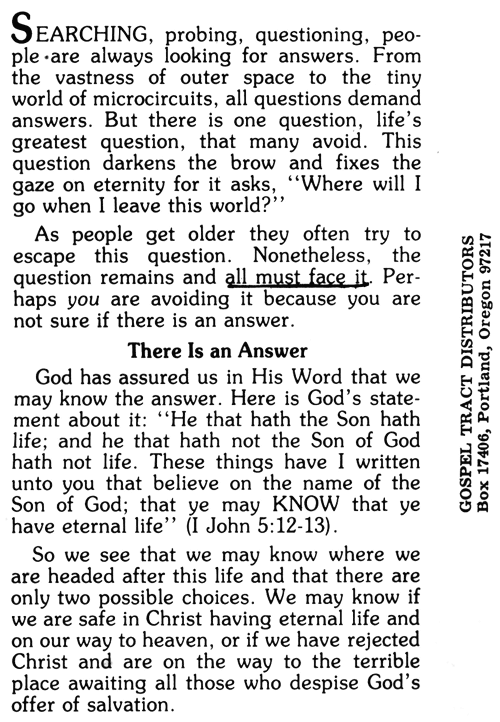
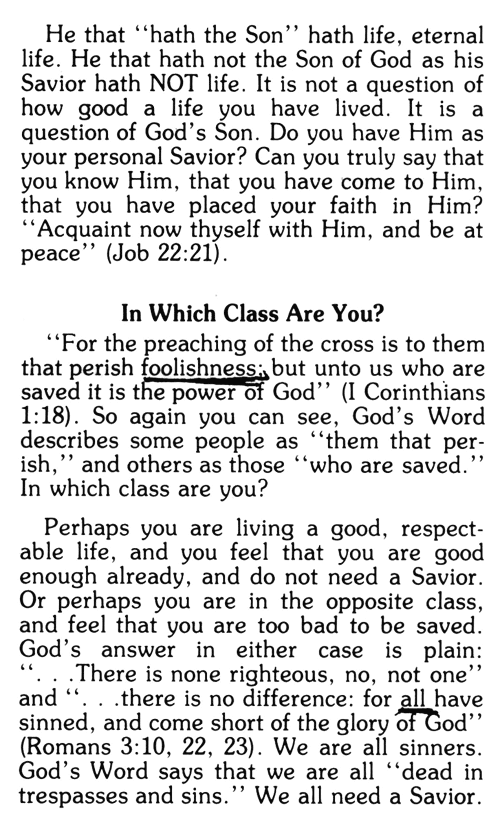
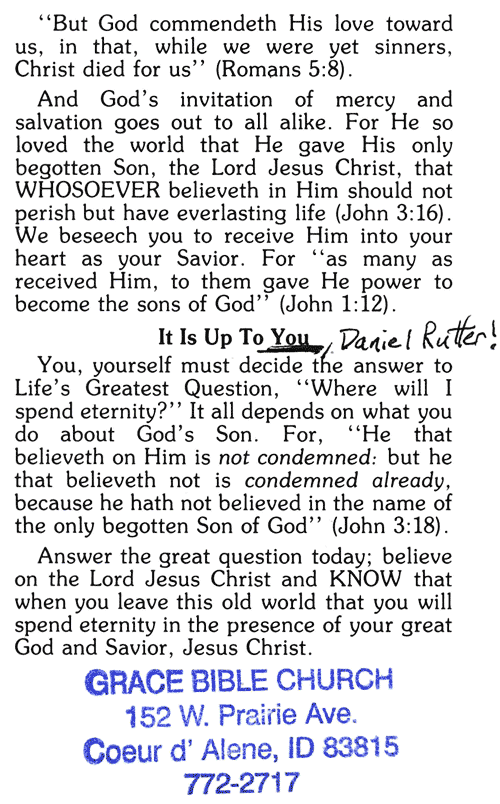
Legibly larger versions of pages one through four are here: One. Two. Three. Four. And here's the text:
SEARCHING, probing, questioning, people are always looking for answers. From the vastness of outer space to the tiny world of microcircuits, all questions demand answers. But there is one question, life's greatest question, that many avoid. This question darkens the brow and fixes the gaze on eternity for it asks, "Where will I go when I leave this world?"
As people get older they often try to escape this question. Nonetheless, the question remains and all must face it [all underlining my correspondent's, not the tract's]. Perhaps you are avoiding it because you are not sure if there is an answer.
There Is an Answer
God has assured us in His Word that we may know the answer. Here is God's statement about it: "He that hath the Son hath life; and he that hath not the Son of God hath not life. These things have I written unto you that believe on the name of the Son of God; that ye may KNOW that ye have eternal life" (I John 5:12-13).
So we see that we may know where we are headed after this life and that there are only two possible choices. We may know if we are safe in Christ having eternal life and on our way to heaven, or if we have rejected Christ and are on the way to the terrible place awaiting all those who despise God's offer of salvation.
He that "hath the Son" hath life, eternal life. He that hath not the Son of God as his Savior hath NOT life. It is not a question of how good a life you have lived. It is a question of God's Son. Do you have Him as your personal Savior? Can you truly say that you know Him, that you have come to Him, that you have placed your faith in Him? "Acquaint now thyself with Him. and be at peace" (Job 22:21).
In Which Class Are You?
"For the preaching of the cross is to them that perish foolishness; but unto us who are saved it is the power of God (I Corinthians 1:18). So again you can see, God's Word describes some people as "them that perish," and others as those "who are saved." In which class are you?
Perhaps you are living a good. respectable life, and you feel that you are good enough already, and do not need a Savior. Or perhaps you are in the opposite class, and feel that you are too bad to be saved. God's answer in either case is plain: "...There is none righteous, no, not one" and "...there is no difference: for all have sinned, and come short of the glory of God" (Romans 3:10, 22, 23). We are all sinners. God's Word says that we are all "dead in trespasses and sins." We all need a Savior.
"But God commendeth His love toward us, in that, while we were yet sinners, Christ died for us" (Romans 5:8).
And God's invitation of mercy and salvation goes out to all alike. For He so loved the world that He gave His only begotten Son, the Lord Jesus Christ, that WHOSOEVER believeth in Him should not perish but have everlasting life (John 3:16). We beseech you to receive Him into your heart as your Savior. For "as many as received Him, to them gave He power to become the sons of God" (John 1:12).
It Is Up To You [handwritten: "Daniel Rutter!"]
You, yourself must decide the answer to Life's Greatest Question, "Where will I spend eternity?" It all depends on what you do about God's Son. For, "He that believeth on Him is not condemned: but he that believeth not is condemned already, because he hath not believed in the name of the only begotten Son of God" (John 3:18).
Answer the great question today; believe on the Lord Jesus Christ and KNOW that when you leave this old world that you will spend eternity in the presence of your great God and Savior, Jesus Christ.
GRACE BIBLE CHURCH
152 W. Prairie Ave.
Coeur d' Alene, ID 83815
772-2717
[This would appear to be that church.]
Oh, boy.
Here's what this tract says, boiled down:
"If you accept the Christian belief system, why don't you accept the Christian belief system?"
That's it. That's all it's got. It says that you have to be a Christian to go to heaven and avoid hell, and it says that again, and then it says it a couple more times.
And, in the immortal tradition of all religious certainty, this tract cheerfully ignores the fact that several of its claims aren't even agreed upon by all Christians.
There are plenty of Christians who don't believe hell exists, for instance. This is not surprising, since it is exceedingly difficult to imagine why a loving god would visit hideous screaming flaming-sulfur acid-burning fingernail-peeling eye-gouging lye-drinking tooth-ripping knee-smashing genital-mincing torture for a trillion trillion trillion trillion trillion trillion et cetera years on Adolf Hitler, much less people who just thought religion was a load of claptrap and lived a good life.
(This tract actually has a bit of a bet each way there, because it doesn't actually mention hell, or lakes of fire or eternal torment - it just talks about a "terrible place" or where one might "spend eternity". This is compatible with the idea of eternal death being the only non-heaven option, rather than eternal punishment.)
There are also plenty of Christians who believe heaven, if it exists, is where good people go, whether or not they've kept any particular day holy or prayed on any particular schedule while pointed in any particular direction. Again, it's difficult to figure out why a loving god made us with this demonstrable inability to determine which, if any, of our thousands and thousands of contradictory religions, is the one true path to paradise. But this tract says he did, and we'd better choose right, or else.
And then there's the odd modern invention of the concept of a "personal relationship with god". This, also, is very far from universally accepted, even among Christians.
If you've got a personal relationship with someone they probably at least occasionally say things to you, after all.
It can also be argued that the very notion of a human having a personal relationship with the infinite creator of the universe is far, far more ridiculous than the notion of an E. coli bacterium having a personal relationship with the human whose gut it inhabits.
Now, this is all just part of the miraculousness of the Lord, of course. He's someone you can have a chat with, even if he doesn't seem to say anything back in a way that can't be blocked by appropriate medication. And he's simultaneously someone who sees the totality of reality spread out before him like a vast polydimensional tapestry, yet you also have free will, unless you're a member of one of the religions that says your eternal destination is known to God before you are born.
And so on, and so on, and so on.
If your religion were true, then just showing someone a tautological tract like this one would be likely to convert them in a flash of spiritual magic. You should be just dripping with miracles, like all of those people in the Bible. Some or all of the true believers should, to give one way in which a true religion might manifest itself, be able to speak in tongues - which is to say, your words should be comprehensible to everyone who hears them, no matter what language the astonished listeners speak.
Instead, religious people who "speak in tongues" have decided that it's actually just babbling away nonsensically in ways usually linquistically connected to languages of which the speaker has experience. It's often alleged that this is the language of angels, and it can be understood by some other members of the congregation, who stand up dramatically to "interpret" the doodly boodly boo boo boobly. (Or maybe it's a "private prayer language", whatever that means.)
I presume you're not a glossolalist, though. You probably have some sort of cessationist explanation for why the sun no longer stops in the sky and bushes no longer spontaneously combust and then start talking. You probably think people who do believe in ongoing but silly-looking modern miracles of one kind or another are misled. Perhaps to the point where the ones who say they're Christians are in fact not true Christians at all, any more.
But how can you tell?
What is it that suggests to you that the mainstream Christian ideas in this tract are the correct ones?
The tract, once again, presents no argument.
One wonders why such a thing as this tract even exists in the Western world, where we all know the basic Christian beliefs.
Even if we manage to avoid organised religious instruction, after all, those of us who live in societies where Christianity is commonplace are entirely familiar with the highly sensible idea that God sacrificed himself to himself in order to expunge the stain of original sin upon all humanity which was there because God allowed the most persuasive liar in the universe access to God's favourite creations and then they disobeyed God and ate something which apparently made evil suddenly exist or something and God then punished not only Adam and Eve but also arbitrarily decided that their disobedience would now sin-stain all of those first humans' offspring even though the offspring were not the ones who committed the sin but it's all right now because the temporary death of the human-like aspect of God during which that aspect might or might not have visited hell or some place like it freed all humans from the abovementioned arbitrary damnation brought upon us by God because of one bad act by our distant ancestors provided we follow the appropriate rules during our life which may or may not involve cutting off a piece of one's penis or being very respectful towards special little biscuits.
For some reason, many people outside the Western world find it hard to take this stuff seriously.
If you've been marinated in it all your life, though, then you definitely already know about these basic Christian beliefs, along with blatantly ahistorical nonsense like Caesar Augustus bizarrely deciding that for tax and census purposes everybody in the Roman Empire had to return to wherever their distant ancestors lived.
People who don't believe evolution is true - who are often quite convinced that God has communicated the truth of creationism to them via another of those "personal relationship" deals - sometimes ask "if we evolved from monkeys, why are there still monkeys?"
This argument fails for at least two reasons, but applying the same logic to religion does not, because religions usually claim to have invalidated previous faiths.
Christianity, for instance, says it superseded Judaism. But if that is the case, why are there still Jews?
And Islam says it superseded Christianity. But there you Christians still are, and the Jews, and the Muslims. And don't you Abrahamic siblings all just get on like a house on fire. (Or a church, or a temple, or a mosque, the setting-on-fire of all of which is apparently often also strongly encouraged by God in those personal conversations people keep alleging they have with him.)
And all this time the Hindus and Buddhists have been sitting there too, not being persuaded by any of you guys. People convert one way or another from time to time, usually to the great alarm of conservative members of whatever faith they converted from, but the overwhelming determinant of your lifelong religion remains the religion of your parents.
Which, once again, is exactly what we'd expect to see, if all religions were fictional.
If one religion were true, with an all-knowing, all-powerful and benevolent deity, then that religion should be more persuasive. Its followers and prophets should be distinctly different too. You certainly shouldn't see everybody in every faith bumbling around in the same way, and every faith producing the same few great people, few terrible people, and great mass of ordinary people.
And yet, that's what we do see.
Most religious followers have plenty of stories of events that plainly prove that they're on the right track. When I worked with Jehovah's Witnesses, for instance, many of them had stories of encounters with the malevolent spirits that constantly strive to tempt us from righteousness. Some Catholics hold forth about the effectiveness of their various sacramental adornments, many Scientologists have seen their "tech" work wonders, many Muslims think you might as well drive with your eyes closed because they've seen many times that you'll only crash if Allah wills it, believers in reincarnation from the Hindu to the New Age think the evidence couldn't be more clear, evangelicals are surrounded by miracles and portents every day, and umpteen religions claim some great practitioner didn't need to eat or didn't rot after they died.
The closer you look at such claims, though, the more tenuous they become. Most religious claims are exceedingly difficult to test in any empirical way, but the very fact that most religions say they have hard evidence that they are the only correct religion indicates that, as in the case where two men say they're Jesus, most of them must be wrong.
For pity's sake, even the three flavours of Christians whose job it is to mind the place where Jesus was allegedly crucified and interred keep getting into fistfights when someone moves a chair. And heaven forfend anybody shift the Immovable Ladder. I am not making this up.
I also have to quibble with the tract's statement that "all questions demand answers". The question of the preferred sock colour of François Mitterrand does not, to my knowledge, keep many people up at night. And this isn't just me snarking; I find "it doesn't matter" is a perfectly satisfying answer to that question, and to many others, some much more important to religious people than the sartorial preferences of deceased Gallic statesmen.
Take, for instance, the question, "do gods, which do not intervene in the universe in any way, exist?"
The logical answer to this question is "it doesn't matter", because a god who does not interact with the universe is a god who might as well not exist.
This is not the sort of god that Christians believe in, of course. Some Christians believe Jehovah interacts with the world in profound and obvious ways, because otherwise humans and roses and organ music and the laughter of little children and preachers who can cure terrible diseases by magic - though, again, not in any empirically-verifiable way... - would not exist.
Many Christians believe Jehovah stopped performing miraculous party tricks many centuries ago, but that he does still definitely interact with the world, once again because of that direct personal relationship with their deity which they solemnly believe they have. This would be impossible if that deity did not interact with at least the minds of his followers, in some way.
This is a pretty solipsistic justification for belief, though. "I feel God's presence in my heart and mind" is all very well as a justification for your own belief, but it won't convince anybody else unless they independently find such thought processes going on for them as well.
And this certainly isn't a reason for any unbeliever to believe in any particular one of the hundreds of different allegedly-holy scriptures out there. If your only evidence is your God-filled heart, then what answer have you to someone who apparently feels as internally convinced as you, but says that God has called upon him to spread the new doctrine of invisible pink unicorns and eating nothing but geranium leaves, and heretics must be put to the sword?
(Or, of course, someone who starves their baby to death on the grounds that he's insufficiently pious, and then waits patiently for him to resurrect and the murder conviction to thus be quashed. They honestly believed it! Who are you to say the baby won't pop back up any minute now?)
This tract doesn't even make it to the level of Pascal's Wager. All it says is, "We reckon heaven exists. Why don't you want to go there?"
Given the paucity of this question, I shall conclude with the answer I most enjoyed delivering to the more dim-witted Jehovah's Witnesses who asked me, "Don't you want to live forever?" I don't believe it, of course, but at least I was doing them the favour of inserting a new idea or two into their brain.
No, I don't want to live forever.
Forever is a long time. Forever is a trillion trillion trillion trillion googolplex trillion trillion, et cetera, years.
If you could carry one atom at a time, at walking pace, you could move the whole observable universe from where it is to somewhere far, far beyond its borders, and still have made no inroads whatsoever on forever.
God, presumably, has lived, and will live, forever.
Christians seem pretty definite about that.
God needed to keep himself amused.
So he made the world, and maybe many other worlds. And heaven, and that's where he lives, and he'd like you to come and join him.
To be in heaven with him.
Forever.
He could let you die, but he won't.
Have you ever wondered why God didn't just kill Satan, given that Abrahamic doctrine makes clear that he could have done so any time he liked?
God's not going to let the bastard die.
All Jehovah has left is sharing the misery.







 . So I've taken the liberty of image-ifying those two pages. Click for more legible versions.