Insert drunk farmer here

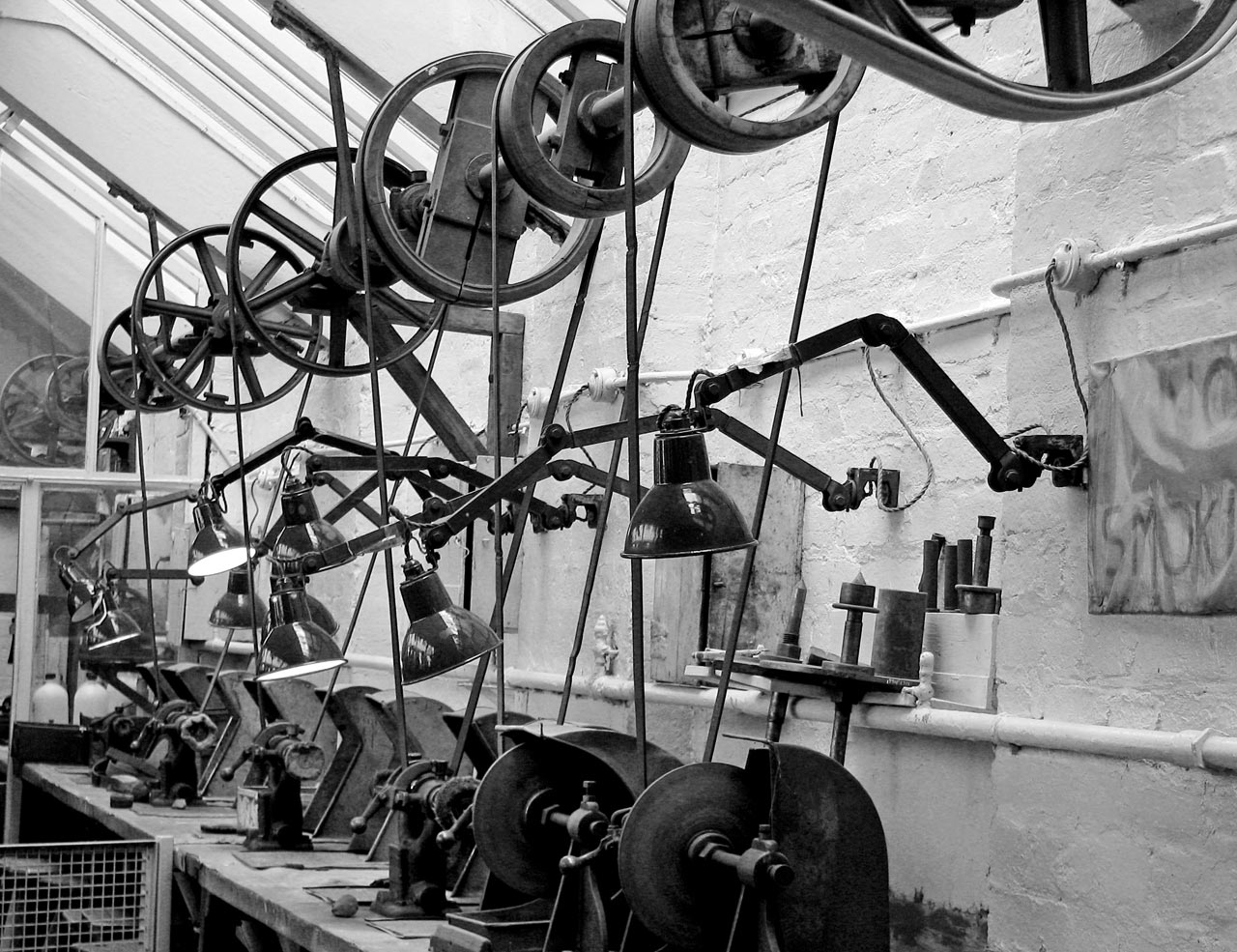
A regular reader took this picture...

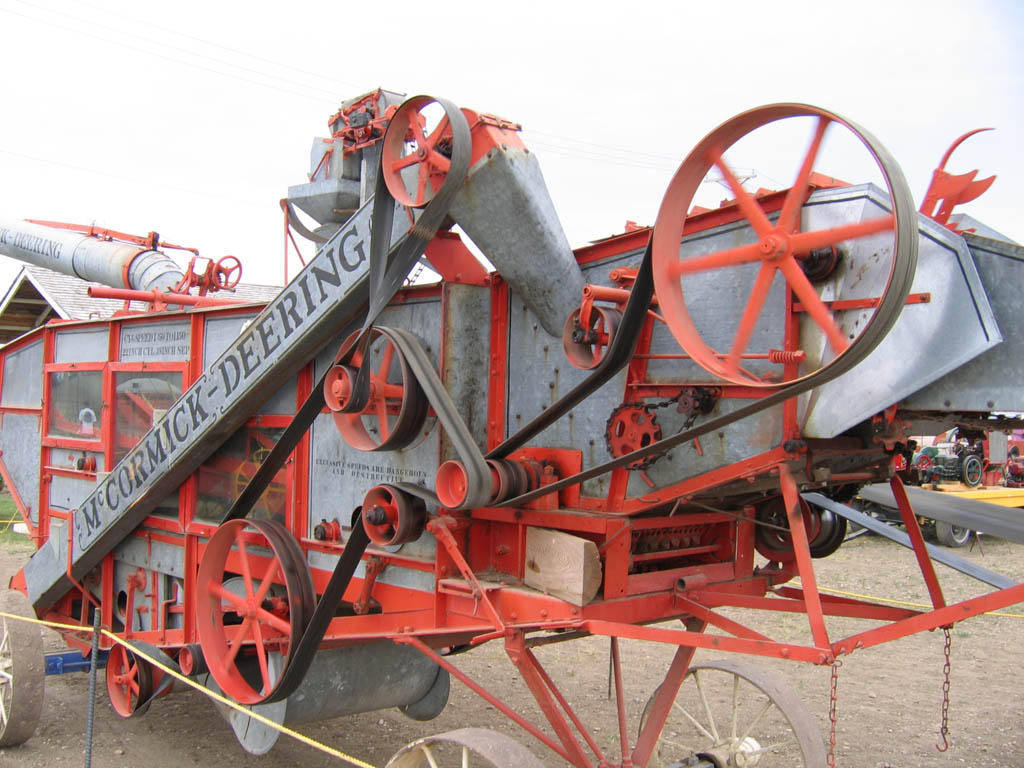
Numerous pulleys and belts

...of an impressive piece of antique finger-grabbing agricultural equipment, and suggested it as another illustration for the "pulley paradox". Again, if you don't know about crowned pulleys, contraptions like this look offensively impossible.

As a weekend project, I suggest commenters point to the most belt-and-pulley-infested machinery they can find on the Web.

I am also pleased to note that unless the corporate copyright enthusiasts manage to extend terms yet again, the works of W. Heath Robinson should pass into the public domain at the end of 2014.

(A few works illustrated by Robinson are already in the public domain, but I don't think any of the stuff for which he's most famous is, yet.)

The pulley paradox

A reader writes:

I was watching "Industrial Revelations" on Discovery, and I noticed a lot of Industrial Revolution factories running from one power source, a steam engine or waterwheel, with power distributed via a load of parallel overhead shafts, which brief Googling tells me are called line shafts. A belt runs from each shaft to each working machine, often with a free-turning wheel next to the one that drives the machine so the belt can be moved over onto the free wheel to "turn the machine off".

What I can't figure out is, what kept the belts on the wheels? They don't have ridges on the edges to contain the belt, they're not V- or U-profile with a matching belt shape, they're just flat metal as far as I can see, yet the belts don't fall off.

What the heck is going on, there?

Bec

Industrial Revelations is pretty good, though not, of course, a patch on The Secret Life of Machines. Most or all of it seems to be on YouTube. There are other series that have covered the same ground, too; Coltrane's Planes and Automobiles deserves a mention, and in the second-series episode of Industrial Revelations where Mark Williams, the presenter, demonstrates the fulling of cloth by trampling on it in a bucket but does not have the bucket authentically filled with fermented urine, it should be mentioned that in one episode of The Worst Jobs in History, the endlessly-associated-with-ordure Tony Robinson did the same job properly.

Where was I? Oh yes - belts.

Traditional flat leather drive belts were a pretty good piece of technology. They weren't even as much of a death-trap as you might think just looking at them, since they often had enough slack that getting some piece of yourself or your clothing caught between belt and pulley wouldn't necessarily whip you into the air or smash your face into the machine. Getting your hand caught in the moving parts of the steam engine or waterwheel gearing on the other end of the lineshafting system was bad, bad news, but if only a belt had grabbed you, you had at least a fighting chance of yanking yourself free. There usually wasn't even enough pressure between belt and wheel to instantly crush your hand.

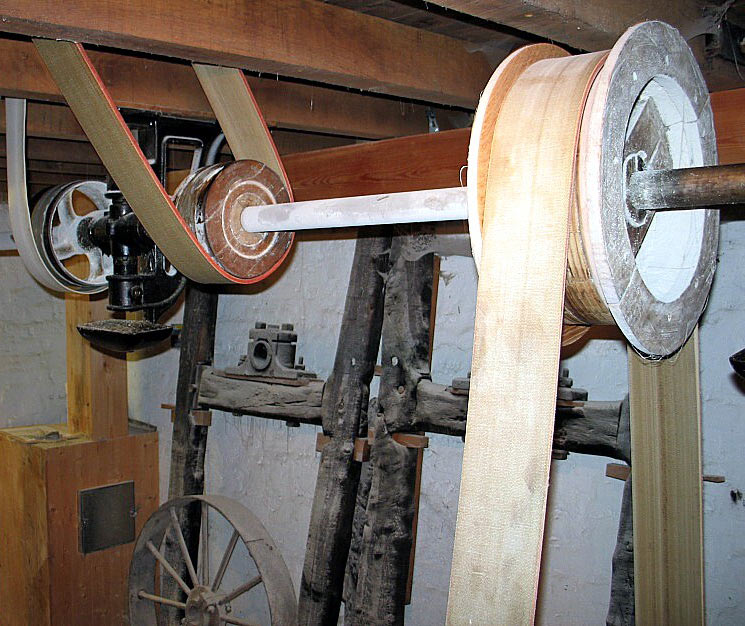
I mean, look at the slack in this little number:

Long drive belt
(source)

Miles of belt, lots of slack.

But this arrangement looks even more insultingly physically impossible than lineshaft setups. That dang belt should fall off the engine right away, shouldn't it?

Occasionally, there's a flat belt that runs on a spool-like pulley with raised flanges on the edges, like the small receiving pulley in the above picture, or this one:

Belt running on spool-like wheel
(source)

That looks as if it ought to stay put without any magic. But in the background, there are two more of those seemingly impossible flat-pulley belts!

Some drive belts are constrained on one side, too, as in this setup for varying the speed of a machine:

Stepped drive-belt pulley
(source)

On all but the biggest of the Towers-of-Hanoi stepped sections of that pulley, the belt can only fall off on one side. But where's the power for the stepped pulley coming from? Another dang flat pulley, that's where!

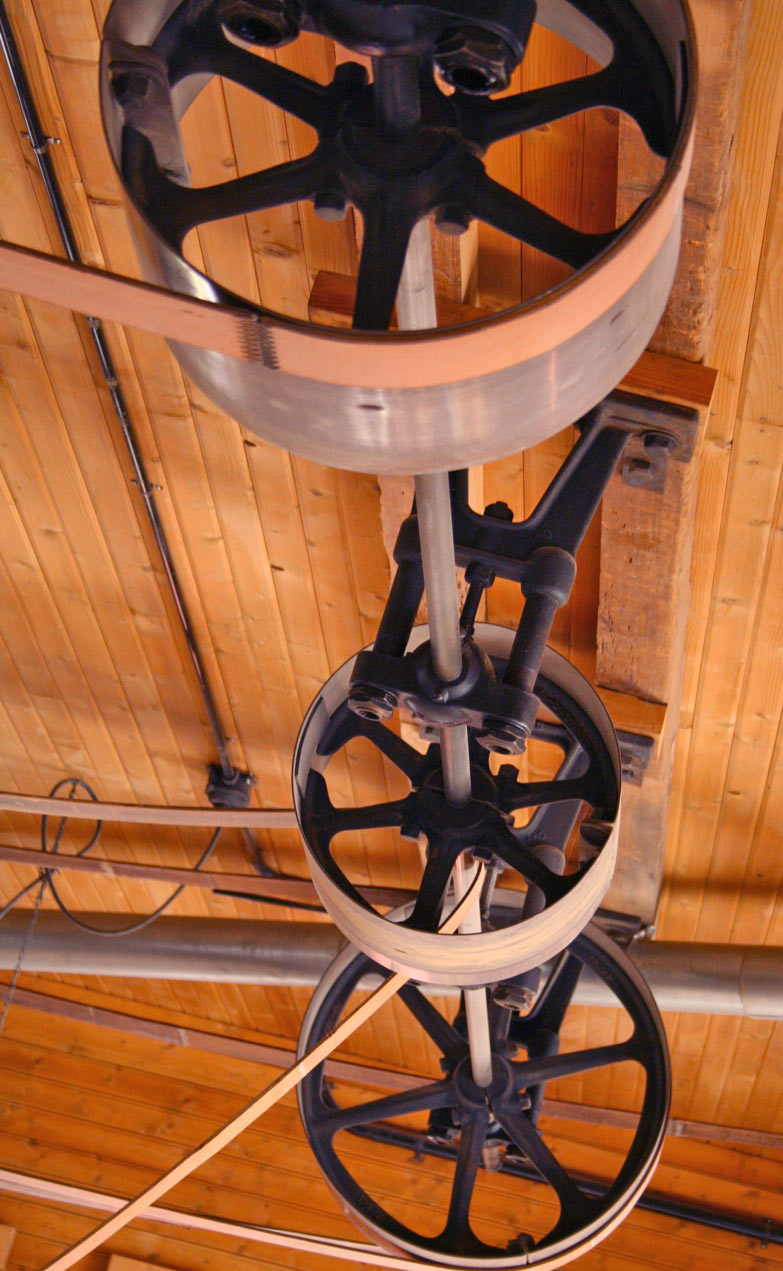
Free-spinning idler wheels weren't the only way of stopping a machine, either; the middle belt in this piece of lineshafting...

Lineshafting
(source)

...has been taken off the wheel to stop it driving. That's "taken off", though, very probably not "fallen off". Left to its own devices, it'd stay where it was meant to.

As do all of these:

Belt-driven machine shop
(source)

OK, that's enough teasing. Why is it so?

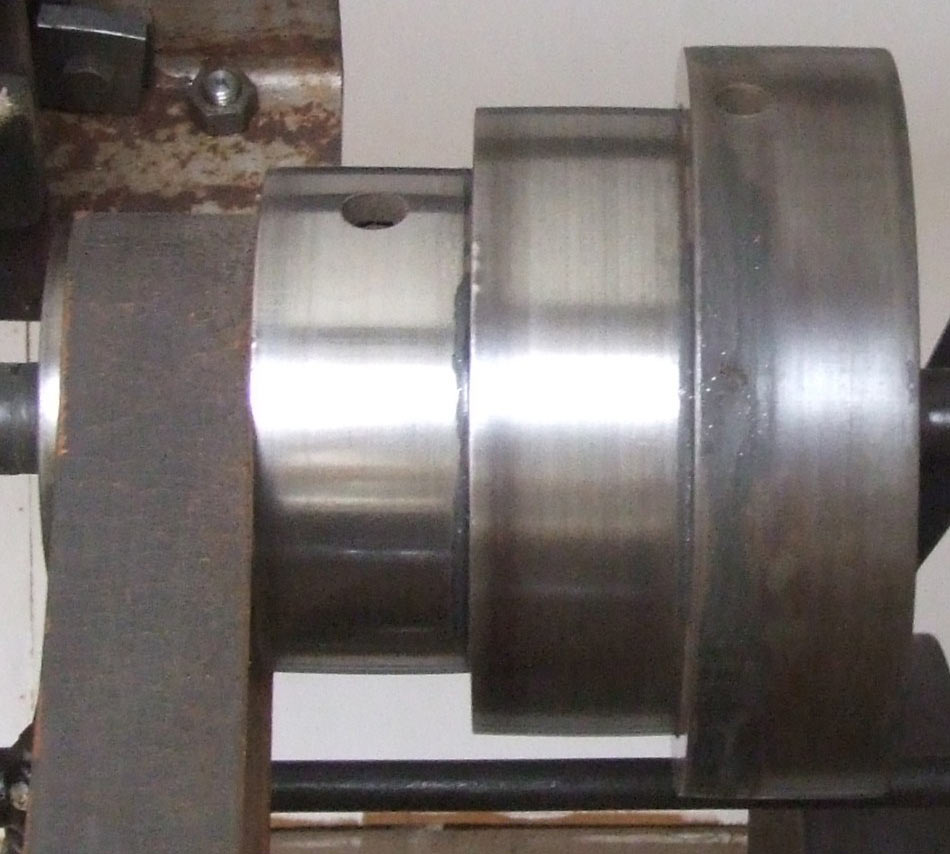
The secret is that the "flat" pulleys on which the belts are running are not, actually, flat. If you look closely, at for instance the stepped pulley picture above...

Close-up of stepped drive pulley
(source)

...you can just about see that the pulley surface profile is slightly convex, or "crowned". The profile of the pulley is sort of like that of a wooden barrel, except less pronounced.

Wherever a flat belt is on a crowned pulley, it will tend to move towards the centre. This effect is reliable enough that some of the pulleys in a flat-belt power-transfer arrangement actually can be completely flat, as long as every belt runs over one or more crowned pulleys somewhere else.

For practical purposes, you can stop here. Slight convex profile to pulley equals flat belt staying in the middle of the pulley. Provided all other pulleys are well enough aligned, at least; if the pulleys aren't lined up very well then even if all of them are crowned, the belt may still "walk" off one of them. But basically, crowned pulleys equals centred belts.

If you want to know why crowned pulleys work as they do, things get a little more confusing. Confusing enough, actually, that the question can be presented as a puzzle, or even as a "paradox".

(Crowned pulleys are much more confusing than tax brackets, but I think less confusing than wind-powered vehicles that travel faster than the wind.)

The edge of a flat belt that is closest to the middle of a crowned pulley will be stretched a little more than the other edge of the belt, because the crowned pulley has a greater diameter in the middle. This gives the belt-edge toward the middle of the pulley higher tension and thus more traction than the other edge. So wherever the more tense, higher-traction portion of the belt wants to go, the whole belt will tend to go.

Any given point on the portion of the belt in contact with a pulley will, by definition, contact a point on the pulley. But when the pulley is crowned and the belt is not in the middle of it, the slight bend in the belt means a point on the tenser side of the belt, closer to the middle of the pulley, will be unable to stay in contact with the same point on the pulley as it rotates. The slight bend in the belt created by the crown profile points the belt away from the middle of the crown profile. All parts of the belt in contact with a pulley "want" to stay in contact with that same part of the pulley - that's sort of the whole point of friction belts on pulleys. But because the tenser edge of the belt, closer to the middle of the pulley, has more grip than the other edge, the whole belt tends to climb to the middle of the pulley.

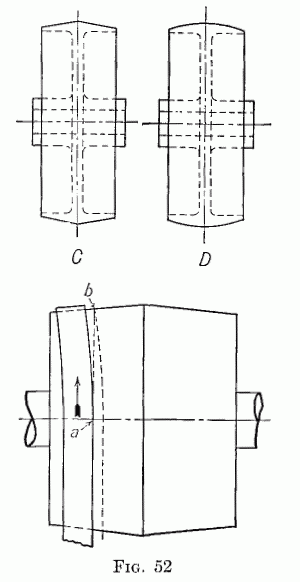
Crowned pulley diagram

This illustration from The Elements of Mechanism, which I found on this page explaining the aforementioned "paradox", may help you visualise this. It certainly helped me. The point on the pulley (in this case two truncated cones, not a smoothly curved crown) which is under point "a" on the belt will end up at point "b" as the pulley rotates. The belt tries to stay frictionally stuck to the same part of the pulley, so it climbs to the middle.

(A "perfect" crowned pulley with a smooth curve is a bit of a nuisance to make, so some crowned pulleys have a flat centre and curved, or even conical, ends, and some are as shown in the above picture, just two truncated cones stuck together base-to-base. These designs don't work as well - a belt will wander on the flat part in the middle of the first type, and the ridge in the middle of the second type reduces grip and wears the belt - but they work well enough for many purposes.)

The crowned-pulley effect isn't very strong unless the crown shape is very pronounced, which would make the belts wear out quickly; this is why it can't compensate for more than slight misalignment of the pulleys. Pulleys with raised edges of one kind or another - including V-profile belts and pulleys and their relatives - can tolerate much more misalignment.

(An exaggerated crown shape does make the crown effect much easier to see, though. Famous Web-woodworker Matthias Wandel has a page about the crown effect too, that includes an exaggerated pulley.)

Although the era of lineshafting has long passed in the Western world, flat belts and crowned pulleys survive as conveyor belts, and in the strangest other places - the paper-handling machinery in photocopiers, for instance!

You can also set up a model steam engine to run a whole model machine shop via tiny line shafts. Most such setups, however...

...use O-ring belts and grooved pulleys:

This one...

...looks as if it may have proper flat belts and crowned pulleys, but the low resolution makes it hard to be sure.

This one, however...

...seems to have flat belts for everything but the initial engine connection

(You should be careful, here; model steam engines can be as dangerous to your wallet as model Stirlings.)

And now, a bonus video; why have mere pistons when you can have a turbine?


Psycho Science is a regular feature here. Ask me your science questions, and I'll answer them. Probably.

And then commenters will, I hope, correct at least the most obvious flaws in my answer.

Today's mechanical conundrum

A reader writes:

As soon as I heard about "Steve Durnin's D-Drive, [possibly] the holy grail of infinitely variable transmissions", my BS meter activated and the needle swung to "Possible thermodynamics violation".

But in his favor he's got an actual physical prototype...

...and is attempting to have a metal model made so its input and output power can be tested.

What do you think of the concept, and can you tell how on earth it works? I'm still trying to figure out how this is too different from CVT, other than maybe a wider range.

I'm still wondering if this is somehow impossible, but personally I'm open to the possibility that it's a similar step such as CVT and the in-article claims are typical science-journalism overestimations.

David

Oh no - it's another New Inventors prize-winner!

Fortunately, though, an infinitely-variable transmission (IVT) is not actually in any way related to perpetual motion. All it is, is a continuously-variable transmission (CVT) that has some way to run its variable "gear ratio" all the way down to infinity-to-one, also known as a "driven neutral".

(This is, by the way, not the same as just running the gear ratio up so much, billions or trillions to one, that the final gear in the train is functionally immobile, and could be embedded in concrete without having any effect on the load of the driving motor for some years. A true "driven neutral" could be driven at a trillion RPM for eleventy frajillion years, and never turn the output at all. A transmission that bottoms out at zillion-to-one gearing would, however, be perfectly usable as a real-world infinitely-variable transmission.)

Because it can gear down to infinity-to-one, this does indeed mean that this transmission doesn't need a clutch, which does indeed reduce complexity. Whether a real-world version of the D-Drive would be too big or too heavy or inadequate in some other more complex way for real-world duty, though, I don't know. But there's nothing crackpot-y about the basic idea.

As the video makes clear, the big deal here is making an IVT - actually, a mere CVT, that still needed a clutch, would do - that uses standard gearbox-y sorts of components, or can in some other way handle lots of power and torque without being unmanageably big, expensive and/or quick to wear out.

Normal CVTs have been available in low-torque machinery like motor-scooters for some time, and are now showing up in some mainstream, full-sized cars as well. But they're still a fair distance from ideal.

It's easy to make a CVT, you see. Here's one made out of Lego. It's hard to make a CVT that can handle lots of power. And yes, the fact that most CVTs contain some sort of friction-drive device is a big part of the reason for this.

Note, however, that there's a big difference between dynamic-friction CVTs like this one or the Lego one, in which friction between moving parts transfers power, and static-friction CVTs like this one, in which friction locks components together (as in a clutch!), and they don't wear against each other.

But even here, real-world elements muddy the water and make it hard for someone who doesn't actually work at the engineering coalface to tell whether they're looking at something genuinely new and useful, or something that's not new at all, and/or won't work. Here, for instance, is the NuVinci transmission, a friction-based CVT that spreads the friction stress between numerous relatively lightly-clamped spheres - it's related to the "ball differential" with which R/C car racers are familiar. The NuVinci's makers claim it's useful for high-power, high-torque applications. And maybe they're right. I don't know.

For an excellent example of the ugliness that can happen when somewhat specialised knowledge is repurposed by people who, at best, don't know what they're talking about, look at this particular piece of "water-powered car" nonsense, where the well-known-to-jewelers electric oxyhydrogen torch is claimed to be some sort of incredible over-unity breakthrough. This sort of thing happens all the time - it's just, usually, not quite such a blatant scam.

As the Gizmag article mentions, many commercial CVTs are also deliberately hobbled by car manufacturers. They force the transmission to stick to only a few distinct ratios, and also to want to creep forward when at rest, just like a normal automatic transmission. This isn't a limitation of existing CVT technology, though; it's just deliberately bad implementations of it.

(The manufacturers do this so that people who're used to normal autos won't be freaked out by a CVT. Those of us who'd like the superior technology we pay for to be allowed to actually be superior just throw up our hands, and cross those cars off the worth-buying list.)

I think one trap for the D-Drive could be the second motor that handles the ratio-changing - that might need to spin really, really fast in certain circumstances.

There's also the fact that this is only really an infinitely-variable transmission at one end of the ratio scale. The D-Drive can gear down an infinite amount, and right on through zero to negative (reverse) ratios. But unless I'm missing something, I don't think it can gear up at all. So the output shaft can't ever turn faster than the input shaft. This is a problem if you want to do low-power flat-highway cruising, when the engine's turning quite slowly but the wheels are turning very fast.

Normal cars have significant gear reduction in the differential, though - the "final drive ratio". Perhaps if you make the diff a 1:1 device, which shouldn't make it that much bigger, the D-Drive's output-ratio limitation won't matter.

The reason why I'm saying "might" and "perhaps" so often is that I, like the New Inventors judges, am not actually an expert on the very large number of mechanisms that the human race has invented over the centuries. The simplicity of the D-Drive makes me particularly suspicious. The D-Drive's mode of operation may be a little difficult for people who don't work with mechanisms all day to intuitively grasp, but there aren't many components in there, and none of them are under 100 years old. Actually, that's probably a considerable understatement; I'm not sure when epicyclic gearing became common knowledge among cunning artificers, but I can't help but suspect that a master clockmaker in 1650 wouldn't find any of the D-Drive's components surprising.

Sometimes someone really does invent some quite simple mechanical device, like the D-Drive, that nobody thought of before. But overwhelmingly more often, modern inventors just accidentally re-invent something that was old when James Watt used it.

To get an idea of the diversity of mechanical movements and mechanisms, I suggest you check out one of several long-out-of-copyright books full of the darn things. I think Henry T Brown's 507 Mechanical Movements, Mechanisms and Devices is the most straightforward introduction; it's a slim volume available for free from archive.org here.

(If you'd like a paper edition, which I assure you makes excellent toilet reading, you can get the one I have for eight US bucks from Amazon. Here's a version of it for four dollars.)

And then there's Gardner Dexter Hiscox's Mechanical movements, powers, devices, and appliances, whose full title would take a couple more paragraphs, which is also available for free.

Both of those books carry publication dates in the early twentieth century, but many of the mechanisms in them were already very, very old. Like, "older than metalworking" old. But several of them are still, today, unknown to practically everybody who's not able to give an impromptu lecture about the complementary merits of the cycloidal and Harmonic drives.

(You may, by the way, notice rather a lot of mechanisms in those old books that do the work of a crank. That's because one James Pickard patented the crank in 1780 - plus ça change. This forced James Watt, and many other early-Age-Of-Steam engineers, to find variably practical Heath-Robinson alternatives to that most elegant of mechanisms to get the power of their pistons to bloody turn something. Watt's colleague William Murdoch came up with a kind of basic planetary gearing to replace the crank. Planetary gears have, in the intervening 230-odd years, found countless applications - including the D-Drive!)

Getting back to Mr Durnin and The New Inventors, they both currently allege that the D-Drive is a "completely new method of utilising the forces generated in a gearbox". According to this Metafilter commenter and this patent application, that may not actually be the case, since 18 of the 19 formal Claims made in the application appear to have been turned down. But, again, I could be getting this wrong, because somewhere behind the impenetrable thicket of legalese I suspect the "Written Opinion" may be saying that the final Claim actually is patentable as a separate worthwhile thing. (See also this forum thread.)

This all has me thinking, again, about the repeatedly-demonstrated gullibility of The New Inventors. When I can bring myself to watch the show, I keep thinking - OK, actually sometimes shouting - about how I'd spoil the party by asking at least one out of every four inventors "would you be willing to make a small wager that your device is not fundamentally worthless, or a duplicate of something that's been in production for years?"

(Sometimes, I'd just say "Have you always dreamed of being a rip-off artist, or is it a recent career development?")

The New Inventors seem to not have much of a peer-review system to keep the show free of crackpots, scammers and ignorant inventors who're unaware that their baby was independently invented in 1775. Or maybe there's just a shortage of interesting inventions, like unto Atomic magazine's shortage of interesting letters, so they let even the dodgy ones onto the show as long as they look impressive.

Perhaps the people on the judging panel just studiously avoid saying anything that might attract legal action from an inventor outraged that someone dared to point out that his magic spark plugs strongly resemble 87 previous magic spark plugs out of which the magic appeared to leak rather quickly.

Personally, I suspect that some insight into the newness or otherwise of the D-Drive may lurk in the various kinds of differential steering used in tanks. (Many of those have also been implemented, needless to say, in Lego.) And don't even ask about differential analysers.

It doesn't even take a lot of searching to find other IVTs. Here's one that, like the D-Drive, has no friction (or hydraulic) components. Its highest input-to-output gear ratio is quoted as "five to one", which is weirdly low; perhaps it's meant to be the other way around.

I hope, I really do hope, that the D-Drive turns out to be a proper new and useful device. We can always use another one of those.

But I remain very unconvinced that something this simple, aiming to do this straightforward a task, really is useful, let alone new.

UPDATE: As mentioned in the comments, Gizmag have a new post about this.

To summarise: The D-Drive does not remove all friction components from the drivetrain, because it can only ever be a part of that drivetrain, and needs supporting stuff that'll probably need friction components. And yes, it would need a motor just as powerful as the "main" one to drive the control shaft.

And Steve Durnin is apparently proud of independently coming up with a system similar to Toyota's Hybrid Synergy Drive "Power Split Device". I must be missing something, there, seeing as if this is the case then the D-Drive probably isn't patentable, and probably wouldn't even be particularly marketable.

If only Formula 1 knew about duct tape and baling wire

Just as not everything that appears on Photoshop Disasters is an actual Photoshop disaster, and not everything on The Daily WTF is uncontroversially WTF-y, so too not everything on There, I Fixed It is actually a half-assed repair job.

Free Wheel Chair Mission wheelchairs

These wheelchairs, for instance, may look gimcrack, but (as commenters quickly pointed out) they're actually real, functional and sorely-needed "appropriate technology".

(If it's stupid but it works, it isn't stupid.)

I think quite a lot of the other There, I Fixed It posts have a similar charm, especially to people like me who actively prefer shabby things to shiny ones. (I am not being sarcastic when I say cat-scratches "improve" furniture.) I like things that look totally ramshackle, or even obviously broken, but actually work, or can pretty easily be made to work.

Stacked-paper desk support

This desk support, for instance, rather appeals to me.

You could make it properly structurally sound, too. Just gather enough unimportant documents - not, I think you'll find, a difficult task for many people - and pile them up one sheet at a time, putting a circle of white glue on each sheet. Then put the desk or something back on top of the pile to clamp it while the glue dries.

You could make a desk that stood on four of these things, a coffee table on four short ones, a single one as a display plinth for your Office Space collectibles...

You could even make the stack lightweight, if you did something like core out the middle inside the glue-rings and replace it with a length of large-diameter PVC pipe. And then you could, of course, hide booze in it!

I invite readers to nominate their own examples of constructions and contraptions in this sort of improbable-yet-functional, broken-yet-working category.

(With pictures, if possible! Commenters can't use image tags, but if you just put the URL of the image, Flickr page or whatever in your comment I'll picturify it, provided it doesn't make my Civil Defense Lemonparty Survey Meter beep too loudly.)

Just your everyday Klötzchenbeförderer

Via TechnicBricks, yet again:

This magnificent contraption is not new - the clip's from 2007, and Make noticed it in early 2008. But I think you'll agree that its creator, "superbird28", could do with some more publicity.

If you'd prefer a more compact version:

This reminded me of another Make find, just the other day:

This is a system used in real factories, to reduce the machinery needed to handle different goods, or the same goods at different stages in the manufacturing process. Note that the cylinders and the cubes don't mix.

Spinning and skiving

Herewith, two metalworking procedures that look like magic.

One: Metal spinning.

Many people are familiar with "spun metal" - you might have a salad bowl or arty lampshade made of "spun aluminium", for instance. But the actual procedure, done by hand on a normal lathe or by automatic machinery, is quite mesmerising:

There's no real upper limit to the size of the objects you can make by spinning. If your lathe can accomodate the initial piece, you can spin larger...

...or much, much larger...

...things.

Two: Skiving.

Skiving is shaving a thin layer off something. I think an ordinary woodworking plane actually more or less qualifies as a skiving tool. It's a standard procedure in leatherworking, but you can do it to metal, too, and that's where it shades over into the miraculous, if you ask me.

A metal-skiving machine doesn't just carve thin layers off a block of metal, like a plane would. In one stroke, it can cut each slice to a uniform length and leave it connected to the base, standing up parallel to all of the other slices.

And so, hey presto, you've suddenly got CPU-heat-sink fins like these!

Skived heat sink

Skived heat sink

In more detail:

Skived heat sink detail

Unfortunately, I can't find a video clip of metal skiving in progress. There's a little picture accompanying the Wikipedia article on skiving machines, but that's all. Do please tell me in the comments if you know of a clip.

Break the laws o' physics, win a prize

Another Metafilter-inspired post, but at least this time I've got some comments in the thread.

Here in Australia, we've got a TV show called The New Inventors, which does not always do as much due diligence on the inventions they feature as they ought.

So, every now and then, something turns up on the show that sounds absolutely fantastic, and is therefore picked as the best invention of the three featured in that episode, and gets significant publicity as a result - but which is actually a scam.

I mention a couple of previous examples in this comment; any readers who watch the show more often than I do (those two examples turned me off it...) may be able to suggest others.

The Exhausted Air Recycling System has done very well for itself. It was named Invention of the Year for 2006.

The trouble is, it just doesn't make sense.

It's meant to be able to make air tools (which are notoriously inefficient) consume up to 80% less power, by routing exhaust air back to the compressor. But I, and others, can't see how this is possible without reducing tool power by exactly the amount you're apparently increasing efficiency.

My bullshit detector didn't trip the first time I saw the EARS - or the second, third or fourth, for that matter - because on the face of it, you'd think that it would be possible to take the above-atmospheric-pressure air coming out of an air tool and do something useful with it.

But now that I've thought about it some more, it seems quite clear that whatever you put on the outlet of the tool will restrict outgoing air flow, which will inescapably reduce the tool's power.

Other commenters on the Metafilter thread and elsewhere have gone on to express severe reservations about other aspects of the system, like for instance the fact that the return hose is the same narrow diameter tubing as the feed hose, despite the fact that the return has to handle a much larger volume of air, now that the pressure is lower.

[blinks innocently] Comments, anyone?

I doubt this'll end up being as much fun as the Firepower saga, but there still ought to be some entertainment to be had.

(The latest update on the Firepower story, by the way, is a good summary of the whole sordid story.)

Is it a snow cone maker?

This comment prompted me to point you all to another site which, just in case you haven't already discovered it, I must warn you will probably eat your whole day. And then some.

I give you: What is it?

Therein, you will find pictures of odd devices - so very, very, many odd devices - which you are asked to identify. Or you can just skip to the answers. Though they're not always complete, damn them. And I still think it's cheating when the picture is of only part of some larger contraption.

The current items are a bit dud, but they're the hundred and fiftieth set. There are plenty of gems in the older sets.

If you're like me, you'll get just enough of them right to keep you going.

(Occasional rewards, and all that.)