Relieve any unpleasantness by inhaling alcohol!

Modern Mechanix is, of course, awesome. It's arguably even better than discovering a big box of Popular Whatever magazines from before the word "gadget" was in the dictionary in your attic, on account of how Modern Mechanix is not full of silverfish.

One of my favourite things about those old magazines is the advertisements.

Modern Mechanix has a category for particularly notable advertisements (and another whole category just covering the still-popular-among-the-terminally-hopeful field of Animals For Profit...), but the ads that entertain me most are the small ones that often run next to the ends of long features, in the back pages of the magazines.

The older magazines are lighter on the ads, but once you hit the Fifties it's pay dirt all the way.

There you are, reading a perfectly delightful piece about what we all had to look forward to if Uncle Joe lost patience with Harry Truman, and on the later pages you're offered the opportunity to purchase profitable lawnmower sharpeners, the new '51 Crosleys, and "easy to erect" log cabin kits!

No-money-down correspondence courses and new and used goods for sale, electricity books and proto-Dremels, and Hawaiian guitar lessons cheek by jowl with that indefatigable symbol of electronic hope, the metal detector.

And, of course, cigarette ads. "Tongue bite"? But what about my "T zone"?

This piece about ammonia doesn't have anything too hilarious in the ad department, but is a fine example of the refreshingly complete absence of safety warnings (if you don't count "spread some newspaper around to catch splashes...") typical of practical science articles of the time. If you weren't actually preparing literal nerve gas, the writers figured you could figure out entirely for yourself that boiling ammonia water is not something you should play with in your unventilated basement.

Look at the 1938 piece that teaches you "thrilling stunts" to perform with hydrofluoric acid. Aqueous hydrogen fluoride is not one of those toxic-but-not-as-big-a-deal-as-people-think substances like mercury. It is genuinely nasty stuff. But not a word of warning is breathed in the article. Wonderful!

There are, to be fair, slight warnings - "relieve any unpleasantness by inhaling alcohol"! - in the very enthusiastic 1933 piece about chlorine (for when nitrous just doesn't do it for you any more). It includes yet another thing you can do with potassium permanganate, and has some pretty good last-page ads, too!

And in a further disturbing attack on the magazines' usual commitment to personal responsibility, this 1932 piece on how to set up your home lab does, at the end, point out that you shouldn't taste your chemicals or pour acid on yourself.

Oh, and the other day I was watching one of those How The Fine Personnel of your Loving Government Protect You From The Evil Brown People shows, in which someone almost got away with smuggling drugs into Australia in soup cans, but failed because the cans didn't weigh as much as the labels said they should, and also didn't weigh the same as each other. Jeez, what a rookie mistake.

I wondered how hard it'd be to get your hands on a can-making kit. And now here one is!

(Old-fashioned soldered can ends would probably be a bit of a giveaway, though.)

It has been clearly explained to me that I am not allowed to further investigate this promising business opportunity. Or grow a huge beard.
SupComTweak

An enterprising Supreme Commander fan has come up with Core Maximizer, a utility for people with dual-or-more-core computers (or even hyper-threaded single cores, though you can't expect a great improvement from those) that makes the game run considerably better. It does it by more efficiently shifting the game's multiple threads onto cores other than the first.

The effect is a large increase in frame rate, at the cost of a small decrease in maximum "sim" speed - which isn't a very big deal, since I for one often find it beneficial to slow the game down a bit when complicated stuff is going on, anyway.

On my dual-core Athlon 64 PC (this one), running the standard "perftest" benchmark showed that Core Maximizer slowed sim-speed to 96% of what it had been, but accelerated render-speed by a factor of 2.4. This resulted in 23% more frames logged during the benchmark, which is pretty darn impressive for this extreme stress test. Other users have reported similar improvements.

(And yes, as an old TA player I, too, originally thought it sounded like a downloadable unit. "The Core Maximizer is a roving optimization system. It upgrades other units so that they move more smoothly.")

Cocktail science

I'm surprised how many people don't know...

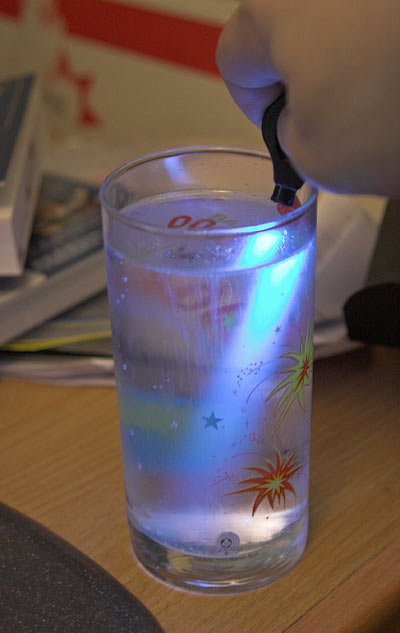
Glowing tonic water

...that tonic water glows under ultraviolet light.

(In this case, light from a UV Photon light.)

Modern tonic water (and bitter lemon, and a beverage made frae girders) only has a little bit of quinine in it. The original anti-malarial version of tonic water had far more of the stuff, which made it medicinally effective but also very bitter, such that adding a generous slug of gin to it could only make it taste better. Well, after you'd consumed enough doses, anyway.

Even a little quinine is more than enough for an impressive glow, though - quinine is often used in photochemistry as fluorescence standard, for this reason.

The ingredients label on the tonic I drink (usually straight; it's an acquired taste) lists quinine as "0.5%". If that's an accurate by-weight figure, then if you manage to put away a whole 1.25 litre bottle of the stuff, you've consumed something in the order of 6.25 grams of quinine. That's more than ten times the every-eight-hours medicinally effective dose of quinine dihydrochloride or sulfate (for IV or oral administration, respectively), which suggests to me that the listed concentration is a severe overstatement.

I did a nice before-and-after shot of a whole bottle of glowing tonic water for this old letters column. Wikipedia's version of the same thing is here.

STOP PRESS: Underpaid computer store workers are not very trustworthy!

This Consumerist piece about Why Geeks Steal Porn From Your Computer (When They're Meant To Be Fixing It, If They Get A Chance), is both informative and entertaining.

Let me tell you right now that if I were 21 again and working in some dead-end computer store McJob, I too would be rifling through the files of any user who needed our help to install iTunes. Anybody who is even marginally surprised about this would probably be horrified to see the contents of the back-room bulletin board of the average one-hour-photo place before the advent of the affordable digital camera.

There are some good tips in the Consumerist piece, but I disagree with the assertion that "drive encryption on your home computer is worthless". There are many easy-to-use encryption systems which provide data security that'll probably defeat the National Security Agency, never mind some dude in a pot-leaf T-shirt. If you just use Windows EFS and hand your password to the computer store along with the PC then they can of course access your data (and ordinary users who use EFS often lose all of their data as a result...), but there are other very fine options for people who just want to encrypt their accounting data, passwords and pr0n.

Hell, just putting that stuff in a Zip file with a ten character password'll probably do the job. Standard Zip encryption isn't very secure compared with many other schemes, but it's still often not practically attackable from any normal human's point of view. If the password's moderately long and not a dictionary word, and the attacker doesn't already have a copy of some of the data in the archive (giving the option of a "known plaintext" attack, which is the major weakness of standard Zip encryption), then a brute force attack is likely to take a very long time indeed. Even refined brute force attacks are likely to take centuries on current hardware.

Learning how to use encryption software is a good step towards learning how to use the rest of your computer like a "pro" as well. Before you know it, you won't have to hand your computer over to Super Excellent Computer Store's Data Commandoes just because you can't get rid of some crapware.

Wires 'n' volts

I just spent a little while perusing the Hobby Corner section of the excellent Discover Circuits site.

I reviewed a "shake flashlight" a while ago, and have since answered a letter from someone who bought a fake one.

Here's a page about how, exactly, the (genuine) lights work - or at least how the cheap knockoff versions do. It suggests a better design, but the shake-light idea is pleasing despite its inefficiency; with decent components they work well enough, and they let the light retain a normal unbroken flashlight casing, rather than requiring a crank handle or pull-string to stick out somewhere.

I've got some of the cheap-yet-functional ones as mentioned on that page; I bought them very cheaply on eBay, so I'm not too bothered that they take a lot more effort to charge and glow more weakly and for less time.

If you feel the urge, you can follow the Discover Circuits suggestions and upgrade the cheap lights with better diodes and capacitors to be much closer to the quality of the brand name versions.

Another Discover Circuits highlight: A super-simple capacitor-based constant current LED power supply to let you run long strings of LEDs from mains power (or fix these crappy LED nightlights).

It is also my considered opinion that the words DANGEROUS VOLTAGES EXIST EVERYWHERE are the mark of a truly excellent schematic.

Retro evil

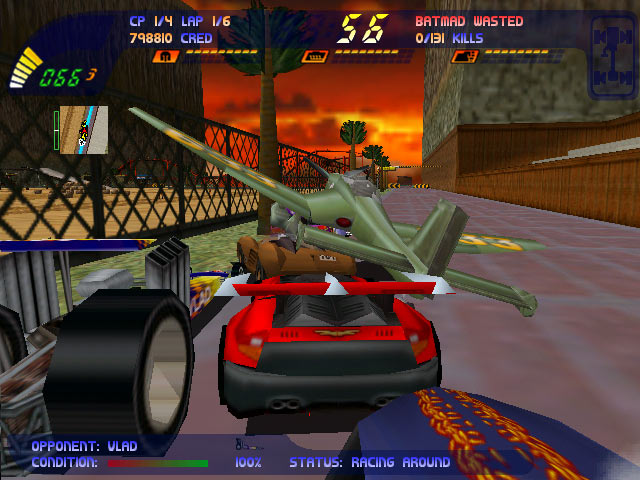
Apropos my previous mention of old games where you do bad things to people: If you've never played Carmageddon II, you really should.

Carmageddon II screenshot

Don't try to tell me that stuff like this happens in the racing games you usually play.

Every kid's used to running over old ladies in 3D these days, of course. But Carmageddon II came out in late 1998, before Grand Theft Auto had made it to (2D) instalment two. And I, and others, think it still holds up quite well today.

It's not, to be fair, a game for the precision car simulator enthusiast. Keyboard controls, a weird lunar-gravity feel, and very little reason to actually bother running through the checkpoints once you'd stacked up some spare time by killing pedestrians and another racer or two.

(There are timed challenge levels that actually force you to perform particular tasks before letting you at the next batch of levels. But you can always cheat past those.)

But despite the cartoonish physics, this actually is a simulator, of a sort. Driven and steered wheels affect car behaviour as they should, as you can see when a car's ridiculously smashed and bent and so can only drive in little circles. You can even get rear-wheel-steer and front-wheel-drive, if you drive the combine harvester.

You also don't have to perform contortions to get Carmageddon II to run on modern hardware. The game's still commercial software so you can't just (legally) download it, but once you've got it and patched it to v2.0 all you need to do is replace the carma2_hw.exe file with this further patch to make it run on Windows XP (and maybe Vista; I dunno).

And then you'll be in business, playing in Direct3D mode in a magnificent 640 by 480. 800 by 600 was possible, but only on 3dfx hardware, back when those cards were so powerful it was kind of ridiculous. Multiplayer requires the bad old IPX/SPX protocol, by the way.

You can take advantage of a modern graphics card by editing the data\options.txt file and changing the value on the "yon" line to 100 or more; that'll give you a much more distant view, so you'll be able to see further down the road, or a whole level at once when you're high up. Extending the view distance seems to hang the game occasionally when the view changes suddenly - like when you press the "recover" key or switch to the in-cockpit view - but that may just be because I'm using an unnecessarily high "yon" value.

People have also modded realistic looking cars into C2...

...and even turned it into a banger racing simulator. The low-polygon high-ridiculousness standard cars are perfectly adequate for starters, though.

To be honest, the only thing that irks me about unmodded Carmageddon II is the unfortunate fact that if you want to remove the dogs from the game, because you're cool with running over people and everything but deliberately whacking Fido goes a bit far, you can only do it by turning off all animals. That includes the far more amusing sheep, cows, moose and penguins. And the elephants, who're something of a challenge to kill.

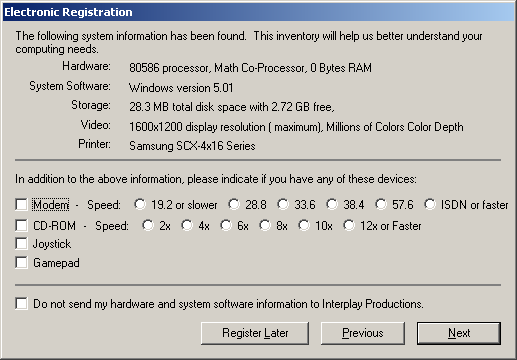
Oh, and if you try to register your "new" copy of Carmageddon II, you'll fail.

I don't think I can submit this any more...

I wouldn't try clicking any of those buttons, if I were you.

Before you see that window, though, you get this one:

Carmageddon II's idea of my system specs

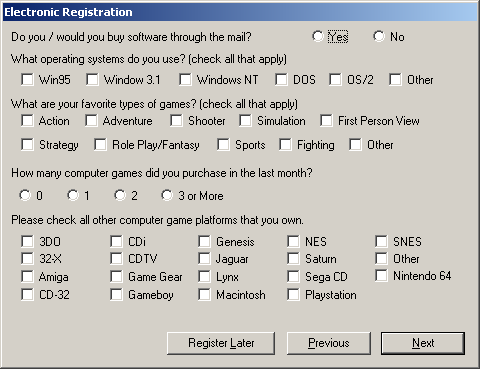
And, more amusingly, this one:

Carmageddon II registration requester

There's your retro game console collection guide, right there. Note the separate entries for the CDTV and the CD32, baby!

eMate data transfer. Bring a packed lunch.

Yes, my eMate is now actually useful, but I had a bunch of fun figuring out how to get data onto and off of it.

I started out by moving data back and forth with a plain old serial cable. I bought the bits to make one, but then a kind reader sent me his old Maclink cable for free!

And, after trying almost everything else, I'm back with the serial cable.

If you want to move documents - as opposed to contacts and calendar entries - to and from a Newton of any flavour, my official recommendation is to stick with serial and save yourself the pain.

But, I hear you say, the eMate has an infrared transceiver, which can talk to standard IrDA things if you install some software!

Yes. Sort of.

To enable IR data transfer, I did as I was told and used the serial cable and Newton Connection Utilities (which is what you use on Windows for serial document transfer as well) to install a bunch of stuff from 40Hz. I installed IC/VC and Neo and Nitro and Ntox and NHttpLib, not all of which were necessarily entirely essential for simple document transfer, but what the heck.

Then I tried to get the eMate to to connect to a PC, only to have it error out at the precise moment it connected, every time. Yes, even if I used the OBEX:IrXfer option, as instructed. This happened with a desktop machine with a USB IrDA interface; it also happened with my ThinkPad.

You actually can transfer data from a PC to an eMate even when it's doing this. What you have to do is kind of trick it, by starting a transfer (which will immediately fail) so Windows lets you pop up the what-file-would-you-like-to-send requester, then selecting the file you want, and starting another transfer. Then you click the OK button just as the connection happens... whereupon it works. For that one file transfer. Then it instantly disconnects again.

(I was sidetracked for a while by the instruction to run "irftp", which is a program that exits silently every time I run it, presumably because it sees no IR connection, because of the instant-disconnect problem. Oh, and if you transfer a plain ASCII text file to an eMate it won't be able to read it, unless you install plain text "stationery" as well. Fun!)

All of this is purely academic, though, because there's no trick you can use in the other direction. If you've got this problem, you can't send anything back from the eMate to the PC via IR.

Neo is supposed to "convert [an] object to text and send it", but all it ever actually does for me is convert an object to the generic eMate errors -8007 and -48205, and send nothing.

Perhaps all of this 40Hz stuff does actually work if you want to sync address book and calendar data, but I just wanted basic file transfer, and it wasn't happening.

You can also, apparently, use some Orinoco 802.11b cards with an eMate, and wired Ethernet cards too. But the Orinoco driver only works if you install Newton Internet Enabler, which is for... accessing the Internet, and doing other perverse things. Not transferring data from other computers. Well, not unless you do something ludicrous like transferring your documents via e-mail and installing a mail client on the eMate.

There's also commercial software that lets you use a CompactFlash card in a PCMCIA adapter as storage for a Newton device, instead of the old "linear" PCMCIA cards that work natively in these devices. I'd almost certainly be able to do this, since my dusty-old-stuff drawer contains the 8Mb version of a 16Mb card that's on the compatibility list, but it wouldn't help me much either, since the files the eMate put on the card would be in Newton Note format and I'd have to translate them somehow to access them on my PC anyway. Might as well hook up the serial cable and translate on the fly.

So, verily, did I say Screw It, and go back to the serial cable.

(I'm using the serial cable with my old ThinkPad, which is the handiest computer I've got that has a real serial port. I think Newton Connection Utilities will work with a USB-to-serial adapter, but I haven't tried it. For a bigger dose of old-stuff-on-new-hardware shenanigans, check out this page about running Windows 1.01 on 2005 hardware.)

This just in: Laws o' physics still unbroken

Whaddaya know - another compression scheme that violates rules of information theory has turned out to be a great big scam. The only part of this that surprises me is that I'd never previously heard of this Brent Kovar and his particular take on the broadband-down-a-thin-straw idea.

(For more shenanigans of this sort, check out the last letter in this column.)