Another voter heard from

From: ron <starrwulf@yahoo.com>
To: dan@dansdata.com
Subject: website
Date: Tue, 17 Mar 2009 08:44:53 -0700 (PDT)

[Quoted from my first magnet review:]
The earth's natural magnetic field is about 0.5G, depending on where you are - it's weaker at the equator and stronger at the poles. It's also slowly declining at the moment, which is something that it does periodically; geological evidence shows that it's actually reversed several times over the planet's life. The mental giants at the Institute for Creation Research use the decline of the field strength to prove that the planet's only a few thousand years old.
In case you're wondering, this, like various other of their proofs, doesn't stand up too well.

;;;perhaps if you had listened to the explaination instead of hiding behind your evolution, the science of it would have made sense to you. Dr. Carl Baugh or Ken Hovind [Links mine! All spelling Ron's!] do a good job of explaining the science of it and other things the so called 'mental giants' of evolution ignore or deny out of hand. sorry to see your science falls short of what true science is suppose to be.

otherwise, your site is informative for the little i have read of it... between your evolution and earth magnetics belief, i am surprised you dont believe in perpetual motion, too.

I think there's something in that for all of us, don't you?

(Just in case some other green-ink-and-underlining correspondent is all het up about me linking to searches of infidels.org and talkorigins.org in the above quote, here's what the homosexual Satanists of Wikipedia have to say about Carl and Kent. {Apparently his friends call him Ken. Who knew?})

Truth is out of style

Robert X. Cringely would like us all to know that what the business world needs is more bullshit.

Apparently he's very impressed with some Indian entrepeneur - I think he's called Sumantra Roy - who is making tons of money, thusly:

1: Figure out that there seems to be a market, "older women stuck with (or thinking about getting) naughty parrots", to whom could be sold an expensive e-book of information about these creatures.

2: Realise that you don't know a thing about parrots.

3: Buy some books about parrots.

4: Realise that you don't know a thing about writing, either.

5: Hire some guy to read the parrot books and make you an all-new parrot e-book of your own, which you can sell to the abovementioned middle-aged ladies.

6: Make one of those God-awful mile-long CLICK HERE YOU IDIOT marketing Web pages [which, thanks to a commenter below, I now know is called a "squeeze page"], full of BIG TEXT and dodgy testimonials. Including one testimonial that goes on and on, from the supposed source of the info in the e-book. This supposed source is called "Nathalie Roberts", and she has a friend called "Wayne" who had a parrot called "Polygon". Nathalie has twelve years of "school of hard knocks" knowledge about parrot care and training!

Behold: ParrotSecrets.com!

7: Profit!

7b (optional, and inadvisable): Cheerfully admit to Cringely that Nathalie Roberts does not exist, and all that "experience" was just slapped together from four parrot books by some work-for-hire guy who sure as hell ain't gettin' a cut of your (alleged) hundreds of thousands of dollars a year.

8: Get presented by Cringely as the kind of go-getting entrepeneur that the world needs more of. I mean, if anybody refused to do this sort of thing because of "ethics" or "morals" or any shit like that, they must be standing on, to quote Rob, an "egalitarian soap box".

The fake Nathalie Roberts is, Cringely says, "like Betty Crocker". You all remember when Betty was presented as a real human being who personally baked all of General Mills' products, right? Yeah, me too!

And anyway, Cringely reckons that all this stuff must be A-OK, because "I have yet to find people bitching and moaning on the Internet about being cheated by Parrotsecrets".

The Internet, Cringely kindly explains, provides us all with a "remarkable self-policing system of commerce". I presume that this explains why things like, I don't know, the standard ads you see next to a Google search, are so wonderfully scam-free.

So there y'go, guys! A product being sold to middle-aged women doesn't have a tide of complaints about it on the Web - so it must be kosher! Every Internet discussion board, as we all know, is just packed with women called Mildred who were born in 1952 - so obviously there cannot possibly be a problem with this product!

The absence of complaints could not possibly have anything whatsoever to do with the rather small intersection of the two sets,

A: Everybody, young or old, who has enough familiarity with the Web to be able to find a place to complain about a dud product where casual Googling will find the complaint, and

B: People who do not automatically categorise any single Web page with many different sizes and colours of text, that you have to page-down 28 times to get to the end of, and which is trying to sell you something, as a scam.

But all of this is a little academic, because right after Cringely said that, a commenter found this site. It's what you might call a... portal page... leading to rather a lot of complaints about Sumantra Roy and his numerous ventures.

Apparently Roy's got a bunch of other similar animal-related sites (which makes his total alleged income a bit more plausible), on which he's followed the same formula of making up someone who supposedly wrote a book and so on and so forth. And he's got a finger in the "Search-Engine Optimisation" pie as well, and... oh, it's all too horrible.

About the best argument anybody in the Cringely post's comments can come up with in favour of this "entrepeneur" is "OK, it's bullshit, but all marketing is bullshit, man!"

Well, OK, yeah. Coke won't really make you young and popular, Bernie Madoff never really made any trades, and those AAA-rated structured investments were all actually worthless. And whenever a financial crisis comes along, there are indeed always spivs who stand ready to find people in trouble and take away even that which they hath.

And apparently, because that's normal, it's also OK!

So get with the program, you unemployed layabouts! Get yourself on the winning team! There can never be enough middle-men, and truth is out of style!

A case study in involuntary magnetic body-modification

A few people have e-mailed me about this.

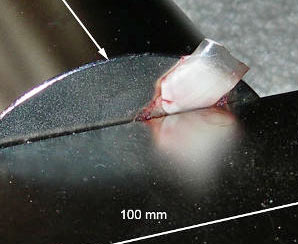
Big rare-earth magnets: They want to hurt you.

What you're looking at, here, is a sandwich. The sandwich's components are:

1: One large neodymium-iron-boron ("NIB") magnet.

2: The fingernail and finger-tip, mashed down to negligible thickness, of a gentleman called Dirk.

3: Another large NIB magnet.

Hackneyed though it is to say this, Dirk was lucky. He could have been luckier, I grant you, but he could also easily have lost a whole hand to rare-earth magnets this large.

You can read the whole grisly story here on the MagnetNerd.com site, the front page of which shows a couple of little half-inch-cube NIBs attracting each other through the thickness of a man's hand.

(The Magnet Nerd also has good pages about magnetic perpetual-motion machines and the various other evergreen magnet scams. And a line of chunky wooden implements to let you handle large NIBs, and pull the blighters apart, without losing any digits.)

The mutual attraction between magnets of all types increases, all other things being equal, exponentially as the magnets get bigger, and approximately with the inverse-cube of the distance between them. (That last part is the bit that really sneaks up on you.) So you can make an instant earring by sticking a couple of small NIB discs together with your ear-lobe in between, or you can smash your whole hand into wafer-thin steak tartare with a couple of magnets the size of cigarette packets.

I think it's brilliant that anybody can buy fist-sized NIB magnets from a variety of dealers - Forcefield ("WonderMagnet"), Engineered Concepts ("SuperMagnetMan"), and of course umpteen eBay dealers. I think the people selling them are generally very responsible, too; in product listings for the big buggers, there's usually a BE CAREFUL YOU IDIOT warning. And to my knowledge NIB magnets are generally very well packaged, too - collections of small magnets get a mild-steel wrapper, and really big magnets get great big double-boxed packaging, firmly holding the magnet in the middle of a large box.

The biggest magnets in this house are the two-inch-square trapezoid and two-by-one-inch cylinders from this old review. I don't know whether you could actually smash all of the bones in your hand by putting one of the cylinders on one side and one on the other. You'd probably just get a very nasty bruise. I'll leave the experiments involving gauntlets, eye protection and supermarket poultry to someone else, though. And the two-inchers ain't nothin' compared to what's on offer these days.

As I write this, a quick eBay search (if you use the not-often-useful "Price + Postage: highest first" sorting option) turns up a 4-by-1.5-inch disc for $US169.99 ex shipping, 2-by-2-inch cylinders for $US109.99, and, most terrifyingly, a two-inch sphere for $US139.99.

Spherical magnets have the problem that only a tiny area of their surface can be in contact with any other object - like another magnet - that isn't concave. For little sphere magnets - the quarter-inchers, for instance, that you can use to make impromptu rings or bracelets - this just means that they need extra-thick nickel plating so the little contact patches between the spheres won't quickly wear down to the brittle black ceramic of the magnet material itself.

A big NIB sphere, though, is aching to smash itself into other magnets just like every other big NIB, but is fated to deliver all of its terrifying impact energy to that one tiny contact point.

I imagine the X-rays of that victim would look quite interesting.

If you reckon it's time for everyone to start calling you "Lefty" or "Stumps", NIB-magnet dealers stand ready to assist you. The Engineered Concepts guy currently has a 6-by-1-inch ring magnet for $US425, 6-by-4-by-0.75-inch blocks for $US325, and wedges for the bold wind-generator maker (find info about this at Forcefield's other site, Otherpower.com) at $US720 for half of an eight-inch-outside-diameter ring.

Forcefield, meanwhile, will be pleased to sell you wedges suitable for making a 14-inch ring, for $US30 each. The rest of their range tops out around the two-inch size class.

(If you're for some reason not seized by an uncontrollable urge to maim yourself in an unusual way, I suggest Forcefield's $20 Grab Bag. It contains an assortment of different NIBs, none of which are big enough to give you anything worse than a blood-blister. If you're buying for a child - preferably one who's old enough to avoid swallowing more than one magnet - I suggest getting a large number of quarter-inch-or-smaller discs or cubes. They're cheap these days, and a lot of fun.)

I run MY ThinkPad from a Leclanché cell

Back in the day, you couldn't spit without hitting someone saying something completely wrong about memory effect. But today, really loopily idiotic writing about batteries is quite hard to find.

So I am indebted to the reader who just pointed me to one Dave Thompson's article in the Sydney Morning Herald, entitled "The big fat lie about battery life". (It also appeared in the Melbourne Age - the two papers are published by the same company and share a lot of material.)

My correspondent gave his heads-up e-mail the title "Worst. Battery. Technology. Article. EVER.", and I am delighted to say that I concur.

Mister Thompson is apparently under the impression that "average" laptops currently come with nickel-cadmium batteries. This hasn't actually been the case for more than ten years. Laptops with NiCd batteries were still easy to find as late as the mid-Nineties; the famous ThinkPad 701, for instance, apparently straddled the gap, with a NiCd battery for early-production 701s.

Nickel-metal-hydride batteries superseded NiCds, and then lithium-ion or lithium-polymer (generally a distinction without a difference; see this piece, from 2001, for more...) took over in the last few years of last century. The demise of NiMH in the laptop market was quite rapid, even though early lithium-ion batteries had a distressing tendency to drop dead after only a couple of years. But lithium batteries gave a lot more capacity per kilogram, and laptops were expensive enough items that manufacturers could put cutting-edge battery technology in them without greatly - proportionally speaking - increasing the price of the computer.

I don't think it's actually physically possible to buy even a NiMH-powered laptop any more, let alone a NiCd-powered one. Lithium-ion dominates the market, including the low end, and I don't just mean laptops. $20 Chinese Picoo-Z-knockoff helicopters, $12.50 tiger-shaped MP3 players, entry-level mobile phones, $US300 netbooks, you name it. I have a mobile phone that retails for a flat fifty bucks unlocked, and it has a lithium-ion battery. I cannot imagine how Dave Thompson has come by his view of the world.

All undaunted, though, Dave ploughs on with a number of fascinating details about the "NiCads" he alleges are still the standard power source for laptops.

Like, apparently they have a limited lifespan. Well, yeah, everything does, but NiCds are actually likely to work fine for many years if not abused. Few rechargeable lithium batteries are likely to be useful for more than five years.

"If not used properly they simply stop working". I thought he might have been thinking of memory effect or something, but no, he reckons they die if you don't use them, and need regular cycling.

You hear this all the time - it's not right out of left field like the bit about NiCds still being in common use - but it's not actually true. NiCds are actually known for their very long shelf life. If they've been on the shelf for a year then most of the charge will have leaked away, but even if they've been on the shelf for ten years you'll probably just be able to give 'em a charge and put 'em to work.

All you achieve by cycling most NiCd, NiMH or lithium batteries is wearing them out faster. There are certain situations where emptying and refilling a battery can be good - NiCds suffering from voltage depression, say, or LiI batteries whose monitoring hardware has lost track of how much capacity the battery actually has - and I think lithium-ion often hits its shelf-life limit before even someone like Dave can cycle it to death. There are special cases in the radio-control world, too, where absolute battery capacity may be less important than high current delivery and a shallow discharge curve, so your electric car or plane is almost as fast at the end of a four-minute race as it was at the beginning. But as a general rule, cycling your batteries is like "cycling" your car's fuel tank, by driving round the block until it's empty then filling up again.

Dave is, at least, correct that NiCds are a pollution risk if you throw 'em out. Cadmium is quite a lot more toxic than lead, and I think there's still no good way to recycle NiCd batteries, here in Australia at least.

So it's a bit of a shame that he's encouraging everybody to wear their NiCds out faster. Good thing laptops aren't actually powered by NiCds any more, ain't it?

The toxicity issue is one of the big reasons why the much-less-toxic NiMH batteries became popular; nickel pollution is a problem too, but nickel is rather less toxic than lead, and far less toxic than cadmium.

Fortunately, old dead NiCds aren't particularly dangerous just sitting there. So you might as well just toss any dead NiCds you have into a sealable container, put it under the house and forget about it, until someone comes up with a way to recycle them that doesn't involve sending them to China to poison people there.

Dave has noticed that, sometimes, someone who last used their laptop on battery power a long time ago discovers to their dismay that it now has "20 seconds" of battery life. He thinks this is because the battery hasn't been cycled. It's actually because modern laptops have lithium-ion batteries, and lithium-ion batteries have a relatively short lifespan (improving all the time, though - things aren't as dire as they were when I wrote this in 2004). If your laptop battery had 25% of its capacity left when you last disconnected the mains power, a year ago, then yes, it's very likely to be completely dead now, and there's nothing anybody could have done over the intervening months to avoid this. (It's possible that the battery is actually OK but the capacity-monitoring hardware has gone nuts, though; cycling might actually help, there. It's also possible that the laptop has a dumb charger circuit that's slowly barbecued the battery; cycling would in this case be a waste of time.)

Well into the article, Dave remembers that NiMH batteries exist - but then immediately refers to "NiCad's well-known memory effect", resetting the clue-meter to zero just when it looked as if he was making some progress. And then he signs off with "All batteries like to be used, so run them down every few weeks and charge them back up properly just to keep them in top shape", cementing his position in the I Hate The Environment, Die, Environment, Die, Coalition.

Maybe, I thought, Dave just had a small stroke while writing this article and is usually quite sensible. So I had a little look around for other examples of his work.

Apparently cameras, wireless peripherals and "pen-drives" can reasonably be expected to work only once, which is news to people who've been using the same wireless Logitech mouse-and-keyboard set for the last ten years.

Oh, and wireless input devices "eat batteries like a cop in a donut shop".

If current wireless-desktop gear is only as good as the devices I reviewed in 2001, this means police officers have listened to their cardiologists and reduced their consumption of doughnuts to maybe one every two months, tops. Good for them!

He has also written... a thing... about Linux. I wouldn't call it an article. I'm not sure what it is.

(This piece has the brilliant subtitle "Dave Thompson gives his take on Google's new search engine, Chrome", but that's probably the work of a subeditor, not Dave. Mr Thompson tried his best, though, complaining about the usage-tracking feature of Chrome without figuring out that you can turn it off any time you like, and don't have to turn it on in the first place.)

The end of Dave's wonderful battery article says Dave "runs a computer-services company in Christchurch, New Zealand". I think this is it. I wonder if his workmates have some stories?

I don't know how Dave's managed to end up with the ideas he's got. Mere incompetence is common enough in all branches of journalism, but Dave's version of it is odd. Perhaps he just fixes his opinion of every computer technology when he plays with version 1.0, and assumes that 20 years later it'll still be the same. Who knows.

(Oh, and here his battery article is on the Stuff.co.nz site, in case the Herald/Age people do another of their embarrassing-article disappearing acts. Here are other sources, from a Google search for a string from the article.)
Still smarter than most spammers

There's an "Ask Dan" button on all of Aus PC Market product pages, that allows people to ask me stuff about AusPC products, in the hope that I may perhaps answer them and then put the correspondence on my site as an Ask Dan page.

We haven't been able to make it completely clear that this feature is for people asking, for instance, whether Video Card A or Video Card B is better for Fallout 3, rather than stuff I don't know like how long something's power cord is. But even without a How Not To E-Mail Me scare page, by and large the Ask Dan buttons work quite well.

In the last few days, some spambot has latched onto Ask Dan. It's clearly mistaken the send-me-an-e-mail form for a Web-forum comment form, and is attempting to use it to post comment spam.

So now I'm getting mail from sukmishelpfs@yahoo.com and lcfwasolzg@gmail.com and so on that says stuff like

<a href= http://viagraonlinebest.50webs.com/viagra-for-woman.html|viagra for
woman ></a>
[url=http://viagraonlinebest.50webs.com/viagra-for-woman.html|viagra for
woman][/url] <a href=
http://viagraonlinebest.50webs.com/viagra-price.html|viagra price ></a>
[url=http://viagraonlinebest.50webs.com/viagra-price.html|viagra price][/url]
<a href= http://viagraonlinebest.50webs.com/viagra-generic.html|viagra generic
></a> [url=http://viagraonlinebest.50webs.com/viagra-generic.html|viagra
generic][/url]

or

<a href= http://casino-best.bebto.com/on-line-casino.html >on line casino</a>
[url=http://casino-best.bebto.com/on-line-casino.html]on line casino[/url] <a
href= http://casino-best.bebto.com/no-download-casino.html >no download
casino</a> [url=http://casino-best.bebto.com/no-download-casino.html]no
download casino[/url] <a href=
http://casino-best.bebto.com/online-casino-gambling.html >online casino
gambling</a>
[url=http://casino-best.bebto.com/online-casino-gambling.html]online casino
gambling[/url] <a href= http://casino-best.bebto.com/casino-game-online.html
>casino game online</a>
[url=http://casino-best.bebto.com/casino-game-online.html]casino game
online[/url]

(The above is quite heavily abridged.)

The funny part is that the spambot has decided to post its mis-aimed comments in the Ask Dan form for exactly one AusPC listing, for this defunct server. Because that product is no longer available, the product page now has no Ask Dan button on it; there is no way for anybody to actually navigate to that product's Ask Dan form. And yet, the spambot keeps Asking Dan about it!

So somehow it's gotten it into its tiny little brain that the Ask Dan page for that product - URL http://www.auspcmarket.com.au/popup/email_dan.php?product_code=SY-CSPC-7045A-TB, which I just created by pasting the server's product ID in place of the ID of another product - is the gateway to bold new markets for online casinos and pills that probably aren't Viagra.

I hope it doesn't discover any of the thousands of other Ask Dan forms. It's much easier to filter this way!

The Copy Of Doom

Would you like to make a Windows PC that has some network-shared folders containing large files look as if there's something horribly wrong with it?

Well, that is, I have just discovered, easy!

Just copy one of the files - let's say they're movies - over the network to another computer.

Then, before the first copy operation is complete, start copying another. And another. And another.

Like, maybe you're copying all of your absolute favourite TV shows and movies, and you're just clicking and dragging whatever catches your eye, and letting the little copy dialogs pile up.

This is exactly the sort of task that a proper file server is specifically designed to handle. Even if the server's storage isn't terribly fast, six people all asking for different things on the same drive at the same time should be put in a queue, rather than asking the waiter to carry every order for the whole restaurant at once, as it were.

But consumer versions of Windows aren't set up to do that. They're meant to serve a single user, and see nothing wrong with just doing exactly what they're told to do if several remote computers - or even just one - ask them to do something like copy 20 large files at once.

(You can probably alleviate at least some of this problem in consumer Windows versions by something like selecting the "background services" and "system cache" options in WinXP's Performance Options -> Advanced tab. Even a cheap Solid State Drive would immensely reduce the problem, too, since the multi-millisecond seek time of mechanical hard drives is a big reason why it happens, and SSDs have near-zero seek time. But SSDs are, of course, still rather too expensive per gigabyte for tasks like bulk video storage.)

Once you've got several large copy operations all happening at once on, let's say as a random example, the Windows XP computer on which I'm writing this, this "target" computer will be flogging to death the drive(s) on which the big files reside. Data to and from those drives probably has a bottleneck or two of its own before it gets to the network, too; the ATA I/O hardware in consumer PCs is not made to deal elegantly with several drives all talking at once.

The upshot of this is that any operation which expects one of those drives to respond snappily to a request - or, quite possibly, which is just trying to talk to some other drive in the computer - will now suddenly find itself waiting a lot longer for that response. And that's one of the standard ways in which programs can misbehave. It's perfectly normal for programs to, say, ignore user input while they're saving a ten-kilobyte file; that should only take a moment. But if it now takes 30 seconds for that tiny file to be saved, as the save operation tries to push through a storm of seeking and reading, the program will appear to have hung. This applies to lots of things besides saving files - if modal windows suddenly take 30 seconds to appear, for instance, the program will seem just as broken.

On the plus side, as soon as you cancel the 20 simultaneous copy operations, the target PC will immediately start working perfectly again.

On the minus side, before you cancel the copies, it'll be doing a very good imitation of a computer with one or more failing hard drives. And practically anything you do to try to figure out what's going on will just add more input/output tasks to the mess, and make things even worse.

Eventually, the user - let's call him Dan - will try to shut the computer down, get sick of waiting for the numerous simple disk tasks this entails to conclude, and just turn the darn thing off. And now, the metaphorical plate-juggler will forget about all of those plates that are still in the air, and leave them to crash to the floor.

In my case, this meant various programs lost some of their configuration data. Firefox, for instance, was back in the default toolbar and about:config state, and all of the extensions thought they'd only just been installed. My text editor forgot about the files I used to have open, and Eudora lost a couple of tables-of-contents and rebuilt them with the usual dismal results.

(If you lose the TOC in a mail client like Eudora that uses the simple mailbox format in which the main mailbox file is just a giant slab of text, and the TOC is the separate file that tells the programs where actual e-mails start and end within that text, rebuilding the TOC probably won't go well. It'll give you a separate "e-mail" for every version of a given message that looks as if it might exist. So if you saved an e-mail you were writing five times before you finished it, you'll get five separate versions of that e-mail, each at a different stage of completion. When you "compact" a mailbox, you're getting rid of all that duplicate data.)

Oh, and the file I'd been writing something in for the last hour was now a solid block of null characters. As, delightfully, was its .bak file.

I lost very little actual data, because I make regular backups. (Remember: Data You Have Not Backed Up Is Data You Wouldn't Mind Losing.) And stuff I'd done since the last backup which I wasn't actually working on at when the Copy Of Doom commenced was all fine. Good old PC Inspector even let me recover a bit more data.

Even quite a lot of data loss would have been preferable to what I originally thought was going on, though. It looked as if the boot drive - at least - was failing, leading me to another of my disaster-prompted upgrades. It's about time for a new PC now anyway, but it's ever so much more civilised to upgrade when the old computer's still alive.

Ten-trillionth time's a charm

A reader writes:

From: John
To: dan@dansdata.com
Subject: re your rod magnets.
Date: Wed, 21 Jan 2009 20:35:17 +0900

Dear Dan,

Amazing,!!! I was looking for what was available and came across your page, and it seems you have what I am looking for.

I am a retired engineer who has had a bee in my bonnet for years about using magnetic force to produce a reliable motor that requires no electricity.

I had a reasonable plan of how to do it but like most never quite got round to doing it.

Now I am looking at videos from YouTube showing how many people have all had the same idea.

I would like to know if you do a pack of 1/4inchx1'long high powered magnets and if so how much in total I am thinking of say twenty to start with.

There is a video under the heading of free energy by a company called Tesla comp. in the States who look like they have cracked it and it is worth watching.

if you could, I would like a price list showing the type of magnet, and the price per pack and of course the number in the pack including freight costs to Australia.

If you have more detailed information that you think would be of help please email me and let me know.

I am really very keen to go into this while I still can.

I served in the royal navy as a saturation diver and worked on the first nuclear subs.

Because they leaked badly (there was a team of eight) we all got cooked about three times and all had problems with cancer of some kind, I got cancer of the bone but am the only one of the team left, and have been on chemo for thirty years. However that is beginning to lose its effectiveness.

As you can guess like all those involved nobody owns up to what they did so no compensation for any including a lot of friends I made in the U.S. Navy.

I look at it that I am still here so you never know.

So i just get my pension for what it is.

Maybe I will come up with something that will pay better, you never know.

It was nice to find your web page and your sense of wit.

All the best and look forward to hearing from you.

John
Western Australia

My reply:

I can only urge you to find something better to do with the remainder of your retirement.

This sort of quest has, on the very very numerous times it has previously been tried, at best led to nothing but frustration and disappointment. I've written about it previously.

I don't sell magnets, I just wrote about them a few times. It's easy to get NIB magnets of all shapes and sizes, from miniscule to large and very dangerous, on eBay these days.

The two outfits that provided me with various magnets for my two big reviews were Otherpower's Forcefield Magnets and Engineered Concepts. (There was also Amazing Magnets...

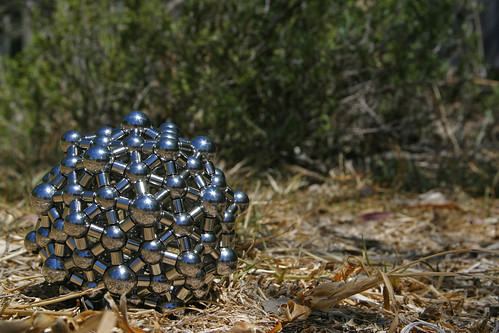
Mysterious magnetic object

...but they're not really what you're looking for here.)

I'm not sure exactly which video you're referring to, because the brilliant - but also rather deranged - Nikola Tesla is almost unavoidable in all areas of electrical "weird science".

(And, of course, a measure of magnetic field strength is named after him. According to the units that bear their names, Nikola Tesla is worth 10,000 Carl Friedrich Gausses!)

The first "TESLA free energy generator" video I found on YouTube/Google Video when I just did a search was this one:

The fact that this video obviously comes from a well-played VHS tape, yet the company responsible still hasn't managed to "reinvent the electric power companies in America", may tip you off to the fact that the product on offer is not quite as valuable as the video makes out. This company is in fact "Better World Technologies", run by one Dennis Lee, who I have also written about previously. There are a number of other outfits doing essentially the same thing Dennis is doing.

I apologise if this isn't the video you were talking about, but I think you'll find that most, if not all, other such works on YouTube, etc, fall into two categories.

The first category is hobbyists who're barking up much the same tree that you're considering, and who may or may not think they're making progress. Often, measurement mistakes like not correctly reading the RMS output of a device make it look as if it's doing something; the poor hobbyist in this situation may spend years trying to find the "minor bug" that must be the only reason why his contraption can't charge its batteries faster than it empties them.

(At this juncture, allow me to recommend the Pure Energy Systems Wiki, PESWiki, which is all about "breakthrough clean energy technologies". It has articles about just about every currently popular free-energy scheme, plus equivalents like "run your car on water" systems. Most of the things documented on PESWiki are utterly preposterous and, in my opinion, not considered nearly critically enough, but it's a great reference source, to see if even True Believers think they've made Device X work, or if they find the claims of Promoter Y plausible. PESWiki has a whole directory page about Dennis Lee.)

The second category of YouTube free-energy videos is entirely made, so far as I can determine, by scam artists, who may be deliberately doing what the hobbyists do by accident, or may have any number of other tricks up their sleeves.

Here in Australia, "Lutec" are a big name in the "press releases about free energy" business. They haven't, to my knowledge, been as successful at the "actually MAKING free energy" aspect of their business.

And then, as we come back toward things that could actually work in the real world, there are outfits like Thermogen, which aren't selling perpetual motion machines at all, but whose numbers still don't quite add up.

There are many "free energy" ideas - in the sense of "power that you don't have to pay for", not "energy from nowhere" - that really are very promising. High-efficiency solar collectors that'll fit on a suburban roof, for instance.

Evacuated-tube thermal collectors are very effective, and can be used for simple water heating or to power a heat engine. There's also considerable promise in photovoltaic concentrator designs, that let you use fewer, higher-quality solar cells - provided you can keep the cells from burning up, and track the sun accurately enough.

(Note also the next letter on that page.)

In closing, I really must urge you in the strongest possible terms to use your remaining years on this planet to do something other than become a footnote, to a footnote, to a footnote, in the Big Book Of Failed Free Energy Ideas.

I am aware that the man who says it cannot be done should not interrupt the man who is doing it, but when "it" appears to have many things in common with both finding the Loch Ness Monster and travelling faster than light, I cannot in good conscience advise anybody to invest any time at all in such a miserably hopeless activity.

The DealExtreme from which you can order is not the true DealExtreme

There was this totally awesome MetaFilter post about the FM3 Buddha Machine. It's a small plastic device inspired by previous "chant-boxes" - little plastic doodads that look like a small transistor radio, but are only able to emit a small selection of Bhuddish mantras.

As soon as I saw the post, I mentioned that m'notparticularlygoodfriends at DealExtreme offer some of the original chant-boxes for sale.

And then I found some even cheaper ones, and somehow managed to say something about them which a MeFi enthusiast considered at least +2 Insightful. I presume he's right, because I've got no bloody idea what this Buddhist lark's about.

Which, in itself, probably makes me the number-one global expert on the subject, given the way in which Bhudularity usually seems to work.

Yes, I really have bought one of the very cheapest, four-dollar, DealExtreme chant boxes.

If it turns out to alert me to the Möbius-strip nature of consciousness and midrange immediacy, I will make sure to tell you all.