It's all fun and games until someone gets sued

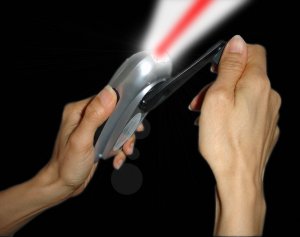
Technology Associates, whose Web site is the somewhat unfortunately named techass.com, were some of the first makers of commercial LED flashlights. I reviewed several of their products.

They haven't come up with anything much new for a while, but their one new-ish product - which has actually been around for more than a year now, but which I only just discovered - was worth waiting for.

It's got the same control electronics in it as their perfectly good little "Derringer"...

Technology Associates flashlight

...but it's got a crank charger.

So they decided to honour one of the world's premiere cranks by calling it... the GeneRay X1!

I invite you all to submit, in the comments, your suggestions for other products that should be named after a celebrity.

News flash: Something Can Live in Diet Coke

About a year ago I bought various titanium offcuts and had a go at the anodising trick. Electricity and a phosphoric acid solution let you turn the surface of titanium different colours, and the finish is very hard-wearing. "Rainbow titanium" gizmoes (like the pen I review here) are common these days.

The easiest way to get your hands on dilute phosphoric acid in this modern world is to use cola, since all cola contains phosphoric acid for flavour. Diet cola is preferable, since it's less sticky. I used Diet Coke.

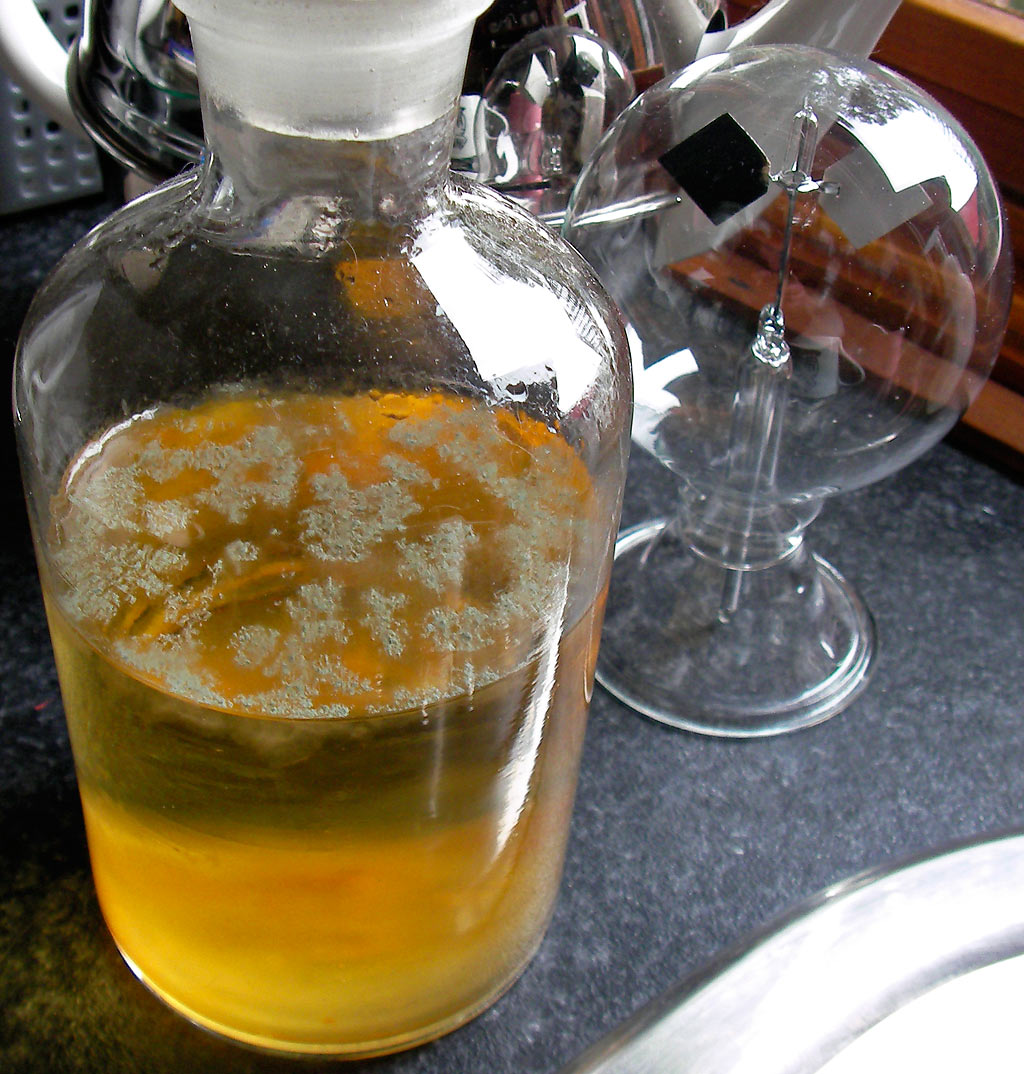
There was plenty of cola left after I'd satisfied my curiosity about anodising, so I put the excess in a ground-glass-stoppered bottle. It's been sitting in the kitchen next to my radiometer, looking all sciencey, ever since.

There is, by definition, very little food value in a diet drink.

But something still, eventually, managed to grow in the bottle:

Gunk!

I'm not sure what's feeding the mould, but I presume it's the "caramel colour" that's number two on the Diet Coke ingredients list.

Ordinary caramel is just sugar that's been browned by heat, and obviously has plenty of food value; Diet Coke may have "less than one calorie" per can, but they're talking about the dietary "large calorie", which is quite a bit of energy. I think the "sulphite ammonia caramel" that's used in acidic soft drinks is much the same, energy-wise, as plain burned-sugar caramel.

If it were just the caramel, though, you'd think that the mould would have grown in the unsterilised bottle quite soon after I'd stoppered it up and left it where it could soak up the morning sunlight every day.

The sunlight may have something to do with why the cola is the colour that it is, too. It's much paler than it was when I first bottled it, and I noticed the colour change long before I noticed any mould.

I suppose the acidity of the cola could have retarded mould growth. Perhaps the breakdown of aspartame into its constituent amino acids (due to the action of the acid, and possibly the sunlight again) had something to do with it.

Or maybe Aristotle was right.

Godly techno-weirdness of the day

Pop quiz, hotshot. You're driving down the highway, and you see this:

Mobile phones for Jay-sus-ah!

It's fifty feet high, and you don't remember seeing it the last time you went this way.

And yes, it's on the premises of a church.

What is it?

Obviously, it's a cell-phone tower, whose construction was paid for by a cell-phone company.

I think you'd probably get better reception from the Rio Jesus, though.

Joey, the Amazing Fetching Cat

When you throw a toy for a kitten, it'll sometimes bring it back.

Most cats grow out of this behaviour when they reach adulthood.

Joey, though, is now getting on for three years old, and shows no signs whatsoever of losing interest in fetching.

Especially if you throw his favourite toy, a coiled-up pipe cleaner.

He also likes clothes baskets. And shoes.

At least it's not from the Prime Minister

One of the simplest ways to get yourself a sample of the current crop of spam is by using a "spamtrap" e-mail address. Such an address is not advertised as being a way to contact anyone, but is visible to spammers' automatic address harvesters. You can, for instance, put such an address on a Web page with the foreground and background text colours set the same, so that no human can even see it when reading the page normally.

Because I write the I/O letters column for Atomic magazine here in Australia (and reprint it on Dan's Data six months after paper publication), I get to see all of the spam that makes it through the filters on the io@atomicmpc.com.au address. The I/O address isn't a true spam trap, since it has a real purpose, but it's certainly not subscribing to any mailing lists.

Recently, io@atomicmpc.com.au has been receiving regular press releases from the Citizens Electoral Council of Australia, which is the local branch of Lyndon LaRouche's completely sensible and entirely not batshit insane political task force.

Most recently, these messages have informed me that the only thing standing between us and the complete financial collapse of Western society is LaRouche's Homeowners and Bank Protection Act of 2007, which includes a number of modest proposals along the lines of nationalising the entire US financial industry.

That seems simple enough. I'm sure that right after George W Bush and Dick Cheney finish having gay sex on live TV, they'll get right onto making it happen.

Woe betide the world if they ignore Lyndon's predictions, after all. Remember how his pan-ethnic street gangs conquered the USA in 1973? Remember how domestic terrorism tore the USA apart in the Reagan years? And, of course, everybody knows that the British Royal Family are drug pushers!

(A bit of a long walk to the joke, but worth it, I think.)

It's possible that I'm only getting the LaRouche spam because the Citizens Electoral Council are still rockin' a 1994-era mailing list system that doesn't send a confirmation e-mail, and someone subscribed io@atomicmpc.com.au as a joke. (Ah, for a return to those halcyon days when you could effortlessly subscribe anyone you liked to dozens of random newsletters...)

I wouldn't be surprised if they just bought a "Press" e-mail list or ran their own Web-page troller, though.

Pitter patter, pitter patter of the phish

"Mjlawson29" is one of eBay's most famous users.

Search for most eBay usernames and you'll just get a few hits from actual eBay pages. As I write this, though, mjlawson29 has "about 537" Google hits, from all over the Web. Pretty good for someone who isn't actually an eBay user any more!

A cursory examination of those hits will reveal that mjlawson29's fame comes almost entirely from the work of a tireless phisher, who's been sending phish-spam about allegedly unpaid items from that seller forever and a day. I get one of them every couple of days, if not more often. Have been for months.

Apparently this phisher thinks this repeated strategy is like playing the same lottery numbers over and over.

It is, of course, actually more like approaching the same annoyed commuters every single day with the same story about how you just need money for a bus ticket because otherwise you won't be able to make it to your grandma's funeral this afternoon.

Mjlawson29 was a real eBay user, with good feedback, but isn't any more. It looks as if they chucked it in at the end of September 2006. Coincidentally, the first mjlawson29 phishing spam that someone bothered to post to Usenet is from the start of October, 2006.

It feels as if I've been getting these phishes for a lot longer than that, but I don't archive my spam (only so many hard drives in the world, folks...) so I'm not sure.

I'm inclined to suspect that the sudden wave of undeserved abuse generated by the phishes drove mjlawson29 away from eBay. But who knows; maybe they just decided to take up a new and exciting career in stealing people's logins.

Project Honey Pot has a couple of entries for the phishers responsible for this particular crap-stream, and also ties them to several other repeated eBay-name phishes.

Have you also heard from "babyphat96", "loriweiss", "nascar*stuff*" or "selectiveseating", over and over again? I know I have!

(Loriweiss was a real user but is now gone; I don't know whether babyphat96 or nascar*stuff* were ever real, but I wouldn't be surprised if they were. Selectiveseating is real, and still trading.)

It'd be simplicity itself for these phishers to harvest a new eBay ID to broadcast with each phish-run, but instead they stick with just a few, and use them over and over and over again.

Now, you would get repeated messages from the same user if that user genuinely did think you hadn't paid them for something. But you wouldn't get 'em for a year. And, as I said the last time I mentioned the output of these particular phishers, sending the same spam to millions of recipients ensures that the identifying features of that spam will become famous.

Phishers don't want to be famous. It's like being a famous secret agent.

1337 H4XX0rZ wanted!

It's great to see such impressive strides being made in the important field of protecting children from boobies.

Back in the day, there was software that confidently classified the Mona Lisa as porno. And also classified porno as being perfectly squeaky clean.

Nowadays, there's software on which my very favourite Australian Federal Government ever has apparently spent 84 million Australian dollars (about $US69 million, as I write this).

This software can, it is said, be bypassed by a kid in a matter of minutes.

(I see no reason to change my conclusion from the end of 2000: It doesn't matter, to the people who make it or the people who pay for it, whether censorware works or not.)

The news.com.au piece doesn't actually tell you how the pictured smirking 16-year-old bypassed the NetAlert suite of programs (while leaving them apparently running!). I presumed it was something rudimentary, like killing a couple of processes in Task Manager. Maybe a few seconds with regedit, too.

[UPDATE: As of 2012, that news.com.au page disappeared, in accordance with their ancient tradition; archive.org has it, but without the picture of the smirking teenager. The government Netalert site has been quietly led beghind the barn and shot in the head, too; here's how it looked when it was young and optimistic. Netalert-dot-COM-dot-au is alive and well, but it's not quite the same thing. I've had to archive.org-ify a few other pages, too.]

This ITWire piece details an inelegant way of temporarily and invisibly disbling Optenet, one of the three programs, by... killing a couple of processes in Task Manager.

This page mentions ways to prevent people from "tampering with Integard", which are hilarious enough that I'll leave them as a surprise, but which include not letting anybody boot the computer from CD.

That is, of course, well beyond the capabilities of the average parent (change boot order in BIOS setup program, set BIOS password, and then just hope your kid doesn't know how to clear the CMOS, which wipes the password and resets the boot order to default in one hit).

Just booting from BartPE or a Linux disc and nuking the nannyware isn't, of course, the sort of elegant and undetectable hack that's being advertised here. So there's probably something neater out there.

I'll be pretty surprised if you even need Process Explorer to nobble the rest of these marvellously enterprisey programs so wisely purchased from their skilled authors with my tax dollars. But who knows?

You mission, gentle readers, is to Outflank the Nanny, in as few keystrokes as possible. The software's a free download.

Our Government's dedication to quality software extends to the "Required" e-mail address and postcode on the download page. The postcode can be any four digits, and the e-mail address just needs to have an @ and a . in it, with two or three characters following the .

(The Safe Eyes download requires some kind of further account creation folderol. I also don't know whether they check to see if you've got an Australian-looking IP address.)
The Strange Case of the Unfreezing Wine

A reader writes:

I observed something I consider strange. I had a bottle of white wine which I didn't drink all of, and I decided to freeze the remnants for cooking purposes.

I put a shallow rectangular container in my deep freeze. Into this I put a plastic bag to line the container. Into the bag I poured the wine, which I then left to freeze.

I expected the wine to freeze into a rectangular prism approx 5 by 10 by 1 cm overnight - BUT THIS DIDN'T HAPPEN.

When I opened the freezer the next day, the wine was still liquid! As I watched (over about 20 seconds or so), crystals began to form inside the wine until it began to form an icy slurry.

The wine eventually froze solid after 2-3 days.

My freezer temperature is unknown, but it will freeze meat and water in about six hours.

Why didn't the wine freeze over 12 hours?

Why did it crystallise when it came in contact with the warmer air?

Sorry, it's probably more a Dr Karl question.

Mark

The wine stayed liquid because there were no nucleation points on the plastic with which you lined the tray.

It's possible to superchill water below zero Celsius and have it stay liquid, if there's nothing in contact with the water that provides a seed point from which crystallisation can proceed. This is also how those spiffy sodium acetate heating doodads work.

YouTube is positively packed with people's videos of this phenomenon.

The classic version of the experiment is to super-cool, then tap or shake, a sealed bottle of water:

(This is one of those experiments that's easier to do if you live somewhere where it gets decently cold in winter.)

More advanced experimenters can pour the water out, to make "ropelike peaks":

And, just like the acetate heaters, freezing supercooled water warms up when it freezes:

You can do the trick with beer, too...

...which adds a nifty multiple-starting-point effect, I presume because the nucleation points are little CO2 bubbles popping in and out of existence when you tap the bottle.

It wasn't the warmer air that started the crystallisation going; a speck of dust probably fell into the wine. An ice crystal from one of the shelves of the freezer would have done it, too. Or just agitation of the liquid.

The reason why it took so very long to freeze completely was probably just because there's some alcohol in it. Mixtures of water with any significant amount of alcohol will never freeze in a very satisfying way unless you chill them quite a lot more than the average freezer can manage. Most beer has little enough alcohol in it that its freezing point is only a few degrees below zero, but non-fortified wine already needs about -10 degrees Celsius to freeze, and stronger beverages are lower again.

This is why "frozen vodka" stays liquid, but starts to look sort of oily, as the water in it tries to solidify but the alcohol stays liquid. 40%-alcohol spirits will freeze at about -27 degrees C. Domestic freezers usually only give you about -18 degrees C.