Spinning and skiving

Herewith, two metalworking procedures that look like magic.

One: Metal spinning.

Many people are familiar with "spun metal" - you might have a salad bowl or arty lampshade made of "spun aluminium", for instance. But the actual procedure, done by hand on a normal lathe or by automatic machinery, is quite mesmerising:

There's no real upper limit to the size of the objects you can make by spinning. If your lathe can accomodate the initial piece, you can spin larger...

...or much, much larger...

...things.

Two: Skiving.

Skiving is shaving a thin layer off something. I think an ordinary woodworking plane actually more or less qualifies as a skiving tool. It's a standard procedure in leatherworking, but you can do it to metal, too, and that's where it shades over into the miraculous, if you ask me.

A metal-skiving machine doesn't just carve thin layers off a block of metal, like a plane would. In one stroke, it can cut each slice to a uniform length and leave it connected to the base, standing up parallel to all of the other slices.

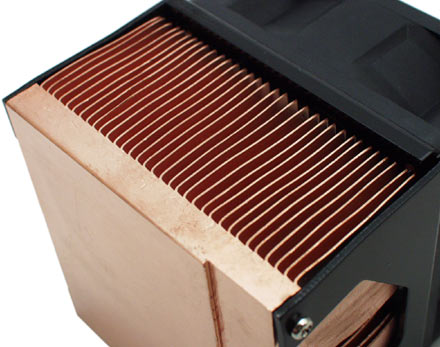
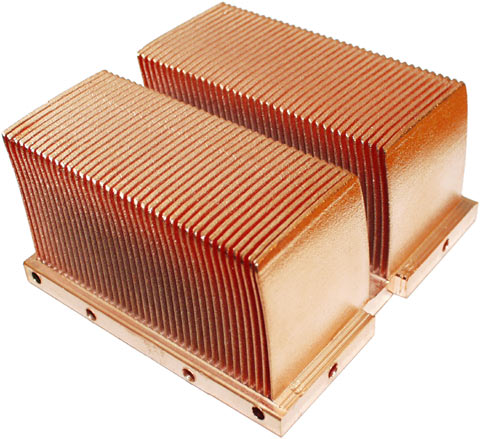
And so, hey presto, you've suddenly got CPU-heat-sink fins like these!

Skived heat sink

Skived heat sink

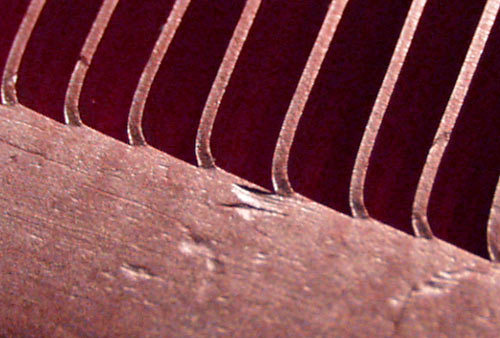
In more detail:

Skived heat sink detail

Unfortunately, I can't find a video clip of metal skiving in progress. There's a little picture accompanying the Wikipedia article on skiving machines, but that's all. Do please tell me in the comments if you know of a clip.

Attack Of The Green Slime

A few months ago, I built myself a new server and from the outset it had that smell of new electronics breaking in. But the smell never went away. Not a burning smell, more like electrolytic caps. I'm always alert for scorching odour.

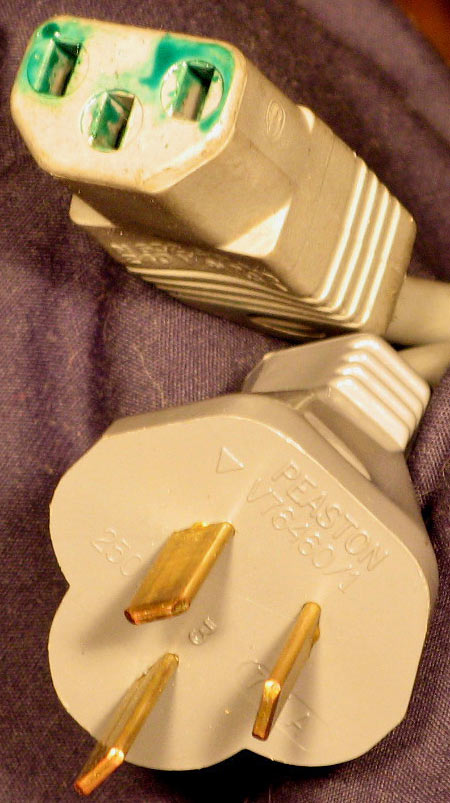
Today I needed to open up the system and unplugged its power cord and was surprised to find green slime on the contacts. Admittedly I mated a new power supply with a cord that is probably 10-15 years old.

It has a slight dimple on one face which makes the lettering appear curved in the photo.

IEC plug with strange green goop

Any idea what caused this?

Thanks,

Paul

The green-ness is a dead giveaway that this is one or more copper compounds, from corrosion of the contacts inside and/or the metal of the pins in the IEC socket.

Many copper compounds are green. The "verdigris" that makes the Statue of Liberty green, for instance, is primarily copper (II) carbonate. In the case of your goopy power plug, the wetness of the goop means that if the computer isn't sitting under a roof leak, there must be a hygroscopic (water-attracting) compound in there. That rules out copper carbonate, but there are several other copper compounds that'll suck water out of the air to one degree or another.

I think this process can be self-accelerating - a tiny bit of the hygroscopic compound is formed, it sucks up some water which dampens the area and accelerates the corrosion, and in the case of an electrical contact may further accelerate the reaction by increasing resistance so the area warms up. It's the warm copper compounds and/or plastic that's making the funny smell. It's also possible that outgassing from the plastic of the plug on the back of the new computer, or degeneration of the plastic in the old cord, has contributed to the reaction. Cable insulation is normally made from PVC, which stands for polyvinyl chloride, and every link in the PVC chain has a chlorine atom just waiting to be liberated, so I wouldn't be at all surprised if there was copper(II) chloride in the slime.

You can see similar green compounds discolouring the edges of copper or copper-alloy fittings in clothing, like riveted jeans or brass belt buckles. The copper compounds form a sticky goop there that's probably based on clothing fibres, sweat and shed skin flakes, all coloured (and flavoured!) by the copper compounds. (I presume hipsters who never wash their jeans develop particularly impressive rings of green goop.)

Fortunately, none of this is a big problem. Just discard the old IEC lead, make sure the pins inside the plug are clean (a pen eraser should be adequate to remove any tarnish), and plug in a new lead.

Hey buddy! Wanna buy me a computer?

The computer on which I'm writing this is still the dual-core Athlon I wrote about in early 2006. Since then, it's had some new RAM, a new video card and about as many hard drives as I could stuff into it, but the faithful old mildly-overclocked Athlon 64 X2 3800+ has kept on chugging along.

I've been planning to upgrade for ages, but my income's taken a serious dip lately. Most of my money comes from ads of one kind or another - annoying ones from Burst Media, less annoying ones from Google, and my various you-can-buy-this-from affiliate links to Aus PC Market - and the global economic slump has hit all of these sources pretty hard. I'm currently making maybe 60% of my income a year ago, and less than half of what I made a couple of years before that.

So I've been putting off upgrading, and putting it off some more, and continuing to put it off, on account of how computer gear gets cheaper and faster pretty much by the week. But lately, my income has been dropping faster than component prices. 50%-tax-deduction-bonus or no 50%-tax-deduction-bonus, I just can't swing a new computer, and see no real prospect of being able to in the near future.

The sensible course of action for me now is, of course, to stop complaining and just keep my old PC. Maybe, to minimise the chance of catastrophic failure, I should buy a new boot drive and clone the old one onto it; I've already done that once, and I've similarly upgraded a couple of data drives. (If your computer is more than a few years old, I strongly recommend you upgrade the boot drive, too. Every hard drive will die one day; people often add more drives to their PC, but they seldom upgrade the boot device, because it's a hassle. But a dead boot drive can be really, really annoying. Waiting six hours for a clone operation is greatly preferable.)

I'm in no danger of actually running out of money, you understand. The cats, and staggering numbers of freeloading cockatoos, are going to keep getting fed. And my life remains ludicrously luxurious compared with that of most of the world's population.

I also keep perversely doing unprofitable things, like picking fights with scam artists and expanding my reprinted magazine columns (like the one I just put up, or this vastly expanded one from last year).

But many of you seem to quite like that stuff. And I haven't had a donation drive since September 2008. And back in 2002, you suckers faithful readers together donated up the not-insubstantial purchase price of...

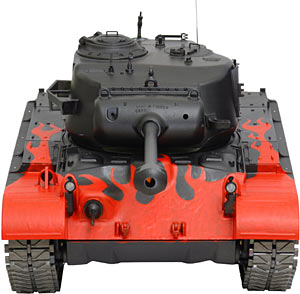
Tamiya Pershing tank

...a 16th-scale Tamiya Pershing tank kit.

So what the hell.

Anybody want to pitch in a few bucks to buy me a shiny new computer? If you do, my PayPal donation page is right here. Or you can just click this button:

You can send me an Amazon gift certificate too if you like, but all I can do with that is buy books and DVDs, since Amazon ship nothing else outside the USA. Oh, and if you're in Australia and would like to bank-transfer some money to me, e-mail me and if you sound trustworthy I'll give you my bank details. Since those bank details are sufficient to make fake cheques, though, I'm not putting them on public display.

NOTE: I'm not the only person tightening his or her belt at the moment, and I'm far from the most deserving recipient of your charity. If you're tossing up whether to send $5 to Amnesty International, Oxfam, the ASPCA/RSPCA or me, for pity's sake support human rights, poor people, or furry animals, not some dude who just wants a new computer to go with his vast monitor.

But if, on the other hand, you should decide to forego a nice breakfast at a cafe for toast at home, and then send the money you save to me, I'd be very grateful.

I would also be perfectly happy to accept a portion of the government stimulus money you would otherwise just blow on a plasma TV, or indeed a cut of the cheque that arrived addressed to your dead great-aunt.

However and whenever I get a new PC, I will, of course, whip up an article about it, like the one about my current computer and the one about the computer before that.

In the improbable-but-delightful-to-contemplate event that you all give me more money than is necessary to buy a new PC, I hereby pledge to spend it on a better theremin than the baby one I got cheap without instructions on eBay, and then record an actual tune played on said theremin, no matter how much harm this does to my relationship with my Significant Other and/or pets.

In Your Heart, You Know It's Flat

No sooner have I finished my second reply to that power-saver guy who took an entertaining religious tack in his dispute with me, than this shows up:

Hey Dan. I enjoyed reading some of the material on your website. You've definitely got some serious knowledge and understanding (not that you needed me to tell you that). But the reason I'm writing you is that it became clear to me that you reject the concept that God created the universe and yourself. As much as you know and can effectively explain to others who are wondering, you can not logically explain away the fact that you know deep down that you were created by God. And I am prepared for you to write me off as a religious psycho (though I myself hate religion) but I wanted to let you know that I prayed for you tonight that you would come to know your Creator who loves you and sent His Son, Jesus, to give you life. This email did not just happen by chance, just like you did not happen by chance. God is drawing you to Himself and I pray that you would accept His invitation.

"That if you confess with your mouth, "Jesus is Lord," and believe in your heart that God raised him from the dead, you will be saved. For it is with your heart that you believe and are justified, and it is with your mouth that you confess and are saved" Romans 10:9, 10

Stewart

You know, I actually do kind of wish that I did "know deep down that I was created by God". It'd make me quite a lot happier, I think. It'd certainly beat the hell out of the terrifying contemplation of the unimportance of all human endeavours when compared with the overall scale of the universe, and the glum certainty that no matter what any human does, and no matter what brilliant tricks any human may manage to pull, in the blink of a geological eye we will all be cold and forgotten dust.

(I think this sort of thing is at the core of your classic Lovecraftian cosmic horror stories. A story that's just about one guy sitting in a chair contemplating his mortality and unimportance probably wouldn't be serialised in sci-fi magazines, though, so you have to add tentacles, asymmetric brain-swapping elder races, all-powerful entities with no mind at all, people who aren't people, and a whole lot of hilarious adjectives.)

The philosophical argument has been advanced that if a God-as-described-in-the-Abrahamic-Scriptures did exist, everybody even slightly sane would believe in him. The fact that there are many apparently reasonable people who do not believe in God may, therefore, be a valid argument for God's nonexistence - it's called the "argument from nonbelief".

(There's probably a nice tidy philosophical name for the argument Stewart presents, that there actually aren't any real unbelievers,
atheists don't actually exist
, and everybody's secretly religious even if they deny it. Does anybody know what that's called?)

But in any case, even if some mysterious suppressed kernel of religious belief survives in my black atheistic heart, why on earth would you assume that the God-of-the-Christians is the only entity that could have inspired it?

(This is the flipside of the there-are-no-real-atheists argument. It can be argued that in fact everybody is an atheist, because everybody disbelieves countless gods, most of whom they've never even heard of. By this measure, the only difference between "real" atheists and religious people is that atheists disbelieve slightly more gods.)

I don't think there's actually much point to asking somebody presenting Stewart's argument why they assume that my alleged tiny ember of religious belief is in the Abrahamic god. I already know what the answer's likely to be. Faith, right? You just know, and you don't need a reason.

If you ask me, just knowing without a reason is defective thinking, which can severely weaken any attempt to think critically about any subject at all. Most religious people seem to be able to compartmentalise their faith away from their everyday life, so if they're crossing the road or buying a house or choosing a movie to see, they don't just kneel down and close their eyes until the Lord tells them what to do. But critical thinking is something you have to learn to do, and learning to be unthinkingly faithful pulls your mind in exactly the opposite direction. It can get to the point where you actually seriously argue that you can arrive at faith via the scientific method, because Jesus said that if you do God's will you will be convinced that it, um, is God's will, which sure sounds like solid scientific proof to me!

(The minor problem that the world is full of people all doing contradictory things while convinced that they have the full support of one or more gods does not appear to injure this argument.)

Many religions say faith is laudable in and of itself, and actively encourage adherents to believe all sorts of weird things. Thinking critically is hard enough as it is; thinking critically about religious topics is almost impossible, unless you're willing to devote years to your education and then, quite possibly, end up sounding not unlike an atheist anyway.

So I can't really blame people for taking the blind-faith route. It combines simplicity with laudability! How often in life does one get the chance to be commended for being lazy?

Around this point, the religious person often says that everybody has faith, it's a perfectly good reason to believe things, don't you have faith that the sun will come up tomorrow and that all of the intersection traffic lights won't turn green at once. And yes, of course you do, but that faith is based on long experience; religious faith, in contrast, is defined by its lack of evidentiary support. You just have to believe that you'll get that million dollars when you leave town.

Clearly, Stewart believes I should embrace some sort of Christianity - while, um, hating religion, by which I presume he means organised religion - but what if the one I choose isn't the right religion? Christianity isn't even the world's majority religion; in total, Christianity is more popular than any other religion, but it's still only got 33% of the religious market (rather less than 33% of the world's population, since many people have no religion). And of course Christianity, like Islam, is itself broken down into various sects which usually insist that members of the People's Front of Judea are all going to Hell, and you'd better join the Judean People's Front if you know what's good for you. It's all very well to reject organised religion and come to your own understanding of the scriptures, but there will still be many other incompatible interpretations, all with believers every bit as sincere as you.

Perhaps I should go with the oldest religion that's still at all popular. That might be Judaism, though of course the Judaism of 1000 BC probably didn't bear much resemblance to any Jewish sect today.

Or perhaps I should tour countries where everybody's very religious, take notes, and see who's got the best argument. Algeria's 99% Muslim, Armenia's 99% Christian, Bhutan's 97% Buddhist, half of Madagascar's population retain their slightly peculiar traditional ancestor-worshipping beliefs, and about 70% of Albanians profess no religion at all!

In all of those places, I can tell you now that the strongest determinant of anybody's faith will be the faith, or lack thereof, of their parents. Adolescent rebellion doesn't actually usually make a lot of difference to that. Which, again, is a bit of a funny thing to see; if there's one faith that you can just start believing and then, hey presto, its truth becomes apparent, you'd think the global religion market would have settled more solidly on that faith by now.

At this stage in the discussion, the theist will usually sally forth with the warm-and-friendly big-house everyone's-welcome ecumenical argument, saying "there are many religions, but I suppose they all worship the same God". I really cannot accept that, though, since the statements and requirements of many of the world's religions are very clearly incompatible with each other, and people seem to get quite upset about it.

Saying that all, or even many, religions are philosophically compatible is like saying that all codes of football are compatible. OK, sure, a soccer player can pick up the ball, run like hell while dodging the bemused opposition and then dive over the goal-line for a righteous touchdown, but I think you'll find that his team's score will not then rise by six points.

So here I am, back in the quandary of which religion to settle upon, with my immortal soul - if I have one - hanging in the balance.

Should I eat bits of my god, start a Crusade, shoot abortionists, or die heroically in battle? Should I pray five times a day, three times a day, or on Sundays, or on Saturdays?

I think the best course of action is to continue to eschew all religious observance, because I think that'll give me - in a sort of permutation of Pascal's Wager - the best chance of getting into heaven or a better spot on the reincarnation wheel or whatever. Because if there's a god up there, and it's fair, it ought not to cast me into a lake of fire unless I directly choose the wrong religion. If I'm just completely confused by all of the options, each and every one encrusted with bizarre counterfactual and/or solipsistic dogma, and so avoid them all and just try to live a good life, then a fair god should let me into paradise.

And if God isn't fair - as, objectively speaking, unfortunately seems to be the case - then we're all screwed anyway. In that case, I might as well not waste any time praying.

Useless "power savers": The saga continues

From: "tan" <tan@epowersaver.com>
Date: Mon, 15 Jun 2009 14:04:39 +0800
To: dan@dansdata.com
Subject: Removing Links - Website

Hi Dan,

We have read your write up and would like to suggest that you remove the
link from your site to our website.

You can still quote some phrase BUT please do not simply add a link without
any permission.

http://www.dansdata.com/gz088.htm

Your immediate action on this is much appreciated.

best regards,

Steven

Use Power With Le$$ Cost

http://www.epowersaver.com <http://www.epowersaver.com/>

If you do not want people to link to your Web site, Steven, then don't have a Web site.

(I know this post will be a bit repetitive for regular readers, but clearly the people selling these gadgets are not giving up, so I reckon the world could do with one more page warning about them.)

Steven's company doesn't even have a stupid linking policy. I'm very disappointed. They may yet cheer me up by getting a lawyer to send me a letter, though!

The Ground Zero column that's bothering Steven is the one in which I talk about the numerous worthless "power saver" gadgets on the market today.

Some "power savers" - including some of the things currently found in my above-linked eBay search - actually work. You can, for instance, buy powerboard gadgets that monitor one socket on the board for current draw, and only turn all of the others on when you turn on that one monitored device. A setup like that can, for instance, turn on all of your home-theatre gear only when you turn the TV on, so everything else won't be sitting there in standby mode drawing a watt here, a few watts there, of "vampire" power when the TV isn't on.

The most common kind of "power saver", though, is the kind that Steven and his buddies at ePowerSaver sell. (Oh no, that's another link - whatever will they do?)

The ePowerSaver device is alleged to save you money not by turning things off, but by correcting the power factor of electrical equipment in your house.

A single small plug-in device like the ePowerSaver cannot actually effectively correct the power factor of other stuff plugged into the same circuit. Apart from the fact that the ePowerSaver is not nearly big enough to contain the hefty high-power componentry it'd need, power-factor correctors have to be matched to the load. Too little correction - which is what you should expect, if your power factor is bad enough to need correcting in the first place and the corrector you purchase is one of these wall-wart-sized "power savers" - and they won't entirely compensate for poor power factor. Too much correction - which is actually possible, even with a cheap plug-in corrector like this, since the overall power factor of a modern household can actually be very good - and they can make a bad power factor worse.

But, and here's the punchline, it doesn't actually matter whether these devices correct power factor at all, because nobody but certain large commercial electricity users is billed by power factor. Normal domestic electricity meters can't even measure it.

The plug-in power-saver idea is so dumb that even TV news can figure it out...

...although it seems that that the difference between apparent power and real power, which is the core of this issue, was somewhat beyond KUTV's Bill Gephardt.

Sellers of power-saving gadgets count on this. Their target market is all of the people whose eyes glaze over when someone who actually knows something about electricity attempts to explain that extra current flow from mains-waveform phase distortion in the starboard Jeffries-tube boson inductors is not the same as actual extra power consumption.

(Just because one TV news show managed to figure out these things are a scam doesn't mean that other stations aren't perfectly happy to repackage VNRs from "power saver" companies and call 'em news, though. I particularly enjoyed this awesome piece from an Atlanta CBS affiliate, which cheerfully advertises the previously-mentioned Power-Save 1200. The voiceover proudly states that "the US Department of Energy endorses the device", which is a piece of information which appears to be news to the Department of Energy, and indeed the rest of the US government. Nothing seems to have changed in Power-Save 1200 Land since I wrote that piece in 2006; now, as then, the closest thing they seem to have to an actual DoE "endorsement" is a report - PDF, from a Power-Save site, here - that says that improving power factor is a good idea if you're a large commercial customer, blah blah blah.)

I suppose it's perfectly possible that the sellers of these power savers are like their customers and TV-news talking heads, and don't know the difference between apparent and real power either. I mean, just look at the ePowerSaver Product Testing page, where they proudly show a bank of fluorescent lights (with, I presume, lousy low-power-factor ballasts; modern fluoro ballasts should be much better than this) drawing 1.306 amps with no "power saver", and then only 0.642 amps when the "power saver" is connected in parallel. That's the sort of reading you might perhaps get if you plugged a large enough capacitive power factor corrector in parallel with a highly inductive load, but your electricity meter will notice no difference at all.

(Note that even if you do have ancient awful-power-factor fluorescent lights in your house, then plugging a PFC-modifying capacitor gadget like this into a socket elsewhere in your house is unlikely to achieve very much, even if by some miracle it's got enough capacitive reactance to cancel out the inductive reactance of those magnetic fluoro ballasts that you should have replaced years ago. The "power" circuit and the "lighting" circuit in normal residences diverge from the breaker panel separately, so whatever electrical ebbs and flows the capacitor in the PFC gadget produces will have to interact with the ebbs and flows from the fluoros many, many metres of wire away from them. And then there are houses like mine, in which the power and lighting circuits are completely separate, coming from different wires on the pole outside. Plugging a PFC doodad into a power socket here will have precisely zero effect on the lighting circuit's power factor.)

I think it's actually rather implausible that the people selling these things have never gone so far as to see if the little disk in the electricity meter starts spinning slower when their product is plugged in. But who knows - maybe they went straight to market after doing that clamp-meter current test. And I suppose it's possible that people who are too clueless to understand that sending complaints to people who link to their Web site is not a great idea may also be too clueless to figure out that their product does not in fact work.


If you don't believe me (and Bill from KUTV and his friends from the University of Utah), here are a few other references about these devices:

The Energy Star program run by the US Environmental Protection Agency and Department of Energy would like you to know that these things are scams. (The Department of Energy unaccountably fails to mention how they absolutely 100% you-betcha approved that thar Power-Save 1200.)

British Columbia's BC Hydro and Power Authority, like many other power companies, charges large commercial customers extra if they run gear with a lousy power factor. Here's their page about power factor correction, which talks about choosing motors to match loads, installing capacitors across motors, et cetera. Note that the power bill they quote in their power-factor surcharge example is about one thousand four hundred Canadian dollars per month. If you're not running motors that cost that much a month to operate, you're probably not being billed by power factor.

The Texas Attorney General has busted the makers of the XPower Saver that was tested in the KUTV video clip.

Electricitysaver.com.au used to sell plug-in power savers, until they realised they were a scam, apologised to their customers, and handed out refunds. Now they sell one of those things that just turns off "vampire" devices.

Michael Bluejay's Mr Electricity site.

Peter Parsons' home energy cost reduction site has a section about power-factor devices. (He's also got pages about some other "green" scams, like ineffective insulation, the unavoidable fake "fuel catalysts", overpriced electric heaters like the ones I've looked at, a fuel doodad for oil-fired furnaces, and fraudulent home-power-generation schemes.)

Silicon Chip magazine here in Australia has checked out the "Enersonic Power Saver" and the less-creatively-named "Electricity-Saving Box", and concluded that both are a complete waste of money. You'll need to pay a subscription fee to read the whole reviews, but the circuit diagrams are rather entertaining (note that the second one appears to be missing a "µ" in front of the capacitor-value "F"). If you ignore the components that only exist to light LEDs and protect a capacitor from damage, you're pretty much left with... a capacitor.

In a box.

Imagine my surprise when I saw what you get when you search for "just a capacitor" power saver.


NOTE: I cordially invite any power-saver manufacturers who're now itching to send me a nastygram about this post to, instead, send me their product to review. I will test its effect on a normal household electricity meter while running various household motor loads, like an electric fan, a vacuum cleaner, a washing machine and a refrigerator.

Should your device do what you claim, I will immediately and cheerfully retract all of the above.

The ATO is mother, the ATO is father

If you go the Australian Taxation Office's security-certificate-renewal page, and choose not to trust their own certificate, they send you to this page:

Trust the ATO!

I chose not to trust 'em quite a while ago, actually. I suppose it was inevitable that they'd cotton on eventually.

Posted in Humour. 4 Comments »

Geek ink

A reader writes:

Just wondering if I could pick your brains (or maybe, more specifically your funny-bone)?

I fancy having a little tattoo done, but have been struggling with what to have permanently etched into my flesh. I've been looking round the web at geeky logos and pictures, scientific equations and symbols, even romantic stuff I could possibly have about the girl I'm marrying in 2 months (not sure about that idea, kids are for life, but divorce can happen after all, haha). Then I hit on the idea of having a funny little "program" or code snippet done, something to insult/amuse the reader. That would be just the right amount of "geek". Doesn't have to be syntactically correct obviously, pseudocode would be fine too. But I'm struggling with it, as I'm no programmer and basically have very poor creative ability.

This is what I've conjured up so far, but I'm not happy with it yet :

TimeInSecs = 0
While YouReadThis = True
AnIdiotIsDistracted = TimeInSecs + 1

See what I mean? Very poor so far I think. It needs a little more, *something* doesn't it... So I know it's an odd request for help, but I thought I'd try my luck, as your writing style always gives me a good laugh and you always seem to help where you can.

Jonathan

I'm not a programmer either, so I can't help you a great deal with code-tattoos, but there's a whole genre of science and other "nerd" tattoos, as you've noticed.

If someone pointed a gun at my head and said "You! Decide on a tattoo for yourself in five seconds, or die!", then I would immediately nominate the "Hacker Emblem" glider, with or without the grid-lines. At the moment that symbol is tainted with the egotistical aroma of Stephen Wolfram, but after his crank theories have been forgotten, Life will endure.

(The Life motif also, obviously, gives you lots of other possible tattoos. Your second tattoo could be an R-pentomino, for instance.)

If you're going with code, consider some famously elegant algorithm, rather than just a gag. Usually, the whole idea of a tattoo is for it to say something about you; if you're a programmer, some landmark piece of code from your field would serve the same purpose as a cosmic-background-radiation tat would for the right sort of astronomer or physicist.

If you're not a programmer, though, I think getting a code-tattoo is a bit like all of those people walking around with tattoos in languages they cannot read (often in languages that don't even exist).

I sent a slightly smaller version of the above to Jonathan, then realised I could turn it into this post with a bunch of pics plundered from the Flickr Geek Tattoos group. I invite readers to contribute their own suggestions, and also to show off their own totally rad whole-back IK+ screenshot or whatever. If you want an image in your comment (which the commenting system won't let you have), just give the image URL and I'll pic-ify it.

And now, on with the tats!

UL fo' life, yo.
UL tattoo
source: jon_gilbert

A classic periodic table:
Periodic Table tattoo
source: o2b
(You might also like to consider the Chemical Galaxy or some other alternative table.)

Geometry Classic™!
Euclidean tattoo
source: normalityrelief

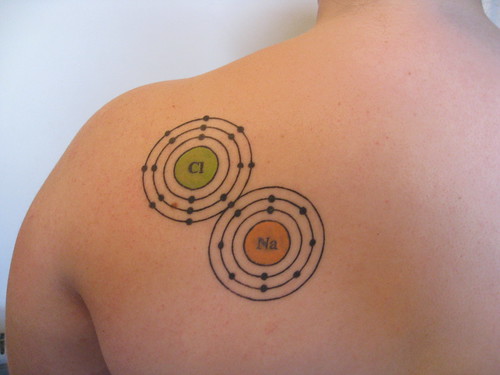
Salt...
Sodium chloride tattoo
source: megpi

...and a smaller tat of a bigger molecule:
Molecule tattoo
source: thiswasmeantforyou

Marrella splendens.
Marrella splendens
source: Anauxite

This isn't quite a science tattoo, but there is an Aperture Science tat:
Valve games 4 life yo
source: vissago

If you're going to go evil, of course, you might as well go ancient incomprehensible evil:
Cthulhu tattoo
source: scragz

Or try to ward it off:
Elder Sign tattoo
source: iamthechad

The Elder Sign within
source: Yabon_Gorky
(If you could get someone to engrave Elbereth somewhere on you too, you'd be pretty much set.)

"It's not the East or the West Side." "No, it's not."
Empire-symbol tattoo
source: katie cowden

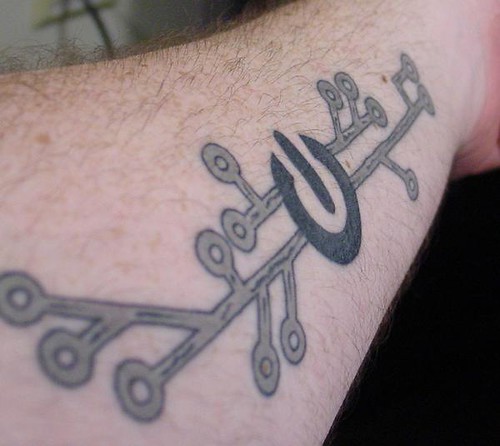
Technical but abstract:
Power symbol and circuit trace tattoo
source: bdjsb7

Hindu Mario!
Hindu Mario tattoo
source: artfisch

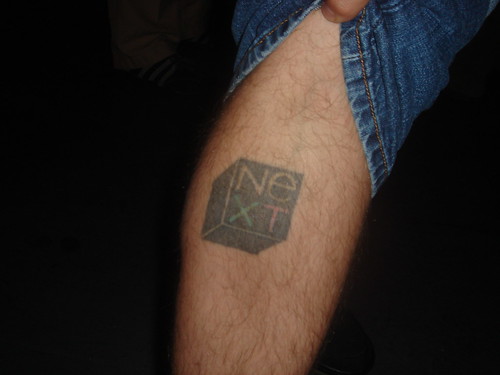
Real computers are magnesium cubes:
NeXT tattoo
source: lantzilla

Ubuntu - but ooh, what a giveaway...
Ubuntu tattoos
source: Myles Braithwaite

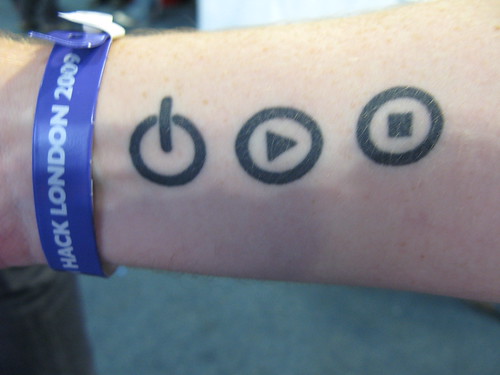
More generic techno-symbols:
Power, Play, Stop symbol tattoos
source: Rain Rabbit

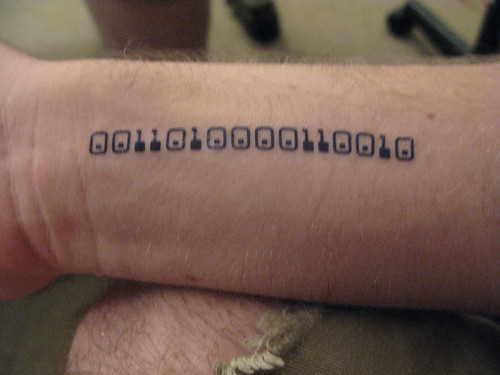
The Answer to the Question.
Binary 42 tattoo
source: sensesmaybenumbed
(That one's actually a temporary tattoo, but it looks good enough to me.)

The BSD Daemon...
BSD Daemon tattoo
source: andyi
...which can be useful for detecting advanced Christians.

The original:
Space Invader tattoo
source: Arkhan

Dammit, Jim!
Bones McCoy tattoo
source: Mez Love

From the same artist:
GOB Bluth tattoo
You gotta be pretty hardcore to successfully rock a GOB tat.

Oh, you're gonna pop a cap in my ass? Then I might just erase your species from history. How you like that, bitch?
Seal of Rassilon tattoo
source: Diamond Geyser
(Another Seal of Rassilon, with further sci-fi and anime tats, here. Also, it now occurs to me that it would be awesome if the Twelfth Doctor was Samuel L. Jackson.)

Reduced to its essentials:
Dalek and TARDIS tattoos
source: HB Art

"NCC-1701. No bloody A, B, C, or D."
Starship Enterprise tattoo
source: hunedx

And the opposition, plus some triangles of no importance.
Klingon tattoos
source: thatgrumguy

And then there's this Romulan spy infiltrating a Gay Pride parade:
Blackwork plus a Romulan Empire symbol
source: djwudi

The Glorious Revolution of Comrade Bushnell!
Ornate Atari-and-star tattoo
source: evil angela

This could just be camouflage for a pool shark.
Nintendo assortment tattoo
source: Fujoshi

A collection of ancient technological talismans:
Green-screen Atari 2600 tattoo
source: fejsez

(You can get geeky temporary tattoos, too. Oh, and if anybody knows where you can buy those fabric fake tattoo sleeves with stuff other than the generic tough-biker or B&W-tribal tats on them, do share. UPDATE: DealExtreme have a bunch of very cheap sleeves now, including a few less-Hell's-Angel-or-pirate options.)

UPDATE: Cracked tells you everything you need to know about tattoos!

Mad Kevin's Crazy Bargains!

This is a bit of a specialised post. It will only be of interest to people who:

1: Are in Australia, and
2: Have an Australian Business Number, OR
3: Are an independent primary or secondary school student, or caring for one or more children who go to primary or secondary school, and meet some other requirements, and
4: Would like to buy new computer gear, or other business-related stuff. Computers only, for the "student" part of the deal.

Everybody else should skip this post. So should people with a short attention span, because I do go on a bit. If you stick with it, though, you could end up paying a substantial amount less tax.

Please note, however, that I Am Not An Accountant, and nothing in this post should be treated as accounting, legal, matrimonial or any other kind of advice. But this is what our accountant told us, and you'd better believe I'm going to take action based on it.

If you meet the above requirements, be advised that the Australian Government, as part of that economic-stimulus malarkey that's suddenly become so trendy, is itching to give you a refund on new equipment of all sorts for your business, and/or computers for the education of yourself or your kids.

It's like a mail-in rebate except, you know, not a scam.

The first deal is called the "Small Business and General Business Tax Break"; the second is called the Education Tax Refund. Each of them allows you to claim a significant amount of money back on eligible expenses.

The Small Business Et Cetera Tax Break is the big news, if you ask me. It gives you a bonus 50% tax deduction, if your business has a turnover of less than two million dollars a year and you pay at least $1000 for some deductible asset.

(If your business turns over more than two million a year, you get a bonus 30% deduction on expenses of $10,000 or more.)

Suppose you buy some tax-deductible business-related thing, like a computer, that costs $2000. Further suppose that you're paying 30% tax on the portion of your income you used to buy it.

Without the Tax Break, you'd deduct the $2000 from your taxable income over whatever period you usually do, and thus get a total $600 ($2000 times 30 per cent) tax refund by the time you've finished depreciating the computer's value to zero. (In most cases, as mentioned on that ATO page, this'll take either three or four years; you can depreciate a laptop computer by 33% per year, or a desktop computer by 25% per year.)

With the Tax Break, you get to deduct $3000 from your taxable income, giving you an extra $300 tax refund, for a total of $900.

To put it another way, 100%-deductible things are now 150%-deductible.

The Tax Break's 50% deduction also, to use gaming parlance, "stacks" with existing deductions. You still depreciate the computer's capital value to zero over a few years, and whatever other shenanigans you've got going with your accountant also still apply. Everything works as it did before, but you get an extra 50% deduction from your initial deductible purchase expenses.

(The only thing the Tax Break doesn't stack with are the previous versions of itself, which worked the same way but gave a lower deduction bonus.)

The Tax Break also applies to any business equipment purchase over the $1000 (for businesses with turnover below two million dollars) or $10,000 (for higher-turnover businesses) threshold.

("Substantially identical" items, or items forming a set, can be grouped together for price-threshold purposes. So if you buy $1200 worth of computer parts from various dealers and assemble them into a PC yourself, you ought to be able to apply the Tax Break to the total price.)

But you don't have to buy a computer to qualify for the Tax Break. Cars, cement mixers, cattle-prods, circus tents; pretty much any capital acquisition that qualified as a business deductible in the first place now gives you 1.5 times the previous deduction (or 1.3 times, if you're in the higher-turnover category).

Business-related computer hardware often seems, of course, to bear a strong resemblance to not-very-business-related computer hardware; a significant number of "educational" computers also seem to be equipped with unnecessarily powerful graphics cards. Where you draw the line is a matter for you, your accountant and your chosen confessor. If something's only half used for business purposes and so only 50% deductible, you can of course still apply the Tax Break to it, provided the deductible portion of the expense is over the $1000/$10,000 threshold.

The Education Tax Refund isn't as exciting, partly because of the requirement that the gear be purchased for the edification of some ungrateful student, but mainly because it only applies to computer equipment and related stuff, like computer repairs, Internet access and so on.

The Education Tax Refund is a straight cash-back deal, though, not a taxable-income-reduction one. You can claim back half of your eligible expenses, up to a ceiling of a $375 refund per primary-school student per year and a $750 refund per secondary-school student per year. You can also roll over expenses above the refund limit to the next year if you're still eligible then.

So if you've got one high-school student and you buy them a $2000 computer, you can claim a $750 refund on the first $1500 of its price the first year, and another $250 on the final $500 of its price the next year.

This is all explained on the Education Tax Refund site and in this very-sensibly-named explanatory PDF. The Tax Office also has a FAQs and Examples page.


The catch

I did a bit of hunting for people criticising the Small Business and General Business Tax Break, to see if there are any pitfalls that've evaded me. The most negative analysis I could find was this post at Dynamic Business.

To answer it point by point:

1: The Tax Break is bad for cash flow. You may be getting a ton of money back, but you only get that money back as part of your tax refund; there's no discount on the actual purchase price of whatever you bought. And you only get the money back in instalments, over whatever period you're allowed to use to depreciate the goods; if something takes many years to depreciate to zero, the benefit per year may be trivial.

If you do your buying before the end of the 08-09 financial year, of course, you shouldn't be waiting very long for at least the first instalment of your refund.

2: If you don't actually have enough cash on hand to buy whatever refund-eligible thing you want to get, you can end up losing money if you borrow in order to buy.

You could still actually end up ahead if you buy a new computer for your small business on your credit card before the end of this financial year, and use the first chunk of the refund to help you pay it off. But if you buy shortly after the start of the next financial year, you will of course not get your first refund-chunk as quickly.

So, you know, don't do that.

(As a general rule, Don't Buy Stuff You Cannot Afford. Video on Hulu here, but not accessible outside the USA.)

3: Some people miscalculate what an additional 50% deduction is worth to them. As the Dynamic Business blogger points out, if you're only paying 30% company tax on your income anyway (or you're not making a huge amount more than the average wage; at the moment the Australian $34,001-to-$80,000 tax bracket is 30%), an additional 50% deductible only adds up to another 15% off the real price of the item. That's nice to have, but not mind-blowing, especially when you have to wait a few years to get it all.

So, uh, yeah - 50% higher deductible doesn't mean you get half of the purchase price back. Sorry about that.

(But the Education Refund does work that way, up to its ceiling.)

4: The Australian car industry really wants the Tax Break to persuade you to buy a vehicle. Or several vehicles. Also, you have to make sure the car is registered to the entity claiming the deduction, blah blah blah, Fringe Benefits Tax, blah.

Don't buy even one new car, if you don't need a new car.

Aaand... that's pretty much it for the Tax Break's down-side.

The Education Tax Refund has, as I mentioned above, other restrictions and ceiling deduction amounts. The only further "catch" I can see for it, though, is that the Education Refund doesn't "stack" with other deductions. If the computer you're buying for your kid is also the computer you're buying for your home office and thus tax-deducting, you can't claim the Education Refund on it to whatever extent you've claimed some other deduction or refund on it. (So if it's a $2000 computer, and you're claiming it as 50% for your home office and thus deducting $1000 from your taxable income, you can only claim a maximum of $500 Education Refund on it. But if you've got an ABN, you could apply the Small Business Tax Break to the business deduction!)

The Education Refund will be similarly reduced or eliminated by any other tax offsets, reimbursements, payments, kickbacks, hush money, or cash flung at you by a weeping tax officer you've just forced at gunpoint to dig a shallow grave out in the bush.


Is it worth it?

If you're wondering when you should buy computer equipment, the answer is almost always "later".

Wait as long as possible before buying new IT gear, if your old gear isn't actively impeding your ability to do business. Everything gets cheaper and faster with each passing week. And the current incarnation of the Small Business Tax Break will keep running for any purchases made before the end of the 2009, so you don't have to leap into action and buy new stuff right now. Unless, of course, you'd like to reduce this year's taxable income, as well as next year's.

The Education Refund offers, in return for its more annoying conditions, better value within its limits. If a new computer was going to be completely non-deductible in any way at all, as is usually the case for ordinary consumers, and if you meet the criteria for the Education Refund and have enough kids of the appropriate age to cover the cost, you really could get that computer for half price.

If you've been seriously considering getting new gear anyway, the Small Business Tax Break's 50% bonus deduction is quite substantial, too. The government isn't giving you the extra refund at the time of purchase, but they really are giving you - OK, to be completely accurate they're giving you back - that much money.

(The size of the bonus deduction depends, of course, on what tax rate you're paying on that part of your income. As I mentioned above, Australian individual tax brackets currently top out at 45%; company tax, which may well apply to people claiming the Tax Break, is a flat 30%.)

Computer shops all over Australia, including m'verygoodfriends at Aus PC Market, have been seeing a drop in sales in recent months. Australia's economy seems to be in decent shape and doesn't look likely to follow the USA down the plughole, but people have still been putting off buying new stuff until they're sure they won't have pawned it and moved into a cardboard box under an overpass by this time next year.

If you've achieved that small level of personal financial confidence then I, in my capacity as a person entirely unqualified to give taxation advice, strongly recommend you accept the Government's gift.

I certainly will.

(Once again: I'm not an accountant. Please don't sue me if there's anything wrong with the above. Do please talk about this in the comments, but contact your own accountant if you need authoritative answers. There's also a "Business Tax Break Infoline" at 1300 337 921.)


Wayne Maber of Maber Business Services is our accountant, and helped me to understand all this.
Posted in Money. 4 Comments »