A bit more lasing

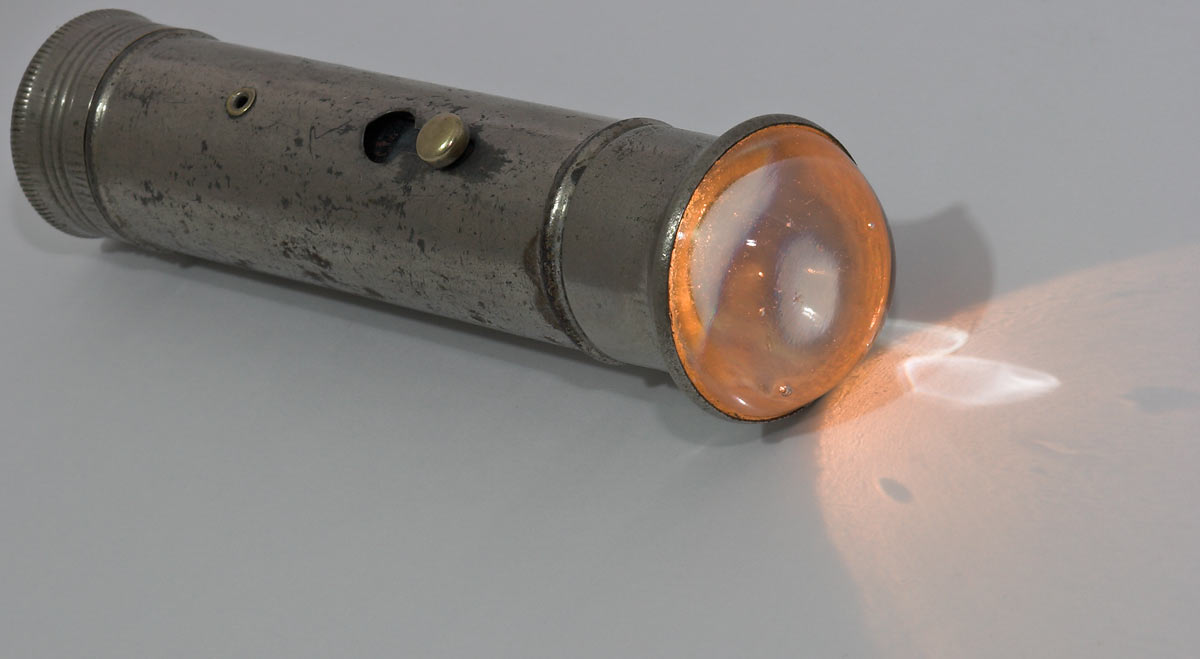
Herewith, the previously mentioned 350mW laser, this time assaulting some plain brown paper. You don't have to hold the dot very carefully still to burn the paper away, or even get it smouldering.

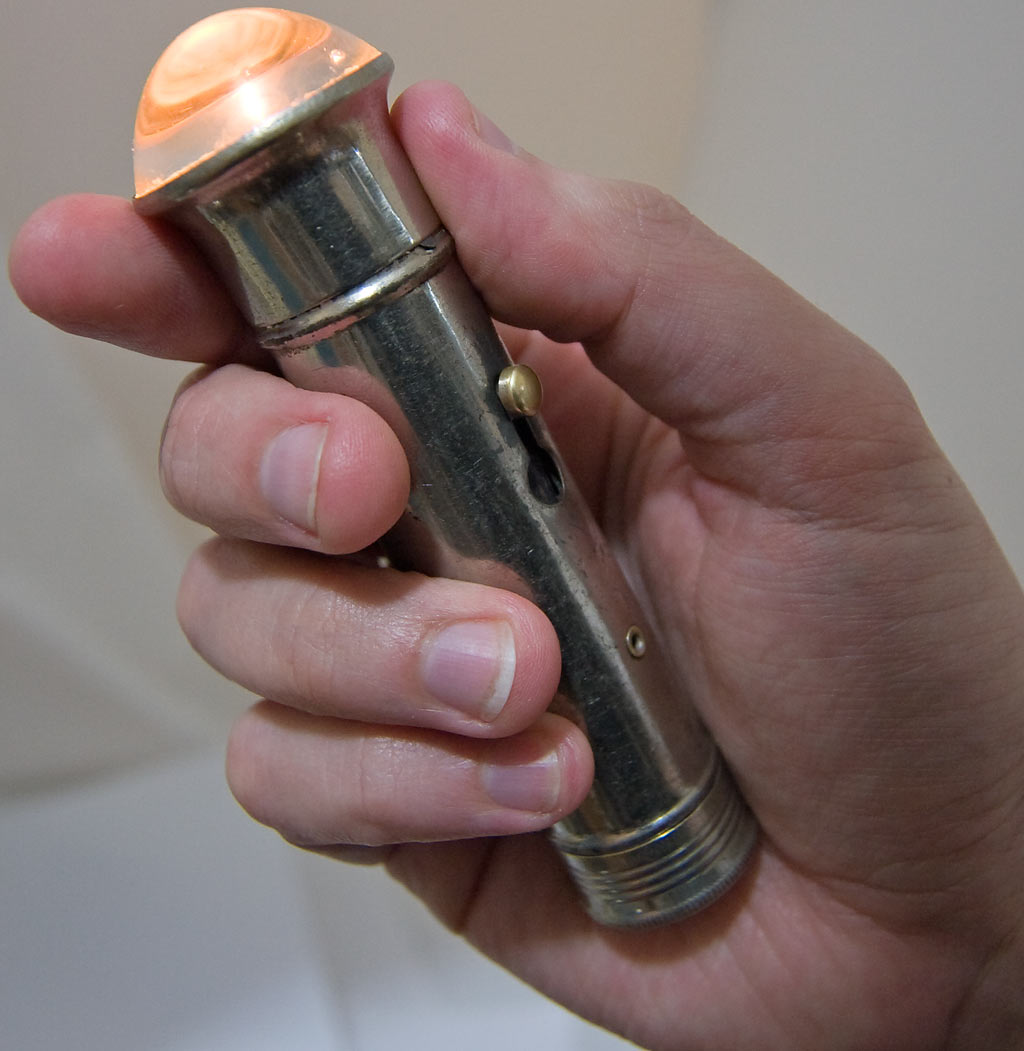
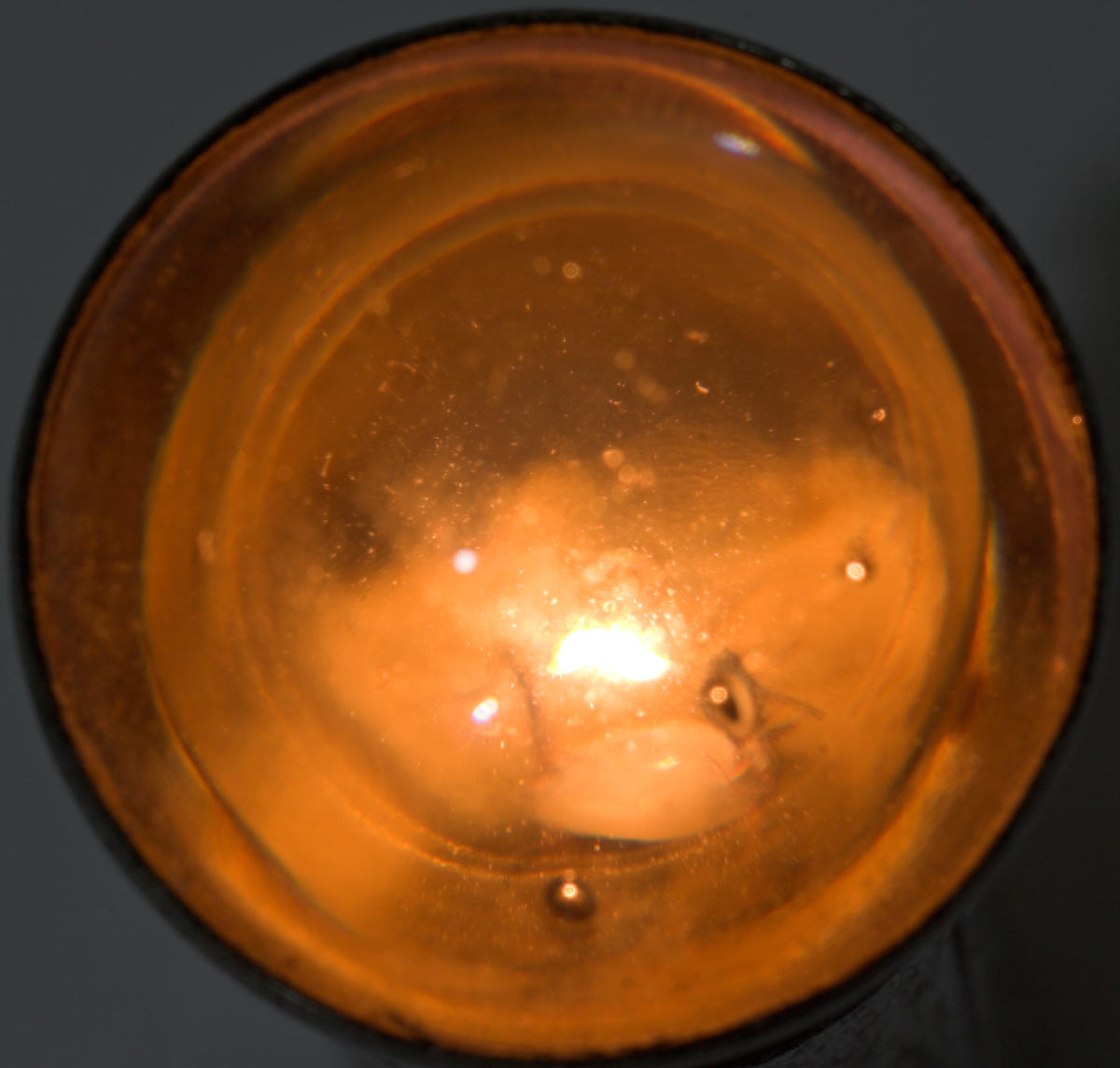
The brown paper looks like red paper because I put a red gel (some of the large amount of Primary Red that I had left over after making a couple of pairs of Bill Beaty's IR goggles) over the lens.

Without the gel, the super-bright dot would have made it very difficult to see what was going on, just as it does in the match-lighting clip.

(Yes, at some point I'm actually going to finish a review of this alarming device, not to mention the two other models that Wicked Lasers/Techlasers sent me.)

Avian nominative bathos

Here in Australia, we're famous for giving things, places and creatures goofy names.

I mean, just pick one letter. Wagga Wagga. Wallabies. The Wollemi Pine. Wollongong.

(And when Monty Python did their sketch about the Bruces from the University of Woolloomooloo, Australia, the silly-named place they chose was actually not some tiny town in the boondocks, but a spot in the middle of Sydney.)

Bird Of Mystery

So, when a rather rotund bird I'd not previously seen showed up at our feeding table, I was optimistic.

Bird Of Mystery

Surely, this plump creature with its habit of thrusting out its neck comically would have a ridiculous name.

Could it, perhaps, be a Wonga Pigeon?

Wait - perhaps it was a Wompoo Fruit-Dove!

But then I found out that this white-headed pigeon is actually... a White-headed Pigeon.

Oh well. Can't win 'em all.

Bug zapping

No video this time, but I have a provisional answer to the question I'm sure you've all been asking:

Can you kill an insect with a 350mW laser?

Well, I just managed to shoot a cockroach off the wall.

The bug clearly didn't like the beam on its body. It wasn't possible for me to hold the beam still enough to just burn the roach's head clean off (350mW will burn most plastic just about instantly, and is clearly powerful enough to incinerate a bug's head, but only if you hold the beam still on the target for a moment). But after I'd shot the roach for several seconds it fell off the wall, into the grasp of the rather intrigued cats.

(Who then probably juggled it for a bit and then lost it under the fridge, or something. They're not exactly killers.)

I don't think the beam had actually damaged the roach enough that it had to fall off the wall; I think its little flowchart brain had just decided that it was being exposed to fire, or something, and should therefore engage its emergency drop-to-somewhere-safer subroutine.

I await the arrival of a mosquito with interest.

Forging ahead

The Forged Alliance expansion pack for the CPU-gobbling Real Time Strategy monolith of the moment, Supreme Commander, is rather good.

A couple of Ythothas. Or Ythothae.

First up: It's a stand-alone game. And not a terribly expensive one - sixty Australian bucks delivered from eBay dealers like the one I used, forty US bucks from Amazon).

If you only have Forged Alliance and not the original Supreme Commander (now only $US29 at Amazon!), you can still play multiplayer games against anybody else who has Forged Alliance, with or without SupCom. But the only side available to FA-only players is the new one, the weird alien Seraphim.

That's not necessarily a bad thing. The Seraphim, once you get past the bizarre names and shapes of their units, are actually simpler than the other three sides. They've got slightly fewer units available, but what they have combines the features of multiple enemy units.

So, for instance, they've got a very annoying "combat scout" unit, which has the wide view and radar coverage of everybody else's scouts, plus a decent gun (the other scouts either have no gun at all or a gun that does nearly no damage), and an automatic cloak feature that makes the scout almost completely undetectable if it's told to "hold fire" and doesn't move.

Forged Alliance's typically lousy storyline revolves around the Seraphim, whose weirdly-named units all look fantastic (those giant chicken-walkers in the picture above are "Ythothas". Or possibly Ythothae). Often asymmetric, always shiny, and usually with some parts that just hang there in the air with no connection to the rest of the machine.

This ultra-tech does raise the question of why the Seraphim units are roughly equal in power to those of the three human sides, but the answer to that is of course "because otherwise there wouldn't be much of a game".

FA has a short, but rather difficult, single player campaign in which you can play any of the three original sides against the Seraphim. (I, of course, would have rather liked the opportunity to play the Seraphim in the campaign and crush the miserable hominids, but we don't always get what we want.)

Forged Alliance is not just a unit pack. The whole game's been dramatically rebalanced, so if you've never played SupCom before you may be surprised to find yourself actually winning against someone who's been playing for months, but is now trying to do the same things they did in the original game.

It is, for instance, no longer economically sound to build vast resource farms full of generators and mass fabricators. Massfabs are much worse value than they used to be, so you can't just button yourself up in a self-sufficient base and not bother trying to control territory.

And veterancy - units getting tougher as their kill count rises - has been dramatically revamped. You used to practically never see a veteran unit except when something got to shoot at a factory that had a long build queue, so the attacker got credit for a kill every time it blew up the latest 1%-complete unit-in-progress. Now, most units get their first veterancy level - and some more hit points, and slow hit point regeneration - at five or ten kills. Little level 1 units veteranise even faster.

What this means is that, although tech-level-one units are more useful in FA, it's now a very bad idea to just spam hordes of tech one tanks at the enemy base. The defenders, including the enemy's all-important Commander, will very rapidly become rather buff at your expense.

(All we need now is Kingdoms-style gold highlights on veteran units!)

People are, of course, still finding things to bitch about, most notably the fact that FA is an even bigger system hog than "vanilla" SupCom, even after you turn off certain features that really pound frame rate down.

Pretty much any dual-core CPU and moderately recent video card is good enough for small multiplayer games of FA at reasonable resolutions (on one or two monitors!), though, so this isn't a You Must Upgrade Your One-Year-Old Computer game (like, say, Crysis).

I recommend it.

My new favourite flashlight

There are quite a lot of flashlights in this house.

So, of course, I had to go and buy another one.
Old flashlight in hand

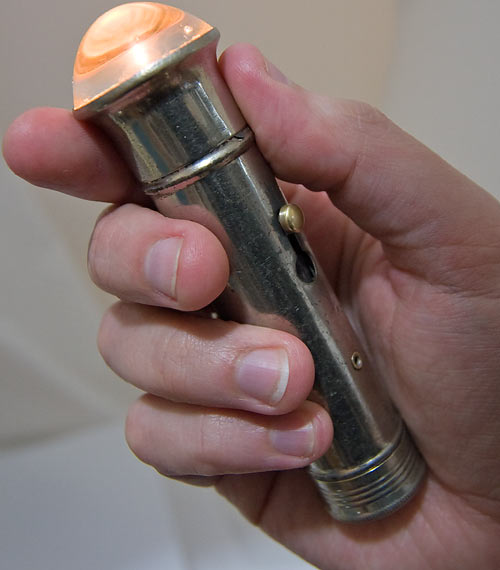
It only cost me ten bucks from this eBay seller. And it's possible that it's actually a genuine antique.

Which is a bit unusual, for an electrical device. Especially one that works.

The generally accepted definition of an antique is something at least a hundred years old, and flashlights that looked much like this one certainly were on sale a hundred years ago.

The first portable electric lamps appeared in the last few years of the nineteenth century. The first commercially successful one was the boxy Acme Electric Light, in 1896. But the easier-to-hold tubular flashlight was first sold commercially, by one Conrad Hubert's Ever Ready Company, in 1899.
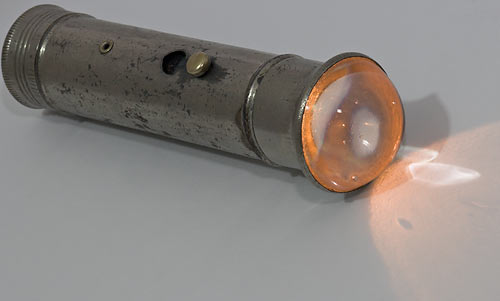
Old flashlight

This light probably isn't nearly that old, but it's still got the thick "bullseye" glass lens that all tubular flashlights had for the first decade or so of their existence.

(If you ask me, "bullseye lens" should only be the term for the concentric-circles fresnel lens, as seen in lighthouses and stage spotlights. This kind of flashlight lens could more correctly be called a "dome". But "bullseye" seems to be the most common term. "Walleye lens" seems to be another term for the same thing.)

The bullseye lens was not a good design.

It's either planoconvex (flat on one side, convex on the other) or, as in this case, slightly concave on the inside and much more convex on the outside. Either way, the lens gives the flashlight a very broad beam.

The beam width is at least 60 degrees, for this light, and it has no central "hot spot" at all. It's quite unlike the output of the more usual kind of incandescent-bulb flashlight, with a thin flat lens on the front and a relatively large reflector around the bulb.

A super-wide beam is great for seeing where you're going, but useless for seeing anything at a distance. This was quite disastrous for flashlights a hundred years ago, because they weren't very bright at the best of times.

This light was probably made to take a tungsten-filament bulb, but those weren't very efficient until the coiled-coil filament was introduced in 1936. Earlier still were the even dimmer, more fragile and rather inconsistent carbon-filament bulbs. And the old batteries had lousy capacity, and lousy current delivery, too.

So overall, old flashlights needed all the light-concentrating help they could get.

But instead, everything that wasn't big and boxy like the Acme Electric Light got a fish-eye lens.

It's been postulated that the bullseye lens was so popular for so long because consumers thought it concentrated, rather than dispersed, the light from the bulb. At a glance, you might think that - look at the bulb through the lens and it appears huge, just as it would if it were in the middle of a big reflector.

But with a bullseye lens, the bulb appears huge from every angle, because light's being thrown everywhere.

I suppose people were accustomed to wide-angle illumination from fuel-burning lanterns. The flame from a lamp with a wick is too large a light source to be effectively concentrated by a reflector of readily carryable size, and there are further problems with just getting a reflector in there, next to a hot and possibly smoky naked flame.

Directional lamps did have reflectors - miners' acetylene carbide lamps are an excellent, and surprisingly practical, example - but they still threw a very wide beam.

(Which, in the case of the carbide lamp, was quite respectably bright even by modern standards. A small "helmet" carbide lamp can easily throw as much light as a five-watt incandescent bulb, and it could do it for several hours. Five watts for five hours is 25 watt-hours; that's about the same amount of energy as you'd get from two modern C alkalines. Carbide lamps are little more than a hundred years old; they were quite revolutionary in their day, and far superior in light output and safety to kerosene or other oil lamps. Carbide lamps were still perfectly capable of burning your house down, though; you could only do that with the new-fangled electric lights if you really tried.)

Bullseye-lens flashlights hung around long after the common availability of modern large-reflector, flat-lens lights - note the Prohibition-era hip flask in the shape of a bullseye flashlight here. So it's quite possible my little light is only about seventy years old. That's still pretty impressive for a device that's still useful today, though.

A nice one of these lights would be an Eveready Daylo, or something. This one's a brandless version with no decoration, cheaply made from sheet metal, so it's probably worth nothing to a collector.

Like other lights of this size and vintage, this flashlight wants a weird battery - a 2R10 "Duplex" or "2B". That's a three-volt, two-cell battery that's apparently about 75 by 22 millimetres in size, and still available today, if you're really dedicated and/or willing to take apart another battery. The 2R10's dimensions make it quite magnificently incompatible with every common battery today.

A 75mm-long battery must have been a pretty tight fit in this light, though, because it turns out that a modern 18650-size (18mm wide, 65mm long) lithium cell fits very nicely, especially if I screwed the bulb all the way in.

But, to do that, I did need a bulb.

The bulbs this old light uses, fortunately, are quite standard. They're the same miniature Edison screw (MES) type that survive in small cheap lights today. (Though no doubt not for much longer, since LEDs are now clearly superior.)

An odd flattened-bulb vintage MES lamp came with the flashlight, but of course did not work any more. I had a cheap push-light doodad sitting around waiting to have some RGB LEDs put in it, so I harvested the bulb from that. It was meant to run from four 1.5V cells and so should have been reasonably bright from the roughly four volts of the 18650 cell, but it was actually quite dim, and died after not many minutes of use.

So I got an Eveready MES bulb for "5D" flashlights, rated at 0.3 amps at 6.2 volts, and tried that. The flashlight's much brighter now, though it's probably running its bulb at rather less than half of its 1.9 watt rating.
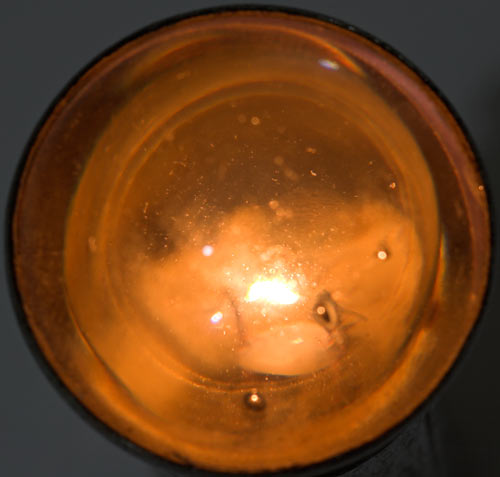
Old flashlight lens

The low voltage makes the flashlight's output very yellow, which I find quite pleasing in this age of blue-white LED flashlights. The light colour's probably quite similar in hue to the light from its original lamp, but brighter. It's perfectly usable as a night-time seeing-where-you're-going light.

I wasn't expecting it to be this easy to make this light work. I thought I'd have to hack some LEDs into it, or something. But it turned out to be easy to fix, in a more authentic manner.

It's been foggy, lately, and now it's getting dark. I believe I may procure myself a Webley revolver, and sally forth with my newly purchased "hand-torch" to investigate the night-cult that drunkard spoke of in the inn, before his fellows silenced him so brutally.

I'm told that a torch whose light is feeble may be a blessing.

There are things which are best not clearly seen.


Buying one

The eBay dealer I bought my bullseye-lensed flashlight from now seems to be dormant, but similar items show up on eBay pretty frequently. They can be a pain to find, though.

This search right here finds anything that could be a real old bullseye flashlight and filters out a lot of useless results, but it's not quite the same as the actual search I've got saved and sending me e-mails just in case a cheap light even prettier than the one I've got shows up. That's not because my search is a trade secret, but because there's a limit to the length of the search string you can link to via the eBay affiliate thing. The full search string, for your cutting and pasting pleasure, is:

(old,vintage,antique) (torch,flashlight) -paisley -"pipe lighter" -"torch green lighter" -"green flame" -"torch lighter" -blow -heat -kero -kerosene -kerosine -projector -patent -bulbs -pin -pins -bearers -guitar -spirit -blowtorch -cutting -bead -"ornamental lighter" -"ornamental gun"

To throw an even wider net, it's easy to search for flashlights in the eBay "collectibles" category (here on eBay Australia and here on eBay UK, both with the added search term "torch" to find Commonwealth-usage listings and clutter the results with ancient rusty dangerous blowtorches). But the results in that category aren't very good; you get a lot of brand-new LED lights and plastic crap from the Seventies. People selling bullseye-lensed lights unfortunately seldom describe them with a handy searchable word like "bullseye" or "dome", so you pretty much just have to scan the thumbnail pictures until you find one.

Do the same search in the "antiques" category (here on eBay Australia, here on eBay UK; I've left "torch" off the search string this time to avoid zillions of hits for tiki torches and candelabras) and and you'll find a lot more genuinely old flashlights. "Antique" bullseye-lens lights that aren't just a pile of rust with a lump of scratched glass in the middle, though, are generally pretty expensive.

Some of them are very beautiful, though. The "bicycle light" type that's a wooden box with a handle on top and a lens on the side is particularly appealing, especially after a dab of wood polish. Box-lights usually have plenty of room inside for modern batteries and lamps, too, so you probably won't even need to disturb the dreams of the world's flashlight collectors by destroying the old fittings in order to shoehorn in a pink LED and lithium battery.


DirectX redux

So, I've got that DirectX Acceleration Not Available problem again. DirectDraw Acceleration, Direct3D Acceleration, AGP Texture Acceleration; all Not Available. Direct3D was available until I tried turning it off in dxdiag, then ran dxdiag again to see if all of the options were back.

Nope, that trick doesn't even work once, any more; now they're all gone. Again. Graphics card allegedly has "n/a" memory on it, et cetera et cetera.

The last time this happened I tried all kinds of things, not a one of which worked, and ended up reinstalling Windows. But somebody mentioned that this was exactly the kind of problem that Windows XP's System Restore (which I of course did not have turned on) was created to solve.

So in this Windows installation, I left System Restore turned on. And when DirectX screwed up yesterday, I used System Restore to roll the system back to its status of about a week ago.

And hooray, the problem was solved!

For about twelve hours.

I'm not crazy about the idea of restoring my system to that save point once a day for the rest of my life. I can see no other option, though, unless I get a whole new computer. I know for a fact that cleaning out all of the drivers and DirectX files before reinstalling will not help at all; all that does is take a long time and require a large number of reboots.

Perhaps a new video card would do it. This GeForce 7800 GT is pretty old and dusty; perhaps the problem does in fact have something to do with the video card failing some kind of obscure internal test, as when hard drives drop back into PIO mode.

The graphics card does still work just fine, as far as I can see; 3D mode is A-OK when DirectX is, you know, working, and OpenGL 3D is A-OK even now. I just ran OpenGL Quake 2; everything's fine, and the video card fan ran up to higher speed as it's meant to.

But perhaps the card didn't give Windows the right password yesterday, or something.

I could try digging up another graphics card, but I haven't another PCIe card in the house, and this computer's too young to have an AGP slot. So I'd have to find some ancient PCI card, and I think the only one of those I've got is in the file server.

God damn it.

Trial by press release

Magic fuel pill vendors Firepower have decided to deal with the gathering storm regarding their claims about major contracts that do not exist, their string of previous similar scams, the criminal connections of their principals and the Australian Securities and Investments Commission investigation of their operation by... issuing a fresh and shiny new press release!

In it, they've basically just restated their previous claims about how "the Fuel Pill showed an increase in the octane rating of fuel, thus leading to an increase in power, faster burn...", blah blah blah, which seems to me to be a fundamental misapprehension of what octane rating actually is.

I, and others, have held forth on this subject on previous occasions. It's easy to boost the octane rating of fuel by adding all sorts of substances to it, but all you get in return is the ability to use said fuel in a higher compression engine. In essence, if the fuel worked OK in your engine before, raising its octane rating will do pretty much nothing.

But fuel "improver" vendors persist in using "octane" in its generally popular sense as some sort of overall measure of the "powerfulness" of a fuel.

But the new press release goes on. It includes a quotation from one Dr Stephen Hall of the University of New South Wales, who is a real person who may or may not have wanted Firepower to quote him in support of their claims. And then it says they received an Award for "Innovation in Fuel Technology 2007" from the UK "Institute of Transport Management", who, if this is accurate, I can only surmise will be feeling like right Charlies shortly.

A longer and less cheerful version of the press release is on Firepower's site here. In that version, Firepower actually mentions the "controversy" over minor details like the fact that Firepower's business looks exactly like that of numerous former fuel pill scam artists, and the fact that Firepower's principals have run the same scam before, in New Zealand.

Among other entertaining points, the expanded press release reveals that the Firepower pill is only even claimed to increase octane ratings by "around 0.3%". In the best case scenario, you could expect such a change to make a difference in engine power of about half of one percentage point. And that's when the engine is heavily loaded; for everyday driving, the difference would be even smaller.

There's also mention of a Heating Value test in which one Firepower pill somehow managed to give sixty litres of petrol 1.09% more combustion energy. Not that this'd make any significant difference for a car either, but I'd like to see that one replicated - or just duplicated on the same equipment a few times, to see what the test rig's error margin was.

e4b48fd541b3dcb99cababc87c2ee88f = elephant

This post on the Light Blue Touchpaper blog tells us all yet another thing we can do with Google:

Find a password, if our l337 h4XX0r skillz have already allowed us to harvest the MD5 hash for it.

The completely stupid way to store passwords, implemented by small children writing programs in BASIC and by $300-an-hour consultants writing enterprise software, is to just save all of the usernames and matching passwords as plain text in a file somewhere. If an attacker can read that file, they can now log in as anybody.

A much better, but still not as secure as it should be, method of saving passwords is to "hash" them using a "one way" or "trapdoor" algorithm, like MD5. A trapdoor algorithm runs very quickly in one direction (turning a password into an almost-unique string of seemingly random characters), but is almost impossible to run the other way, if you don't have access to cubic kilometres of sci-fi nanotech.

If someone gets hold of the file in which you store password hashes, the one-wayness of the hash algorithm means the attacker still can't figure out what passwords correspond to what hashes, and so cannot make use of his discovery.

Well, that's the theory.

In practice, attackers can take a dictionary of passwords, hash them all, then search for matches between their new hash dictionary and the password hashes. There are even helpful online tools that'll do it for you, like the long-established passcracking.com/ru, or md5oogle. When there's a match, you've got the password.

And this is what Google allows you to do in two seconds, if the password hash you're trying to "reverse" corresponds to a common word.

The word "elephant", for instance, hashes to e4b48fd541b3dcb99cababc87c2ee88f. Search for that in Google and you'll get a bunch of pages which, for reasons explained in the Light Blue Touchpaper post and its comments, often also have the word "elephant" on them, or right in their title.

(This post will probably be very high in those search results in a day or two. Check out the above-linked online reverse MD5 hash lookup tool if you'd like to explore other options - it lets you hash any string you like, then checks some databases for it. While it's checking, you can be Googling the same string. Md5oogle lets you generate MD5 hashes as well, but it converts everything to uppercase first - which many password systems also do.)

This technique only works for passwords that're common words - or, at least, have for some reason been hashed and stored in a Google-visible file. If your password is something nonsensical like dj347F, which hashes to 54041c87e2e431f3fc4c47e55d114ef3, the hash won't be found anywhere on the Web (except, again, on this page, once Google indexes it).

This technique also doesn't work if the passwords are "salted" with some extra data before being hashed. So if a user foolishly decides to choose "mypassword" as his password, the software actually hashes, say, 28391mypassword, and thus creates an un-findable hash.

Adding a simple fixed salt to every password still doesn't give you really industrial-strength security, but it's streets ahead of a lot of the junk that makes it to production. And it does stop dumb attacks like Google searching - well, at least until people find out that MurderDeathKill 3D's online gaming logon system just adds 28391 before hashing passwords, and start making tables of dictionary words with 28391 in front of 'em.

Lots of current popular software uses unsalted hashes, including the WordPress software that runs this blog.

So it's pretty lucky that I made my admin password "3hv78UEr", isn't it?