New Nvidia drivers: Worth having.

I just installed the brand new v163.71 Nvidia drivers (the last non-beta release was v162.18), and benchmarked Supreme Commander before and after. There's a small but significant improvement.

I'm tired of seeing articles about AMAZING NEW DRIVER IMPROVEMENTS OMG and then discovering that there's only any difference if you're using a GeForce 8800 on Windows Bloody Vista.

I've got a 32-bit-WinXP computer with a 2.2GHz (at the moment) dual core Athlon 64 and a 256Mb GeForce 7900 GT.

That's probably still faster than the average, but it's pretty far from the current cutting edge. (Only two cores, dahling? However can you cope?)

Driver tweaks aimed at the super-expensive dual-slot super-cards won't help me at all. I'm guessing that they won't help most of you, either. Tweaks that help a GeForce 7900 ought to be some use for various other current affordable Nvidia cards, though.

I've also got an effing big monitor, so I ran the tests in 2560 by 1600 resolution. That's practical for fullscreen Supreme Commander if you've got some flavour of 8800 (ATI aren't really in the very-high-end race at the moment), but it's actually very playable if...

Supreme Commander at 2560 by 1600

...you split the monitor between the normal view and the easy-to-draw topographic-view map.

Running the standard "perftest" benchmark in that resolution guarantees, despite Core Maximizer, that the game will be video-card-limited most of the time.

The Supreme Commander benchmark reports total frames rendered, "sim" performance (how fast the game calculates everything-but-graphics), "render" performance (graphics alone) and a "composite" score that roughly represents overall performance.

In this graphics-heavy test, my "render" result increased by nineteen per cent with the new drivers. The giant resolution and less-than-incredible video card meant that, in the peculiar jargon of the perftest benchmark, the "render" score only improved from minus 1029 to minus 863. But trust me, that's still good.

The logged-frames difference was +0.7%, which probably means less than experimental error and definitely means nothing you'd ever notice. The sim score improved only slightly more, at +1.6%. But the composite score improved 4.7%, from 5794 to 6065.

You probably wouldn't actually notice that in play - it's a general rule of thumb that differences of less than ten per cent aren't noticeable. But almost five per cent is not a bad improvement to get for free.

Complex Supreme Commander games are almost 100% CPU limited. Smaller games, though - and even complex games when you can't see much of the enormous map you're playing on - don't give your graphics card much time to breathe, especially if you've taken advantage of SupCom's still-rare ability to make use of a second monitor. So I don't think I'm lying with statistics, here.

(I'm not, to be fair, actually playing much Supreme Commander at the moment. I got ETQW yesterday, and intend to Strogg 4 Life for a while before getting back to the direction of vast robotic armies.)

Seam carving comes home

The remarkable "seam carving" image resizing technique that I and everybody else posted about a month ago has now been implemented in at least two ways.

First, there's the Liquid Rescale plugin for GIMP.

[UPDATE: Picutel's "Smart Resize" is a Photoshop plugin that does the same thing. You have to buy the full version if you want to work with images bigger than 640 by 480, though.]

Rsizr

Second, and much more interestingly for casual dabblers, is rsizr.com (of course).

Rsizr lets you watch the seams being carved before your very eyes in a Web browser.

It's not the fastest process I've ever seen, since this is a rather computationally intensive technique (since it's doing it in Flash, I suspect it may be based on one of the open-source ActionScript seam carving implementations mentioned here). If you want to mess about with Rsizr, I therefore recommend you use images no bigger than 1024 by 768, even if you've got a firebreathing computer.

Note also that after you've done the seam-carving, you still have to click the image and drag its border to actually resize it. Well, I think you always have to do that; Rsizr's pretty much documentation-free at the moment.

But it definitely does work.

Original image

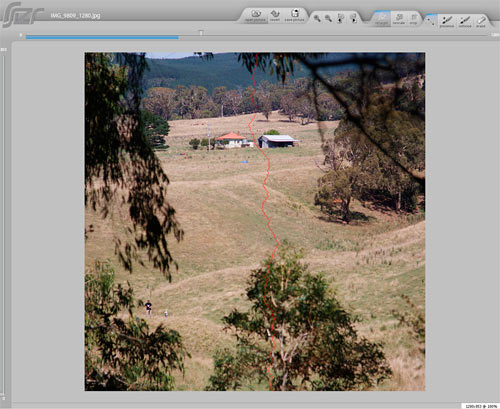
It allowed me to turn this 1280 by 850 pixel original...

Seam-carved version

...into this 855 by 640 pixel version. Click the images for full-sized versions.

The reduced-size version now has rather cramped composition, and the terrain looks a lot more hilly than it really was. But all of the major image elements - the sharp trees, the two buildings, the man and the boy - are preserved almost unchanged. They're just closer together than they were.

The rsizr.com server's being hammered a bit at the moment, so the "Save" function takes rather a long time to work. It's easy enough to get around that, though - once you get your image the way you want, just take a screenshot of the window and cut the image out of it.

(I presume there'll be a decent free Photoshop-plugin image carver Real Soon Now. In other news, one of the guys who came up with the idea has been hired by Adobe.)

My very own digital pepper-mill

You know those people who gloat insufferably about how they were in a junk shop in Chickenmilk, Wisconsin, and they found a 1933 Leica or Amazing Fantasy #15 or something for $5, and aren't they clever?

Curta calculator

Well, I scored myself a Curta calculator for forty Australian dollars.

And yes, it was in a junk store, next to the usual random collection of broken cameras and mildewed binoculars.

(When the junk shop owner names a price and you immediately smile broadly and say "Sold!", they know they've screwed up.)

Mine is not an incredibly collectable Curta. It's a Type I with serial number 67087, which makes it an early 1967 unit, with plastic crank and storage case but (slightly unusually, I think) a metal "clearing ring".

Unfortunately, the actual finger-loop part of the clearing ring - the part that adds an element of hand-grenade-ness to the otherwise pepper-grinder-ish look of all Curtas - is broken off...

Curta calculator fisheye

...perhaps because it sticks out when you don't swing it into the stowed position.

And there's no manual either. But it's still easy to twirl the top around to clear the readings, and everything else (including the carrying case) is in excellent condition. It's in perfect working order and clean as a whistle.

Intact Curtas regularly go on eBay for $US700 or more - they're somewhere between slide adders and Fuller Calculators on the mechanical-calculator-collector expense scale (I don't think Enigma machines really count).

So I reckon this still has to be a $US500 item, at least.

(I'm not itching to sell it, but if you're willing to pay top dollar, especially if you're in Australia, let me know.)

The actual practical value of a Curta calculator today, as opposed to its collectible value, closely approaches zero. It's not actually very difficult to use a Curta - for basic calculations, at least. But, like books of logarithms, Curtas have been made about as completely obsolete as is possible by electronic calculators.

Pretty much any electronic computer at all is hilariously superior to the finest hand-cranked calculator ever made. You have to try quite hard to make electronic calculation more obscure than mechanical.

The standard slide rule and its various specialised derivatives still have a place today as an inexpensive and durable rapid estimation tool. But Curtas were never cheap, aren't very tough, and don't let you quickly eyeball a multiplication or logarithm. Don't even ask what you have to do to calculate a square root.

This functional omission is at least partly by design, of course. People whose needs were already served by a $5 slipstick certainly weren't going to spend $US850 in today's money on a Curta.

I could go on, but there's little I could say about Curtas that Clifford Stoll didn't say in his 2004 Scientific American piece about them. Find plenty more resources at curta.org and vcalc.net.

(Original PDF here; it's one of those weird ones that looks like crummy scans overlaid by what looks like OCRed text, which you still can't search. Does anybody know what the deal is with such files?)

MakeMyMovieLessHorrible.com

Today, I received a press release whose title was "FixMyMovie Launches with James Bond-Style Video Enhancement".

This did not fill me with joyous anticipation. "Video enhancement" is one of those ridiculous action movie cliches - any old security camera footage can be "enhanced" to hundred-megapixel detail whenever it's necessary to move the plot along.

FixMyMovie does not, however, actually make such stupid claims. It would, in fact, probably be perfectly useless to James Bond.

What it aims to do is apply MotionDSP processing muscle to low quality video, to make it better looking without losing detail. At the moment you can make a free account on fixmymovie.com and upload any video clip smaller than 352 by 288 pixels in resolution and 20 megabytes in file size, and see what transpires.

So I did.

When I reviewed the Aiptek Pocket DV2 toy digital video camera back in early 2003, I strapped it to the top of a model tank and took it for a drive around a park. The Pocket DV2 produces grainy, fuzzy, nine frame per second 320 by 240 video, which is pretty much on par for cheap phone cameras these days. FixMyMovie is specifically designed to enhance phone camera video, so I figured one of the Aiptek clips would be a good sample.

Here's a Google Video version of the clip. [UPDATE: Now moved to YouTube.] Video of this quality is one of the few things that GooTube compression won't make a whole lot worse, but it's still lost some quality; you can download a DivX-compressed version of the original footage, which looks almost exactly the same as the original Motion JPEG video but is quite a bit smaller, here.

Here's the FixMyMovie-d version. If you can't see it, you probably need the latest beta Flash plugin. [UPDATE: This post is years old now, and the above FixMyMovie player code doesn't work any more. The YouTube version of the stabilised video is below.] If you've got the right plugin already, you've probably noticed that the FixMyMovie player currently has a MySpace-style auto-play function, which you can't turn off. Sorry about that.

The difference really is quite impressive. FixMyMovie has gotten rid of the prominent blocky compression artefacts in the original video, without noticeably blurring it. It's not an amazing, incredible, action-movie-bulldust improvement, but it's very worthwhile. Rapid camera movements - an acknowledged weakness of the enhancing technique - leave noticeable ghosts from previous frames. But they're only noticeable if you're trying hard to see something wrong with the video. The improvements far outweigh the problems.

The deal with FixMyMovie - once it leaves its current beta state - is that it'll only enhance the first ten seconds of any clip for free. If you like the look of it you can "Order" a fully processed version, which will cost money - 99 US cents, to enhance this clip.

(It took quite a long time to process this clip, presumably because people are already hammering the FixMyMovie server. You get an e-mail when processing is finished, though, so you don't have to sit there refreshing the My Videos page.)

At the moment, you get $US25 credit when you create a free account - and no, you don't have to give them a credit card number; use a disposable e-mail address if you're really paranoid. $25 should plenty to try the service out.

The player lets you play the whole clip even when only ten seconds have been enhanced, seamlessly connecting the enhanced beginning to the unprocessed rest of the video. Click the bar on the right-hand side of the video and you can compare processed and unprocessed still frames with a nifty mouse-drag interface.

As the FAQ explains, once you've fully processed a video, you can download it in various popular formats, including native h.263-encoded FLV flash video format, for upload to YouTube, which will then not recompress the video.

Here's the video on YouTube - I only just uploaded it, so it ought to be viewable in a moment. If you can't be bothered installing the new Flash player, or if it's not available for the computer you're using, this is pretty close to the fixmymovie.com version.

Google Video and YouTube still aren't completely harmonised; you can upload FLV-format video like this to YouTube, but not to Google Video.

The enhanced WMV and MOV versions of this dinky little one-minute clip were fifteen megabytes in size. They've got a bit more detail than the online Flash version - they look a bit better than the 7.5Mb FLV-format version too - but they're not nearly better enough to justify that huge file size.

The FixMyVideo enhancement hasn't done anything to the frame rate (which is good), but it's blown the file resolution up to 640 by 480, which along with 64 kilobit per second audio (which the crappy-camera original didn't have) accounts for the file size inflation.

The smaller FLV-format version is 320 by 240, as it should be, because that's the native resolution of GooTube.

The big file sizes aren't really a problem, because this enhancement technique is based around interframe interpolation; it tries to find the same image components in different frames, and overlay them to leave the image data and eliminate various forms of distortion. So it's kind of like speckle imaging and image stacking, but for motion video. Sticking with the original resolution would have thrown away some of the interpolated detail.

In brief, though: Yes, FixMyMovie works. I don't know how much value it'll have for video that looks OK to start with, but if you've got some crappy phone, web or toy camera video that you'd like to improve, check FixMyMovie out while it's still free.

Ecowatts: Place your bets!

Ecowatts doohickey

The "Ecowatts Thermal Energy Cell", according to the entirely reliable Daily Mail, produces far more output energy (in the form of hot water) than you have to put into it in electricity.

Ecowatts, according to the Mail, have the support of one Jim Lyons of the University of York, who is a real person with real engineering qualifications and says he's tested the device and been amazed.

Ecowatts say on their site that "the technology has been verified by UK Universities and Measurement Organisations"; needless to say, they don't go on to name any of them. There's not even a mention of Mr Lyons.

Ecowatts gave the University of York fifteen thousand pounds to do the research. The person they were listed as giving it to was apparently not Jim Lyons, though. I doubt this is a plain CorporateWhore situation, but who knows.

There's a lot of room for improved efficiency in most hot water systems. The standard arrangement in which a lot of water is made hot and kept in a tank waiting for use is bad enough. The fact that people then "shandy" the hot water with cold water when they use it for bathing is even worse.

But one place where efficiency really is perfectly fine is the point where, in an electric water heater, the element heats the water.

That stage, like all other electrical heating, is as close to 100% efficient as makes no difference. (A tiny amount of the input energy to a hot water heater element is lost, for instance as sound.)

So a device which, as Ecowatts say, "converts electrical power into heat at an efficiency significantly greater than that of a conventional immersion heater", is by definition an over-unity device. Being able to get "150 to 200 per cent more energy out than we put in, without trying too hard", as Mr Lyons says in the Daily Mail piece, takes the heater straight into the realm of practical perpetual motion.

Because I have a passing knowledge of the 100% historical failure rate of these sorts of things, I am completely certain that this newest device will fizzle out just like all of the others.

I'm hoping for a more dramatic denouement this time, though. Not just the usual sad bilked investors - I want revelations of corruption and academic arguments!

It probably won't be as much fun as Firepower, but it could still be good for a giggle.

UPDATE: The end of the Daily Mail piece mentions that this gadget was previously being hawked by a company called "Gardner Watts". I've found this piece from the Daily Telegraph which talks about it. It's from 2003.

Once again, the claims were apparently verified scientifically - by one Doctor Jason Riley of Bristol University, who is another real person.

And the claims were bigger that time. According to the Telegraph, the 2003 version delivered "energy gains of between three and 26 times what had been put in".

The 2003 Gardner Watts "cell" was going to be on the market "within two years".

But here we are, four years later, and still... nothing. All that time, and not one published paper, let alone a working product.

And not even a nibble from those cynical bastards at the Nobel Institute.

News flash: Something Can Live in Diet Coke

About a year ago I bought various titanium offcuts and had a go at the anodising trick. Electricity and a phosphoric acid solution let you turn the surface of titanium different colours, and the finish is very hard-wearing. "Rainbow titanium" gizmoes (like the pen I review here) are common these days.

The easiest way to get your hands on dilute phosphoric acid in this modern world is to use cola, since all cola contains phosphoric acid for flavour. Diet cola is preferable, since it's less sticky. I used Diet Coke.

There was plenty of cola left after I'd satisfied my curiosity about anodising, so I put the excess in a ground-glass-stoppered bottle. It's been sitting in the kitchen next to my radiometer, looking all sciencey, ever since.

There is, by definition, very little food value in a diet drink.

But something still, eventually, managed to grow in the bottle:

Gunk!

I'm not sure what's feeding the mould, but I presume it's the "caramel colour" that's number two on the Diet Coke ingredients list.

Ordinary caramel is just sugar that's been browned by heat, and obviously has plenty of food value; Diet Coke may have "less than one calorie" per can, but they're talking about the dietary "large calorie", which is quite a bit of energy. I think the "sulphite ammonia caramel" that's used in acidic soft drinks is much the same, energy-wise, as plain burned-sugar caramel.

If it were just the caramel, though, you'd think that the mould would have grown in the unsterilised bottle quite soon after I'd stoppered it up and left it where it could soak up the morning sunlight every day.

The sunlight may have something to do with why the cola is the colour that it is, too. It's much paler than it was when I first bottled it, and I noticed the colour change long before I noticed any mould.

I suppose the acidity of the cola could have retarded mould growth. Perhaps the breakdown of aspartame into its constituent amino acids (due to the action of the acid, and possibly the sunlight again) had something to do with it.

Or maybe Aristotle was right.

The amazing $125 sitemap

Reply-To: peter.kramer@mplw.com
From: "Peter Kramer" <peter.kramer@mplw.com@gt;
To: dan@dansdata.com
Subject: Sitemap File missing - http://www.dansdata.com
Date: Sat, 15 Sep 2007 03:24:25 +0200

As I was on http://www.dansdata.com this morning, I was unable to locate a "Google Sitemap file" on your website.

I am not referring to a regular "site map" for people to visit online, but rather to a script called "Google Sitemap file" which helps Google to read and index your website overall content. I advise you to visit us online where we explain clearly what is a "Google Sitemap file" and what you need to do to get one: http://www.sitemapfile.net

A Sitemap file is a "script/code" placed in the root directory of your website which captures all the crucial information about your website, thus facilitating the crawling and indexing process for Google. We can set up your Google Sitemap file for $125 should you need help to do so.

If Google takes the time to publish a page titled "What is a Sitemap file and why do I need one?", it is obvious that every responsible online marketer should take action accordingly.
Read what Google says about Sitemap file and why you need one: http://www.google.com/support/webmasters/bin/answer.py?answer=40318

Regards,

Peter Kramer, Ph.D.
peter.kramer@mplw.com

GLOBAL VIBRATION INC.
1250 Connecticut Ave N.W. Suite 200
Washington, DC 20036 USA
TEL: 1 (202)-787-3989 - FAX: 1 (202)-318-4779
http://www.mplw.com:
Multilingual Search Engine Promotion Services since 1999.

Even if I didn't regard being described as an "online marketer" as a deep personal insult, it would still be my considered opinion that this service is a rip-off.

As other people have observed (after getting this same offer for sites that apparently already have a sitemap...), making a sitemap is likely to be a semi-automated process that takes about 15 minutes.

That makes $US125 for making one a pretty good hourly rate. Even before you notice that they're apparently offering four different and separate kinds of $125 sitemap - Google, MSN, Yahoo and "General". Only $375 if you order all four!

I can see nothing in the sitemap format that actually requires those files to be different for different search services. And since April 2007, Google, Yahoo and MSN have supported automatic "discovery" of sitemap files via a simple robots.txt entry. So you don't even have to manually submit your sitemap URL to get it noticed. Not that the submission process was ever difficult enough to justify a separate fee.

And there's more.

Global Vibration (insert joke here...) aren't even selling you an automatic-updating sitemap service.

As far as I can tell after reading their mildly illiterate FAQ, they'll just make one lousy XML file and then, I guess, charge you another $125 if you want more addresses added to it and aren't smart enough to twig to the fact that you can edit the thing yourself.

And, furthermore, dansdata.com has no need for a sitemap file, as a cursory examination of the site reveals.

The basic purpose of a sitemap is to make it easier for search engine spiders to find dynamically created pages that can't easily be located by just "clicking on links".

Web forums, for instance, are difficult to effectively spider. If you've for some reason decided to use a Flash interface for your site navigation, that'll also stymie spiders.

Google spiders all of the pages on Dan's Data with no trouble whatsoever, though. Google also discovers new pages on my site within hours, if not minutes. I used to manually submit new pages to Google just to make sure, but they show up in searches just as quickly if I don't.

Dan's Data also has zillions of incoming links from other sites. Even if I deleted my huge full index page and all of my intra-site links, most if not all of my pages would still be regularly spidered.

And I don't have any "dynamic" pages at all. Dansdata.com is a good old fashioned flat-file site.

That makes it painful if I want to change an element on every page - I have to re-upload the entire site, which at the moment means about 36Mb of HTML - but it reduces the load on my server. And it also makes the site trivially easy to spider, since every URL is simple and static and there's no half-baked Content Management System shuffling stuff around.

Dansdata.com has been around since 1998, and has a PageRank of 6. Oddly enough, despite the fact that Global Vibration claim to have been providing "Multilingual Search Engine Promotion Services since 1999" (http://www.mseo.com/ and http://www.globalvibration.com/ have apparently only existed since 2001...), their own site currently has a PageRank of... zero!

I would also like to propose a General Rule of Credibility: Anybody who puts "Ph.D." after their name whe they're trying to get you to buy something is less likely to be on the level than someone with no letters after their name.

If I were uncharitable, I might wonder where Peter Kramer got his doctorate. I might also wonder what discipline it was in.

Another contextual advertising masterpiece

On this page, I found the following:

Weird contextual ad

That's an ad from Kontera, the people with whom I had so much fun in this column.

I initially thought it was completely inexplicable that "Michael Jackson" and "financial ruin" were connected strings in Kontera's laughable "contextual" ad database, but it turns out that those two strings have been seen in the headlines of lots of news stories. Which is no doubt why Kontera's brainless ad server is linking them together.

You can really see why they get paid the big bucks, can't you?

Posted in Ads. 11 Comments »