Crimes Against Graphing

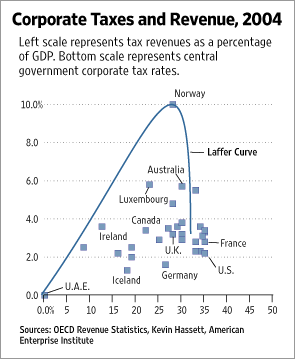
Not the Laffer Curve

Here's a demolition, if any were needed, of this outrageous graph. Anybody with the slightest comprehension of what a graph with data points and a best-fit line ought to look like can see that it's nonsense, and yet the Wall Street Journal's ever-reliable editorial page used it to try to argue (in brief) that tax cuts pay for themselves (for that sort of thing is the Holy Writ of the WSJ editorial writers).

(Oh, and it turns out that they didn't even put the Norway "outlier" in the right place. It should actually be in the same blob as the rest of the data points.)

The graph reminded me inescapably of...

Electron Band Structure In Germanium, My Ass

...that classic of scientific literature, Electron Band Structure In Germanium, My Ass.

The difference, of course, is that the WSJ are ignoring the actual data and just preaching their Laffer Curve gospel, while Lucas Kovar was doing his darndest to make an experiment work when it just bloody wouldn't. He then wrote up his results with, under the circumstances, great tact and restraint.

Allow me to conclude with my own favourite fancy graph.

Fancy graph

The data points - universally applicable, I think you'll find - are my own. The decoration was shamelessly scanned from The Visual Display of Quantitative Information, which is a much more entertaining, and beautiful, book than you might at first expect.

For more on silly graphs, see my old piece about thermal goop.

Relieve any unpleasantness by inhaling alcohol!

Modern Mechanix is, of course, awesome. It's arguably even better than discovering a big box of Popular Whatever magazines from before the word "gadget" was in the dictionary in your attic, on account of how Modern Mechanix is not full of silverfish.

One of my favourite things about those old magazines is the advertisements.

Modern Mechanix has a category for particularly notable advertisements (and another whole category just covering the still-popular-among-the-terminally-hopeful field of Animals For Profit...), but the ads that entertain me most are the small ones that often run next to the ends of long features, in the back pages of the magazines.

The older magazines are lighter on the ads, but once you hit the Fifties it's pay dirt all the way.

There you are, reading a perfectly delightful piece about what we all had to look forward to if Uncle Joe lost patience with Harry Truman, and on the later pages you're offered the opportunity to purchase profitable lawnmower sharpeners, the new '51 Crosleys, and "easy to erect" log cabin kits!

No-money-down correspondence courses and new and used goods for sale, electricity books and proto-Dremels, and Hawaiian guitar lessons cheek by jowl with that indefatigable symbol of electronic hope, the metal detector.

And, of course, cigarette ads. "Tongue bite"? But what about my "T zone"?

This piece about ammonia doesn't have anything too hilarious in the ad department, but is a fine example of the refreshingly complete absence of safety warnings (if you don't count "spread some newspaper around to catch splashes...") typical of practical science articles of the time. If you weren't actually preparing literal nerve gas, the writers figured you could figure out entirely for yourself that boiling ammonia water is not something you should play with in your unventilated basement.

Look at the 1938 piece that teaches you "thrilling stunts" to perform with hydrofluoric acid. Aqueous hydrogen fluoride is not one of those toxic-but-not-as-big-a-deal-as-people-think substances like mercury. It is genuinely nasty stuff. But not a word of warning is breathed in the article. Wonderful!

There are, to be fair, slight warnings - "relieve any unpleasantness by inhaling alcohol"! - in the very enthusiastic 1933 piece about chlorine (for when nitrous just doesn't do it for you any more). It includes yet another thing you can do with potassium permanganate, and has some pretty good last-page ads, too!

And in a further disturbing attack on the magazines' usual commitment to personal responsibility, this 1932 piece on how to set up your home lab does, at the end, point out that you shouldn't taste your chemicals or pour acid on yourself.

Oh, and the other day I was watching one of those How The Fine Personnel of your Loving Government Protect You From The Evil Brown People shows, in which someone almost got away with smuggling drugs into Australia in soup cans, but failed because the cans didn't weigh as much as the labels said they should, and also didn't weigh the same as each other. Jeez, what a rookie mistake.

I wondered how hard it'd be to get your hands on a can-making kit. And now here one is!

(Old-fashioned soldered can ends would probably be a bit of a giveaway, though.)

It has been clearly explained to me that I am not allowed to further investigate this promising business opportunity. Or grow a huge beard.

SupComTweak

An enterprising Supreme Commander fan has come up with Core Maximizer, a utility for people with dual-or-more-core computers (or even hyper-threaded single cores, though you can't expect a great improvement from those) that makes the game run considerably better. It does it by more efficiently shifting the game's multiple threads onto cores other than the first.

The effect is a large increase in frame rate, at the cost of a small decrease in maximum "sim" speed - which isn't a very big deal, since I for one often find it beneficial to slow the game down a bit when complicated stuff is going on, anyway.

On my dual-core Athlon 64 PC (this one), running the standard "perftest" benchmark showed that Core Maximizer slowed sim-speed to 96% of what it had been, but accelerated render-speed by a factor of 2.4. This resulted in 23% more frames logged during the benchmark, which is pretty darn impressive for this extreme stress test. Other users have reported similar improvements.

(And yes, as an old TA player I, too, originally thought it sounded like a downloadable unit. "The Core Maximizer is a roving optimization system. It upgrades other units so that they move more smoothly.")

Spam Appreciation Day

I rely on spam for my daily dose of randomness. Whether it's the smattering of apparently genuine (or maybe just address-testing) messages about adopting adorable puppies on the other side of the world that I received a week or so ago, or the numerous opportunities to build a collection of Korean-made railway rolling stock, old freighters registered in Panama and, of course, Chinese pumps, the less common flavours of spam give my inbox a pleasingly gonzo edge.

Recent examples:

An outfit called ByteShark, previously chiefly notable for its very plausible claims of a cure for baldness, has now decided to become some sort of "visual content" search engine.

I think you're meant to be able to upload a picture from your computer and find Web pages with similar pictures on them, or something, but all the search seems to do at the moment is take an incredibly long time (while showing you an ad for the baldness remedy!), and then turn up a bunch of severely sub-Google-Images results. If you upload an image, ByteShark appears to be very good at finding other images that resemble it in no way whatsoever.

The best part about the e-mail, though, was that it was sent to me, because Byteshark had brilliantly decided that since dansdata.com is hosted by SecureWebs, I must be the contact address not for securewebs.com, but specifically for shop.securewebs.com, which is the server that delivers the little "Hosted By" image on the bottom of dansdata.com pages. Which ByteShark now indexes. Hurrah!

It's OK to play around with exciting new search engine paradigms. Just don't start spamming people about your revolutionary product until it can at least pretend to work.

(UPDATE: Just now, on the 24th of October 2007, ByteShark have sent me another copy of the exact same announcement message.)

Example two:

I've always enjoyed the interminable politico-religious screeds that some people spam. Fair enough; you can't wait for people to discover your 500-kilobyte one-page Geocities site when the fate of Christendom, or something, hangs in the balance.
Here's something I got yesterday. I hope you're sitting comfortably.

  mr. dan,
 
     I was looking for computer check meters, I got your message on google images, saying , the meter told me that and reached you,
here what I have written to a computer software specialist, same for you. In the last my complete introduction.

:
   Dear mr. mansoor,
   sql server magazine,
  
 
       I append below my general information for your kind perusal
   It was good to see the name, mansoor, as my brother's name is
   also mansoor and he is settled in  southafrica.  I would be glad to know  your origin.  I have a question,
 
    how to put a sign-in seal , that would create a link between a certain
   computer cpu, and yahoo.  I have got many accounts closed. so I complained to hong kong arbitration centre.
 
   what do you think a sign-in seal means authorised access by yahoo
to a certain computer, and what if firewall is put on, will sign-in seal
be created, or we should remove the firewall first and then , sign-in
seal could be made.  I was unable to put a sign-in seal, to prevent
password theft.  However my password was
not stolen, yahoo company officials have been frequently closing my e.mail accounts.
 
  I knew about yourself, that you are founder and chief technology officer of  I S P R I N G.  My introduction is appended below.
 
  pakistan


  My name: Munsif rasool, s/o Late ghulam rasool
  surname: 
Babbar,
  comp. NIC NO: 41303-1480967-9 issued from Pakistan's
                                national database authority.
 
  education:  commerce graduate
 
Deasirs/mam,
 
   I am munsif rasoo, aged 37, and former agricultural developmentbank employee.  I worked for this bank from  17-5-95 to 30-8-2002.  During my service tenure in the year 1997,98, I wrote some direct requests to the
authorities of bank for legitimate purposes, to which bank responded, and I got the due advantages from bank.  In the month of februaray-2001, security guards of army run company called sms security, fought outside first women bank ltd, gul centre branch, Hyderabad, and they later got a complaint registered at cantonment police station, saddar, hyderabad.  I was later removed from the service on the pretext that I defamed the image of the bank.
 
  However, I explained my position with regard to all the allegations levelled against me, explaining that why would I go to a police station to get a complaint registered, so that image of agricultural bank should be defamed.
 
  In the month of august-2002 some conspirators ignoring head office instructions issued to audit zone-10, hyderabad, where I was posted,
came up with old matters and turned them into allegations that I wrote direct
requests to head office.  On the contrary matters of the past had settled in past.
 
  The bank, outside where , sms company security guards made the hue and cry and made scuffle, are still in first women bank ltd, opposite , pakistan airforce recruitment and selection centre, saddar, hyderabad. And the woman named iffat bashir who was manager, at the time of scuffle outside first women bank ltd, gul centre branch, has now joined united bank ltd, of his excellency sheikh nahyan bin m,abarak al-nahyan. a renowned industrialist of abudhabi.  she joined this bank in the month of april-2004.  In the month of june-2004, I also received a letter from the head office of united bank ltd, karachi.  The sender was one mr. shahid habibullah, div. head, hum,an resources.  He said that my cv had been included in computer database, as and when opportunity arose , I would be contacted.  I kept wandering around the UBL,
regional head quarter for three years, but I could never get the job of even marketeer.
 
  Hundreds of people were seen in the two branches of united bank ltd, i.e. gul centre branch and civic centrebranch, but some terrorists started terrorism and they onceagain started to fight.
 
  That I am a poor and orphan, I was looking for a job to support my research activities, and goons from mohajir mafia started to get jobs in this bank.
 
  I received a valid letter no.ps/DH/RCD/278,  21-6-2004, for a permanent post in united bank ltd, but terrorists started to threaten me, and I started to send a case against this bank to UAE and the newspapers of other countries.
 
  I have made hectic efforts to get my job in agricultural bank back, but nepotism, and hostitlity never go, and I became a victium of hostility.
 
  my father was regional manager, Agricultural development bank of pakistan , he passed away in the month of nov.1991, my mother also passed away in the month of may-1995, and now after august-2002 I am on roads and streets to find a source of income.  What it turned out to be later, I have drafted a complete report against the psyche of pakistanis in the banks and other govt. institutions, please read this report at     munsifrasool_007@yahoo.com
 
munsif_55@yahoo.com, because when I started to send my report to the newspapers of other muslim countries , I started to find my e.mail accounts to be closed.  Hoping that someone gracious, and generous will help an educated person.
 
 
Send instant messages to your online friends http://uk.messenger.yahoo.com

Send instant messages to your online friends http://uk.messenger.yahoo.com
Send instant messages to your online friends http://uk.messenger.yahoo.com

Send instant messages to your online friends http://uk.messenger.yahoo.com

Cocktail science

I'm surprised how many people don't know...

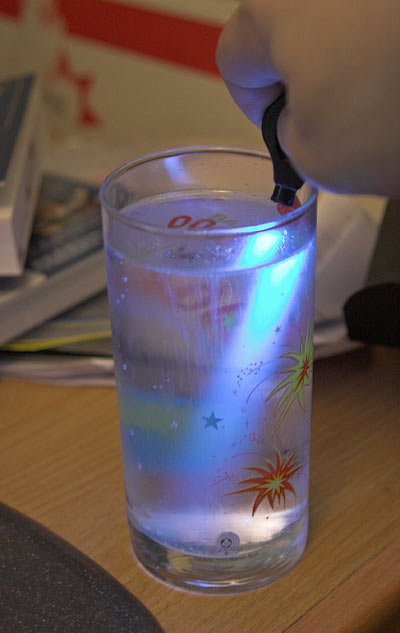
Glowing tonic water

...that tonic water glows under ultraviolet light.

(In this case, light from a UV Photon light.)

Modern tonic water (and bitter lemon, and a beverage made frae girders) only has a little bit of quinine in it. The original anti-malarial version of tonic water had far more of the stuff, which made it medicinally effective but also very bitter, such that adding a generous slug of gin to it could only make it taste better. Well, after you'd consumed enough doses, anyway.

Even a little quinine is more than enough for an impressive glow, though - quinine is often used in photochemistry as fluorescence standard, for this reason.

The ingredients label on the tonic I drink (usually straight; it's an acquired taste) lists quinine as "0.5%". If that's an accurate by-weight figure, then if you manage to put away a whole 1.25 litre bottle of the stuff, you've consumed something in the order of 6.25 grams of quinine. That's more than ten times the every-eight-hours medicinally effective dose of quinine dihydrochloride or sulfate (for IV or oral administration, respectively), which suggests to me that the listed concentration is a severe overstatement.

I did a nice before-and-after shot of a whole bottle of glowing tonic water for this old letters column. Wikipedia's version of the same thing is here.

STOP PRESS: Underpaid computer store workers are not very trustworthy!

This Consumerist piece about Why Geeks Steal Porn From Your Computer (When They're Meant To Be Fixing It, If They Get A Chance), is both informative and entertaining.

Let me tell you right now that if I were 21 again and working in some dead-end computer store McJob, I too would be rifling through the files of any user who needed our help to install iTunes. Anybody who is even marginally surprised about this would probably be horrified to see the contents of the back-room bulletin board of the average one-hour-photo place before the advent of the affordable digital camera.

There are some good tips in the Consumerist piece, but I disagree with the assertion that "drive encryption on your home computer is worthless". There are many easy-to-use encryption systems which provide data security that'll probably defeat the National Security Agency, never mind some dude in a pot-leaf T-shirt. If you just use Windows EFS and hand your password to the computer store along with the PC then they can of course access your data (and ordinary users who use EFS often lose all of their data as a result...), but there are other very fine options for people who just want to encrypt their accounting data, passwords and pr0n.

Hell, just putting that stuff in a Zip file with a ten character password'll probably do the job. Standard Zip encryption isn't very secure compared with many other schemes, but it's still often not practically attackable from any normal human's point of view. If the password's moderately long and not a dictionary word, and the attacker doesn't already have a copy of some of the data in the archive (giving the option of a "known plaintext" attack, which is the major weakness of standard Zip encryption), then a brute force attack is likely to take a very long time indeed. Even refined brute force attacks are likely to take centuries on current hardware.

Learning how to use encryption software is a good step towards learning how to use the rest of your computer like a "pro" as well. Before you know it, you won't have to hand your computer over to Super Excellent Computer Store's Data Commandoes just because you can't get rid of some crapware.

Wires 'n' volts

I just spent a little while perusing the Hobby Corner section of the excellent Discover Circuits site.

I reviewed a "shake flashlight" a while ago, and have since answered a letter from someone who bought a fake one.

Here's a page about how, exactly, the (genuine) lights work - or at least how the cheap knockoff versions do. It suggests a better design, but the shake-light idea is pleasing despite its inefficiency; with decent components they work well enough, and they let the light retain a normal unbroken flashlight casing, rather than requiring a crank handle or pull-string to stick out somewhere.

I've got some of the cheap-yet-functional ones as mentioned on that page; I bought them very cheaply on eBay, so I'm not too bothered that they take a lot more effort to charge and glow more weakly and for less time.

If you feel the urge, you can follow the Discover Circuits suggestions and upgrade the cheap lights with better diodes and capacitors to be much closer to the quality of the brand name versions.

Another Discover Circuits highlight: A super-simple capacitor-based constant current LED power supply to let you run long strings of LEDs from mains power (or fix these crappy LED nightlights).

It is also my considered opinion that the words DANGEROUS VOLTAGES EXIST EVERYWHERE are the mark of a truly excellent schematic.

Retro evil

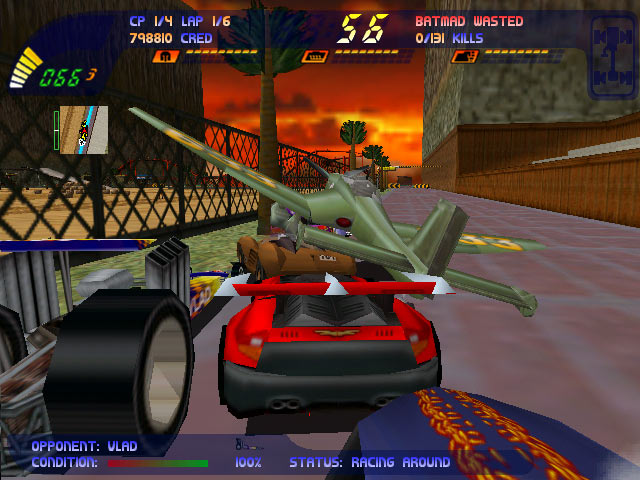
Apropos my previous mention of old games where you do bad things to people: If you've never played Carmageddon II, you really should.

Carmageddon II screenshot

Don't try to tell me that stuff like this happens in the racing games you usually play.

Every kid's used to running over old ladies in 3D these days, of course. But Carmageddon II came out in late 1998, before Grand Theft Auto had made it to (2D) instalment two. And I, and others, think it still holds up quite well today.

It's not, to be fair, a game for the precision car simulator enthusiast. Keyboard controls, a weird lunar-gravity feel, and very little reason to actually bother running through the checkpoints once you'd stacked up some spare time by killing pedestrians and another racer or two.

(There are timed challenge levels that actually force you to perform particular tasks before letting you at the next batch of levels. But you can always cheat past those.)

But despite the cartoonish physics, this actually is a simulator, of a sort. Driven and steered wheels affect car behaviour as they should, as you can see when a car's ridiculously smashed and bent and so can only drive in little circles. You can even get rear-wheel-steer and front-wheel-drive, if you drive the combine harvester.

You also don't have to perform contortions to get Carmageddon II to run on modern hardware. The game's still commercial software so you can't just (legally) download it, but once you've got it and patched it to v2.0 all you need to do is replace the carma2_hw.exe file with this further patch to make it run on Windows XP (and maybe Vista; I dunno).

And then you'll be in business, playing in Direct3D mode in a magnificent 640 by 480. 800 by 600 was possible, but only on 3dfx hardware, back when those cards were so powerful it was kind of ridiculous. Multiplayer requires the bad old IPX/SPX protocol, by the way.

You can take advantage of a modern graphics card by editing the data\options.txt file and changing the value on the "yon" line to 100 or more; that'll give you a much more distant view, so you'll be able to see further down the road, or a whole level at once when you're high up. Extending the view distance seems to hang the game occasionally when the view changes suddenly - like when you press the "recover" key or switch to the in-cockpit view - but that may just be because I'm using an unnecessarily high "yon" value.

People have also modded realistic looking cars into C2...

...and even turned it into a banger racing simulator. The low-polygon high-ridiculousness standard cars are perfectly adequate for starters, though.

To be honest, the only thing that irks me about unmodded Carmageddon II is the unfortunate fact that if you want to remove the dogs from the game, because you're cool with running over people and everything but deliberately whacking Fido goes a bit far, you can only do it by turning off all animals. That includes the far more amusing sheep, cows, moose and penguins. And the elephants, who're something of a challenge to kill.

Oh, and if you try to register your "new" copy of Carmageddon II, you'll fail.

I don't think I can submit this any more...

I wouldn't try clicking any of those buttons, if I were you.

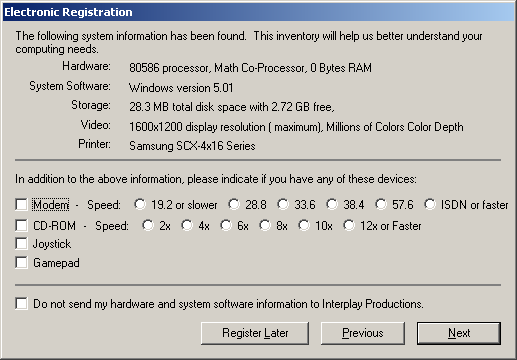
Before you see that window, though, you get this one:

Carmageddon II's idea of my system specs

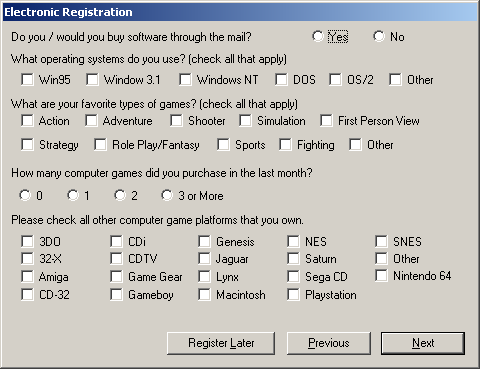
And, more amusingly, this one:

Carmageddon II registration requester

There's your retro game console collection guide, right there. Note the separate entries for the CDTV and the CD32, baby!