eMate update!

Curse you, Jax184, for telling me to make sure a screen hinge clutch spring on my eMate wasn't about to let go and puncture the video cable.

Oh, all right, I suppose it's better to know about the problem before it happens than after. But still.

Off I went, all innocent, to the disassembly instructions here. They informed me that Apple cheaped out on including a couple of lousy connectors on the eMate mainboard, so you have to unsolder four wires if you want to actually remove the mainboard from an eMate.

Why do you have to do that? To reach the dodgy screen hinge springs, that's why. It's very difficult to reach the hinges even with the straw of a spray-grease can when the mainboard is still held in place by the soldered wires.

Since everything was, actually, still fine, I was pretty much willing to forego the unsoldering, put my eMate's back on it again, and just trust that the springs would hang in there. Except then I heard a piece of plastic rattling around inside.

It was, no doubt, some important little light guide or button that'd come astray (the disassembly instructions mention these things in some depth...), and I now had to remove the mainboard to reach it, anyway.

So I unsoldered the wires and removed the board... and found that the loose piece of plastic was actually just the base into which one of the case mount screws threads. It had broken loose at some point in this eMate's life.

That sort of thing doesn't actually matter at all, of itself. If more than one case screw in a gadget loses its mount then the device is likely to start feeling a bit creaky, but you can live without one.

Well, I was there now. I CAed the mount back down, put washers under the spring retention screws to prevent the springs ever popping loose, sprayed some new Miracle Lubricant Stuff that I'd bought earlier in the day at the second hardware store I went to in search of light-grease-in-a-spraycan (a Scottish fellow I once knew described the hardware store as "the store of broken dreams"; it sounds better with the accent) on the springs, and spent some time reassembling the bloody thing while the bits that jump out of their correct locations all jumped out of their correct locations.

After which, it was time to do the job that I had originally expected to have to do: Building a new battery to replace the very very dead original one.

I wouldn't say I'm a dab hand at battery building, but I've done it a few times. It's quite easy to solder up battery packs even if you are limited, as I was by what I had on hand, to normal cells without pre-attached solder tabs.

These excellent instructions for making a new eMate battery show you the solder-tab way, but you can solder directly to the ends of normal cells (even non-rechargeable ones!) as well. Just use a soldering iron with a broad tip, only a moderate heat, and - and here's the big trick - scratch up both ends of each cell first with a file or sandpaper, so that the solder will stick.

Get it right, and the solder will flow into place almost immediately. Get it wrong (fine-tip iron, high heat, unscuffed cells), and you'll boil the life out of the cells while still not getting any solder onto 'em.

(I talk about this more in my ancient piece about making external digital camera batteries, from back when all digicams ate AAs like popcorn.)

Aaaaanyway, I was so cocky about all this that I even built the pack out of fully charged cells. That's a big no-no for beginners - short out the pack while you're working and the thing may catch fire in your hands.

Against all expectations, though, everything went fine. The eMate played its happy first-startup sound (a variant on the Mac chime) the second I plugged the new pack in.

I didn't bother taking any pictures of this whole procedure, since I always find this sort of thing quite exhausting all by itself. Especially when you're working on something with a swoopy curvy case that's easy to not quite put together properly afterwards, requiring re-removal of screws and realignment of little catches and tabs.

But, hurrah, now it works, and I can actually play with it.

(My greatest achievement so far is working out that "Styles" is how you stop everything you enter appearing in large-print Apple Casual, which looks far too much like you-know-what.)
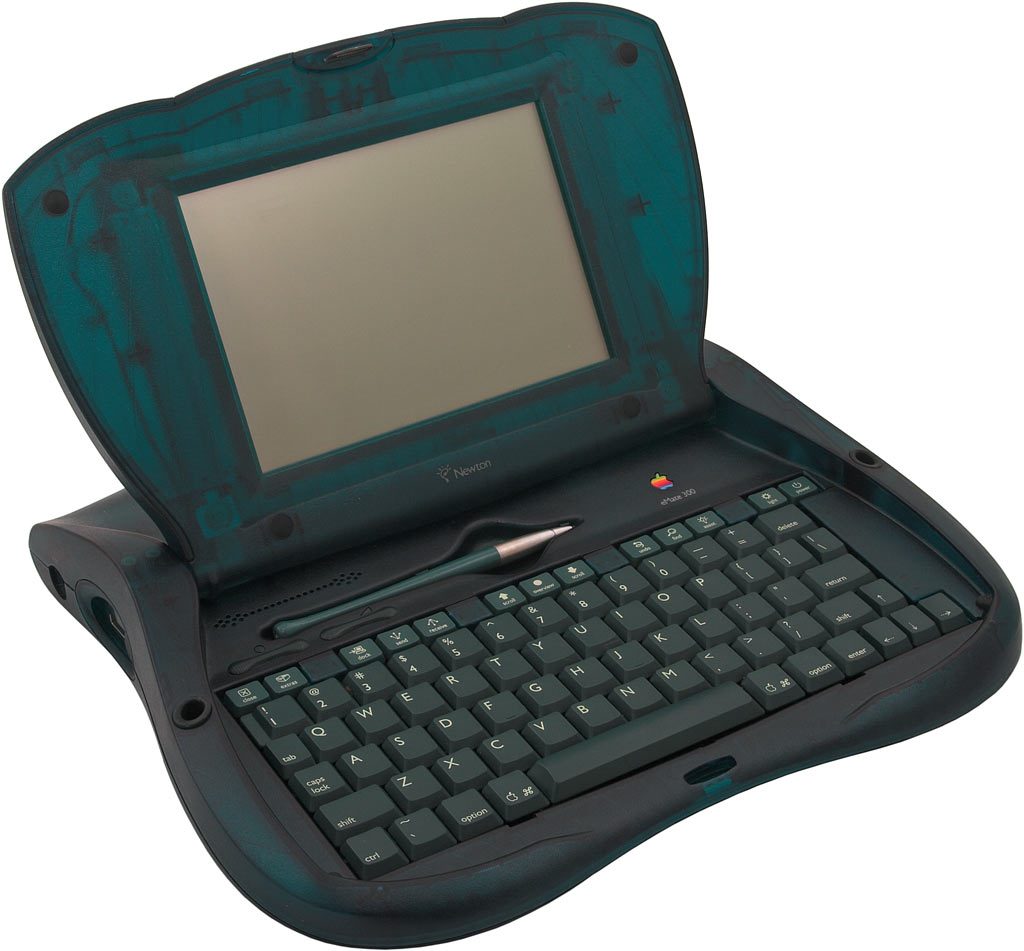
My new laptop

Apple eMate 300

...is an Apple eMate 300.

The eMate is the keyboard-equipped cousin to Apple's groundbreaking but unsuccessful Newton, and it's one of those gadgets that's remained desirable in its (in computer terms) old age.

I've considered buying an eMate on eBay, but I don't really need one, and the bidding usually goes much too high for my essentially idle interest in the things.

Now, though, this eBay seller here in Australia has, after reading the above-linked column, kindly sent me one of the eMates he's selling, for free.

The engraving on the underside of my eMate tells me that it and its brethren came from Mount Riverview Public School. Where, if the condition of the thing is anything to go by, nobody got much use out of them.

(Now some kid who used this very eMate when she was in fourth grade is going to e-mail me and tell me how much she's enjoying her career as a barrister.)

It's not surprising that the eMates didn't get used a lot. Half-assed ineffective school computing schemes are still extremely common today, let alone ten years ago - but it's still a shame. The eMate remains a very competent assistant to a "proper" computer, at least for people like me whose needs stop at "Palm-ish sorts of jobs, plus a keyboard".

(Yes, Newton enthusiasts, I am aware that the Newton has some features, even if they were a bit slow, which other PDAs still haven't matched.)

The eMate is a product from the Golden Age of Apple, when they were concerned that mere high prices and IBM-incompatibility weren't always enough to prevent people from buying their computers. So sometimes, Apple simply refused to sell things to ordinary consumers.

Lots of regular people would have loved an eMate. The mere fact that it's still quite useful today ought to make that clear. But Apple wouldn't sell you one unless you managed to persuade them you were part of the "education market".

(More recently, they did the same thing with the early eMacs. Then they sobered up and started selling them to everyone.)

Now that I've got my eMate, I feel morally obliged to walk out into the bush with it and spend more hours writing something than I could using either of the other (working) portables in this house. I'll have to rebuild the utterly dead '97-vintage battery pack before I can take it anywhere, but that's no big deal. Even getting data on and off of the thing shouldn't be too painful, since the eMate has an IrDA transceiver.

(It's got a PCMCIA slot as well, but you can't plug any old laptop Ethernet card in there and expect it to work.)

I'll let you all know how I get on with my new toy.

Talk crap for money! It's easy!


$10 Police Flashlight Hack! - video powered by Metacafe

There's some insight and a considerable amount of confusion in the LifeHacker thread about this video, so rather than tack a wordy comment onto the end, I decided to post about it here. And then it sort of snowballed. But first, the flashlight thing.

Yes, you can relatively easily upgrade cheap flashlights with a higher voltage battery pack and a cheap bulb to match. Grab any old Maglite clone, install 12 volts worth of cordless-drill NiCds and a 50 watt halogen downlight globe (or more), and you're in business (not much run time, but feel the brightness!). CandlePowerForums is an excellent place to kick off your new obsession with flashlights (or it would be, if it weren't down at the moment).

This particular project, though, isn't a good idea.

One commenter observed that the flashlight might melt, but I wouldn't worry too much about that; I reckon running a bulb meant for six volts from three CR123s will burn it out long before it manages to make the plastic smell funny. You're pushing the bulb to something approaching twice its rated wattage - filament lamps increase in resistance as the filament heats, so you can't do a simple V=IR calculation for higher input voltage, but the difference isn't huge over normal working power ranges. Double power will absolutely murder the poor little thing.

Surefire, in contrast, rate their filament lamps for 30 hours of life, and it's hard to find anybody who's had one blow that soon, even if they drop their light, hit things with it, or screw it onto a frequently-used firearm.

(Normal flashlight bulbs do not like being shocked while they're operating, as anybody who's ever hammered on a tyre iron with their 6-D Maglite and killed both the working bulb and the foam-padded spare will know. The Radio Shack bulb is rated for 15 hours, but that doesn't include dropping the flashlight. LED lamps, in contrast, are rather more shockproof than many other components of a flashlight.)

I'd be very surprised if the bulb in this "overclocked" flashlight lasted 30 minutes. 30 seconds would not be out of the question, with fresh CR123s.

But then, as I'd reached the above point in the writing of this post, I noticed that a couple of commenters on the Lifehacker thread said they'd done the hack and it worked fine.

So I decided to give it the benefit of the doubt. Maybe that Radio Shack bulb is just unusually strong?

Then, though, I clicked through to the Metacafe page for the video in question. And discovered that it had by that point earned (according to the Metacafe money-for-popular-videos system; I believe the origin of this money involves underpants gnomes) its creator nine hundred and fifty-six American dollars.

And it's not "Kipkay"'s biggest earner, either.

Even then, I could have let it go; it's not as if the guy's stealing from orphans, and what the hey, the trick may work.

But then I looked at some of Kipkay's other videos.


DVD Player Hack! - Click here for the most popular videos

The sum total of the useful information in this one, for instance, can be boiled down to one URL. But it's still made Kip $935 to date!


Trace Any IP Address Or Website! - Click here for more free videos

More than thirteen hundred bucks, for this one.

Let's ignore "the name of the IP address", Kip's instruction to use tracert when ping will do the same job, and the fact that at first glance he appears to be cool with the idea that the White House is in Boston. The major point is that geographic IP address locating cannot ever be more than vaguely accurate.

The site Kip suggests does its best, but it still confidently puts me 94 kilometres by road from where I actually live. It places the White House's IP address somewhere near the corner of P Street and 8th in Washington DC. That's only about a kilometre off, but the effective range of my RPG-7 is quite a lot less than that, Kip! Gimme information I can use!

Kip's got plenty of videos that're perfectly genuine, plus others like this one ($665!) that're borderline enough not to matter.


Make Traffic Lights Change!! Amazing! - Click here for this week’s top video clips

And this ($765!), while a complete and unexpurgated lie and probably plagiarised, could be classed as a harmless prank since it just gives people something to do while they wait for the lights to change.

And this one...


Potatoes Power My MP3 Player! Amazing! - Free videos are just a click away

...could be taken as a lame attempt to imitate the far more stylish (and, I think, rather less profitable) Mark Erickson, who, in case you're wondering, is not the same person as Kip.

(I still, however, think Kip should suffer one disfiguring skin ailment for every child who tries to build this potato battery and is left disappointed by Kip's lies.)

If I were very charitable I could even give Kip a pass for calling this...


Cool Ball Bearing Rocket! - These bloopers are hilarious

..."a new trick with ball bearings and magnets", despite the fact that the 2002-vintage scitoys.com page for the exact same thing has for ages been the number one hit in a Google search for "gauss gun" (which, yes, should technically be a coil gun, but never mind).

(Kip also rips off a #1-hit Science Toys page for this video. Oh, and he's not above ripping off Mythbusters, either. And he copies his floppy disk Enterprise from this four-year-old page.)

But then there's this...


HyperMiling! Plus Secret Trick! - A funny movie is a click away

...which starts with sensible tips and then slides into bullshit about acetone, which will absolutely not improve your fuel economy - it's another one of those strange phenomena that seems to happen less and less the better you test to see whether it's happening at all.

But hey, who cares about the hoses and seals in the cars of suckers, when Metacafe will give you twelve hundred bucks for talking crap!

And then there's this:


Does GOD Exist? The Eye... - The best video clips are here

Oh, and I choose my words with care here, for fuck's sake. This one's only made $157 to date, but that's about a million dollars more than this Pascal's Wager of the creation-evolution "debate" is currently worth.

(What's with the "100 years of [unspecified] Cray time" part, you might be wondering? That's because Kip can't even come up with his own Creationist claptrap, so what he's reading here was originally published in Byte magazine in nineteen eighty-five, and presumably republished without permission in some pamphlet Kip's pastor gave him.)

Getting back to nerdly topics, check out this one, billed as "You've seen it all over the internet but this is the original version!":


9 Volt Battery Hack! You'll Be Suprised... - The best free videos are right here

Well, OK, when I mentioned it in 2001 I didn't actually say that this was an emergency AAA-equivalent source. But I didn't pretend to have invented the idea, either.

I realise this isn't exactly an Ebert-versus-Schneider-level put-down. All Kip's doing is taking Metacafe's money for making videos for which people vote with their clicks. And it's not as if I'm starving in a garret or something; I for one would take Kip's money with a smile on my face and a song in my heart, but I don't need it.

But it's just so dispiriting.

I know that out in the real world the people who fix their eyes on the prize and do what's necessary to get it, bugger the consequences, are always the ones who end up sleeping like babies on mattresses stuffed with money. I get that. But I thought things might be just a little fairer here in the Internet fantasyland.

There are lots of super-cool people out there in the hacking, fabricating and doing-science-at-home communities. They're seldom in it for the money, which is good, because there's seldom anything other than a large negative amount of money in it.

But if you think Kip deserves the money he's made more than, oh, Matthias Wandel, there is something wrong with you.

And don't e-mail me if you do believe Kip deserves the money more, because I already know why you think that. You read books about selling, and you think the boy's got "chutzpah", right?

Bullshit artists with selling skills are Part Of The Problem. They sell expensive credit to poor people, they sell worthless remedies to the sick, they sell wars to whole countries.

The rest of us don't need you people, and I don't care what you learned when you got your degree in marketing.

The world already has an ample supply of bullshit, Kip. Give us all a break and stop adding more.

New horizons in cat photography

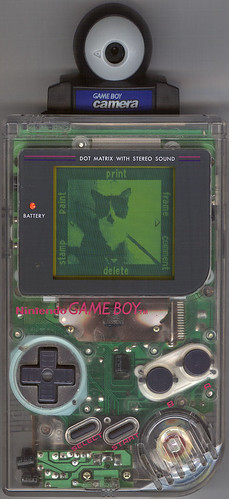
A while ago, because nobody sensible stopped me, I bought a Game Boy Camera to go with the clear-cased original Game Boy we've had for a while.

The Game Boy Camera may be the lowest fidelity digital photography device ever made. I'll leave it to others to explain its magic.

If you've got the Camera, though, the logical next step is to get a Game Boy Printer.

If you don't have a Printer, you can get images out of your Game Boy Camera by using a cable that connects to a PC and makes the Game Boy think it's connected to the Printer.

Old school digital photography

Or, as I did, you can improvise.

But I needn't scan the Game Boy any more, because yesterday I took delivery of my very own Printer!

With no paper.

Like lots of other old crummy printers, the Game Boy Printer uses thermal paper. The special little narrow rolls are now very hard to come by.

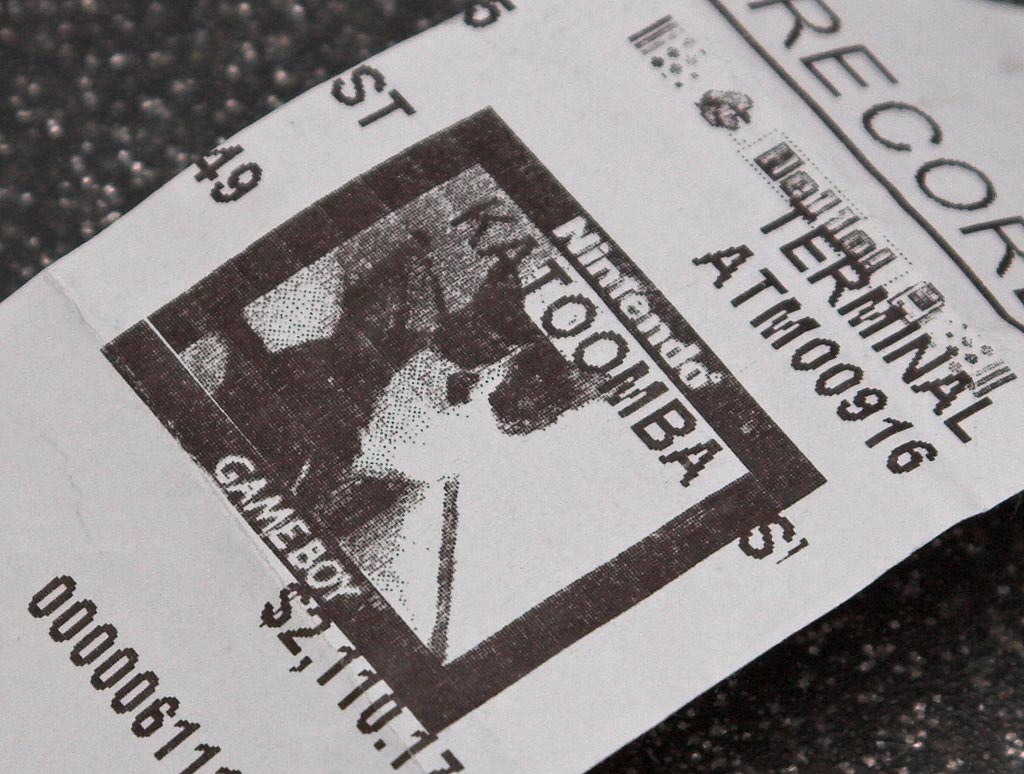
All thermal paper is, however, very much the same. So I rifled my wallet for an ATM receipt, cut it to fit the printer...

Cat on an ATM docket

...and made my first print!

The "KATOOMBA" is from the original ATM printout, as is everything else except the black-framed picture of Joey and, at the top right, the greeting from Mario that you get when you turn the Printer on with its Feed button held down.

The image area inside the print's black "NINTENDO" border is 21.5 by 18mm. About 410 such prints would fit on one of the "Super A3" sheets that're the biggest my Stylus Photo R1800 can accept.

Big and bigger

StarCraft II Marine

The StarCraft II cinematic trailer is mainly about the awesome and terrifying technical processes involved in the production of the pissiest unit the Terrans have. Which is a great gag, and one which I've often found myself thinking would make for a good Supreme Commander promotion.

Not that it makes any real difference to gameplay, but SupCom's scale is the biggest of any real-time strategy game in which you still control individual units (check out the old '06 E3 trailer for some soul food for the 14-year-old boy inside all of us). Even little cute units like the spherical basic Aeon construction bots are half the hight of an adult tree, and they hover far enough off the ground that they'd whiz way over the head of StarCraft's battlesuited Terran Marines.

The Tech 3 siege bots that everybody uses in hordes if a SupCom game lasts that long are BattleMech-sized (this is 0.38-scale!). It has also been observed that the biggest gun in Supreme Commander is about as tall as the Eiffel Tower.

Nobody's going to be making any more official trailers or full-sized trade show models for SupCom now that it's out, of course, but I hope some nutty fan will work something up. A crowd of Siege Tanks desperately attempting to hold back the unstoppable might of four tech-1 light assault bots would be entertaining.

How To Make Your Kid Grow Up Like Me

The other day, I realised I could only remember two of the kids' science fiction series that shaped my young mind.

First and foremost, beyond question, were the Danny Dunn books.

I loved them, not least because they made a solid attempt at getting the physics right.

Example.

When people get shrunk to the size of ants in practically any other sci-fi or fantasy story you care to name, they carry on with their lives more or less as normal in their scary new world of bus-sized cockroaches and bean-bag-sized blood cells, or whatever.

Which is wrong, for the same reason that it's wrong that Superman is so often able to take a firm grip of one end of a battleship or something and lift it bodily out of the water.

We can accept that normal physics doesn't apply to Superman himself, just as we can accept that absent-minded Professor Bullfinch in Danny Dunn and the Smallifying Machine has indeed managed to construct the eponymous Machine. But Superman doesn't magically make the battleship as tough as he is just by laying hands on it. The ship is still subject to normal physics, so when Clark grabs and lifts he should end up with two large handfuls of torn steel, and look like an idiot.

(Image Comics did this right at one point, with the new and clueless Mighty Man trying to lift a car by the bumper and, of course, just ripping the bumper off.)

Anyway, when Danny and company get shrunk, they find they can't walk any more. Because, of course, the acceleration due to gravity is still 9.8 metres per second squared, and if you're scaled down to a thousandth of what you were, that now looks like 9.8 kilometres per second squared.

So if you're standing up and tilt slightly forward with the intention of starting to walk, BANG you're on the ground. Just like an ant would be, if it tried to stand on its hind legs.

You suffer no damage, since scaling down makes you tougher in scale terms, but bipedal locomotion is completely out of the question unless your body and consciousness are accelerated by the same factor by which they've been shrunk.

Which, in the Dunn stories and in all of the crappy Incredible Voyage/Honey I Screwed Up The Physics Hollywood versions, they never have been.

So there.

(Warning! This sort of thing can lead to long conversations later in life about the stability of the Ringworld, which is even worse than prolonged Monty Python quoting when you're at a party and should be meeting girls.)

The other sci-fi(ish) series I could remember was Norman Hunter's immortal Professor Branestawm series, which takes a lot more liberties with physics but is plainly doing so in the service of humour. Branestawm is more of a wizard than a professor; he'd be perfectly at home in Unseen University.

(The Branestawm books, or at least the good editions of them, were also illustrated by nobody less than W. Heath Robinson!)

There was another series, though, that I just couldn't pin down. I could remember it featured a family adventuring around the galaxy in an old spaceship, with memory implanting machines to school the kids, and the spaceship needed its engines de-coked in at least one book... nope, no useful search strings arising from those memories.

(I include them here so that now someone who can only remember the de-coking, or indeed decoking, or decoked or decoke or coke engines spaceship books, will find this post.)

Anyway, considerable Google-bashing finally reminded me that those books were the Dragonfall 5 (or indeed but incorrectly Dragonfall Five, frustrated searchers!) series.

All three of these series are significantly dated these days, but I think that, in itself, has more educational value for the kind of nine-year-old who'll find them interesting. They're all out of print, too, but seem pretty easy to find on the used market, and should be available from any half-decent library.

Towards a transgressive hermeneutic of OMG THERE'S AN EAR IN HIS ARM

Stelarc is everything the famous-in-certain-circles Kevin Warwick would be, if Kev had more guts and less self-promotion.

I base this evaluation on the fact that Stelarc does bowel-clenchingly freaky things to himself and says he's an artist, while Warwick does things any schmuck could do and calls himself a researcher.

An ear in an arm!

It's probably best that those of a delicate disposition not click the above, or look at this later picture either.

I think Stelarc's a bit like Survival Research Laboratories would be, if everything they made had to pass through their bodies somewhere.

Further evidence: Kevin Warwick has said wanky things about Stelarc, but I don't think Stelarc's said anything about Kevin.

(Via, via.)

Turbine time!

Another Crabfu creation.

Slightly louder than the previous ones.

I recognised the chassis as being from a Kyosho Blizzard just from the first picture of the thing. I haven't a clue about the motors and boilers, but if you want an R/C tracked vehicle of any size spotted, I'm your man.