The Things People Will Believe: Two Connected Aspects

Thanks to my previous musings on bogus fuel and energy gadgets (and additives, and more...), I attract more letters about such things.

Most recently, a correspondent has brought the Hydrodrive Electronic Converter to my attention. He did, to his credit, say that it sounded "completely bogus" to him, but he still asked me "Does it really actually do anything?"

I confess that I did not spend a lot of time examining the Electronic Converter page.

That's because it looks like a perfectly typical long crackpot rant (not helped by the fact that it's a freeservers.com page; like Geocities before them, Freeservers are an absolute wellspring of groundbreaking physics...). I see no reason to even start trying to unravel what the hell all that multicoloured capitalised marqueed-and-blink-tag text is trying to say.

It is not, of course, impossible that the person responsible could have actually come up with a revolutionary device to do... whatever it is this device is supposed to do. It is also not impossible that Elvis is still alive and, thanks to some magnificent plastic surgery, currently serving as the leader of the Democratic People's Republic of Korea.

I consider these two possibilities to be similarly likely, and I also wonder why on earth anybody would even bother asking someone else about it.

Is there anything, anything at all, about that gadget that suggests that it has any value at all? Am I missing something? Or is this just like the Unanswerables that plague Barbara and David, as the world's e-mail-forwarding-aunties keep asking them whether that little boy really does need a new body to replace his burlap bag filled with leaves?

I've noticed that one of the common features of many of these kinds of sites is a page proudly displaying completely ridiculous "awards", which the crackpots responsible cannot tell from real ones.

A fine example of this phenomenon may be found at the justly famous site of the Atom Chip Corporation. Their URLs have shifted around since I last wrote about them (end of this column), but their proudly displayed Bogus Prize That Looks Exactly Like An Academy Award, I Mean, How Obvious Can You Get, Jeez, is still on display. It's now here.

Srinivasan Gopalakrishnan, the fellow responsible for the Hydrodrive Electronic Converter, lists on his personal page a similar, if smaller, collection of awards. He does actually seem to have invented some real things before he came up with the Converter, so I dare say the patent and such lower on the page may be for genuinely useful things (though a patent does not actually mean the patented idea has value; it's not the patent office's job to figure that out).

But the second thing on that page is a letter congratulating Srinivasan for having made it through the rigorous qualification procedures for the American Biographical Institute's frightfully prestigious "International Directory of Distinguished Leadership".

Unfortunately, the ABI's IDoDL - like their rather popular Man of the Year nomination, which Srinivasan reprints next - is one of those bogus Who's Who scams, kin to the expensive Forums and poetry collections whose only real purpose is to extract money from the people listed, invited or published.

(After that, Srinivasan has another similar certificate from an Indian outfit with no Web site that I'll betcha is just as fake, though less successful.)

I was, at first, amused to find someone who's apparently proud to have attracted the attention of both the American Biographical Institute and the International Biographical Centre of Cambridge, England (so "Centre" is not actually misspelled, you twit). But my smile faded as I discovered that pretty much anybody who falls for one of them seems likely to fall for the other.

Apparently Wikipedia is not as well known as I thought. But people are about as dumb as I thought.

Yes, I have received letters from these kinds of scammers, too. Not for years, though. There's nothing like being nominated as one of the World's Most Super-Smart And Really Cool Ultra-Professional Top Executives, Wow, You're Like James Bond And Warren Buffett Rolled Into One, You Are when you're 22 years old and, in my case, living with your mum, to tip you off to the scam.

(I might have been younger. I don't remember exactly. I was licking frogs pretty often back then.)
Domestic Alternative Power Options That Don't Work

When we were house-hunting, one of our options had an honest-to-goodness stream flowing in the front yard. The driveway and front path had little bridges. It was awesome.

(But too far from the shops.)

That house popped into my mind when I read about the new Beck Mickle water generator that will, according to its makers, give useful power from the babbling brook in your back yard. Let's assume that you have both a yard and a brook, for the purposes of this argument.

The Beck Mickle Hydro site doesn't have much information yet, but that's OK, because the outer bounds of the system's efficiency are already defined. Quite simple physics tells us the theoretical maximum amount of energy that can be derived from X much water per second dropping distance Y. You can read all about the equation involved in various places; here, for instance, or this PDF for a fancier version.

The big deal about the Beck Mickle generator is supposed to be that it works from very small "heads" - a very small amount of "fall" for the water. There's no problem factoring that into the equation, though; you can just ignore the usual few-feet head that's the minimum (and a major limiting factor) for most "micro-hydro" systems. They have that head limit because we don't live in Physics Experiment Land; inadequate head means the efficiency of the system will fall vastly, possibly even to zero, as the water just doesn't have enough energy to get the generator turning. The Beck Mickle thing is apparently easier to turn. Groovy.

Let's assume the Beck Mickle system really does work just fine from a miserable eight inch head, and let's further be insanely generous and assume it is 100% efficient at turning water energy into electricity (versus the 55% efficiency that's common in current systems).

How much flow would you, then, actually need to achieve the one kilowatt output talked about in the Daily Mail piece?

Well, the equation [New! Improved! Actually correct now!] is Gross Head (in metres) times Flow (in cubic metres per second) times System Efficiency (decimal equivalent, where 100% equals 1) times a constant (9.81 in this case, the acceleration due to gravity in metres per second squared; it's a less neat number if you do the calculation in units other than metric) times the density of water (1000 in this case, because that's the number of kilograms in a cubic metre of water) equals Power (in watts).

(The oregon.gov page I mention above simplifies the equation by giving results in kilowatts and leaving out the water-density figure. I screwed up the first time I worked it out here, using their version of the equation but imagining power was still in watts.)

Assuming you've got a 60 centimetre head - three times the alleged minimum for the system - solving for Flow gives

0.6 * Flow * 1 * 9.81 * 1000 = 1000

So: Flow * 5886 = 1000

And thus: Flow = 0.17 cubic metres per second.

That's quite a lot [though not nearly as much as I thought it was when I had it wrong].

An Olympic swimming pool holds about 2500 cubic metres. You'd have one of those coursing through your back garden every 15 seconds every four hours or so, which isn't quite as spectacular as I first thought, but is still a bit speedy.

(I don't know how many Libraries of Congress per second that is.)

To pay for itself in the quoted two years, at standard UK electricity prices of around ten pence per kilowatt-hour, this £2,000 generator would indeed have to deliver the quoted 28 or so kilowatt-hours per day - even more than a thousand watts of constant power - in order to break even in two years. And that's assuming that it doesn't need any expensive repairs, which would both increase the price and reduce its generating hours.

(Curse my cynical mind for thinking that a v1.0 product might not last for two years just because it is (a) constantly rotating and (b) constantly wet.)

When I had the calculation wrong, I thought the claimed results were utterly ludicrous. Now that I've got it right (thanks, nichyoung!) it's less ridiculous; this thing actually could make worthwhile power, if (a) it works as advertised and (b) you have a decent little stream to put it in.

Of course, it's still unquestionably not actually going to be very close to 100% efficient. Advanced water turbines can manage 80%; backyard hackers are lucky to crack 50%. But, still, could be worth it.

Another reason why this story caught my eye is because, apart from being based on a different element, the claims made for the domestic waterwheels generator sound very much like the claims made for small wind generators.

Small wind turbines look pretty impressive, until you discover that the unremarkable-sounding wind speeds needed for them to start generating properly are actually, often, Beaufort Force Six. The hardy maritime types who came up with that scale may only call Force Six a "Strong Breeze", but it's actually Strong enough that, if it's raining, you may do better to not bother trying to open your umbrella. Few residential areas have Strong Breezes much of the time, because people try not to build towns in places like that.

Awesome dude Tim Hunkin has something to say about all this.

If you actually want to get reasonable power from a wind generator in "normal" winds, you need something like a twenty foot turbine eighty feet up in the air. From that, you will genuinely be able to get a kilowatt of power on pretty much any day when there's what a city dweller would call a breeze, and you'll get a reasonably reliable 2kW or more if you live somewhere more windy, but not startlingly so.

But if you've got a Neighborhood Association, they will not like it.

Balderdash of the day

I've just had digestion of my Christmas lunch interrupted by discovery of the Nordost VIDAR, a "cable conditioning" device.

You plug audio cables into it and it, um, conditions them.

Apparently it's been around for a few years now.

According to the ad in the newspaper gadget supplement in which I found it, "both new and used cables often have very high levels of electrical charge which must be neutralised if they are ever to achieve their maximum performance".

(Apparently this very high charge level, which comes from nowhere, has not yet been tapped as a source of environmentally friendly power.)

You can read more about it from some happy believers here.

The newspaper ad was from this outfit, who are happy to take $AU25 from anybody dumb enough to want their cables "conditioned". They're audacious enough to suggest that cables need to be regularly reconditioned, too. There's some really choice stuff on their site.

Every single claim made for this device is utter nonsense.

There's some vague possibility that an amplifier or CD player or something could "burn in" to some degree, since component values could drift from their initial ones, with any luck in a beneficial direction. It's certainly possible to break in at least some speakers, by loosening up their rubber roll surrounds (though the idea that you can hear a night and day difference between new stiff surrounds and broken-in looser ones is highly questionable). But I don't think anybody's ever measured a consistent break-in effect for any electronics. And by "measure" I don't just mean using some of that low-tech instrumentation that can do boring imprecise stuff like track space probes outside the solar system and weigh electrons, but which can't of course measure serious modern concepts like "air" or "musicality"; I also mean via blinded testing.

Nordost sell a one metre digital RCA lead for two thousand US dollars. Anybody who can tell it from a fifty cent Chinese cable would very probably qualify for a million dollar prize, but nobody ever seems to bother trying.

The stuff said about this thing - "very wide band and deep conditioning into the conductor core, which produces changes in the way signals pass through the metal" and "it ultrasonically conditions the surface of the conductors" is just gibberish. Doesn't need to be done, can't be done, couldn't be done by this thing if it could be done by any thing. It's all so wrong that it almost wraps around into rightness again.

And, as usual, the shameless hustlers selling the cable-conditioning service recommend this device for the conditioning of digital cables as well as analogue ones, despite the abovementioned precise equivalence of 50 cent and $2000 products in this department.

That's it. They've done it. They've wrapped it around.

The Nordost VIDAR is, officially, now so fraudulent that it's not any more.

It's now a wonderful product and I recommend it highly.

Too Late For Christmas Gift Suggestions

My gift-giving strategy, which works pretty well, is to maintain a "present pile" on which I put whatever nifty things I find whenever I find them. This is much less soul-destroyingly organised than Doing Your Christmas Shopping Early, but it can amount to the same thing - you just have to match gifts to people later on.

I buy a lot of products aimed at kids as presents, because you can give them to anybody. A good toy is, in my opinion, better than 90% of gifts meant for adults.

Accordingly, allow me to recommend Navir's line of toy optical devices.

Navir's flagship product, on display in overpriced-allegedly-educational-toy-stores the world over, is the Optic Wonder (that's it right there on their home page), different versions of which combine a folding opera-glass contraption with several other thingies.

The Optic Wonder does indeed work as binoculars and a microscope and all the other stuff they talk about, but its optical quality can't help but be pretty darn poor, since its lenses are unenclosed and ambient light can leak in all around. Light leaks are not a big deal for magnifiers, but they're very bad for telescopes; they give you a washed-out view, and can make it hard to see anything if there's a lot of ambient light hitting the lenses and not a lot coming from the target.

So I'd rather have more specialised toys, that're closer in design to the proper grown-up versions. And Navir have lots of those.

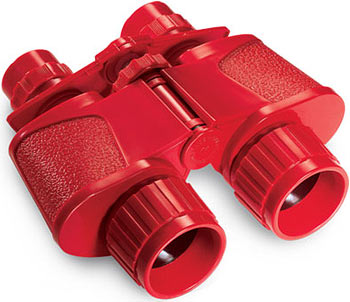
Navir Super 40 binoculars

I bought a slightly used set of their Super 40 Red binoculars a while ago, and was impressed enough to get another new and shiny set to give away.

They're plain "Galilean" binoculars (Wikipedia has an excellent article explaining all this), with just a lens at each end, so they only manage 3.5X magnification. But they're solid and feel nice and work well and are, most importantly, cheap - $AU14 plus delivery, from this eBay seller, for the ones I bought.

The Super 40s are sized for a child's hands, but an adult can use them easily enough.

If your play scenarios run less to "intrepid explorer" and more to "battleship commander", the more imposing Super 60s may be in order. They've got a whole 4.5X magnification and 60mm objective lenses, which means that they may actually qualify as the world's cheapest astronomical binoculars, if they can manage half-decent sharpness. Low magnification and high light-gathering ability is, as I have explained in the past, exactly what you want from a basic astronomical instrument, because many interesting things in the sky are quite large, but very dim.

"Proper" binoculars have, for more than a century now, used prisms of one kind or another to allow wider spacing of the objective lenses (for a bit more stereo effect) and higher magnification (the prisms fold a longer optical path into the instrument without making it unmanageably bulky). But 3.5X magnification is actually quite enough for many viewing tasks, and it also means the image doesn't jump around annoyingly. And the image quality really is pretty good, too; certainly not excellent, but if you assume "toy binoculars" equals "useless binoculars", these cheapies will surprise you.

Cheap telescopes, in contrast, invariably have frankly lousy image quality. They don't have to, but they're forced into it by the fact that they've all got lots of magnification. That's because you just can't sell a cheap telescope that only says "10X" on the side. High magnification, unfortunately, also magnifies all of the problems with cheap lenses and tubes. Focus consistency (if it's sharp in the middle of the circle it'll be blurry on the edges), chromatic aberration (coloured fringes on everything), light leaks and internal reflections (because matte black light-tight tubing is more expensive than cheerfully coloured plastic). All perfectly tolerable at 3.5X, but awful at 30X.

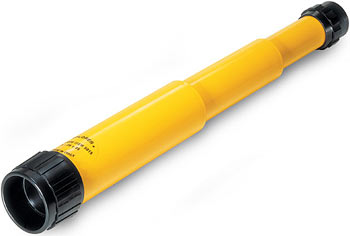
Navir Explorer telescope

That said, I like the Navir Explorer telescope. It cost me only another $AU14 plus delivery, and for that price it is a fine product. It's another basic Galilean design, with a not-too-stupid 15X magnification and the classic collapsible design that's essential for games of Horatio Hornblower Versus Blackbeard The Pirate.

You can pay a lot more than this for a Super Professional 50X Astronomical Very Good Telescope in a department store and get surprisingly little extra for your money. It's much harder to see things clearly through the Explorer than through the lower magnification binoculars, but at least you don't feel ripped off.

Navir Looky periscope

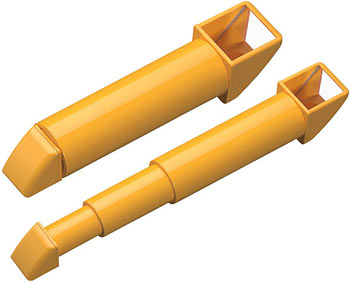
And then, there's this. It's the Looky periscope, and it does what you'd expect it to do. Collapsible tube, mirror at each end, siblings, for the spying on. It cost me only $AU10 plus delivery.

Navir have a couple of more impressive periscopes - one tank-ish version and one with magnification - but they're not nearly as sneaky as the little one-eyed Looky.

The Looky is the least educational Navir product I've bought, but it's also the one I most want to keep for myself.

On Doing The Impossible For A Living

This is great. It starts out with a straightforward job that's technically impossible (but, like many technically impossible things, easy to do when near enough is good enough), and leads into an entertaining discussion of mathematical proofs, both accepted and faulty, many of which have a lot more direct application to human life than you might at first think.

See also the gloriously annoying Doctor James Anderson, a computer scientist and garden-variety mathematical crank who's recently attained a certain amount of celebrity for his tireless work in polluting the brains of children with nonsense.

Light bulb diffraction

Diffraction glasses

These fun glasses for kids contain low grade "starburst" diffraction gratings.

You can use them to examine the emission spectra of different light sources, which tells you about their colour rendering, which in turn helps you pick lights which give more natural output. Such lights are nicer to have around your home than lights with poor colour rendering, and they can also assist you in serious colour-critical tasks such as telling your jelly beans apart.

I've bought a few optically superior diffraction gratings from this eBay seller, and it's fun looking at lights through them and shining lasers through them and so on. The ones in the kiddy-specs are uncalibrated (measure the spacing yourself!) and a bit cloudier, but they're also big enough to cover both eyes, and they get the job done well enough.

Halogen lamp diffraction

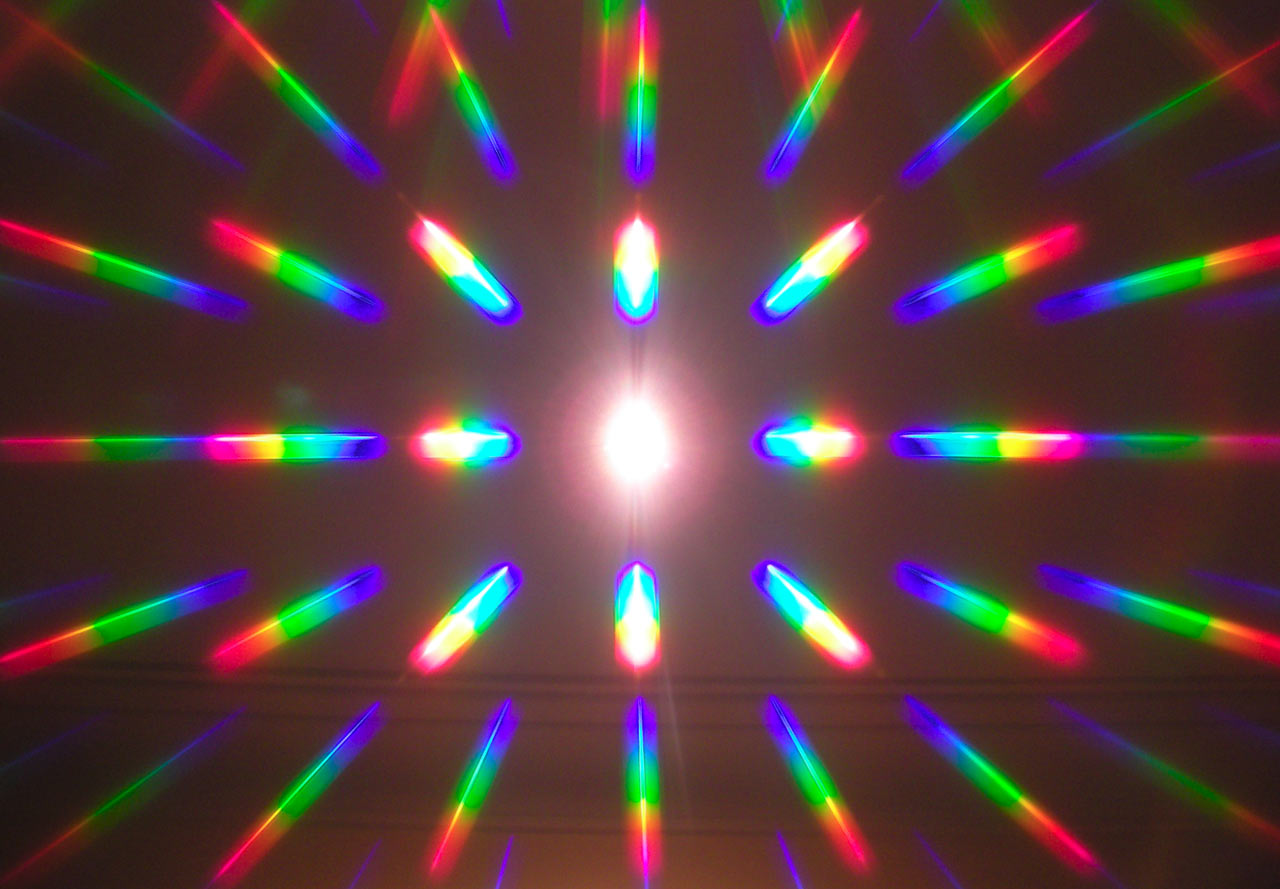
"The job", defined.

The light in the above picture is a normal halogen downlight, so its diffraction spectrum is a smooth rainbow, like sunlight or a candle flame. Lights with a lower colour rendering index have different spectra, and diffraction glasses make that easy to see.

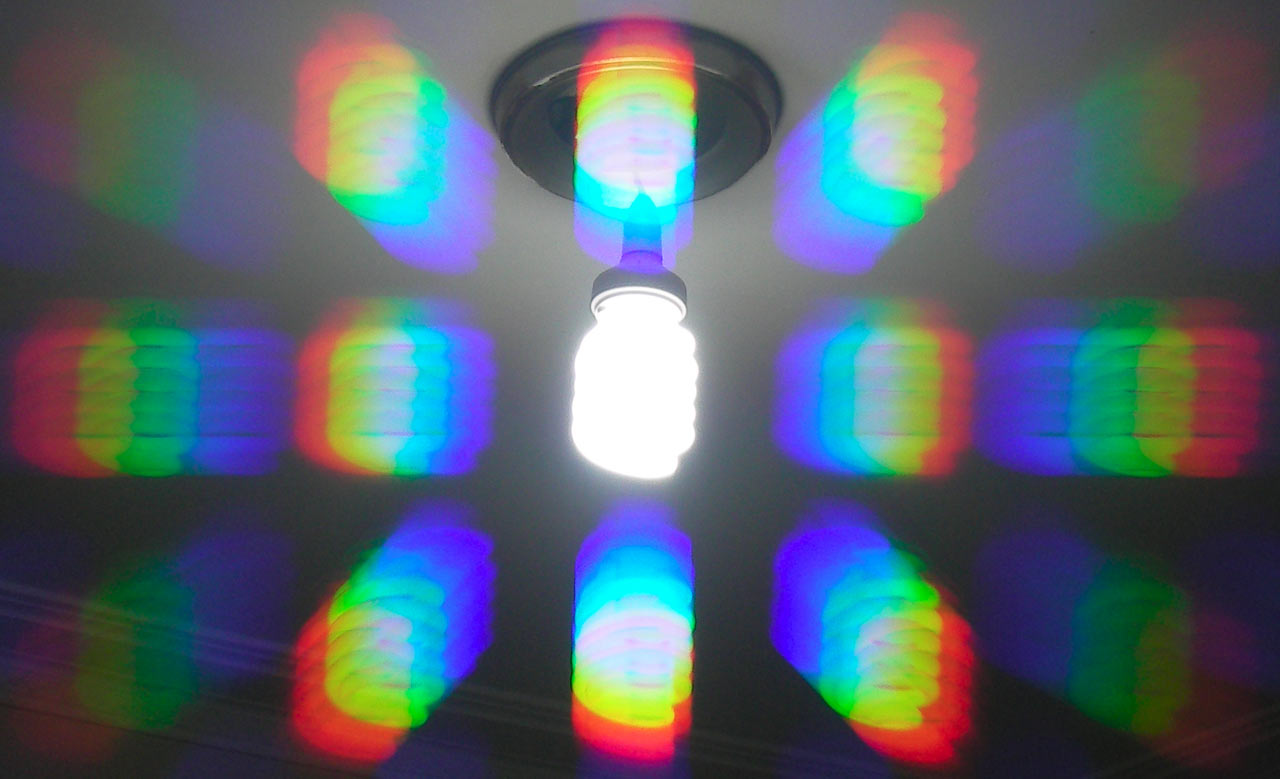
Big CFL diffraction

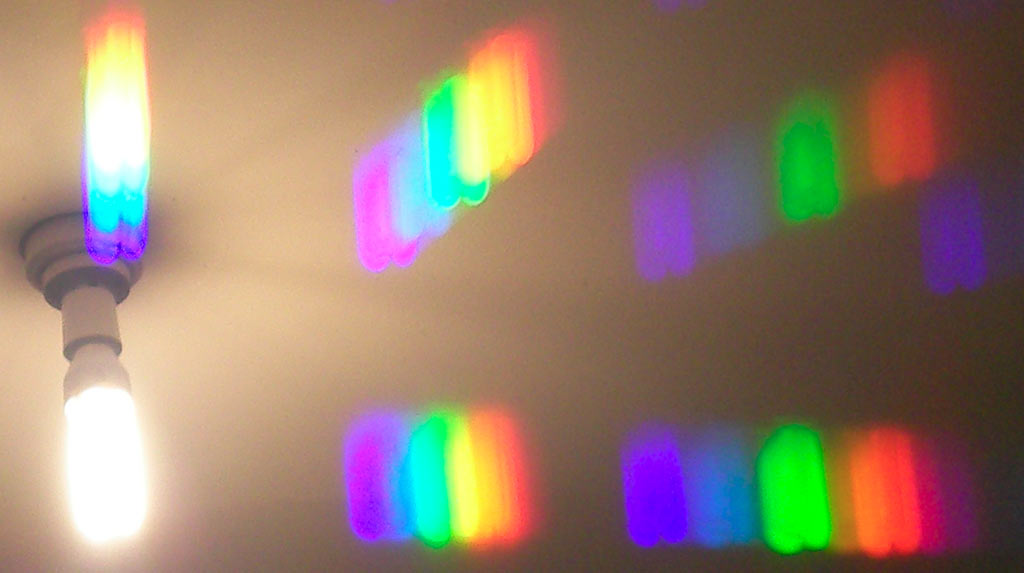
This is my giant compact fluorescent, which is alleged to have an eighty-plus CRI (where 100 is perfection), but which doesn't look that great to me. There's a smear of blue, probably indicating at least a bit of output colour range from the blue phosphor - perhaps a darker and a lighter blue on top of each other. But then there's quite distinct sub-images of the lamp in green and red, suggesting that it's got quite narrow output in those ranges.

But it sure is bright, as low-CRI lights tend to be; the classic "triphosphor" fluorescent lamp is still popular, because it's cheap and very high efficiency. It makes everybody look like corpses, but that's just the price you pay.

(I probably would have got a better shot of the big CFL from further away. It's so large that its sub-images overlap a lot at this distance.)

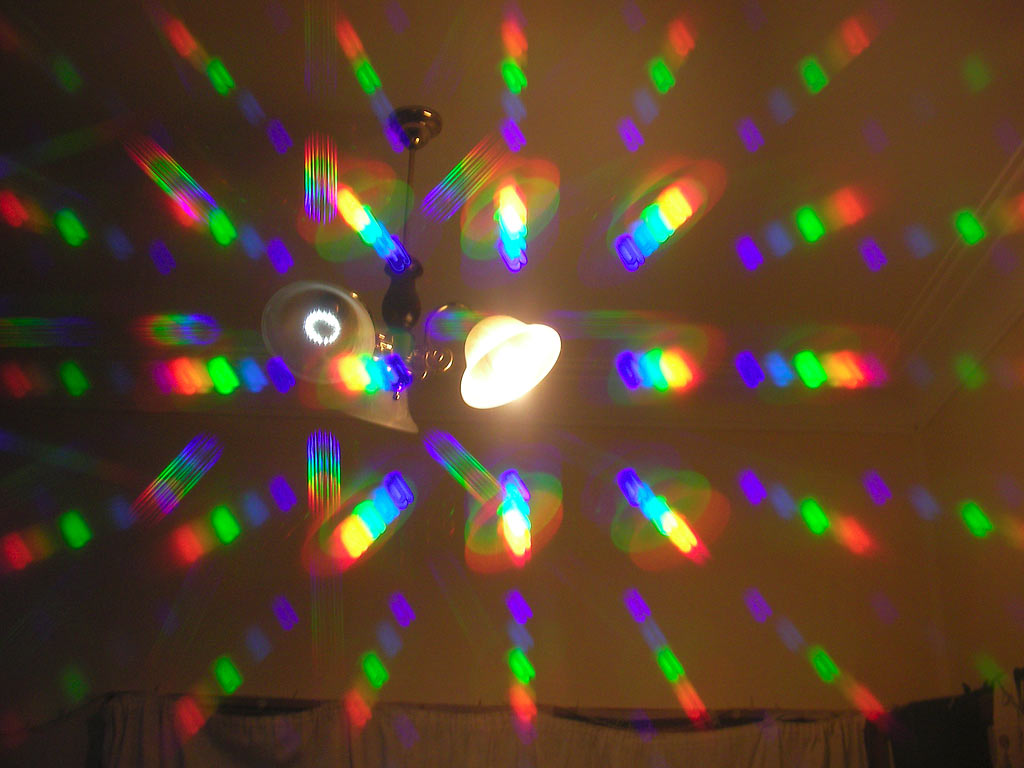
Compact fluorescent diffraction

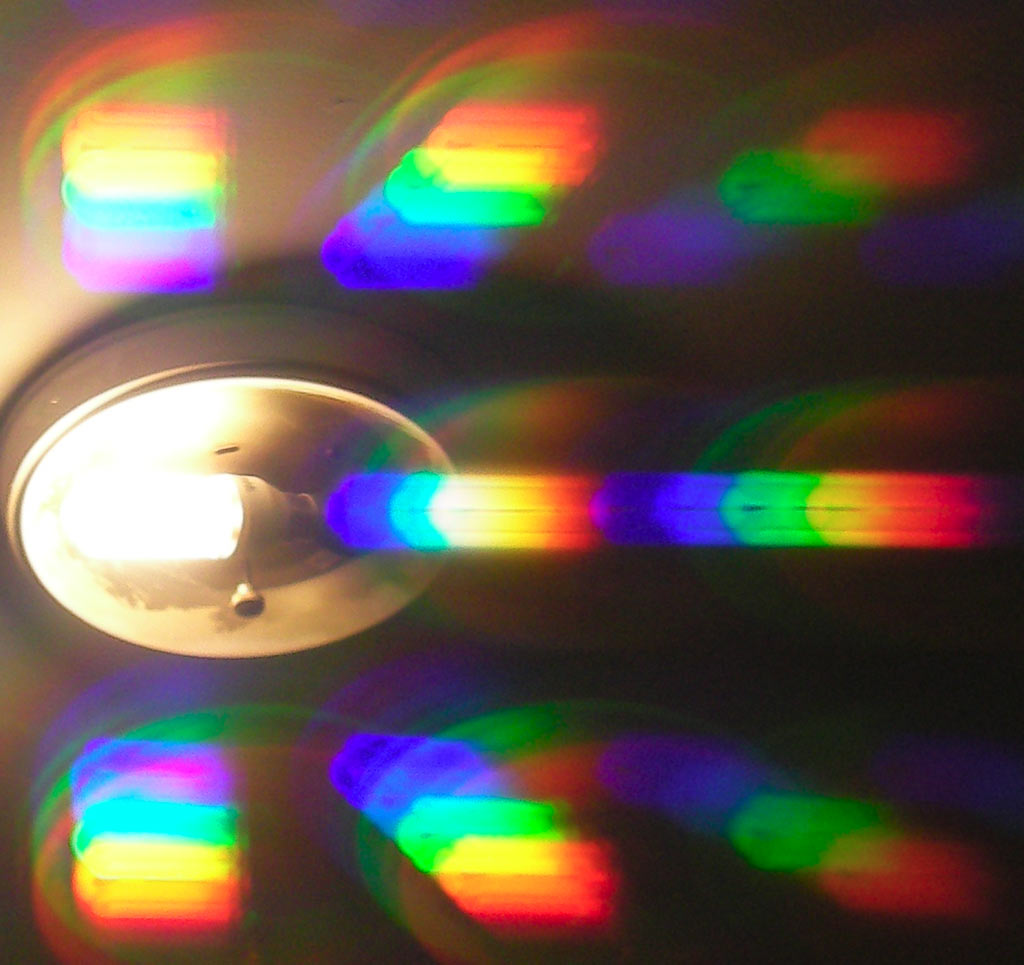
A normal modern "warm white" compact fluorescent lamp (CFL), flanked by a half-burned-out LED lamp of no particular distinction.

You can see quite distinct violet, blue, green, orange and red diffraction images, each of which ought to correspond to a phosphor flavour. Generally speaking, the more phosphor colours, the better the CRI.

Compact fluorescent diffraction

Some good images from that lamp in close-up.

Compact fluorescent diffraction

A different CFL. I count four bright phosphors, plus two or three dimmer ones filling out the spectrum.

Compact fluorescent diffraction

Yet another CFL. Maybe only four phosphor colours in this one.

LED lamp diffraction

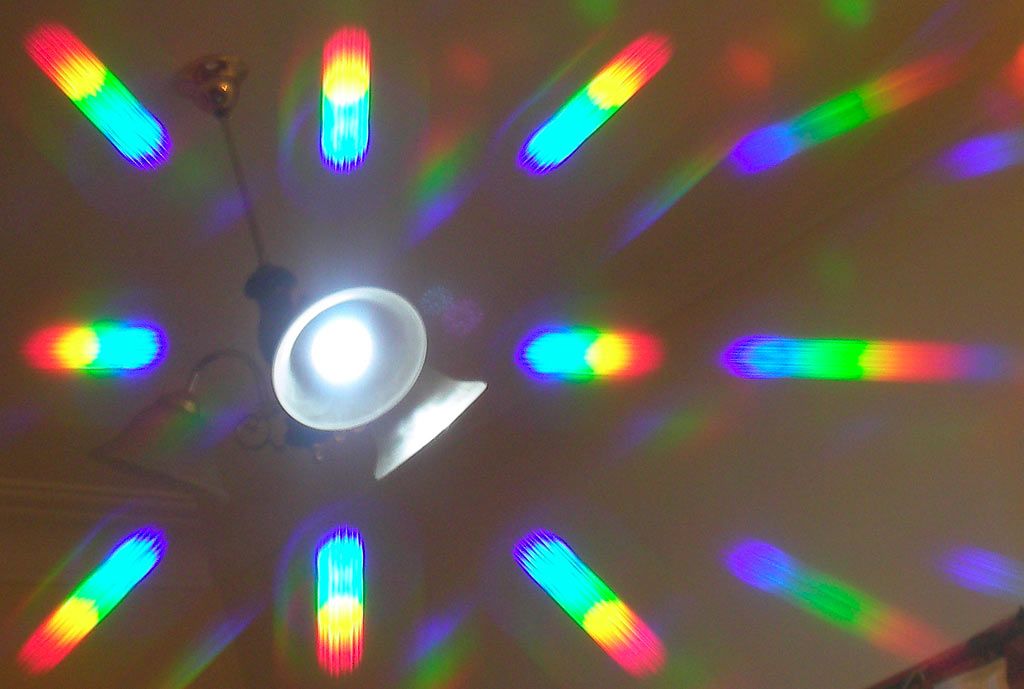
And, finally, another of those LED lamps, which really aren't a very interesting product - the only reason to use LED lamps for general lighting so far is if you want something that'll last 25 years, and these cheap Chinese lamps can't be counted on to last 25 days.

It's a nice spectrum, though. This is a normal "cool white" shade of white LED, created by putting a mixed phosphor layer over a naturally blue LED die. The result has quite good colour rendering.

I took all of these pictures with the little C6, by the way. It's got a physically small lens, which makes it good for taking pictures through other things, like these glasses, or telescopes, or whatever.

Dilute it enough and it turns into science

There's something to be cherished in those moments when people in positions of authority decide it's time to make perfectly clear that they shouldn't be.

So I'm happy to report that one Lionel Milgrom, on the Board of Directors of the UK Society of Homeopaths, is now, officially and unquestionably, a whiny little liar.

I was going to e-mail him and ask him why he hasn't apologised for what I originally presumed to be, I don't know, an e-mail sent while drunk or something, but apparently all you can expect from him in return is abuse, so I think I'll give it a miss.

This isn't really news, of course. Professional apologists for orthodox homeopathy must, like professional apologists for young-earth creationism, be able to accept the complete wrongness, and indeed frank dishonesty, of the basic arguments they present, and yet come out swinging again the next day as if nothing has happened. Anybody with enough moral fibre that they can't stomach doing that is naturally replaced by someone who can. It's like politics.

(I ramble on about homeopathy here and here.)

Entertaining additive

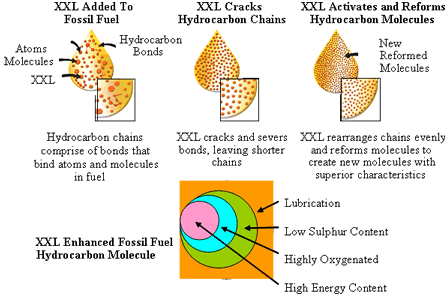
XXL Bio-Fuel Enhancer is an amazing development from Malaysia, where there are many palm oil plantations and palm oil costs very little. And where, by means of a secret refining process, it turns out that one can convert this palm oil into "XXL nano-molecules that can crack and reform hydrocarbon molecules in fossil fuels into high quality, powerful fuel molecules that contain vast amounts of energy and oxygen"!

And all you need is one drop per litre! Which is good, because now the palm oil costs, I don't know, a hundred times as much? More?

Extremely plausible explanation

See? It's just that simple!

And in absolutely no way a gigantic pile of bollocks!

Don't listen to those people who foolishly suggest that breaking molecular bonds to turn a compound into another with greater combustion energy is difficult without, you know, some kind of energy input. Not to mention anybody who points out that when your fuel molecules already have oxygen in them, that means they're already partially oxidised, which means you get less energy when you burn them (that, essentially, is why alcohols have less energy per litre than hydrocarbons).

Presumably one should be careful not to add too much XXL Bio-Fuel Enhancer to one's fuel tank, lest it crack all of the bonds in the gasoline hydrocarbons and leave you with a fuel tank full of charcoal, and a cloud of hydrogen floating away into the sky.