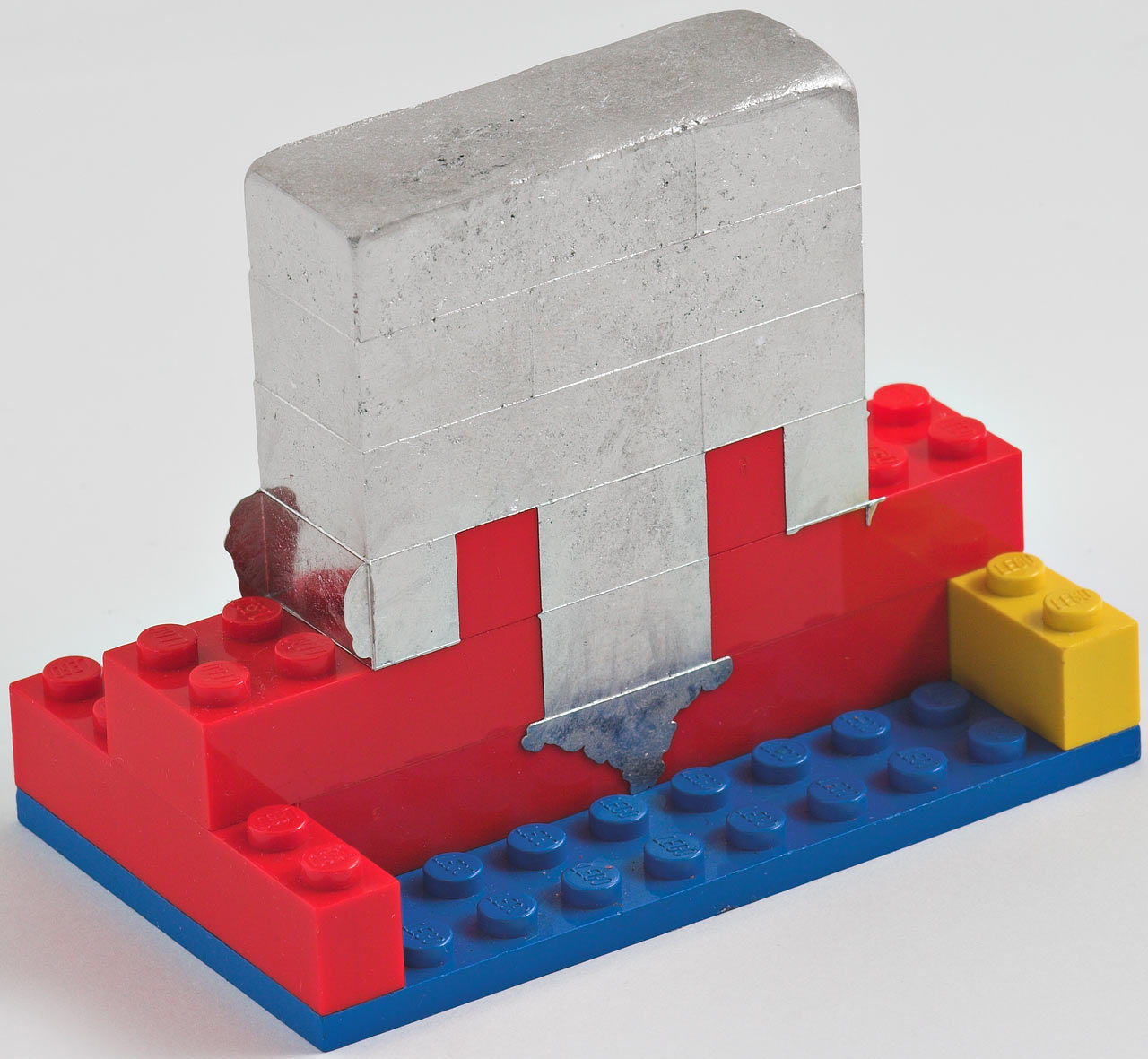
It is, however, exactly what it looks like - a metal casting that's been poured in a mould made of Lego. Plain Lego bricks are, of course, made from ABS plastic, whose melting point is a bit above 200 degrees Celsius.
There are lines on the side of the casting that give the impression that it's made out of bricks itself, but they're from the bricks that moulded it - the metal is all one piece.
You could even make actual metal Lego bricks this way, if you wanted to. Just make a rubber mould of the brick, and pour the metal into that.
The reason why it was possible - easy, in fact - for me to do this without instantly destroying the mould and setting fire to the kitchen is that the metal is Wood's metal, a bismuth-based eutectic alloy. Its melting point is only 70 degrees Celsius, and the "eutectic" part means it melts and freezes as you'd expect a normal substance to, at one temperature, rather than having one component of the alloy remaining solid or liquid while the other changes state.
(I got my Wood's metal on eBay; here's a search that finds a few current sellers of the stuff.)
Anyway, you can melt Wood's metal in boiling water - or in a beaker sitting in some boiling water, which is what I did. Then I just poured it into the mould and left it to sit.
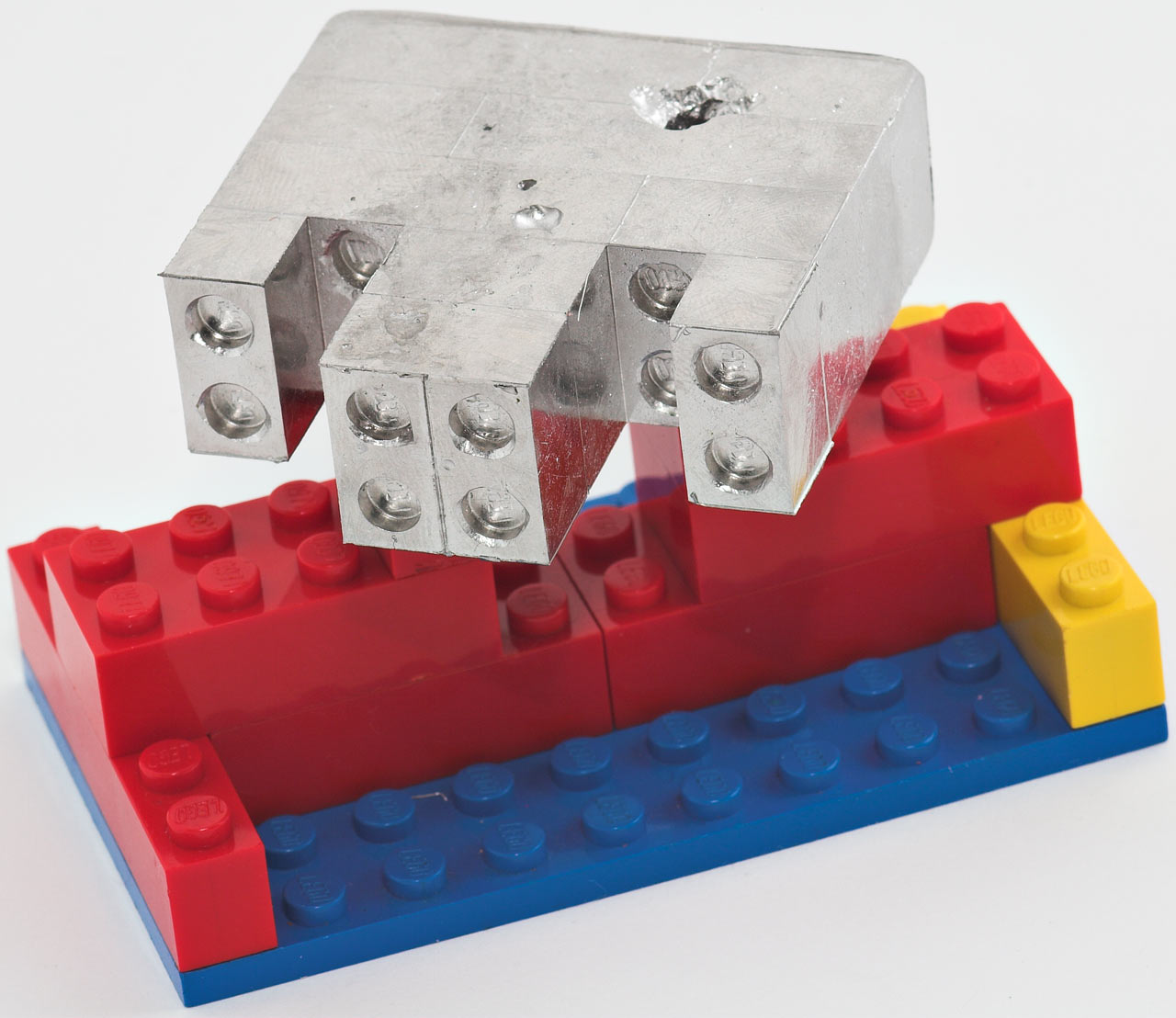
Here's the casting, removed from the Lego and with the bits of flashing where the metal flowed into the gaps between bricks broken off.
Never has a brick separator been more useful. I needed pliers to get the two 2-by-1 bricks out, though.
There are a couple of obvious voids in the side of the casting, because I didn't agitate the mould to bounce bubbles out of it. It's usually a good idea to pre-heat casting moulds, too; the Lego was only at room temperature.
For a first attempt, though, this really isn't bad.
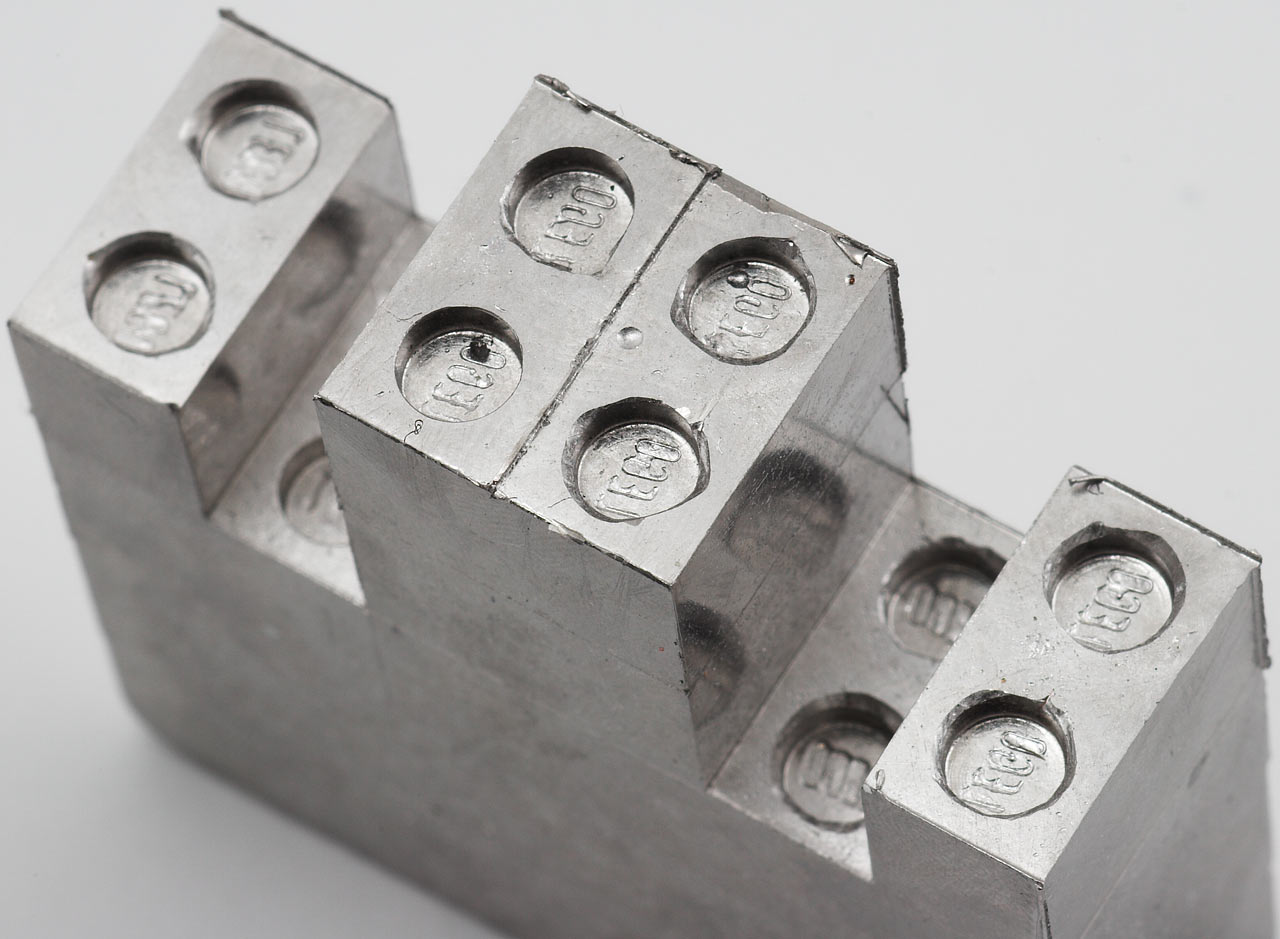
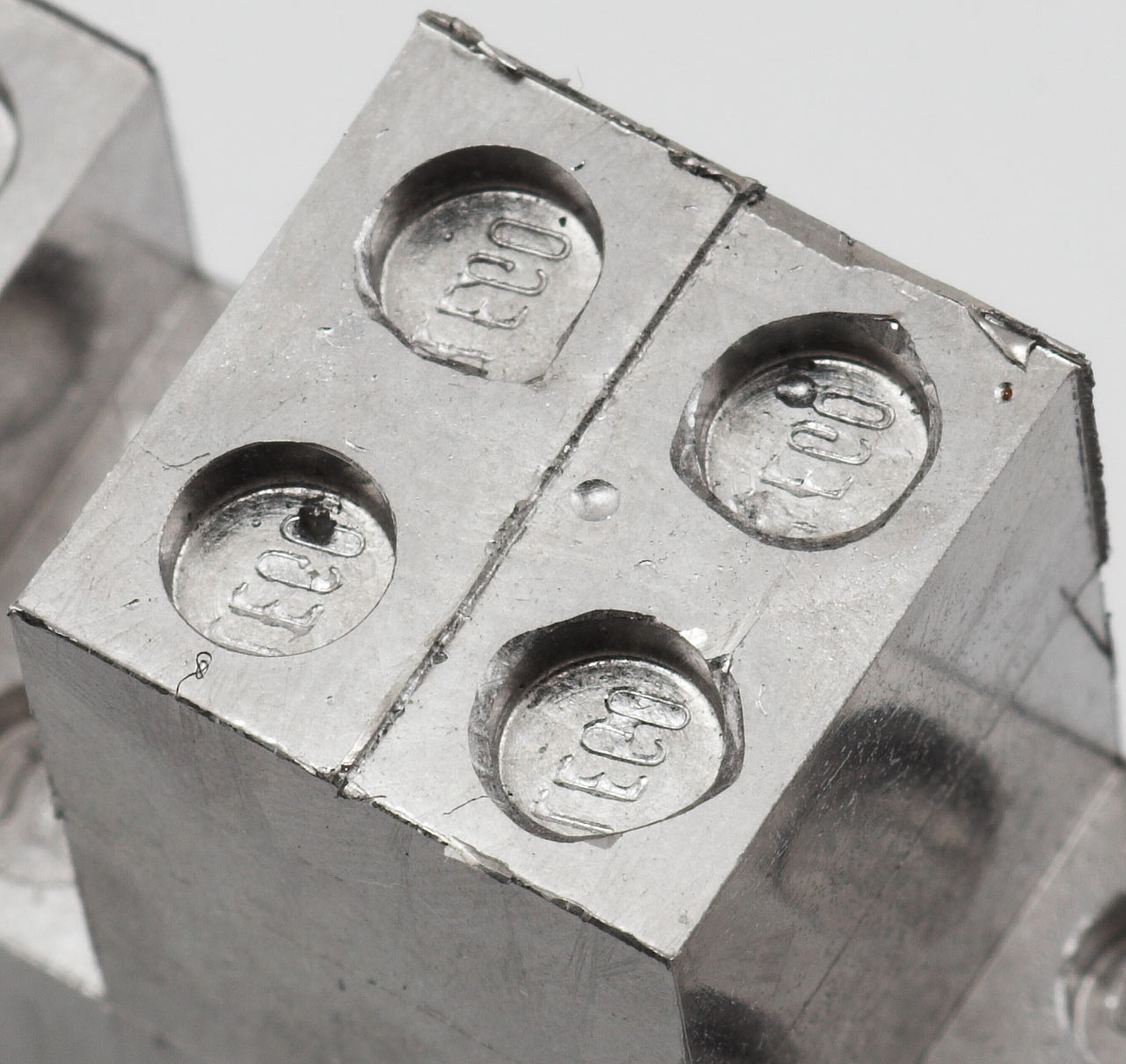
It's close enough that if I wanted to put it back together with the Lego, it'd actually matter whether the "LEGO" stamped on the tops of the blocks was the right way around.
Wood's metal isn't very hard or strong, so you can't use it for most serious casting purposes. Because it's got lead and cadmium in it, you should also be a bit careful with it, though if you wash your hands afterwards and refrain from eating any of it, you should be fine (the other constituents are bismuth and tin, both of which are safe enough; Wood's metal overall is far less dangerous than mercury). But you can still use it for, for instance, casting up temporary holders for odd-shaped things on which you want to perform machining operations, or filling fragile tubes before you bend them. Just pour boiling water over the thing afterwards to get the Wood's metal out.
Back on the Lego kick, Wood's metal is pretty dense, so you could use it to increase the weight of existing bricks. This could come in handy if you were, for instance, competing in a Lego robot sumo contest and didn't have any of the very rare official lead-weighted bricks to make your 'bot heavier. More practically, it's a casting alloy that you could pour into the nose of a model plane, or something, to easily put weight where it's needed.
Wood's metal is easy to buy from metalworking suppliers and on eBay. The stuff I got is allegedly a more precisely measured mixture than the cheaper bulk versions, which may or may not have justified its somewhat higher price; I got it from this eBay dealer, but they don't have any on sale as I write this.
After I said rude things about an incoherently promoted automotive gadget in this letters column (as usual, it promised to give you better fuel economy, more power, and anything else they could fit on the page), one of the people who worked there sent me an e-mail.
He was, thankfully, not threatening to sue me (unlike some people mentioned in that same column...), but he did say that it was their policy to only charge customers who agree that they "feel the difference".
He asked me if I'd ever heard of a scammer who offered this level of service. He has not replied to me since I told him "yes, just about all of them".
Money-back guarantees are, actually, absolutely standard in this field. I'm sure some of those guarantees are fake, but they seldom need to be. People who're willing to buy a quantum dimensional vortex optimiser for their car's fuel line are also people who're likely to "feel the difference" from it, even when there isn't any actual difference to feel.
I often link to Tony Cains' excellent Guide to Fuel Saving when I'm talking about these kinds of gadgets (and fuel additives), because he's pretty much got the whole field covered. His page about the dangers of testimonial evidence is particularly relevant, to both this specific issue and the general subject of bogusproducts in which people believe.
Stuff I Did Years Ago But Am Only Blogging About Now:
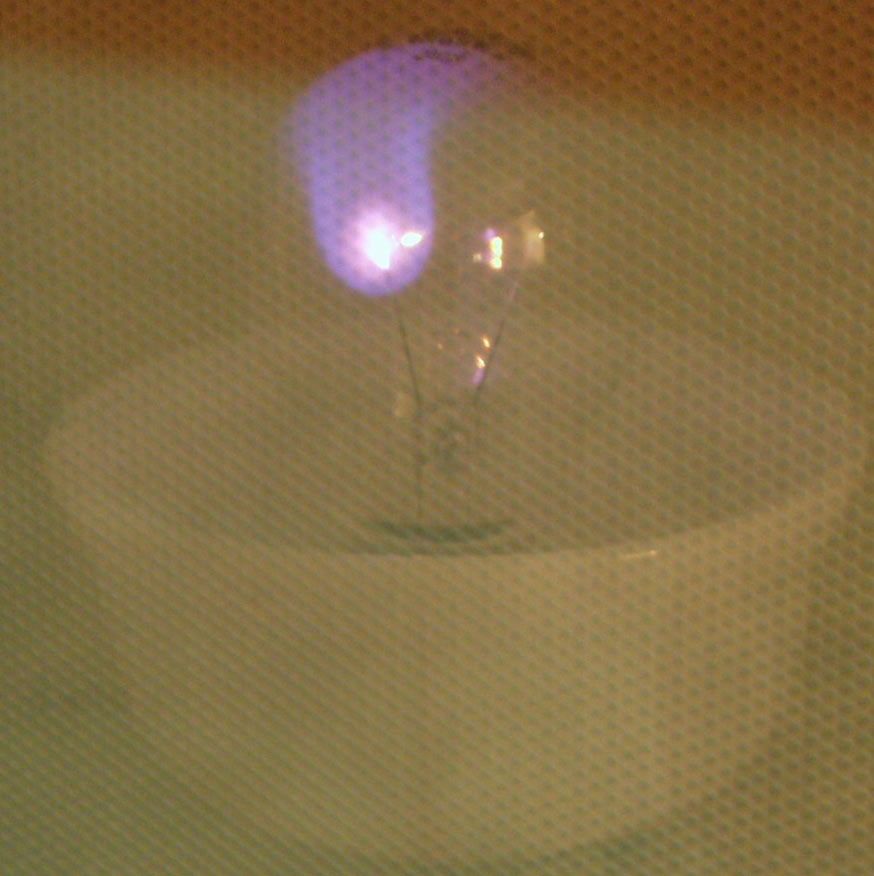
I microwaved a light bulb.
I took pretty ordinary pictures of it at the time, but in this modern age, it's easy to find video of this trick...
...among others.
The milk is not actually specifically necessary, though it is a good idea to put a glass with some water in it in the oven along with anything weird you intend to nuke, so that the microwave can sink some energy in the water. A light bulb or CD or grape or whatever looks like nothing to a microwave oven, and it's not good for them to run them empty.
I was thinking of making a video to demonstrate the near-magical process of electrolytic de-rusting that I mention in this column, but I don't need to, because someone already has:
Everything you need to know is in the video.
Note that it's fine to immerse an alligator clip holding onto the part to be de-rusted, but the clip attached to the sacrificial positive-terminal steel must not be immersed, or you'll sacrifice the clip too.
Note also that even a strong sodium bicarbonate solution won't hurt your skin - well, not quickly, anyway.
Commercial electrolytic derusting is often done in a sodium hydroxide bath, which will (a) turn you into soap if it gets a chance and (b) produce some really choice fumes.
The other day, I got in an argument with an eminent and highly respected man - and, just to make me feel even more of a jerk, his lovely wife - about cars.
Unfortunately, cars were not his strong suit.
I didn't ask, but I'm perfectly certain that he has never watched Top Gear.
But, like most people who've been driving for a lot longer than I've been alive, he's pretty sure that he knows more about cars than me.
He and his wife own, and adore, a Toyota Prius.
The Prius is very good at exactly one thing. That thing is consuming small amounts of fuel in city traffic.
Hybrid cars are made for city traffic, because they stop their engines when they're sitting still. Every other car keeps its engine running when it's stationary, sucking down fuel at a magnificent zero miles per gallon. Hybrids don't. So, in city traffic, they get something pretty close to their highway fuel economy.
("Litres per 100km", by the way, is the standard Australian measure of fuel economy. It is stupid. It turns people's brains backwards when they try to figure out how far they can go on X litres of fuel, and it's also an inverted metric compared with miles per gallon - more mpg is good, but more l/100km is bad. If we used kilometres per litre, one of which equals 2.35 miles per gallon, I wouldn't have a problem. But we don't, so I'm sticking with the lesser of two evils and using miles per gallon.)
This excellent fuel economy in stop-start traffic, plus the lower pollution contribution of a car that doesn't run its engine when it doesn't need to, makes a hybrid an excellent vehicle for people who do a lot of city driving.
Out on the highway, hybrids still get decent mileage, but not because they're hybrids. They do OK on the highway because they're light (which means aluminium, which contributes to the cars' price), and have excellent aerodynamics, and have low rolling resistance tyres - like when you pump normal tyres up to 60psi, but, you know, safe.
Some hybrids, like Honda's Civic version, even use special low viscosity oil. The Prius doesn't, though.
Hybrids get some assistance from their electric motors on the highway, when overtaking or trying to maintain speed up hills. But that's because they've got weedy little engines (76 whole horsepower at 5000RPM, for the current Prius - I think that's actually beyond the engine's redline) that need that assistance. You can save a lot of fuel if you manage to avoid accelerating up hills, but hybrids can't entirely avoid that unless you let significant speed wash off when travelling uphill.
Unfortunately, my statement of this fact, and my further observation that the choice of informed fuel misers for all-around driving is actually something like a Volkswagen Golf TDI, went down like a lead balloon. My conversational companions were firmly convinced that the only things that sipped fuel slower than their Prius, in any situation, were glorified lawnmowers incapable of comfortable highway driving.
They'd seen it for themselves! They'd driven from Sydney to Melbourne - about 900 kilometres - on eighty Australian dollars worth of petrol!
My observation that I could do that in my dented 1995 Nissan Pulsar - if you can manage 35 miles per gallon on the highway, you're there with a hundred kilometres to spare - was received with disbelief.
(Actually, I think they might have said they went there and back on $80 worth. That'd require a minimum of about 62 miles per gallon, which I don't think any human has every managed to wring out of a Prius on public roads. About 55mpg is the best I've ever seen reported.)
Things really went downhill when I foolishly mentioned that the Prius does not handle well.
Which it doesn't, because it's physically impossible for it to do so. Priuses have a comfortable ride and low rolling resistance tyres, and therefore cannot possibly grip the road very strongly.
Handling is, of course, absolutely one hundred per cent irrelevant to most drivers most of the time, especially if they're driving a car with stability control (which the Prius has). Stability control lets an ordinary driver in a low-grip car successfully cope with unexpected situations which would probably defeat an excellent driver in a high-grip car. It's amazing, it's almost magical, and it's a crime that it's still practically impossible to find in cheap cars.
When push comes to shove, though, a Prius does not have a very large performance envelope, and traction control cannae break the laws o' physics. It is easy for a Prius to run out of traction, and when it does...
...it understeers directly to the scene of the accident.
I did not succeed in explaining this to my conversational partners, who firmly insisted that their Prius had excellent handling.
My working hypothesis is that this is because they do not actually know what handling is, and have confused it with ride comfort.
I freely admit to making a further blunder when they pointed out that their other car also has excellent handling, and volunteered the information that it's another Toyota.
I couldn't help, at this point, blurting out that this proved that they knew nothing about cars at all.
Which I should not have done.
I shall draw a discreet veil over the rest of the conversation, except to mention that the phrase "we'll agree to disagree" was directed at me.
I have used that phrase myself. When I use it, it means "You're wrong, and stupid, and I would like you to be quiet now". I suspect it might have meant that in this case, too, since when I offered to e-mail the gentleman the evidence, he said he'd rather I didn't.
Anyway. To finish off, here are the three basic classes of very economical car that normal human beings might want to own, while we're waiting for that groovy modular automobile to come along.
1: A Prius.
Great in town. Tolerable on the highway. Bad if you have to steer suddenly to avoid hitting something. New and shiny and nice.
Insofar as there exists such a thing as "an average driver", a Prius is realistically good for a quite remarkable 50-plus miles per gallon overall if you're careful, and 45mpg even if you're not.
You could probably abuse a Prius into delivering only 40mpg if you really tried. Lots of very short trips would do it, if you don't make judicious use of the EV button. But you wouldn't have a lot of fun doing that, which rather defeats the purpose of wasting fuel.
2: A Volkswagen Something-Or-Other TDI.
The 1.9 litre Volkswagen turbo diesel, when mounted in its natural habitat (a Golf), is good for a perfectly realistic 55 miles per gallon. Maybe only 45, if you're a more excitable driver and/or have an older Golf.
You can get at least one and a quarter new diesel Golfs for the price of a new Prius, at least here in Australia.
Like all other diesels, the TDI can run on biodiesel, which gives it more environmentalist bragging points than any petrol Prius will ever have.
3: An old-ish diesel, canonically a Mercedes-Benz 300D in an unattractive colour.
A decent 300D will cost you a tenth as much as a Prius. Its fuel economy and general performance are both quite unexciting - though it wouldn't surprise me if an orange 300D wagon could beat a Prius around a track - and it very conclusively lacks stability control, though you don't have to pay much to get one new enough that it at least has anti-lock brakes.
The Unique Selling Point of cars like the 300D is that you can run them on waste, or even fresh, vegetable oil.
In theory, you can do this with no conversion equipment at all, if you live in a nice warm place like Australia (the oil thickens in cold climates, requiring tank heaters and/or a dual fuel system). In practice, you'll need a new fuel filter and maybe a new hose or three.
But that's all, for a $3000 car (donate the money saved to the dolphin-hugging organisation of your choice), with most modern conveniences, that runs on filtered fry grease.
Thereby putting to shame even the biodiesel crowd, let alone those dinosaur-burning Prius drivers.
Here in Australia, big cans of brand new vegetable oil currently cost, at retail, only about 1.5 times as much per litre as mineral diesel.
A huge plastic tank of filtered waste oil meant for animal feed will probably cost you quite a lot less than mineral diesel, even including delivery by a confused fellow in overalls who can't figure out where you're hiding your cows.
All nerds worth their salt know about the Buran. It was the Russian Space Shuttle, that looked like a straight knock-off of the US original a la Concordski, but which actually had considerable improvements over the American horse-designed-by-a-committee.
(In this regard Buran was, arguably, also like Concordski, despite that aircraft's distressing tendency to fall out of the sky.)
Buran wasn't completely liberated from the stupidity of the Shuttle's design. It still sat dangerously on the back of its giant fuel tank rather than in the obviously-more-sensible on-the-nose-of-the-tank position, despite the fact that it didn't have the rear engines that force the Shuttle to be where it is, getting smacked by foam and blown to bits by booster failures.
But the Buran was still better. The Soviet Shuttle program didn't get off the ground, but the hardware was just fine.
Anyway, six years ago I was working at the end of Darling Harbour (I didn't stay there a lot longer...), and was reviewing the then-remarkable, now-pointless Sony Mavica MVC-CD1000 digital camera (it used 77mm CDs for image storage, which was a good idea when a megabyte of memory card cost five bucks, but is ridiculous now that the price is three cents).
Click for the full sized version, complete with antique EXIF headers.
After this, that poor old bird got dragged all over the place, and has I think been stuck in Bahrain for some time now. OK-GLI is, however, apparently eventually going to take one last boring sea-and-land trip to a German museum, where it can rest in peace with a Concorde, a Concordski, an enormous Cock, and lots of other neat stuff.