WANTED: People to kick me in the nuts and take my stuff

A certain subset of the Craigslist user base has a well-documented lack of reasoning skills. This may explain why all you have to do to get someone's house completely ransacked by a bunch of freeloaders is post a Craigslist ad that says something like:

"I, John Smith of 123 Acacia Avenue, Chickenmilk, Wisconsin, am aghast about the cancelling of the Bionic Woman TV series, and will be setting myself on fire this afternoon to protest it. So I've no further use for any of my possessions. Come and get them! Everything's free! If the house is locked, just break a window!"

The first time this happened was a year ago. That ad was apparently placed by a disgruntled recently-evicted tenant. The ad only survived for about an hour and a half, but that was long enough to attract plenty of avaricious house-wreckers to thoroughly trash the joint in question.

This second example has a bit more meat to it. Apparently this time the ad was posted by a couple of people who'd stolen some stuff from one Robert Salisbury's house a few days before. Then they decided to cover their tracks with the fake-ad scam, inviting other random people to steal everything else - including a horse, about which the scammers posted a separate ad.

The perpetrators of the Salisbury scam have now been caught. But the only reason that happened was because, with the idiocy so characteristic of the amateur criminal, they used their own highly traceable computer to post the ad.

If I were them, I would have posted the ad from an Internet cafe. Or, for extra evil points, from some poor suburban sucker's open wireless access point. I just checked to see if Craigslist accepts Mailinator addresses - yes, it does!

Malicious ads themselves are not new. The classic example is an ad for a brand new Porsche for only a hundred bucks, allegedly placed by a wife whose husband cheated, or something. Such ads have been filling victims' weekends with phone calls and irate visitors for many years.

If you're posting a malicious ad just about anywhere but Craigslist, though - in the newspaper, for instance, or on eBay - then you'd have to pay for it somehow. That payment can often be traced.

But Craigslist ads are free.

This no doubt accounts for the host of other scams that pop up, however briefly, all over the site.

(I've never actually used Craiglist for anything, so I might have missed something obvious that makes this scam harder to pull off. Tell me in the comments if I have.)

The interesting part about this sort of hoax/scam is that it has two levels of perpetrator. The main perps are the people who post the malicious ad; the secondary perps are the people who then come and take everything, in good faith or not.

I wonder if you could pull off the same scam without using the magic anonymous Internet - by, for instance, sticking flyers on telegraph poles around the neighborhood, or dropping leaflets in letter boxes?

Various commentators have remarked on people reading the Craigslist ad who apparently figured "it's on the Internet, so it must be true"; some of them brought printouts of the ad to wave at poor Mr Salisbury when he was trying to stop them driving off with his belongings.

You're never going to go broke by underestimating the intelligence of Internet users, so I'm quite sure some of those people were entirely sincere. But I think many of the people just figured the ad made a good excuse for what they were doing.

Free magazine!

The Skeptic is the official publication of the Australian Skeptics. It's edited by Barry Williams, who has kindly made the digital version of this year's Autumn edition (The Skeptic is published four times a year, and it is of course now autumn here in Australia) available for free. That's an eleven Australian dollar value, at the standard one-year subscription rate!

In this edition: A Psychic Course On How To Contact Missing Persons And The Deceased, The Placebo Effect Explained, Vitalism and Mystical Energies and, as they say, more.

The PDF file is only 5.75Mb, and I've made a torrent of it to save Barry from his previous distribution method, which was manually e-mailing the file to people who asked for it. And yes, he specifically asked me to do this, just as Tim Hunkin asked everyone to distribute The Secret Life Of Machines.

Y'all can download the torrent right here.

(If you, like Barry, are still a bit hazy about what this BitTorrent thing actually is, this beginners' guide should help you out.)

I'll take "things that burn asbestos" for $100

The sadly neglected "Things I Won't Work With" category of Derek Lowe's organic chemistry blog (previously) now has another entry, as a result of an innocent inquiry regarding what chemicals will, if you dump sand on them to try to stop them burning, start cheerfully burning the sand.

It turns out that chlorine trifluoride (merely discovering that one Cl and three Fs can in fact be squished together should send shivers up the spine of anyone who was paying any attention at all in high school chemistry) is a party looking for a place to happen.

STOP PRESS: Pixie dust unsuitable for household lighting

A reader pointed this page out to me, about the recent Greener Gadgets Design Competition $1000-second-prize-winning Gravia "floor lamp powered by gravity".

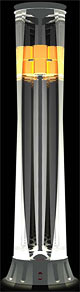
Gravia lamp

It's a funky looking thing, which was widely reported around the gadget blogs, and was alleged by its designer, Clay Moulton, to give the equivalent light output of a 40-watt incandescent bulb for four hours from the energy of a weight dropping about four feet, or 122cm. When the weight gets to the bottom, you just lift it back to the top and away you go again.

Now, it stands to reason that a mere 1.2-metre drop isn't going to give you forty actual watts for four hours unless the weight is incredibly heavy. Ignoring losses, it would by definition take forty watts of power over another four hours to lift the weight back up again, which is 160 watt-hours, which is quite a lot. A normal adult human in reasonable shape can manage about 75 watts of output when pedalling away on a bike connected to a generator; it'd take more than two hours of such pedalling to raise that weight back to the top of the Gravia light's tube, if the weight were heavy enough to make a constant 40 watts on the way back down.

So I just assumed the lamp's brightness was greatly overstated, and wasn't even four-watts-of-LEDs-that-are-sort-of-equivalent-to-forty-watts-of-incandescent. But since they'd clearly actually made the thing and it'd won an award, I presumed it did work, if only as a night-light. Fair enough.

But neither Clay Moulton nor anybody else has, actually, built a Gravia.

The damn thing doesn't exist.

And Mr Moulton, who apparently designed the thing as part of his Virginia Tech master's thesis, didn't even bother to check whether his design could possibly bloody work at all, even if you built it with LEDs from ten years in the future.

Looking at the schematic for the Gravia shows that the falling weight is defined as fifty pounds, which is 22.7 kilos, which is indeed about as much as a variety of humans could reasonably be expected to be able to lift back to the top of the tube every few hours.

22.7 kilograms falling 1.22m in gravity of 9.8 metres per second squared gives you a grand total of 271.4 joules.

That, once again ignoring losses (which are likely to be considerable, seeing as there's a ball-screw and an electrical generator in the Gravia), will by definition run a one-watt lamp for 271.4 seconds, or four and a half minutes.

If you downgrade the lamp to one tiny 0.1-watt LED night-light, you get three-quarters of an hour.

The maximum possible luminous efficacy for any kind of lamp that will ever exist - if every quantum of energy going into the thing is used to make visible photons that come out - is 683 lumens per watt. And that's for a lamp that emits monochromatic 555-nanometre green light, not white (the world record for white LEDs in the lab so far is less than 150lm/W), but never mind that for now.

So if your tenth-watt lamp is just such a perfect device that can never actually exist, it will emit 68.3 lumens of light.

There's no standard lumen rating for an incandescent 40-watt bulb - generally speaking, the ones that last longer have lower output - but something like 400 lumens is in the ballpark. Actually, the Gravia has been alleged to output 600 to 800 lumens, but even if you only shoot for 400, 68.3 lumens is 17% of the target.

So instead of the output of a 40-watt incandescent bulb for four hours, we've got the output of a 6.8-watt incandescent bulb for 45 minutes. And that's with a perfect lamp and no other losses in the system. With the best white-light lamp that humans will actually ever be able to make and million-dollar hardware for the rest of the thing giving the lowest possible losses, I think you'd actually be talking the output of a two-watt incandescent flashlight bulb for about 30 minutes. At best.

Looking at it from another angle, 271.4 joules is 271.4 watt-seconds, 683 lumens per watt is the physical limit, so by definition 271.4 joules of energy can only produce 185,366.2 lumen-seconds of light. Four hours is 14,400 seconds; 400 lumens for four hours is 5,760,000 lumen-seconds. So 271.4 joules into a perfect lamp can only possibly ever give you 3.2% of the required light. Or 1.6%, if you take the 800-lumen ceiling figure for the Gravia's output.

These facts have not evaded other observers, and have now also been communicated to the Gravia's designer. That pesn.com page now features, in the comments, about a minute worth of these back-of-an-envelope calculations that anybody with a basic physics textbook could have done, and it also now features an apology from the designer of the Gravia, who now concedes that the thing could not actually be made and that he did not deserve, and will be returning, the prize.

Actually, I reckon he did deserve the prize, since the Greener Gadgets people are clearly a bunch of idiots (see also: The New Inventors) and their prize is therefore worthless.

I hereby propose magical light paint, which glows harmlessly at 200 lux for 500 years (power source: A D battery filled with the blood of saints) and costs a buck a gallon. Tah-daaah! I just won first prize in the next Greener Gadgets Design Competition! Drop me a line, guys, and I'll tell you where to send the money!

The original press release about the Gravia on the Virginia Tech site now also contains a disclaimer from Moulton, though without any mention of him giving back the prize. I think it's worth mentioning one line he uses on both pages, though: "I was told it was not possible given current LED's, but given the rapid pace of innovation in low powered lighting, it would be a conceptual challenge."

Yes, Mr Moulton, it certainly bloody would be a "conceptual challenge" to make a lamp that produces more than thirty times as much light as the laws of physics say is possible from the energy you put into it. That would be a pretty damn impressive achievement. I propose Virginia Tech not permit you to graduate until you do it. How's that grab you?

The Gravia is very far from alone, of course. There's a veritable plague of these entirely imaginary "concept" devices. The gadget blogs are rotten with 'em. But usually these things have the decency to obviously just be a 3D render of some stupid concept that couldn't possibly work (image-intensifying sunglasses, say...). Sometimes it looks as if at least a mock-up has been created. Only seldom does an impossible device actually win an award for "design innovations for greener electronics".

(I suppose a lamp that doesn't work is, in a manner of speaking, quite "green". It reminds me of that Goodies episode in which string is a "safer and cheaper" subsitute for electrical wiring, "because it doesn't work".)

One bit on the Gravia's design competition page is particularly priceless: "Gravia is also [a] metaphor for an understanding of social activism."

Yes, Clay, it is. If you just sit on your arse and make shit up without paying any attention to the actual nature of the world, you will not succeed in social activism or lamp design.

It is... the FORBIDDEN link!

Australia is not alone in having some pretty hilarious copyright laws. But the Australian Copyright Council site presents some quaint little variations on the common themes which have just given me considerable entertainment.

The ACC's a non-profit company, largely government funded, whose purpose it is to provide Aussies with advice about our somewhat dotty local copyright laws. Their information sheet on "home taping" (the Australian government hasn't quite noticed hard disk video recorders yet) is about as straightforward as I reckon it could be (PDF here). It makes clear that the ACC's as bewildered by the current legislation's weirdness as all the rest of us. Fair enough.

But that weirdness seems to be leaking out, into the ACC's own brains.

I can't really say I'm surprised. Get this, for instance:

Here in Australia, it is currently legal to make exactly one backup copy of software which you have purchased, as long as there's no copy protection on that software, because Australia now has DMCA-ish anti-circumvention laws.

So far, so (relatively) sane.

But you're not allowed to back up anything but the actual program files.

To quote the Australian Copyright Council Information Sheet on that subject (PDF here), "you would be entitled to make a backup copy of a disk or CD-ROM that only contained computer software, but not a disk or CD-ROM that included other copyright material, such as a computer game, music, text or images" (emphasis mine).

So, apparently, you can copy anything that ends in .exe or .com off your program disc... but nothing else. Not even the readme file.

Which means, going by what they seem to be quite clearly saying, you can't actually make any kind of real backup of something like a game disc, which these days is likely to contain only a few per cent of executable code by volume, the rest being taken up by the all-important graphics and sound data, without which the game will not work.

Actually, it's likely to be impossible to legally back up anything but the installer program on most game discs, since the rest of their content is likely to be a few giant compressed files containing all of the stuff which the installer unpacks and copies to your hard drive. Some will be "software" by the copyright-law definition; most will be "other copyright material", and you probably can't separate them. Not that it'd be worth doing if you could.

Thinking about this sort of thing on a day-to-day basis appears, as I said, to have affected the Australian Copyright Council's grip on reality.

I base this assessment on the fact that they forbid the world to directly link to any of their information sheets, or apparently even to any of their Web pages, unless you ask first.

So, because I'm sad to say I neglected to ask them (what if they said no?!), I was not in fact allowed to do this. Or indeed even link, without asking, to the page that forbids you to link to pages without asking.

People all over the world have been laughing about stupid linking policies since long before the Stupid Linking Policies site was established in 2002, but the darn things just keep popping up. They're legally ridiculous and don't even serve a social function, since anybody can tell in a matter of seconds who's linked to them (well, as long as someone's clicked the link) by just looking at their server logs, or using Google Analytics or any of a zillion other Web stats services. So you don't even need to put a "if you link to me, please send me an e-mail" note on your site, much less angrily FORBID people to link to you unless you've explicitly permitted it.

You're also, by the way, not allowed to print more than one copy of any of the ACC's documents, without asking them for permission.

So if you print a copy and lose it, remember to ask before printing another one!

I suppose this is marginally better than the companies that refuse the world permission, under any circumstances, to link to all but one of the various pages which they carefully and deliberately made available for the world to see on the Web server they carefully and deliberately connected to the Internet, and didn't even "protect" with a cockamamie page of legalese with an "I agree" tickbox at the bottom.

(It is, of course, also easy to make your Web server refuse deep links. If you don't, then I suggest that you must not actually be terribly serious about FORBIDDING them, no matter how many capital letters you use).

But the Australian Copyright Council are supposed to be staffed by "experienced specialist" intellectual property lawyers. And yet here they are pretending that it's possible to forbid people with whom they have no contractual relationship at all from downloading a file from their Web server without clicking through from the front page.

(And they've been doing it since 2006. Back then they said "Please ask us before linking to this website so that we can tell you about our URL and descriptors policy". That's less rude, but no less dumb.)

If someone's harvesting content from your site and presenting it as their own, or hotlinking your images, or even just framing your whole site within their own (has anybody actually done that since, like, 1998?) then you have grounds for complaint, at the very least.

But "link policies" are like putting a statue in your front yard and then telling passers-by to sign a contract before they look at it.

My advice to people considering a linking policy: Mix it up a little. How about forbidding people from viewing your source code, linking to any page on your site or even mentioning that your site exists?

Awesome!

Wanna buy a porn blocker? Only $3000!

Remember those lame Internet filters which my faithful readers helped the smut-hungry youth of Australia to dismantle, last year?

Well, the whole taxpayer-funded content-control software handout program has now officially been declared (by Australia's new Federal Labor government) to be a miserable failure.

Apart from the fact that the NetAlert packages were quite easy to get around, it turned out that nobody actually very much wanted them.

The Government predicted that 2.5 million households, about 31% of the whole country, would want their free copy of one or another of the packages (which they'd paid for with their taxes already, of course).

As it turns out, they got a grand total of 144,088 CD orders and downloads.

And not all of the people who got the filter software bothered to use it. The ridiculously-named government department responsible says only about 29,000 of the packages were actually installed.

That's 1.2% of the target, for those of you keeping score at home.

The total price of the software filter scheme was 85 million Australian dollars. That's about $US78 million, at current exchange rates.

So this software ended up costing the taxpayer about $AU2930 ($US2685) per installed unit.

A copy of Net Nanny will cost you $US27 from Amazon. That's almost exactly one per cent of the effective price of the "free" software.

All that, to stop red-blooded Aussie kids from seeing boobies and doodles.

But have no fear - the new Federal government is much more sensible! They enthusiastically explain that their own very expensive scheme to implement "mandatory ISP-based filtering to deliver a filtered feed to all homes, schools and public internet points" will work far better. You know, just as it has in the other countries that've implemented secret Internet blacklists which, in effect, accuse lots of random innocent people of being child pornographers.

Never mind that, despite more than $15 million worth of advertising (including a booklet sent to every household in the country), it is now demonstrable that approximately three-fifths of bugger-all Australians have any interest in filtering their own Internet connection.

No, never mind that. We must be protected from filthy filthy porn, whether we want to be or not!

This is all more evidence that, as I've said before, it doesn't matter whether censorware works. Which is good, because it generally doesn't.

The purpose of censorware is not to Protect The Children, but to get some people elected and keep other people employed.

THIS legal threat, I'm less worried about

To be perfectly honest, I don't really care very much if someone rips off the pretty pictures I take of products and uses them for their eBay listings.

If you ask me for permission to use my pictures for commercial purposes, I'll cheerfully license them to you for a small fee.

But most people don't ask, of course. They just do a Google Images search and take whatever they want.

That doesn't actively take money out of my pocket. It just deprives me of royalties from someone who clearly doesn't want to pay royalties anyway. Which is why I don't very much care.

(Cue ISO Standard Piracy Argument in 3, 2, 1...)

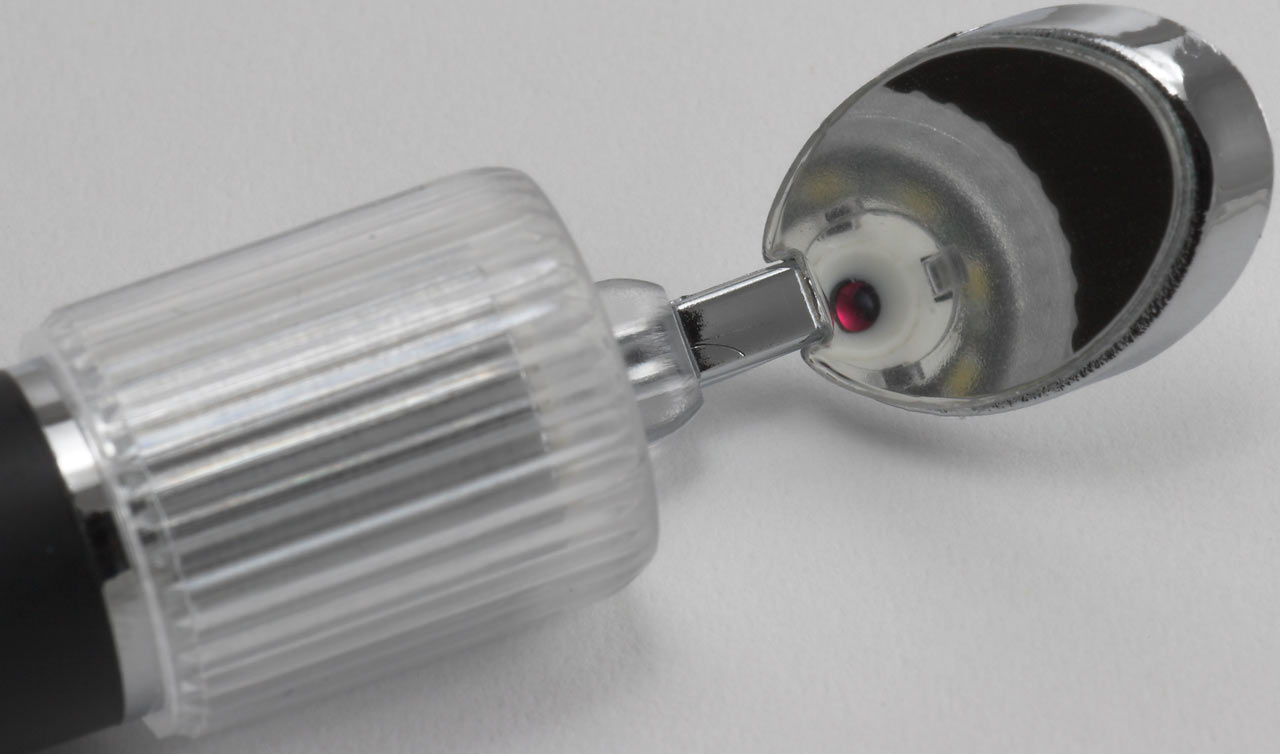
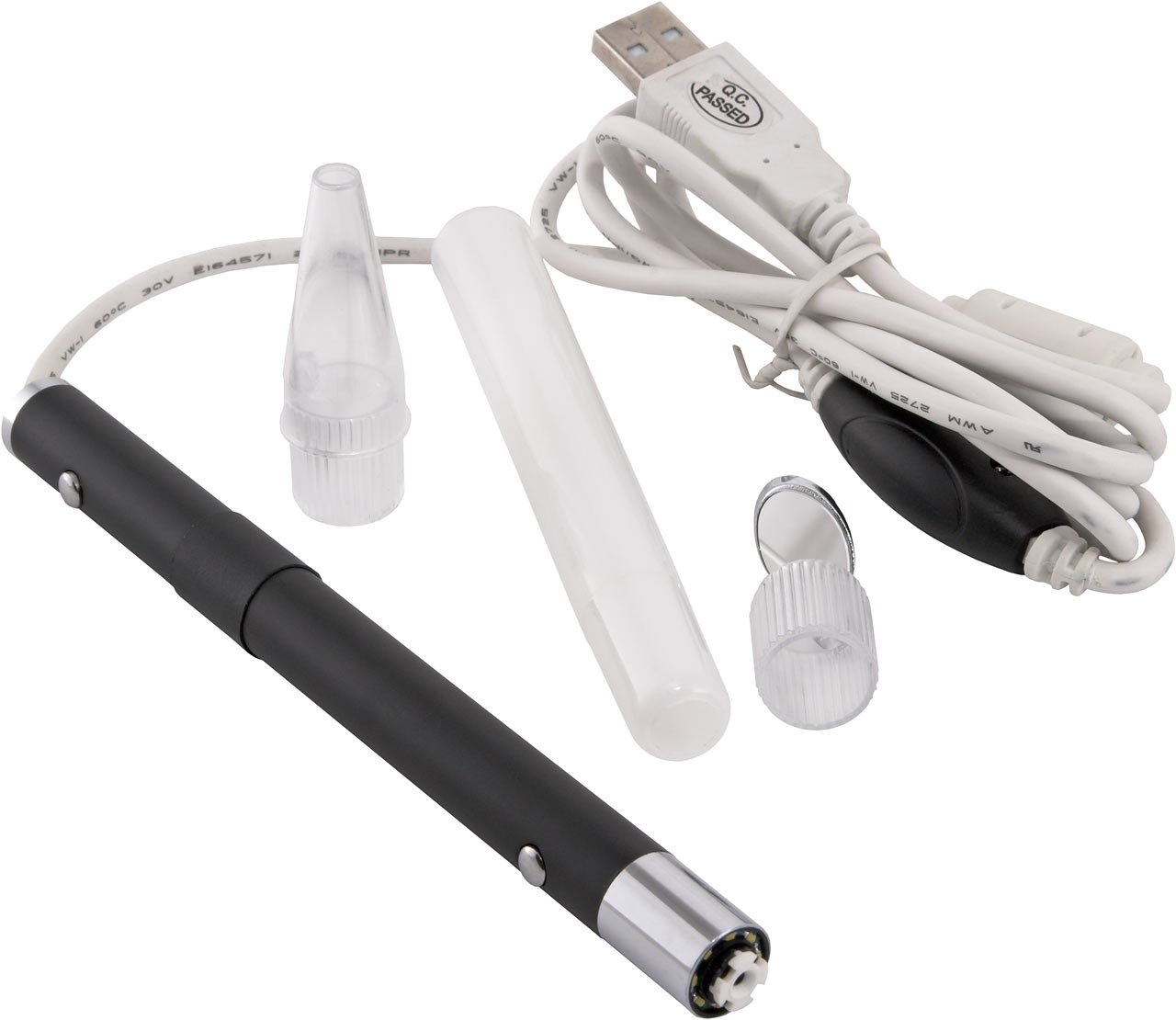
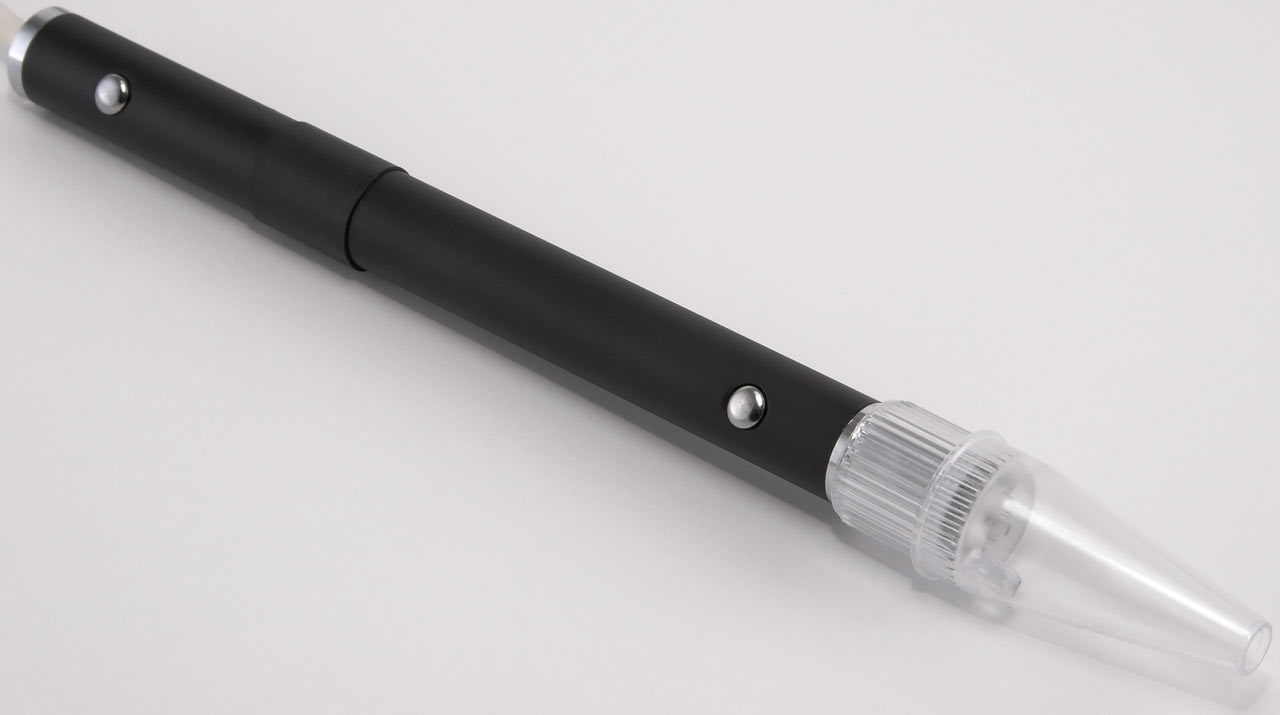
Anyway, a little while ago, I reviewed a pen-shaped close-focus webcam thing called the ETime Home Endoscope. It's a neat gadget.

There aren't many pictures of the ETime Endoscope online, so if you image-search for it, you'll get a bunch of my pics on the first page of results.

This, and the absence of any decent handout pictures from the people who make the camera, has made my pictures pretty much the only option for someone who wants to sell ETime endoscopes on eBay or wherever but (a) can't be bothered taking their own pictures and (b) doesn't want to pay for someone else's pictures.

Since I'm now signed up with eBay's Verified Rights Owner ("VeRO") program, though, all I have to do to get eBay to delete any listings that copy my stuff is send them an e-mail. A couple of days later, the offending listings will be kaput.

So every now and then, when a reader points out a ripped-off listing to me or when I find one myself, I do that.

I did that with one seller of the Endoscope a while ago. Their listings disappeared, and they didn't post any more that I've noticed. Apparently taking pictures of the stuff they sell cuts into their profit margins too much to make it worthwhile, or something.

The other day, I found that another eBay seller, "endoscopes.endoscopy", was doing the same thing. They appear to be under the impression that putting their own advertising text on top of my picture, and/or sticking three of my pictures together with some others from the ETime site, is enough to make the pictures theirs.

Even as I was typing this, the above PhotoBucket-hosted image mysteriously disappeared. Clearly the work of someone who's quite sure that everything they're doing is perfectly above board!

I saved it, though. Here's the top portion of their composite image, which contains no pictorial content besides my images and ones from the ETime site.

Their PhotoBucket page at the moment still contains several versions of the composite image. From the text on the variants, it would seem they're also listed on eBay as "usb.etime.pencams". And here, here, here and here are their direct copies of my images, except with the aspect ratio screwed up and text slapped on top.

Oh, and apparently they don't like people copying images from their own site about hockey! It would appear that people "who steal all our photos and ideas" are "punk asswipes"!

Couldn't have put it better myself, guys!

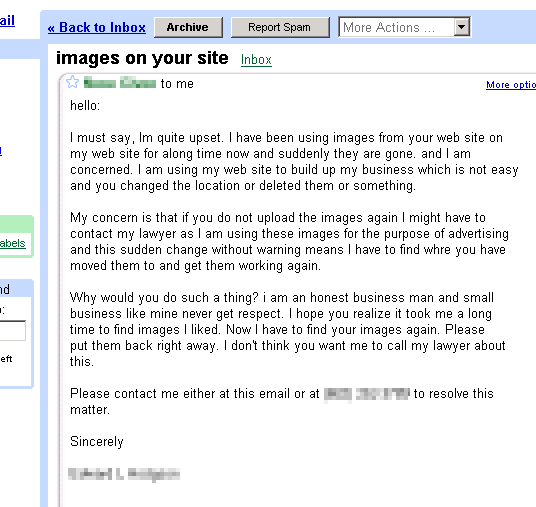
I'm speculating, above, about how these people's reasoning works, because it's kind of hard to figure it out from this:

Date: Sat, 16 Feb 2008 15:36:42 -0500
From: "usbscopes@gmail.com" <usbscopes@gmail.com>
To: dan@dansdata.com
Subject: removing our ebay listings

Dear Dan,

1) We don't appreciate you removing our ebay listings of e-time pencams off ebay!

2) We are an authorized ebay distributors of etime ehe pencams.

3) We didn't use any wording or images off your website!

4) If you have our listings removed again, We are hiring an attorney in Australia to take you into court. So please be prepared!

endoscopes.endoscopy

After sending me this, they listed another ten or so auctions with the same ripped-off pictures in them.

I told them the exact pictures they had copied, and that I took those pictures in my house, with my camera, for my review of the product. And I filed another VeRO complaint, and got all of the new listings pulled too.

Their cogent response:

Date: Sun, 17 Feb 2008 13:47:21 -0500
From: "Steven Jordan" <usbscopes@gmail.com>
To: Dan <dan@dansdata.com>
Subject: Re: removing our ebay listings

see you in court asshole

(...followed by the quoted text of my e-mail, which it seems did not make much of an impression upon them.)

I'm sure these guys are hopping on a plane from Florida right now. I'd better make some space on my calendar.

And yes, I'm aware that this could have been much, much funnier.

I must say, I'm quite upset.

But I have to work with what I can get.

Firepower's "results"!

And now, on to the "results" which Stephen Moss, the sue-happy CEO of Firepower, has commanded me to publicise, on pain of being sued for defamation.

Those results were presented in a generously proportioned PDF file which he attached to his threatening letter. He told me to make it available for download, and at no point did he complain about the fact that I did so - but apparently some OTHER person from Firepower decided to threaten Blogsome (not me, my blog hosts - classy!) with legal action for doing what the CEO told me to do, so now you'll find no link to the file here.

(If only I had some other Web site on which you might find more information about this...)

The PDF, mildly hilariously, has a line on the bottom of every page telling you it was created with the unregistered version of deskPDF PDF Writer, a piece of software which costs only $US19.95 to register.

I remind you that Stephen Moss is a fellow currently depicted on buyfirepowerpill.com as putting a fuel pill in "his" 2007 Rolls Royce Phantom LWB, a vehicle which costs $AU1,095,000 here in Australia, or 49,130 times as much as a registered copy of deskPDF.

Classy.

Aaaanyway, on to the Results!

Page 9 of the PDF alleges that the Firepower treatments actually did slightly raise the octane number of some fuel. This makes no difference whatsoever, unless you've got a car that changes its ignition timing when it's running on higher-octane fuel, in which case you should just be buying high-octane fuel in the first place. The Firepower treatments didn't manage to increase octane numbers by nearly enough to turn cheaper lower-octane fuel into the more expensive stuff, anyway.

(You can raise a fuel's octane count by adding all sorts of substances to it. I write about this in more detail in this post.)

Page 10 of the PDF contains a statement from a German laboratory that says Firepower additives did not do fuel any harm they could notice, and goes on to specifically state that it's making no claims about fuel consumption or engine life.

Page 13 claims that the "Singapore Institute of Standards and Industrial Research" found that Firepower treatments massively reduced all kinds of engine emissions, by (according to page 12) greatly reducing fuel consumption.

These results, if correct, make Firepower products far and away the greatest breakthrough in automotive science of the last twenty years, at least. Maybe the last fifty.

But since there is, yet again, not the slightest clue as to who at the abovementioned Institute did the tests, when, and how, and since Firepower have previously admitted that when they said tests were done "by Volvo" what they actually meant was they were done, um, on Volvo trucks (that result gets one line on page 25 of the PDF!), I remain unconvinced.

Honestly - giant fuel economy differences like this are the sort of thing you could test in any technical college. You could just send a free tube of fuel pills to every TAFE in Australia that has an engine on a test stand, and within a month you'd be sitting on a pile of beautiful replicated results that you could take to Toyota or whoever.

Even if Firepower's additives only turned out to reduce world oil consumption by 10% - an easy feat, you'd think, given the much larger improvements shown in many of their testimonials - that'd save something in the order of nine million barrels of oil per day.

At current oil prices, that's more than eight hundred million US dollars.

Per day.

And yet Firepower are still messing around with photocopies of photocopies from some guy in Oman, and sending lawsuit threats to some bloke with a blog who dares to wonder why they seem so interested in selling fuel pills in packs of ten to individual motorists, and so uninterested in grabbing their entirely fair half share of the $US300 billion per year they could easily be saving the world.

Fuel-pill companies, of course, always do this. They make their florid claims, they allude to lab tests the details of which are apparently secret, they say that testimonials are all the evidence they need, and they sell to whoever'll believe the flimsy evidence they offer, rather than putting together proper evidence and becoming richer than Queen Elizabeth.

Every time, they do this. Over and over. For the last hundred years, if not longer.

(They often come up with a conspiracy theory, too. I don't think Firepower have done this yet, but give 'em time.)

But let's get back to the Singapore Institute of Standards and Industrial Research (SISIR) report on Firepower's products.

When do you suppose that test was done?

Well, I can only suppose it was done before 1996, because that's when SISIR ceased to exist. But don't worry - I can totally see how those sloppy, unorganised Singaporeans might have still been publishing research reports on old letterhead a decade later.

Or was the SISIR report, perhaps, used as supporting evidence for one of the Firepower principal's several previous fuel additive companies, all of which made much the same claims but none of which, all the way back to the early 1990s, have amounted to anything?

I'm speculating, here, but that's what you have to do when all you're given is a big happy bar graph and the name of an institution that hasn't existed for almost 12 years.

Page 14 of the PDF starts a long series of accounts of alleged fuel economy and emissions improvements, sometimes presented as bald claims with no tracking information at all (apparently Firepower products did great things for "Railways, Minsk" in March 2006...), sometimes as anecdotes that are at least on someone's letterhead with a signature, and with the occasional "this additive didn't mess up the fuel" certificate thrown in for spice.

Some of these accounts do at least allege that some sort of proper drive cycle test has been done.

On page 15, there's a test allegedly by the Russian Ministry of Defence, saying a Firepower product worked on a T72 tank, with what looks like some sort of controlled test. Page 16 says someone called Professor Evgeny Kossov of the Research Institute of the Russian Railways found considerable improvements in a long-term test, which at least could have been properly controlled, on one locomotive. And then page 18 has a signed testimonial from someone in Oman attesting to massive fuel savings in a generator, with a description of what would be a controlled test if it were actually done, and if nobody cheated, and if the meters all worked right - but what am I going to do, call Hamed Salim Al-Magdheri's mother and ask her if her son's prone to lying?

And then, on page 21, there's a testimonial, dated November 1999, from a Lieutenant Colonel in the New Zealand Army. It's a bit funny that they left that in, since the New Zealand military is one of several major organisations which has said they actually have no record of ever having any connection or contracts with Firepower.

I suppose some bloke in the Army might have bought some fuel treatment stuff himself and formed the opinion that it worked without telling anyone else - but many thousands of people have done the same thing over the years with many hundreds of other fuel treatments, none of which turned out to actually work. So all this adds up to is yet another scienceless testimonial.

(The other companies that denied connections with Firepower were Caltex/Ampol, BP, General Motors and the Australian military, none of whom are mentioned in the "results"... any more.)

On page 22, I thought that someone who glories in the name Calliope Sofianopoulos (and is a translator, by trade) claimed that Firepower products significantly improved the fuel consumption and exhaust gas composition of three taxis.

I was wrong, though - as Calliope points out in the comments, below! She actually just translated that document, and the geniuses at Firepower decided to uphold their reputation for fanatical devotion to accuracy by just scanning the translation, complete with her letterhead, and sticking it into the middle of their Results File.

Who actually did the taxi tests? Who knows?

We have names for three Greek taxi drivers and the make and model of their cars, and we've got magnificent fuel-consumption and emissions numbers. But that's all. The actual testers remain a mystery.

Did the anonymous testers do drive cycle tests to validate the fuel consumption figures? 'Course not. Why should they? But if they haven't, then nobody should use the results as evidence that the product works, because it is not in fact anything of the sort.

On page 23, some organisation called "Labtest Hong Kong" apparently also thought that just driving a car around was an adequate test, which I really must repeat yet again it is not, even if the test is blinded so the driver doesn't know when you've added the supposed fuel enhancer. That did not appear to be the case for this test, which raises some questions in my mind about what kind of "lab" that joint actually is.

Then there's one from the Philippines on page 29 that has an actual static test of a truck as well as the usual useless driving around, and claims a 16.43% fuel economy improvement - though they for some reason tested it with the engine idling, which doesn't strike me as very useful. I suppose we've got to take what we can get, though.

And on it goes. But who knows what any of these tests, even the better-looking ones, actually are?

I know I'm not going to call Directory Assistance in six countries to try to find the people apparently associated with the higher-quality tests and grill them about what they really did. Firepower should be the ones presenting multiple proper tests from clearly identified and readily contactable authorities. And they shouldn't be presenting them to me; they should be presenting them to all of those big fuel and car companies with whom they said they had such impressive deals.

If you've got a super fuel additive that does the things Firepower's stuff is supposed to do, and if you've got enough money to sponsor sports teams and show off a million-dollar Roller, then obviously you've got enough money to get proper tests done by proper, respected, well-known organisations - in Australia, I'd start with the NRMA and the RACV. And then blammo, billions of dollars are yours.

But Firepower are not, of course, going to do that. Because Firepower are just the latest in a very long line of companies making stuff to put in your fuel that... doesn't really do anything.

They say the exact same things as many of their forebears.

I mean, look at page 5 of the PDF. It says "when the fuel is burned in the combustion chamber not all of the fuel is used and a proportion goes out the exhaust...".

This is true, and a frequently-heard claim from fuel additive manufacturers. But the actual unburnt fuel fraction for a modern engine is 2%, at the very most.

So there's almost nothing to be gained there.

Apparently the Firepower products work "by burning more of the heavier elements of your fuel, increasing power and fuel economy". But this is impossible; if any significant fuel energy were actually left in the exhaust from a normal engine, it would either burn the car's catalytic converter off in very short order, or cause the car to miserably fail any modern emissions test. Firepower claim fuel economy gains of well over 10%; well over 20%, in some of the testimonials. But the only mechanism they provide by which this can happen can give you only a couple of percentage points, and probably less.

Fuel additive companies always take advantage of people's vague knowledge that engines are only thirty-something per cent efficient, and use it to make people think that sixty-something per cent of the fuel energy is readily recoverable, because the fuel isn't burning completely, or fast enough, or in the right pattern, or something.

Engines are actually so inefficient because, although the fuel burns very completely, there are inescapable thermodynamic reasons for lots of the resultant energy to be lost as heat. In brief, unless you make an internal combustion engine that runs a lot hotter, you can't make one that's a lot more efficient.

There have, as I said, been many "fuel pill" products before, one of which was, I remind you, actually sold by the same guy who's the chairman of Firepower now. The case study of the discredited BioPerformance Gas Pill on Tony's fuel saving gadget site (to which I have been linking rather a lot, lately...) is informative, here; it appears to be very similar to the Firepower pill in composition, claims-made and backing evidence.

If Firepower want people to take them seriously, it seems to me that they should have proper independent tests done on their supposedly miraculous technologies, rather than just touting all of the contracts they've supposedly signed with people who haven't necessarily done any more due diligence than have Firepower themselves.

If Firepower substantiate their claims with proper tests, I'll be the first to recant my skepticism and sing their praises. And buy the pills, too - though I imagine they'll be in short supply for a while, what with every motorist on earth being eager to get hold of them.

While Firepower insist on acting exactly like a long line of previous fuel-pill hucksters who turned out to be selling worthless products, though, I cannot in good conscience treat them any other way. No matter how much they threaten me.