The bunch of shady individuals who resell electricity to us (no, not these dudes - "Jackgreen", who're no better if you ask me) saw fit today to provide us with a cheery note telling us that, as of next year, we will automatically be supplied with "10% accredited" GreenPower!
GreenPower is, according to the Australian Government Web site all about it, new renewable energy. Not just the hydro-electric power that Australia's had since the Seventies; an actual replacement for the vast amounts of almost entirely coal-fired electricity (some of it the particularly filthy brown-coal-fired type...) that keeps the rest of Australia's lights on.
We have, Jackgreen excitedly added, the option of upgrading to 25%, 50% or one hundred per cent "accredited" GreenPower, for an extra fee, if we like.
Gee! Doesn't that sound great!
The GreenPower Accreditation program has actually been around for more than ten years now, as I discovered when I read the absolutely riveting 2006 GreenPower Annual Compliance Audit (PDF).
I felt obliged to plunge into this sizeable document because, on the face of it, the GreenPower numbers didn't seem to add up.
And the more I learned, the more confusing it became.
The thing that originally puzzled me is that the 25, 50 and 100% GreenPower rates from Jackgreen will cost us $AU1.10, $AU2.20 and $AU4.40 a week, respectively.
That's it.
A flat rate.
Whether your house's total electricity budget comprises two night-lights and a transistor radio, or five thousand marijuana plants thriving under fifty kilowatts of metal halide illumination, you pay a flat rate extra to have all of your electricity "greened".
I know it's a flat rate just by looking at the Jackgreen page that lists all three GreenPower options. The Product Disclosure Statement (PDF) makes perfectly clear that the actual tariffs for each level of GreenPower, not counting the extra weekly fee, are exactly the same!
(I also particularly like the significant "Daily Availability Payments" that apply across the board. Here in Katoomba there's about one brief blackout a week, and at least one longer one a month. "Why, when that happens they must refund the Availability Payment for the affected day," I hear you say! Alas, no.)
The Compliance Audit document tells me that GreenPower can be sold by the kilowatt-hour like normal electricity, or bought to match the amount of electricity you're drawing from some other supplier that (presumably) doesn't subscribe to the GreenPower scheme, or sold as a "consumption based product whereby customers nominate the level of GreenPower purchased according to a nominated percentage of their total electricity consumption".
That last one would appear to be what the schemes we're being offered are. But we're obviously not, in any economically meaningful way, "purchasing" a nominated percentage of GreenPower if we don't pay more, to account for that more-expensively-generated percentage, when we consume more bloody power.
This seems to be the most obvious thing in the world to me, but it nonetheless appears to have sailed right past the Government, who say on the GreenPower site that "you can buy 100% GreenPower for approximately $5.50 extra per week".
Except no you bloody can't, unless you just arbitrarily define "GreenPower" as "NotActuallyGreenInAnyWayPower".
Which, more rooting around in the document eventually made clear to me, seems to be what they've done.
Working my way on through the Compliance Audit, I hit the all-important Rules of the Program, which say that GreenPower providers must "source all generation included in a GreenPower product from GreenPower approved sources" and, as of half way through 2006, "source 100 per cent of accredited GreenPower sales from 'new' GreenPower generation". "New" is defined to mean "any generator built or commissioned after 1 January 1997 that is GreenPower approved".
This is, therefore, pretty straightforward. When you buy 100% GreenPower, you really do have to get 100% GreenPower, not as much GreenPower as your electricity dealer has to sell you, followed by ordinary, um, BrownPower. It doesn't mean that someone's going to send special green electrons to your house from a generator powered by kitten purrs, but if you order 100% GreenPower, however much power you draw really and truly should be sent into the grid, somewhere, by a new and shiny renewable source of some description.
But now we strike a problem.
Apparently nearly eight per cent of Australia's electricity comes from renewable sources at the moment, but that's including the old Snowy Mountain hydroelectric system, whose peak capacity is the thick end of four gigawatts but which doesn't run at anything like full capacity most of the time.
Take the Snowy system out of the picture - which you should for GreenPower calculations, since the rules forbid GreenPower providers to just sell that hydroelectric power - and you've got a magnificent 1.5% of our total consumption left over.
That is, at the very most, the sum total achievement of ten freakin' years of this GreenPower initiative. And a significant portion of the 1.5% doesn't qualify as GreenPower anyway, as we'll see in a moment.
At this rate, we might make it to 50% renewable energy in as little as three hundred years!
But right now, it's obvious that if any significant number of people sign up for any significant amount of GreenPower, the amount of genuine two-words-no-capital-letters green power available will be exhausted rapidly.
This was the point where the light dawned upon me, and I theorised that the government must have just shifted the goalposts and, themselves, allowed "GreenPower approved" generators to include a whole lot of... other... sources of electricity.
I was led to believe that there was some straightforward old fashioned lyin' coming up by the delightful discovery in section 2.1.4 of the 2006 Compliance Audit that "GreenPower providers are required to reduce emissions ... to 5 per cent below 1990 per capita emission levels, equivalent to 7.27 tonnes per capita by 2007" (emphasis mine).
Well, here we are at the end of 2007, and Australia as a whole hasn't quite done that.
What Australia's actually done - and yes, we should be very proud - is top the world in per capita power generation carbon emissions, with a magnificent 226 million tons emitted this year, about 10.7 tonnes per capita.
This is hardly surprising, since Australia is as crazy for air conditioning and plasma TVs as the USA (who are currently managing a mere 9.2 or so tons per capita), but we don't have any nuclear power at all.
Now, GreenPower's approved providers presumably do emit relatively little carbon per customer. But since there isn't nearly enough genuinely green power to sell to customers - as we'll see - I wouldn't be at all surprised if the actual per capita electricity-related CO2 output of GreenPower customers was only a hair below the national average. There's no way it's actually lower than 1990 levels.
So I was thinking that if they don't mind about that particular huge miss, they wouldn't mind a similarly bold declaration that GreenPower and BlackPower could be the same thing... from a certain point of view.
But in section 2.1.5, they define a "green" electricity generator as "an electricity generator that results in a greenhouse gas emission reduction and net environmental benefits; is based primarily on a renewable energy resource; and complies with the guidelines in the National GreenPower Program Accreditation Document".
Which would appear to rule out the source of 93-odd per cent of Australia's power. You just can't use that definition and simultaneously allow GreenPower purchasers to actually be sent regular power.
Flick on through to section 2.4, and you find that total GreenPower sales for 2006 add up to 802,417 megawatt-hours.
That sounds like a lot. And it is - you'd have to run a thousand-horsepower engine for 123 years to make that much energy.
But Australia's total electricity consumption is up around 200,000 gigawatt-hours per year.
So total GreenPower sales for 2006 were about 0.4% of Australia's total electricity budget.
Or one two hundred and fiftieth, if you prefer.
The Compliance Audit says there were 391,403 customers - 373925 residential, 17478 commercial. If you assume they're all on 100% GreenPower and they all get an equal share of the available power, that's a grand total of 2.15 megawatt-hours per customer per year.
This actually distorts the situation - a graph in section 2.6 of the Compliance Audit makes clear that sales to commercial customers were far higher per customer, as you'd expect. But let's run with the straight average for a moment.
An average US or Australian household is likely to consume around eight to twelve megawatt-hours per year. So the total current GreenPower sales are only enough to supply the current customer base for, oh, two or three months of the year they've paid for.
This is reflected in the fact that section 2.4, before it tells you that 802,417MWh of GreenPower were sold in 2006, tells you that 3,889,200MWh of GreenPower were purchased.
This threw me for something of a loop. I've read over it several times. I'm doing my best to figure out what it means. If anybody knows better, do please fill me in (or just post a comment below).
The sold/purchased discrepancy is an unusual situation. Not often do the books of a business - well, of an honest business, anyway - tell you that 4.8 times as many Acme Widgets were purchased by customers as were sold by Acme.
But here in the world of GreenPower, "product providers" certainly can buy way more power than they actually sell.
There's some sort of certificate system involved too, but it's not related to any actual consumer reality, because of that weird connected-to-nothing tiny flat rate I mentioned way up at the top of this post. I presume there are government subsidies involved as well - so, in the end, everybody's paying for this scheme whether they pay the flat fee or not - but fat chance of finding any mention of those on the GreenPower Web site.
Aaaaaanyway, the factor-of-4.8 difference between GreenPower purchased and GreenPower sold quite neatly increases the 2.15 megawatt-hours per customer to about 10.4MWh. That lines up much better with a plausible figure for actual average demand from all of those GreenPower "users". If everybody was on a 100% GreenPower contract then it'd be too low to account for the electricity-hungry commercial customers, but I'm sure there are lots of 25% and 50% contracts in there pulling down the average order size.
So it seems to me that this really is the deal. The government goes through all of this rigmarole of officially approving GreenPower suppliers, tra la, and allows customers to sign up for the suspiciously-cheap "100% GreenPower" and receive faithful assurances that this means their electricity supplier is "purchasing" exactly as much GreenPower as the customer uses.
And then in their official audit report they just whiz right over the trivial detail that 79% of the item being purchased does not, if you want to be boringly picky about it, exist.
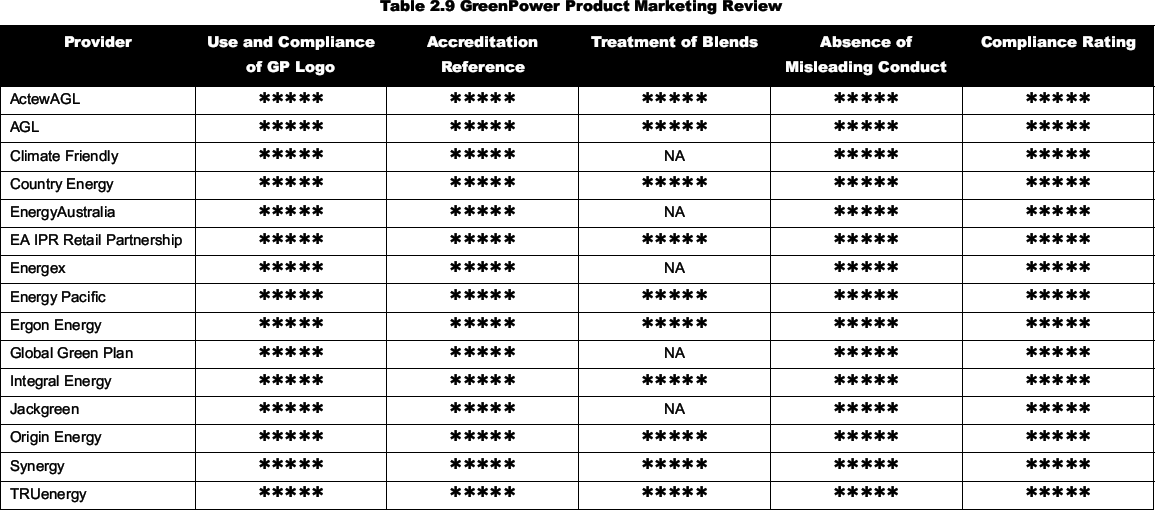
And then in section 2.7, you can hear them giggling as they give every single GreenPower provider the maximum five-star rating for honesty in every kind of marketing they conduct!
Step right up, folks! Everyone wins a prize!
Any new GreenPower drive that causes market growth to exceed the growth of the actual GreenPower generation capacity will, of course, only make the ratio of power purchased to power sold even worse. And it's not as if all of those extra customers will be bringing billions of dollars with them that'll make GreenPower more real than it currently is. Each new customer, wanting ten-odd megawatt-hours of environmentally friendly power a year, will be (directly) paying at most $AU286 to help make that happen.
You could realistically expect a big old 1.5-megawatt wind turbine to be able to produce about 4000 megawatt-hours of power per year. It'd be more than 13,000MWh if the thing ran at full power all the time, but the capacity factor of wind generators - the fraction of the time, on average, that they can operate at their rated power - is lousy, down around 30%.
But 4000MWh in a year, ignoring storage and distribution, is still enough to run 400 ten-megawatt-hour-per-year households.
If all you're getting from those households is 400 times $AU286 per year, though - $AU114,400 - it'll be a bit of a while before you can afford that turbine. A 1.5MW turbine will set you back at least a couple of million US dollars, and its upkeep ain't free either.
So, if the extra GreenPower rate is all you have to spend, it'll be twenty years before you can even buy that one darn turbine. And then it's probably going to wear out in thirty years, tops - whereupon, given what you paid to run it in the meantime, you may just about be able to afford a replacement. Whoopee.
Page 3-2 of the Compliance Audit finally dropped a tantalising hint about what is to be done if "there is a shortfall of valid claims for new GreenPower purchases to satisfy new generation requirements for sales of a GreenPower product", and directed me to the even more fascinating National GreenPower Accreditation Program Accreditation Document (PDF).
Therein, I found the straight-faced statement that purchases and sales are required, as they would be in a sane system, to be equalised after some reasonable period of time.
In the staggering situation that this turns out to be impossible - as, I'm willing to bet, it has been for pretty much the entire existence of the GreenPower program - GreenPower Providers are directed to make up the difference with non-"new" GreenPower sources (of which there are nowhere near enough), and are then allowed a five per cent "shortfall" on energy sales (still not nearly enough to fill the gap), and are then directed to "rectify the shortfall via credits/rebates to affected GreenPower Customers".
And if they don't do that, they can have their oh-so-precious GreenPower accreditation revoked.
I can find no evidence that any credits or rebates have ever been given to anyone, or that any GreenPower providers have been taken to task about it. Since their job is self-evidently impossible, I suppose it'd be a bit unfair to make them give back the money that's supposed, however feebly, to be priming the renewable energy pump. But this still seems to make an absolute nonsense of all these po-faced rules by which everybody says they're abiding.
As it stands, the GreenPower system seems to me to be a facade. At a glance, it looks great - but if you pay a bit more attention, the green-ness turns out to be only skin deep.
I suppose we should be grateful that there are at least (apparently) honest numbers in the public documents, and it's not all a total cover-up. But that doesn't excuse the fact that the whole scheme is basically a sham. And it certainly doesn't make it OK for a genuinely progressive environmentalist political party like The Greens to just go along with the pretense, using GreenPower as a political playing card along with all of the other issues-that-mean-the-opposite-of-what-they-seem-to.
I can't help feeling that I must have missed something very serious, here. But it's not just a couple of numbers in the Compliance Audit that touched this all off - it's the small flat rate, the well-known lack of any serious new renewable energy generation capacity in the country, and the glib insistence from all of the electricity resellers that you can just tick the box, pay the few bucks a week, and be carbon-neutral just like that.
Has anybody else noticed this? Is there something more to it that I've failed to understand?