All heart, no brain

I started watching The Waters of Mars, the most recent Doctor Who special, a few days ago. Then I paused it after 12 minutes and didn't resume for a few days, because I had other stuff to do and it clearly wasn't going to be very good.

I know Doctor Who is really fantasy, not sci-fi, and I know it's now all about heart and emotions and not so much about coherent storylines. That's fine, if done with some imagination; I actually quite liked the episode Gridlock, for instance, which was a veritable lace doily of plot-holes if you looked at it critically.

And I know Doctor Who is primarily aimed at young viewers, and I also know that kids aren't very discriminating and will watch any old crap.

But none of that excuses this level of crapness.

(Spoilers, naturally, follow. But I'm spoiling the bad bits, not the good ones, so perhaps you'll come out ahead.)

The Waters of Mars reminded me of Robert L. Forward's excellent (if you like hard sci-fi) Dragon's Egg (the sequel's pretty decent, too!). The only purpose of the characters in the first couple of dozen pages of Dragon's Egg is to set up the story proper, so Forward obviously didn't see any need to spend more than a lazy half-drunk afternoon writing the first part. (Actually, I wouldn't be surprised if he wrote the first part last, just to give the audience a minimal on-ramp to the highway he'd already finished and was impatient to publish.)

So Forward, for instance, details exactly the garments which a young female astronomer puts on before racing off to advance the plot, but because he's not paying attention he gives her a skirt but forgets to mention any underwear. This is forgotten once you get into the real story, but it's somewhat startling at the time.

Likewise, in The Waters of Mars, the writers are clearly so eager to get to the, super-heavy-handed but still pretty neat, ending and teaser for the upcoming Christmas special, that they just didn't care about the preceding story.

Robert Forward's dodgy beginning bit was very small. In The Waters of Mars, the dodgy beginning bit takes up five-sixths of the show.

I could just about handle Mars gravity being the same as Earth gravity, when it ought to be less than 0.4G, because that's apparently still too expensive for live-action TV to do properly. And I could barely accept explosion debris cheerfully burning away in Mars' 95.8%-carbon-dioxide, 0.2%-oxygen, less-than-1%-of-Earth-pressure atmosphere, because, um, maybe this Mars-base was built out of bamboo packed with potassium nitrate.

But the monsters are creatures that can make water (and fusion power!) out of nothing. But they're desperate to get to Earth, because there's so much water here. (And they've got the same name as the principal villains of all of the Halo games.)

All the writers would have had to do was make the monsters express a great hunger for all of the people there are on Earth for them to infect, or specifically mention how pleased they are with Earth's ever-shrinking ice-caps that promise a gigantic habitable area for them in their liquid form. But no. One of 'em stands there, drooling a steady stream of water onto the floor, and just says that it's impressed by the quantity of water that Earth already has.
Cliched self-destruct

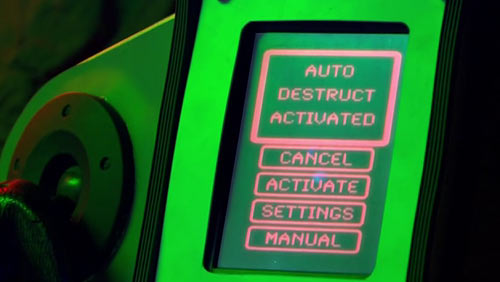
And there's not just one, but two, self-destruct mechanisms activated in this one episode.

I suppose it's not that surprising that the systems exist - nobody puts a "Blow Up This Vehicle" button on real-world dashboards, but if you live in the land of TV sci-fi you can expect super-virulent body-snatching alien and/or supernatural monsters to pop up about every other week. The only surprising thing is how slow people always seem to be to figure out what's going on and press that deadly button that'll save the rest of the world.

(We should probably count ourselves lucky that only one of the self-destructs has a Red Digital Readout. And to be fair, it still isn't your typical Acme Mechanically-Assisted Plot-Tensioner, a device which has the mystical ability to make the last 60 seconds of the countdown take up five minutes of screen time.)

As regular readers know, I am actively delighted by stupid Doctor Who monsters. But they're meant to be stupid-looking, not just by-the-numbers Central Casting zombies plodding through a script that exists only to give the Doctor a reason to emote.

I'm quite happy with fatally-plot-holed sci-fi as long as it's imaginative. When I finish watching some oddball anime and say "what the fuck was that all about?!", I'm always smiling. And Doctor Who is supposed to be among the most imaginative live-action shows, because it's got the fewest restraints. It's not stuck on a particular starship or even a particular planet, it doesn't take itself very seriously, and after some decades, the audience is accustomed to the fact that the TARDIS seems to independently seek out deadly peril, especially when the Doctor intended to have a little holiday.

This all makes it particularly disappointing when you get a story like this, that's no better than the 62nd time the holodeck tried to kill everyone on the Enterprise.
Hello? [thump thump thump] Is this thing working?

The comments for my last post were split between people who were talking about the actual game that was the subject of the post, and other people talking about the ongoing dansdata.com connectivity problems.

To recap: Most visitors can see Dan's Data just fine, but a seemingly random smattering of users from all over the world can't see it at all. For them, it looks as if the Dan's Data server was just turned off some time ago. Months ago, in some cases.

(If you can't see any of the pictures in that game post, by the way, it's probably because you can't see dansdata.com. Most of the images on this blog are actually stored on the Dan's Data server. Not all of them, though; the pics in this post, for instance, are from my Flickr account. If you can see pics in that post but not in the game post, the dansdata.com connectivity problem is almost certainly the reason.)

So here's another post about this connectivity problem, which I dare to hope may now actually be fixed.

Yesterday a reader clued me in to a problem with one of the two nameservers for the domain. That bug - which would have prevented anybody whose DNS request ended up at that secondary nameserver from getting to the site - is now fixed, along with a couple of others that may or may not have been related to the problem. Now all of the online traceroute tools that used to make it all the way to fe-0-0-3-kf-br1.securewebs.com, one hop away from dansdata.com, and then die, can make it all the way:

http://looking-glass.optus.net.au/cgi-bin/nph-looking-glass.pl
http://traceroute.optusnet.com.au/?args=dansdata.com
http://www.telstra.net.au/cgi-bin/trace
http://looking-glass.uecomm.net.au/
http://www.getnet.com/cgi-bin/trace?dansdata.com
http://www.csc.fi/cgi-bin/nph-traceroute?dansdata.com
http://lg.evolink.net/

(In some cases, the last hop of the traceroute shows "beechler.com", not dansdata.com. Beechler.com is a site that used to, and possibly still does, share the same physical server as dansdata.com. I don't think this is a problem symptom, but what do I know.)

A traceroute, or ping, can fail when there's nothing actually wrong with a site. All you need is some router along the way that firewalls traceroute or ping data, but lets normal Web traffic through. I think the traceroute problem has been a constant for everybody who hasn't been able to see Dan's Data, though, so now that it seems to be fixed, surely nothing further can go wrong, how hard can it be, could be worse, could be raining, gee it's quiet tonight, Macbeth Macbeth Macbeth, Hastur Hastur Hastur.

Please comment below, with traceroutes and/or pings as per last time. What we're especially looking for are people who could see Dan's Data until recently but now can't, or couldn't see it until recently and now can.

Pew pew pew! ZAP! Whoosh! Ka-BOOM!

You know when you read a review of a game that says that one part of the game, say the battles between spaceships, looks great and is tons of fun, but the rest of the game is kind of boring?

Gratuitous Space Battles is that part of that game, without anything else.

(And before I say anything else, note that there's a free demo.)

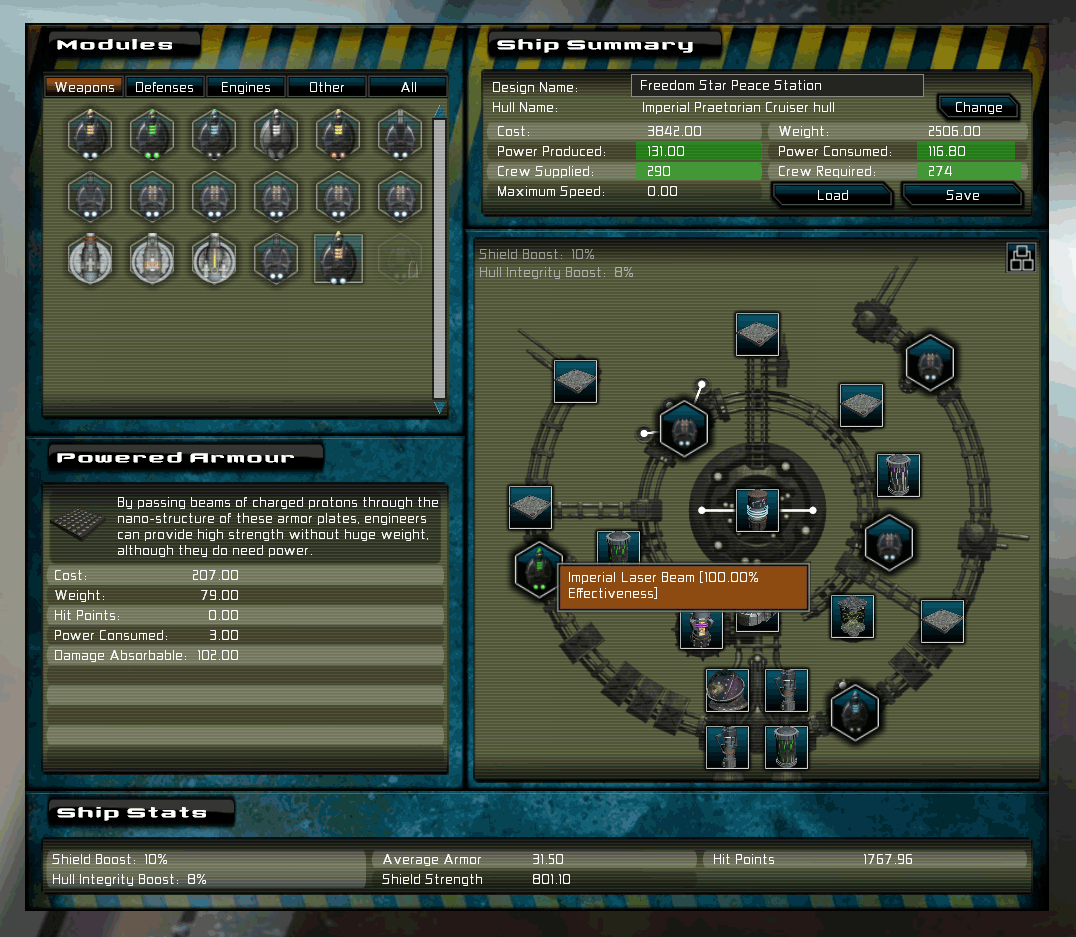
You pick a fighter, frigate or cruiser hull for each of your vessels...

Gratuitous Space Battles ship design

...you kit them out with weapons and shields and engines and so on, you deploy an armada of ships of different sorts (or all of the same sort, if you like), and then you give them all orders. Concentrate all fire, prefer to shoot enemies that're already wounded, shoot this kind of ship over that kind, protect this ship of ours, protect any ship of ours that's damaged, stop at this range from the enemy and plink with your long-range missiles rather than charging into beam range, et cetera et cetera.

And then you click the "Fight" button, and sit back and watch.

For the actual battle - which is fought on a 2D battlefield, though ships can go over and under each other - you're a pure spectator. GSB is like a tower defense game, in that regard. (Many tower-defense games let you build new towers during a battle, though; GSB does not.)

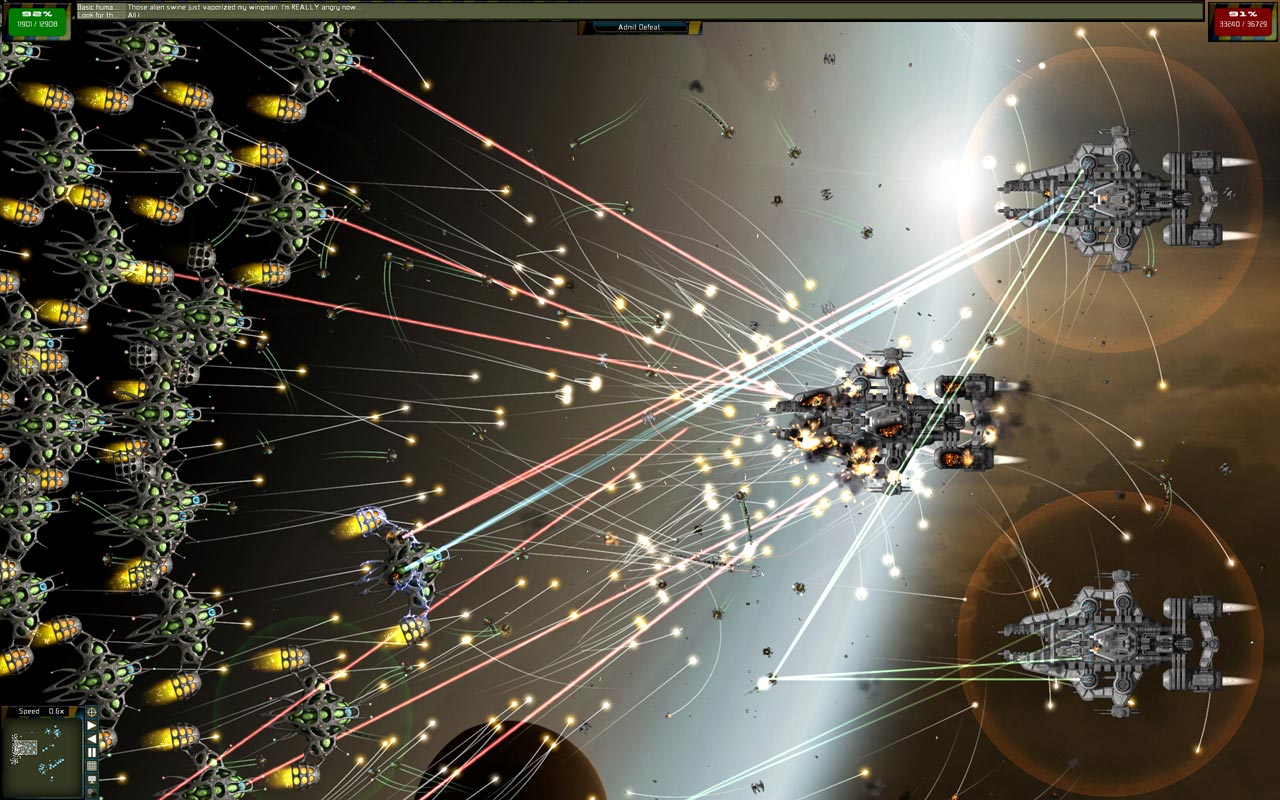
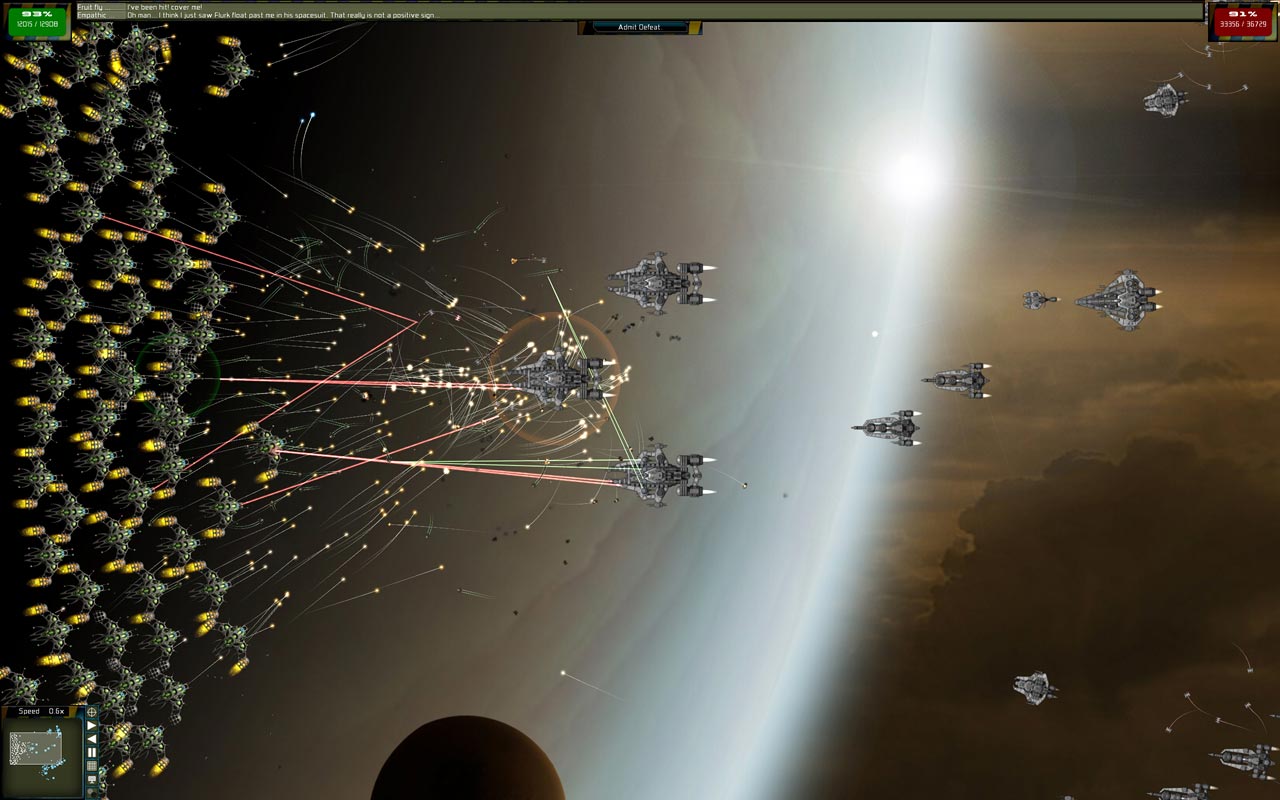
You can speed up and slow down the battle, and you can zoom in and out. From a distance, the action looks like this:

Gratuitous Space Battles wide view

(In this battle, I'm employing the Unsporting Crowd of Torpedo Frigates strategy. I'm also playing at full resolution on my huge monitor, so the full-sized screenshot is 2560 by 1600 pixels and rather a lot of kilobytes.)

Zoom in, and you can see...

Gratuitous Space Battles zoomed in

...each individual weapon shot, repair drones patching flaming holes in hulls, and fighters weaving around the capital ships. (Full-sized screenshot here.)

When you win a battle you earn "honor" with which to unlock new hulls, equipment and the three whole alien races besides the one you start with, the Federation. (The big Federation ships, rather delightfully, all look like a hybrid of a Starfleet vessel and a Battlestar.)

It's all a lot of fun, and should become even more fun as the game expands. Cliff Harris, the indie developer of GSB and a few other games, is actively patching bugs and adding stuff, and GSB is also very moddable. Fans have already, according to the ancient tradition of the first few mods for any game, created a few rough-and-ready super-battleships by just adding more module mounting points to existing hulls. Some proper high-quality mods with all-new graphics, like unto the Babylon Project mod for Weird Worlds, should be arriving soon.

So try the free demo and see what you think. The full game takes into account what you've done in the demo, by the way, so you won't have to play the tutorial level again if you don't want to, and get to keep whatever honor you earned.

(GSB is Windows-only at this point, but because it's not a very demanding game it generally works fine on other OSes if you play it in an emulator.)

Gratuitous Space Battles is $US22.99 from the developer, or only $US20.69 on Steam.


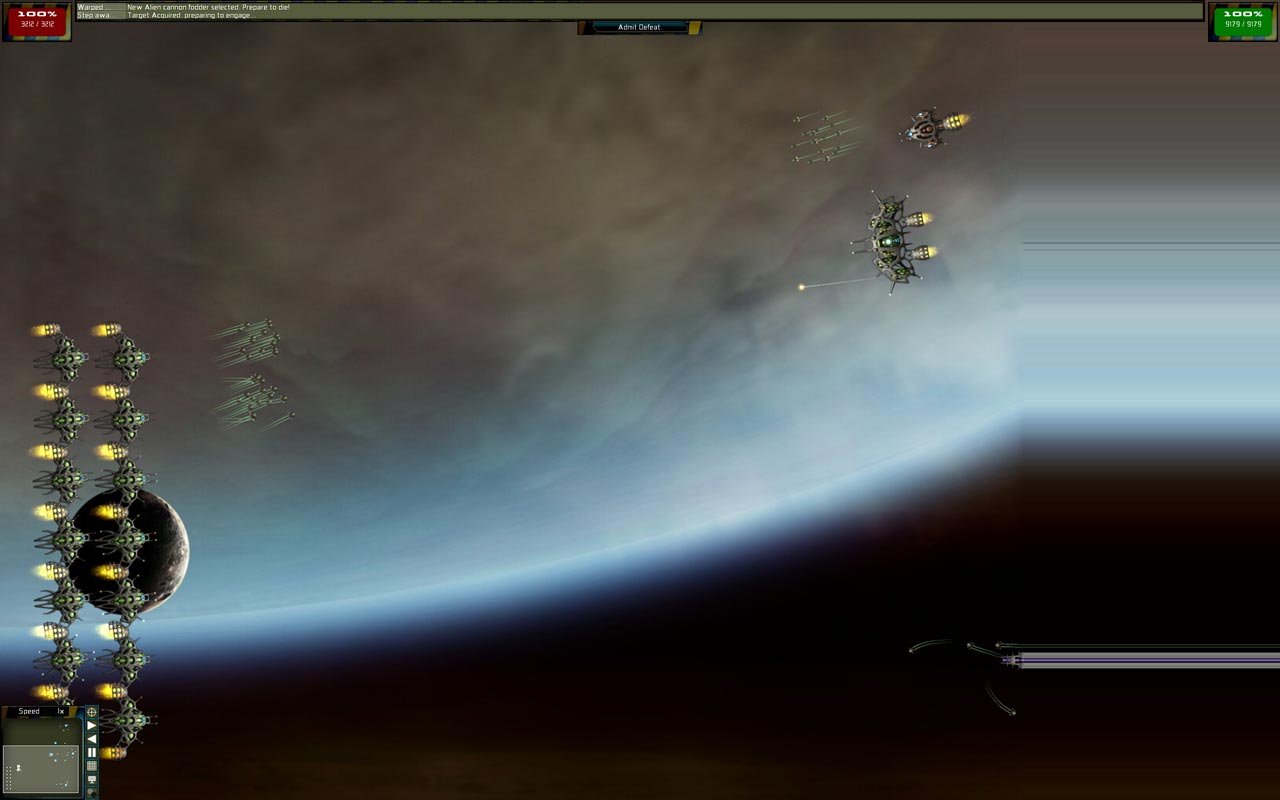
Note that there's a graphical glitch in GSB that affects people who're using an unusually high horizontal screen resolution (so, one giant monitor, or a row of smaller ones). It...

Gratuitous Space Battles screen glitch

...turns a column of screen to the right into stripey repeats of the last correctly-drawn column of pixels.

I think this was meant to be fixed in the recent patch, but it doesn't seem to have been. No problem, though; just go to the options and disable "Gratuitous Shaders", and with very little eye-candy reduction, the whole screen will draw properly again.

Achieve financial independence with boiling mercury!

On this blog and dansdata.com I've written about mercury, and, thanks to the very independent thinkers at Life Technology, also alchemy.

So I suppose I was just asking for this correspondence, from yesterday:

Respected Sir,

I have visited your website and then I am writing to you. so If you dont't mind then give me some opinon abuout mercury after reading below datail:

I have making mercury into solid shape in Zink and then I want to give it into golden color, I have packed it in a Copper small pots shaped " Male Female" and then put it into a ceramics Cup, then cover the Copper port with wett soil. when I heat it. after heating I made it cool and open the copper pots then I saw that due to leakage the mercury has flew up, only zink was in the pot.

I want to ask you that I want to block the leakage of copper pots so that mercury should heat and boiled but should not evaporates from the copper pots

what should i do to stop the the leakage from copper pots.

please give me some cheapest opinion. I am waiting for your good response.

Abdul

My reply:

I'm not exactly sure what you're trying to do here, but:

1. If you actually manage to seal the containers solidly, they may explode when heated. Mercury's boiling point is low enough to make this possible with relatively little heating.

2. You don't need to heat mercury much, or at all, to get it to form an amalgam with any of the many metals with which it will amalgamate. (This includes, by the way, the copper from which you are making the vessels...)

Warming the mercury over boiling water should be as much as is ever necessary, and I wouldn't even bother with that unless I'd already tried it at room temperature and it hadn't worked.

The mercury does need to directly touch the metal, though. Mercury amalgamates readily with, for instance, bare aluminium, but it will not amalgamate with ordinary zinc or copper, because of the thin layer of carbonate and oxide (respectively) on the surface of those metals. Brush the metal with a little dilute hydrochloric acid, though, and the mercury will suddenly "wet" it, and amalgamate. Metals that take a while to dissolve in mercury will dissolve faster if you chop, grind or file them into small pieces, to increase their surface area.

3. I presume you're doing this somewhere with good ventilation - preferably a standard laboratory "fume hood", but just doing it outdoors is a lot better than nothing.

You should not be doing any experiments with mercury in a poorly-ventilated area, or science will become harder and harder for you to understand, because your brain will be rotting away.

Abdul replied:

thanks for reply me. Actually I want to speak truth to you for more guidance. I belong to a poor family, and I have got a knowledge to make Gold with the combination of Zinc, Mercury with the normal temprature of Sulphur.
I have make Silver with the cmbination of Zinc and Mercury, the last Step is to Give this combination into Golden color. I have put the Prepared Silver into copper ( Male Female Pots) and then make plaster to copper with mud. then I heated the pots.

result is nearly to success but when I open the copper pots I saw there was no Mercury only burned Zinc was in the pots.

Please guide me if you can help me I will pray for you for the betterment of the world and the hereafter.

Thanks

Abdul

My reply:

Uh... do you mean you're making something that looks like gold, but isn't? You can't do that with zinc, mercury and sulphur, but there are a number of scams that're a bit like this. I'm sure, for instance, that some "alchemists" used fire-gilding, where you make a gold/mercury amalgam, rub that on what you want to gild, then boil off the mercury. That can make a lead brick look like a gold one. People have also hollowed out lead bricks and filled them with mercury, because it's a bit denser than lead and gives a fake gold brick a slightly more realistic weight.

If you think you're actually making gold, though - or have actually already made silver - then I am afraid you are mistaken.

Every possible combination of commonly-available substances under every possible combination of domestically-attainable conditions, and then some, has already been tried by alchemists, over many centuries. And all of them failed.

The alchemists didn't know why they never managed to come up with the Philosopher's Stone, but now we do; it turns out that there are very good basic physical reasons, supported by very, very large amounts of evidence including the functionality of devices which most of the world's population use every day, why turning base metals into gold is impossible.

(Well, OK, you can do it with a particle accelerator, but that requires immense amounts of electricity to make minute amounts of gold.)

Anybody who still tries to make alchemy work is like someone who declares that they don't care what astronomers say, stars really are just holes in the sky that let light through from heaven.

I feel I must repeat my warning about mercury poisoning. Alchemists who decided mercury was the key to finally making the Philosopher's Stone never made any gold, but did quite often give themselves mercury poisoning.

If you don't believe me, I suggest you take your "silver" to a precious-metals dealer and see if they want to buy it.

Abdul has not yet replied. I like to think that he's actually seeing if he really has made silver from base metals.

UPDATE: Abdul's latest, and I hope last, e-mail to me:

Respected Sir,

Thanks for reply me with kind attention.

Actually A herbal pharmacist purchased the that is called " Mercury with copper heated M aterial" at the rate of equal with gold.

My brother in law has adviced me and give me the procedure to prepare the Mercury.

I have prepared Mercury amalg with zinc but when I heat this thing in copper pots the result is opposite to his remarks.

my brother in law said that your copper pot should be leak proof so that Mercury should boiling in it but it should not evaporated or not leakage from this pot.

but I could not stop this leakage . every time all the Mercury leaked out of the copper pot when it boiled or heated.

if it is possible to stop leakage without any welding. then please guide me

I have seen that people prepare many things with Mercury then how is it possible? and how can we control Mercury and mould it in any shape or color.

I will be thankful to you.

Abdul

I told him again that these ideas are thousands of years out of date, and that we now know down to the subatomic particles why they cannot work, and that he might as well be trying to construct a ladder to the moon. I then asked him to think about why it might be that his brother-in-law is not the richest man in the world.

Perhaps it'll make some sort of impression upon him. As with this bloke who was using his twilight years to try to construct a perpetual-motion machine, I hope he finds something better to do with his life. Which could, of course, be drastically shortened if he spends a lot of time in a cloud of mercury vapour.

I wonder if there have actually been millions of people, over the millennia, who've thrown their whole life down the dry well of the Philosopher's Stone or the quest for the Fountain of Youth or perpetual motion. I suppose it'd have to be many millions, if you count all of the people whose extremely demanding religious observances leave them with little time to themselves, and few things their gods will allow them to do in their leisure time anyway. (Even if one agonising ultra-orthodox faith is actually correct, that only makes things worse for followers of all the others.)

Just your everyday Klötzchenbeförderer

Via TechnicBricks, yet again:

This magnificent contraption is not new - the clip's from 2007, and Make noticed it in early 2008. But I think you'll agree that its creator, "superbird28", could do with some more publicity.

If you'd prefer a more compact version:

This reminded me of another Make find, just the other day:

This is a system used in real factories, to reduce the machinery needed to handle different goods, or the same goods at different stages in the manufacturing process. Note that the cylinders and the cubes don't mix.

Perhaps I'll use it as a doorbell

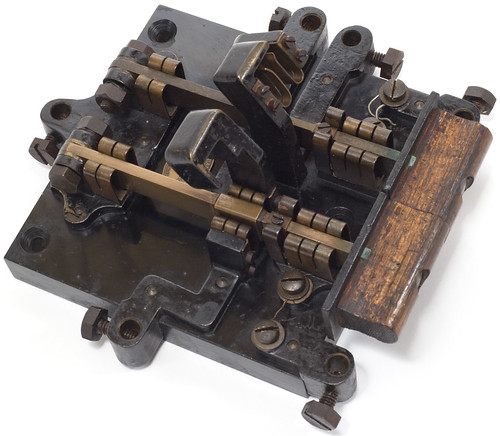
If you had to name one electrical component that just shouts "mad scientist", the knife switch would be that component.

(I'm not counting the Jacob's Ladder as a "component", here.)

Connecting lightning to your not-yet-animated monster, activating your death ray, powering up the time machine; all jobs for a big old two-blade knife switch.

Knife switches have plenty of actual practical uses in the real world. Even small ones can switch very high current, their position is obvious at a glance, and they can put up with a lot of abuse. They're obviously not a great choice for high-voltage switching, but they'll usually actually do that very well too - you just have to stay away from the live bits.

(Knife switches made for really high-voltage operation often have special spring-loaded doodads that stay connected as you raise the knife-bar, then snap up very quickly. Their purpose is to break the contact very rapidly, so you don't pull an arc between the terminals.)

So naturally I had to get one. And not one of the little plastic science-classroom versions with binding posts or spring terminals; I wanted something beefy, as were and still are used to isolate radio gear from the big lightning-attracting antenna outside. A knife switch also makes a dandy automotive battery isolator, but I didn't want one of those, either.

After a year or two of e-mails from my saved eBay search, I found just the thing.

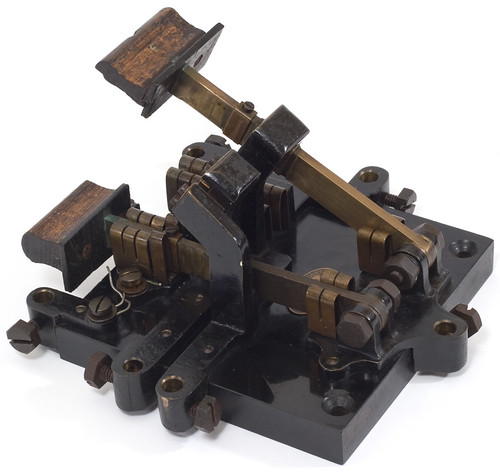
Knife switch - both blades up

This handsome object cost me $AU28.11 delivered, which I thought might have been a bit too much, until it arrived. I now realise I got a bargain. This thing's way cooler than I expected it to be.

All of the terminals and contacts work OK; a couple of the hefty terminal screws were seized and remain tight after cleaning and oiling, but this is a perfectly functional piece of gear.

The Bakelite-slab base is only about 14 centimetres square (5.5 inches), but the whole assembly weighs about 1.86 kilos (4.1 pounds). And it's surprisingly complicated.

Your standard two-blade knife switch is simple enough. It's either a dual-pole, single-throw, or a dual-pole, dual-throw (if you don't know what this means, check out the Wikipedia article on switches).

This thing, in comparison, is a freakin' logic puzzle.

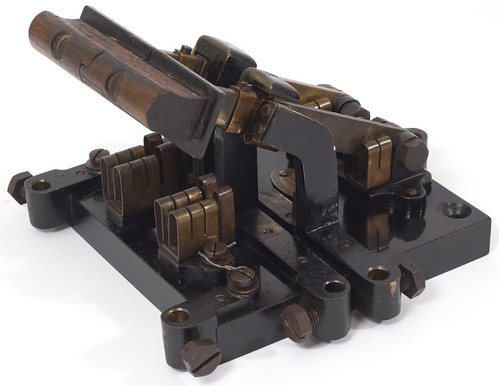
It's got six terminals, and two separately hinged - but electrically connected - blades. The worn (and now lightly polished!) wooden handle is in two parts, too, one for each blade. But the two handle parts form a rebate joint.

Knife switch - one blade up

This makes it possible to have both blades down, both blades up, or only the left blade up. But, because of the rebate joint, you can't have the right blade up and not the left.

Knife switch - both blades down

Let's number the terminals clockwise from the one at the bottom right of this picture. So the one to its left is terminal 2, terminal 3 is the one on the back connected to the bases of the blades, and so on to number 6, which is partly obscured by the wooden handle in the above picture. Pay attention, there will be a test.

With both blades up, terminals 1, 2 and 6 are connected to nothing, and terminals 3, 4 and 5 are connected to each other.

With the right blade down and the left blade up, terminals 1, 2, 4 and 5 are disconnected, while 3 is connected to 6.

With both blades down, terminals 1, 3 and 6 are connected to each other, and terminals 2 and 4 are connected to each other; only terminal 5 is no longer connected to anything.

(If you can't quite see how that is the case, note that the middle section of the left blade, the lower one in the above picture, has a copper sleeve around it that's insulated from the blade itself. When that blade's down, the sleeve connects terminal 2 to terminal 4, but not to the blade itself.)

Oh, and terminals 1 and 6 are connected to the blade contacts via a couple of bits of might-perhaps-be-fuse-wire-but-probably-isn't. So you could easily connect either or both of them to some other part of the assembly, if you wanted.

(Does anybody know of a piece of software that'll take a description like this - "in state A, these parts are connected, in state B, the situation changes to this", et cetera - and will then draw you a diagram? I started drawing it out by hand in a flowcharting/circuit-diagram program, but then realised I had no idea how to draw these crazy ganged switches.)

The baseplate bears a little oval plaque that says:

VICTORIAN RAILWAYS
ELECTRICAL ENGINEERING BRANCH
WORKSHOP SPENCER ST.

(It just occurred to me that the switch could easily have been used for switching railway signals of some sort. The rebated handle interlock could be for something like preventing green lights for both directions on one line.)

I actually will use this switch as a switch, from time to time. But when it's not in use, I think I'll hang it on the wall somewhere.

Ronnie Biggs waited until he was 71

As a number of readers, Gerard Ryle's blog and my saved Google News search have informed me, Tim Johnston, former proprietor of the dramatically-failed magic-fuel-pill pseudo-company Firepower, recently flew back into Australia.

I am not alone in being entirely unable to figure out why he did this. Tim was quite successfully hiding from his creditors overseas, but then decided to waltz back into the country using his own passport. ASIC then told all of the airports to not let him out again. And then he surrendered his passport. But then, last night, he went for a little drive, evading process servers.

Don't worry - I'm sure we'll catch him soon. I mean, it's not as if there are many places to hide around here.

UPDATE: And now we hear that Johnston allegedly used a forged letter from ASIC to assure potential investors that he was not in fact being investigated, and had only fled to London for a holiday, or something. Which is kind of like discovering that John Dillinger was also guilty of failing to pay his council rates, but the more charges the merrier, I suppose.

UPDATE 2: The process servers managed to locate Tim and give him the order to appear at a civil hearing, which the Firepower liquidator hopes will lead to criminal charges. He actually turned out to be pretty easy to find, because he obligingly turned up in another court to ask for his passport back.

This JavaScript alert box is admissible in court

Most people have seen stupid "copy protection" on Web pages, where some message about copyright or something pops up when you click the right mouse button. This is supposed to stop you from wickedly making another copy of some portion of the data that has already been stored on your own hard drive when your Web browser asked the server for the page, and the server cheerfully sent it.

(See also, people who make Web sites and then demand that you not link to them.)

Via The Daily WTF's most recent instalment of Error'd, though, comes what may be the Greatest BS Right-Click Warning Ever:

Ridiculous right-click warning

Every listing from this seller has this. Just scroll down to the main product description and click your wicked pirate terrorist right mouse button somewhere on it, and you will immediately receive your very own copy of this fascinating alert box.

Right-click over and over! Send dozens of "reports"! Wheeee!

In case you're new to all this, and wondering: No, nothing's actually being "recorded" or "reported". The alert is created by a little snippet of JavaScript that tells the browser to do something when you release the second mouse button. In this case, the code pops up the alert with the stupid message.

It works in the same way as this, which also pops up an alert when you click on it. (It's also not unlike the system used for "security" by the subjects of another Daily WTF story.)

Unless you've got JavaScript disabled, that is, in which case it won't do anything at all.

If you throw caution to the wind and view the source of any of this eBay seller's item pages - using that advanced hacker tool, your browser's "View" menu, or perhaps just by right-clicking somewhere else on the page from the main product description - you'll see that the high-powered enterprise-computing code that creates this very serious warning is part of a rather long single line.

As entertained DailyWTF commenters have observed, that line is, in the case of the listing I looked at anyway, a magnificent 40,076 characters in length.

Some text editors will choke on lines longer than 32,768 characters, you know.

So that's even more security, right there!