The boy who cried wolf 155 times

Every now and then I check back in with "The Lord's Witnesses" at TrueBibleCode.com. (The Lord's Witnesses may be an actual group of people, or maybe just one guy called Gordon.)

Since 2006, the Lord's Witnesses have been confidently predicting the start of Armageddon, usually to be heralded by nuclear explosion in Manhattan, in the very near future. Which is to say, weeks, or a few months at most, from the date on which the prediction is made. It's all based on careful analysis of encoded data in the Bible. It's really very simple.

Over and over and over, the Witneses have been wrong. But there's seldom even breathing space of a few days between the expiration of the last nuked-New-York deadline and the arrival of another, equally confident prediction that it's now very likely to happen by a new deadline. They always apologise for their previous error.

The Lord's Witnesses (who aren't connected with the Jehovah's Witnesses, except that Gordon used to be a JW) are so darn snappy about producing the new predictions that I suspect they may work on the new predictions before the old ones have expired, possibly just so as to have something to do while waiting for the Whateverocalypse.

The Witnesses have now reached the entertaining conclusion that the large number of times they've been wrong to date (155 times, according to them; a few more if you take every line of the frank list of mistakes on the front page as one error) may, itself, have numerological significance!

This stands to reason, of course. Why would God tease them like this, if not to enlighten them to another aspect of His ineffable plan?

(A plan which seems to have been in progress for rather a while. According to the Bible, Jesus Himself clearly predicted His own second coming before everybody then alive had died. Perhaps there's some troublesome immortal out there extending the deadline.)

It's refreshing to see an apocalypto-church, however small, whose org-chart doesn't taper to a point composed of people who are making out like bandits, and socking away the believers' cash in investments that're obviously incompatible with an actual belief in the imminent end of the world.

But at least sometimes those guys get caught. In the early 1990s, there was a Korean church called "Mission for the Coming Days" whose Australian branch was headquartered in a block of flats just up the road from my house. (Apparently there was a Korean "Hyoo-go", meaning "Rapture", movement at the time, and the Mission for the Coming Days was the biggest single church in the movement.)

The MftCD predicted the end of the world on October the 28th, 1992; that date stuck in my mind, since it was printed in big letters on the side of their van, which I passed every time I went to buy groceries.

As you may have heard, it didn't happen.

Some Korean followers of the Mission for the Coming Days committed suicide, I would imagine at least partly because they'd given everything they owned, including their homes, to one Lee Jang Rim, the guy in charge of the church. Some other Hyoo-go enthusiasts tried to kill their preachers.

I think that Lee Jang Rim himself, though, moulders in a Korean jail to this day. The giveaway was his substantial investments, some of which matured after the predicted end of the world.

My two alien implants

A couple of years ago, I went to the dentist. I don't go to the dentist very often, because I have no need for their services; all of my teeth are in excellent condition, presumably partly thanks to the evil fluoride conspiracy, and partly because of my enthusiasm for cleaning between them.

(I have now written more about my crackpot theory of dental care.)

This time, though, I suspected I had a supernumary wisdom tooth pushing up under one of my existing ones. That's a very uncommon complaint, but it was the only thing I could think of that explained the uncomfortable developments in my jaw. A small but definite bony protrusion was poking out of the inside edge of my left lower jaw.

It wasn't an extra tooth, though. There just seemed to be too much gum hanging on around one of my ordinary, non-supernumary wisdom teeth. This is a much more common problem, and easy to cure - numb it, carve away the excess, job done.

But my extra-tooth suspicion was partly triggered by the fact that there really was some surplus toothy stuff in there. A little shard of tooth, pushing out on my gum. It wasn't part of the wisdom tooth, it wasn't part of another tooth. The dentist and her assistant didn't know what the heck it was.

It's great when medical professionals peering into you through double eye-loupes say "Amazing!". I suggested they take it a bit further, and go for "Holy crap - what the hell is THAT?!", or indeed "Aaaa! The Antichrist! The Antichrist!".

But I digress.

My dentist's best guess was that the mystery object might have been a shard of a baby tooth that'd just sat peacefully in my jaw for twenty-something years, until my body decided to push it out, as bodies sometimes do. Many people's jaws are in a state of continental drift, as it were, that doesn't tally at all with the subjective feeling of a bunch of very hard things set very firmly in place.

But the dentist cheerfully admitted that she was just guessing, never having even heard of such a thing before.

Maybe a year later, it happened again. Same spot, same funny little shard of tooth or bone or whatever poking up out of my gum. I knew what it was this time, so I just dug it out myself with a pair of tweezers. (Unfortunately, this was before I reviewed the ETime Home Endoscope, which would have allowed me to take fascinating pictures of the little shard in-situ.)

The shard was kind of woody-feeling, not rock-hard like tooth enamel. So I suppose it might indeed have been bone, or perhaps dentin. I presume there's just a little glitchy bit of my jaw that decided to sprout a couple of these things. It's not unusual for a bit of normal tissue to occasionally grow in the wrong place, but it's only really noticeable when it has more dramatic results, like a dermoid cyst.

If I were inclined to believe in alien woo-woo or sorcery, though, I could easily have convinced myself that these strange objects were "implants", or voodoo thingummies, or some other phenomenon of great occult significance. After it happened the second time, there would have been no possible question - the Greys were clearly abducting me, shoving an implant into my jaw, wiping my memory and letting me go.

After the dentist thwarted their plan the first time, they just did it again! Clearly, it'd be time for me to find myself a "therapist" to hypnotise me into remembering the aliens putting the stuff in my mouth, not to mention all the times the witches/ghosts/aliens paralysed me as I lay in my bed, and of course that guy sacrificing giraffes to Satan in the tunnels under the day-care centre.

(Oh, and apparently you can remove alien implants with ear candles!)

Back in consensus reality, if you look closely enough at the body of anyone who's been on the planet for at least a few decades, you'll very probably find some little bits of something stuck in 'em somewhere. My girlfriend's got a tiny grey tattoo in the middle of her chest, under which somewhere is the bit of pencil lead that caused it when she managed to stick herself with it as a child. Anybody who lives an active life probably has quite a few tiny scar-encapsulated bits of wood or stone under their skin. Someone who works in a machine shop will light up like a Christmas tree in a full-body scan; heck, some of them have tiny metal turnings in their eyes that they don't know about, until they encounter a very strong magnetic field.

Given this, there's a very good chance that anybody whose mind turns to thoughts of alien abduction will be able to find disturbingly personal "concrete evidence" of said phenomenon, if they look hard enough.

Or you could just wait 'til there's smoke

A reader writes:

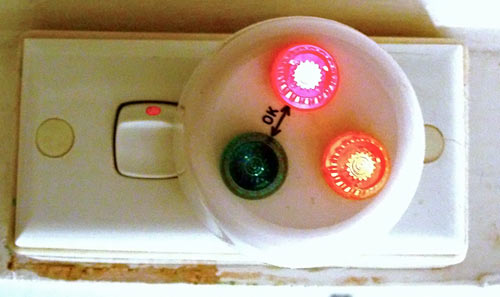
Back when Dick Smith still had Dick Smith in the logo and sold more than plasma TVs and pre-paid mobile phones, you could find there a little electrical detector thing made by HPM. I remember seeing it as a kid, but can't now remember what it was supposed to detect. I came across one in a laboratory undergoing decommission early this year, and took it home and plugged it in. It cheerily lit up a red and green "OK"

Satisfied that something was "OK", I left it plugged in in the bathroom to entertain my housemates.

That probably isn't good.

Last week, though, it switched to red and flickering orange, which I suppose means "Not OK". It has stayed like this ever since, but returns to normal in other people's houses. Lacking the manual, I wonder if you knew what this could signify?

Jonathan

PS Manuka Coles supermarket is selling the power meter you reviewed last year, this time branded Arlec (nostalgia!), for $29.90. Power metering for the masses!

I remember those things! They're "receptacle testers" or "outlet testers", thousands of them no doubt still lurk in kitchen drawers, and more refined versions still exist today.

I don't remember the exact wiring inside the old kind, but their basic idea is to light "Not OK" combinations whenever they see something other than the correct socket wiring. They want to see volts on active, no volts on neutral, no volts on earth, neutral and earth not electrically connected, and earth actually doing some earthing. (I think that's all.) Anything else gives you Not OK lights.

(I think these testers only exist in places, like Australia, where standard electrical sockets always have an earth pin, and only work one way around, so even a two-pin plug cannot be plugged in backwards. The USA, in comparison, is full of non-polarised earth-less sockets, so you can't make a tester that can figure out if there's something wrong, beyond incorrect voltage. UPDATE: As commenters point out below, I was wrong here - the States may still have a lot of two-pin either-way plugs, but any slightly modern building should have three-pin polarised sockets.)

If the tester's working properly, the Not-OK combination does indeed indicate a serious electrical problem. It's entirely possible for a building's wiring to originally be OK and then go bad; that rules out the classic "amateur electrician connected the wires wrong in 1978" problem, and if your appliances still work then that narrows it down further, but there are other ways for wiring to go bad. You could have no earth at all any more, for instance; that can have zero effect while everything else is fine, but if a wire comes loose inside your toaster and touches the chassis, then instead of shorting to earth and popping a breaker, it'll just sit there waiting to shock you.

I suppose this could perhaps just be something wrong with the old socket tester, but since it works in other houses I rather doubt that this is the case. But all things are possible, in this best of all possible worlds.

You can look at the socket wiring yourself without greatly endangering your life, by setting a multimeter (a $10 cheapie meter will be fine, as it almost always is) to the appropriate AC-volts range, and sticking the probes into the appropriate pin-holes of the socket.

(Deem usual warnings about how it's not my fault if you do the above after putting the other ends of the test leads in your mouth to have been included here.)

Looking at the socket, here's what the holes should be:

active /   \ neutral

         | earth

Active-to-neutral should give you 240 volts AC (Australia is now nominally a 230VAC country, but I think pretty much everywhere still actually has about 240V). Neutral-to-earth should give you zero (a small voltage here does not indicate a serious fault; capacitive coupling between active and neutral wires can give neutral a few volts with a safe near-zero current capacity). Active-to-earth should give you 240V (or near offer) again.

It's possible, but unlikely, that doing the last test may trip a "safety switch" (ELCB or RCD), since the multimeter will pass a weeny bit of current. This doesn't by itself mean there's anything wrong; it's normal for perfectly safe appliances in the average house to also leak a very small amount of current to earth, which'll use up some of the trip capacity of the safety switch and leave it susceptible to tripping when something, like a multimeter, adds only a little more leakage.

The impedance of a cheap multimeter in AC-volts mode should be a couple of million ohms, so it should only pass a small fraction of one milliamp from 240V. That isn't likely to bother even a twitchy 5mA safety switch, let alone one of the more common 20-30mA ones. But if your $10 multimeter does manage to trip the RCD, just go to the breaker box and un-trip it again.

(If your safety switch trips when it sees a 20-milliamp difference between the current in active and the current in neutral, and stuff in your house is already leaking, say, 17 milliamps in total, then you can get irritating "nuisance tripping" at random moments. This may be curable by a process of elimination, finding the one appliance in the house that contributes most to the problem; if that doesn't work, the annoying safety switch may be trying to tell you about a real wiring problem.)

A safety switch may also instantly trip when you plug an outlet tester in, because the old-style three-lights tester comes from a time before safety switches, and inherently passes a small current between pins that should not normally be connected. Modern outlet testers are more sophisticated (and more expensive); they typically have an "RCD Test" button, and only pass current from active to earth when you press that button.

If I were you, the first thing I'd do would be to unplug everything unpluggable, and see if the outlet tester returns to happiness. If it does, plug things back in one at a time until the problem recurs, then unplug the offending appliance, cut its cord off and dispose of it. (Or get it fixed, if it's your hundred-inch plasma TV.)

If unplugging stuff doesn't help, and especially if the above quick multimeter test reveals a problem, it's Qualified Electrician Time. If you're lucky, the fault is in the breaker box or the Lovecraftian wiring that lurks behind it. If you're less lucky, the problem's in the walls somewhere. Either way, it's something you need to attend to, lest you get zapped, or awaken to a thrilling housefire.

UPDATE: Modern equivalents of the old socket-tester do exist. Here's one with an Aussie plug that only costs $AU21.95.

Minor Crimes Against Science Education, Part 273

A reader pointed out yet another "water powered clock" to me, and asked:

What do you think? Scam, right? To me it sounds like it's got a battery in it, and water is just a conductor for it. "2 year lifespan" makes me even more certain...

Yes, that's kind of the deal.

Herein, I shall shamelessly reprint and slightly expand something I previously wrote as a comment on Book Of Joe:

Man, I'm tired of things like this. "Fruit Powered Clock", "Water Powered Radio", "Potato Powered Web Server" (that one required rather a lot of potatoes, as I recall). Some of them are complete hoaxes, but the commercial ones all do actually work. Every single one of them is misnamed, though.

In all of these cases, the object or liquid in between the electrodes is not "powering" anything. It is acting as the electrolyte, like the goo inside a flashlight battery or the acid inside your car battery. The actual power comes from an electrochemical reaction between the electrodes. For little gadgets like this one, the electrodes are generally paddles of copper and zinc.

All the electrolyte does is transport ions from one electrode to the other (and collect contamination along the way, which is why you mustn't eat the orange that's been "powering" that clock for the last couple of days). The actual power comes from the electrochemical difference between the material from which the electrodes are made. One electrode will be slowly eaten away, and the other will slowly crust up with crud.

To say otherwise - as the packaging for these devices invariably does - is like saying that your television is "powered by wire".

Science toys are fantastic.

Science toys that're dumbed down until they're lying to us are an own goal.

Know everything they type, or stop them from typing at all!

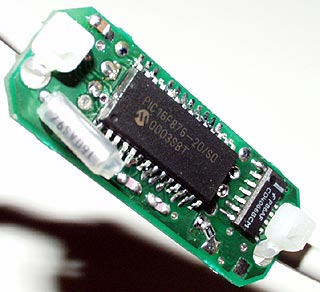
Back in 2000, I reviewed the KeyGhost Security Keyboard, an apparently ordinary keyboard with a hardware keylogger hidden inside it. Later that year, I reviewed the KeyGhost II Professional, another hardware keylogger, this time built into an innocuous-looking keyboard plug adapter.

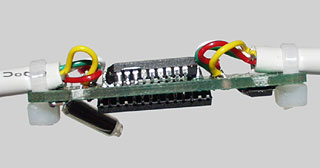
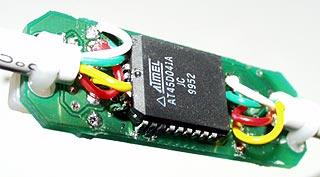
Those reviews have a special place in my heart, partly because I just love the sneakiness of these little things, and partly because someone ripped off my pictures of the guts of the Security Keyboard...

Keyghost unit

Keyghost unit side 2

Keyghost unit side 1

...to create an urban legend about hardware keyloggers allegedly being built into Dell laptops. (Or other makes of computer - the story's had a few mutations over the years.) Some people appear to have decided that the fact that the pictures and info about the hardware are obviously copied from my review means that I'm part of the conspiracy.

(KeyGhost now offer a Mini PCI keylogger, which actually could be hidden in a laptop computer with a spare expansion slot, or in a desktop machine with a Mini-PCI-to-normal-PCI adapter. I'm pretty sure they're not selling them by the million to the Department of Homeland Security, though.)

Anyway, KeyGhost don't sell those exact products any more. They've got better ones. And a new gadget with a completely different purpose, whose value it took me a little while to see.

The old Security Keyboard I reviewed had a memory capacity of half a million keystrokes, before new keystrokes would start overwriting the oldest ones. The KeyGhost Pro had a compression system that let it fit rather more keystrokes into the same amount of memory. And they weren't particularly cheap; the Security Keyboard version I reviewed listed for $US299, and the KeyGhost II Professional was a $US249 item.

Nowadays, you can get a 128,000-keystroke plug-adapter "External KeyGhost Home Edition" for only $US89, and for the price of the old Security Keyboard you can get the KeyGhost Professional SE Security Keyboard, with more than two million keystrokes of capacity. That's enough to hold, for comparison, Moby Dick plus the New Testament of the King James Bible).

All of the "Professional" KeyGhost loggers also still have 128-bit encryption of their contents. It wouldn't be very hard for someone who doesn't know the password for a KeyGhost Pro, but who does have some experience with hardware hacking, to dump the entire contents of the Flash memory chip - the actual dump would take almost no time at all, since you're only talking a couple of megabytes for even the top-spec KeyGhosts. But if there isn't some weakness in the encryption scheme, the attacker would then need cubic kilometres of sci-fi nanotech to decrypt the data.

As you'd expect, KeyGhost also now have USB keyloggers for people who prefer a 15-year-old keyboard interface to a 25-year-old one. The USB loggers are more expensive, starting from $US199; the flagship model is $US349. For that price, though, you get a keylogger that date-stamps keyboard activity, and records everything that's typed on any USB keyboard plugged into the computer, whether or not that keyboard's plugged in through the KeyGhost itself. It even works with multiple USB keyboards.

UPDATE: I misunderstood part of the USB keylogger product page. What that part actually meant was that the USB keylogger can be plugged into root ports or into a hub, and still work. It will also work with a keyboard that has its own built-in USB hub, provided all you have plugged into that hub is a mouse (many Mac keyboards are like this). But the USB KeyGhost only logs keystrokes from the one keyboard that's plugged into it.

And then, there's the new "QIDO". It's another little thumb-drive-shaped thing, but it doesn't log keystrokes - it changes them. Its name stands for "Qwerty In, Dvorak Out", and it does what it says on the tin - translates keystrokes from any ordinary Qwerty keyboard into Dvorak Simplified Keyboard keystrokes - and it supports a few different Dvorak variants, too. You activate and deactivate the QIDO by double-tapping Num Lock (or, apparently "Clear", on some Mac keyboards).

If you're one of the few, the proud, the Dvorak-keymap users, you'll be used to fooling around with keymap settings every time you sit down in front of a new computer, and whenever you want to make the computer usable for a Qwerty typist again. With a QIDO, all you need to do is carry the little USB dongle with you. It costs $US119 $US89 plus $US29 delivery, or less if you buy two or more.

The QIDO is a plug-and-play USB device, so to install it, all you have to do is unplug the USB keyboard cable and insert the QIDO between keyboard plug and computer (or USB hub) socket. Actually, because of the QIDO's thumb-drive form factor, I'd recommend you get a little USB extension cable to put between QIDO and computer, so the QIDO isn't hanging in the air, stressing its plug and the computer's socket. But it's still easy to install, and very portable.

The KeyGhost people asked me whether I'd like to review a QIDO, but I don't really see that there's a great deal to review in there. I can tell you now what my review would say: "I plugged the thing inline with a USB keyboard, and the keyboard continued to work normally, except when I tapped Num Lock twice, whereupon I couldn't type any more because I don't know Dvorak."

Ideally, QIDO would magically transform the keyboard's keycaps from "qwerty" to "',.pyf" when you switched modes, but you can only do that if you've got one of those incredibly expensive Optimus Maximus jobbies with a little OLED display built into each key. (The Maximus is apparently quite rubbish to type on, by the way.)

Having the wrong things printed on the keys is not actually a huge problem for Dvorak typists, once they've learned the layout well enough that they don't have to look at the keys for everyday typing, or have just built a mental lookup table of which Qwerty keys correspond to which Dvorak ones.

This isn't as hard as you might think, because standard Dvorak only relocates the alphabetic keys and common punctuation. So the lesser-used symbols of which people are most likely to forget the precise location - @, #, $, % and so on - are still where the keycaps say they are. And if you're learning Dvorak on a Qwerty keyboard you can, of course, just stick a picture of the Dvorak map on the wall and glance at it as necessary.

Since the QIDO can't change the keycaps, though, I was having some trouble figuring out what real advantage it offers over the free alternative - just changing your operating system's keymap.

It's easy to add a Dvorak keymap in Windows - or Mac OS and Linux, for that matter - and then you can switch keymap in a couple of clicks. The QIDO makes switching even faster, but by and large it didn't seem to me that it does anything that changing the keymap in the OS doesn't do.

But then I found this blog post from one Alex Eagle, which I shall now shamelessly plunder.

[KeyGhost now tell me that Alex Eagle is actually "the guy who came up with the concept for the QIDO", so it's obviously not coincidental that his blog-post wish-list so closely matches its actual features.]

Reasons why the QIDO's worth buying:

1: OS keymap control is imperfect. It's possible, for instance, to find certain modifier-key combinations that don't Dvorak-ify properly.

Windows XP (and maybe Vista - I don't know) does Dvorakification in a strange "application-by-application" way. If you add a Dvorak "Keyboard layout/IME" to WinXP, and then bring up the little Language Bar thing and select the new layout, you'll find that you're back in Qwerty mode as soon as you select any other application. This probably isn't what you want, but you're still going to have to separately select Dvorak from the Language Bar for that app, and for every other app you switch to. Each application remembers what keymap is selected, but they all seem to have to be told individually.

Windows Explorer itself counts as an application, here. So you have to select Dvorak after clicking on the desktop or a folder window, if you want to be able to press the-key-usually-known-as-R and have Windows highlight a file whose name starts with the Dvorak-layout P.

I don't think I've quite gotten to the bottom of this, either. The WinXP computer I'm typing this on is now slightly confused, after I switched the keymap back and forth umpteen times; it just switched to Dvorak spontaneously when I was in the middle of typing this document. I can definitely see the attraction of having a keyboard that sends Dvorak-mapped keycodes all by itself, and doesn't even dip a toe into this OS-mediated weirdness.

2: Some software bypasses OS keymap control and looks at direct keyboard scancodes, assuming them to map to the Qwerty values. Or, even more annoyingly, some software may sometimes look at scancodes, and at other times obey OS keyboard remapping. (From reading Raymond Chen's The Old New Thing, I know that just because an application has a user base of more than fifty million people does not mean it won't do boneheaded things like this.)

3: The QIDO lets you have a Dvorak keyboard and a Qwerty keyboard both connected to a computer, and working, at the same time, with no switch-over needed and no fooling with strange WinXP-type keymap selection. This isn't something that most people need, but if you do need it, you probably need it quite badly.

4: Remote computing. If you take control of another computer via VNC or Remote Desktop or whatever, you may or may not get the same keymap at the other end. Again, the QIDO fixes this problem altogether.

You can use the QIDO with any computer you can plug it into, regardless of whether that computer has software support for Dvorak keymaps; it will even work when the computer's not even running a normal operating system, like in BIOS setup programs (provided the computer accepts USB input in BIOS setup, of course) or the Splashtop quick-starting Linux environment. There's probably some allegedly-USB-supporting computer out there that won't work with a QIDO, but it's a standard low-power Human Interface Device, so it really ought to work with just about anything. I could believe it not working if you use it with an old high-power-consumption PS/2 keyboard (like my beloved IBMs), but I wouldn't be surprised if you just needed a better PS/2-to-USB adapter, like the one I mention here.

5: The QIDO doesn't just support Dvorak Standard and a Dvorak-Qwerty hybrid, but also the Single-Handed Left and Single-Handed Right Dvorak variants, for typing using only one hand.

(Certain jokes immediately suggest themselves, but single-handed keyboards of various sorts are immensely helpful for people who only have one hand to type with, because the other one's missing, or because the other one's busy with some other task, like steering their freaky computer-bike, or something.)

You select the keymap you want the QIDO to switch to by using a system taken from the KeyGhosts; type "keydvorak" into a text editor when the QIDO's plugged in, and a "ghost" will type out a menu for you and then await your selection.

Since the QIDO unfortunately does not magically rearrange your keycaps, I think it's likely that most people who'll want a QIDO will also want a keyboard with keys that match their Dvorak layout. It's not easy to actually find an ordinary, inexpensive off-the-shelf keyboard that comes with Dvorak-layout keycaps, but you can often just swap the keycaps around. This'll move the key-locating "pips" that most keyboards have on the F and J keys, and it's unacceptably untidy if your keyboard has differently-angled keys on each rank; if that's the case, you can just use stickers, or break out the sandpaper and permanent marker.

Switching your mind between Dvorak and Qwerty can be a lot harder than switching your keymap. If, for whatever reason, you're better at typing on a Dvorak keyboard than on a Qwerty one - which you'd of course better be at some point in the near future, if you're bothering with Dvorak at all - then you're probably going to need some way of Dvorak-ising any computer you're going to need to type on, lest you overtax your fading brain.

An expensive keyboard with a hardware Qwerty/Dvorak switch on it will solve this problem for you, provided you're happy to carry the darn thing to every computer you use. The QIDO isn't cheap, but it's not as expensive as any switchable keyboard I've found, and it's an awful lot more portable.

The only things it won't Dvorak-ise are computers that can't accept a USB keyboard for whatever reason, and laptops. But you'll probably be able to muddle along with operating-system keymap switching then, if you don't face these situations too often.

I, personally, have not the slightest need for a QIDO. But contrary to my first impression, it really does look like a useful little gadget. If you're using flaky OS keymap switching all the time and tearing your hair out, a QIDO for $US119 plus delivery could be a bargain - and, as mentioned by KeyGhost in the comments below, everybody now gets the $US89 bulk price, even if they're only buying one unit!

A surprisingly un-awful interface

I've become something of a connoisseur of dreadful user interfaces.

They usually grow like pearls, when a programmer adds features to the software he's writing, and sticks the interface elements for each new feature wherever they fit.

From the programmer's point of view everything's fine, because he knows the software back to front and can remember where he's put everything. From anybody else's point of view, though, the interface looks as if a drunk reeled unsteadily around the window, dropping a checkbox here, vomiting up a drop-down menu there. If the program has a lot of features, then even if the programmer doesn't do anything really stupid, the interface can still be hilariously horrible.

It's possible for an interface to be inscrutable at first but pleasant to use after a relatively short learning period - look at Kai Krause's old Photoshop plug-ins, for instance - but developer-made interfaces that just growed like Topsy usually aren't like that.

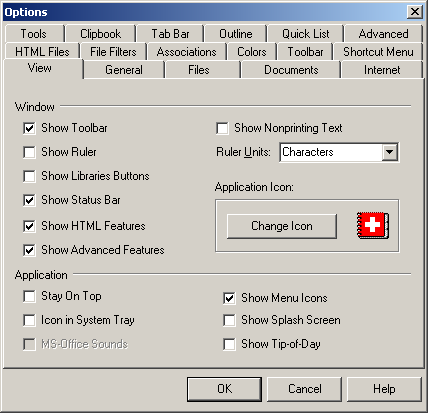
One that I see quite often is NoteTab's many-tabbed Options dialogue...

NoteTab setup window

...but there are some much more impressive examples.

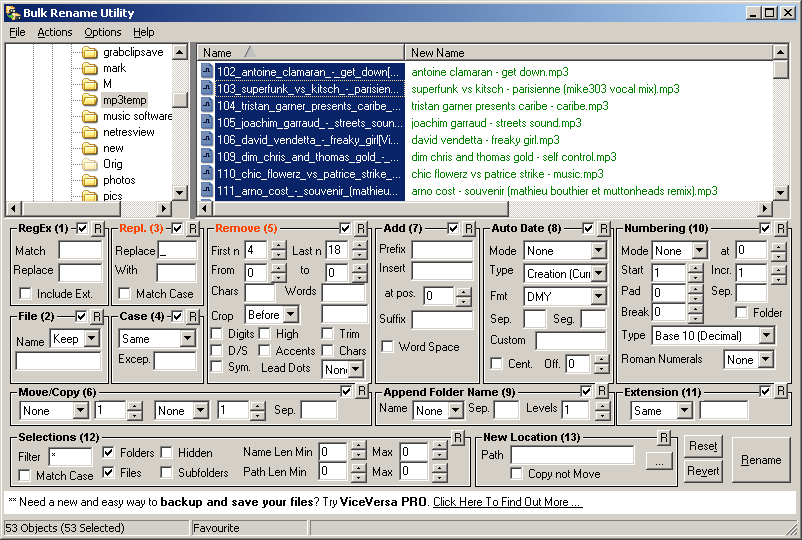
Bulk Rename Utility interface

Like this, for instance.

I had a directory full of MP3s that all had file names with a number on the front and a chunk on the end that I didn't want, and which all had underscores in place of spaces. I wanted to make the file names prettier.

To do a job like this on a PC, there are four ways you can go.

1: Rename them all by hand. Acceptable for six files, not acceptable for sixty, a tedious way to spend an afternoon for six hundred, a steady job for life for six million.

2: Write a little batch file, usually in some inelegant way like doing a dir >foo.bat and then editing foo.bat so that it ends up as a long list of "ren" commands. Or even uses "for", if you're fancy.

3: Use a proper Unix-style shell like Cygwin or something, that lets you do stuff like this in one operation on the command line, or at worst with a very small script. The standard Unix/Linux/whatever "mv" command can't do this in one line, but any decent shell should have a quite powerful "rename" command. More complex operations are likely to require you to know regular expressions, though.

4: Chicken out and just find a stand-alone file-rename utility.

I chose option 4, and headed off to Pricelessware, the alt.comp.freeware reference archive. Pricelessware pointed me to Bulk Rename Utility, whose inimitable interface you see above.

Let's have another look at it, shall we?

Bulk Rename Utility interface

When I first ran Bulk Rename Utility and saw this, I just sat there and laughed. That lower portion of the window contains, unless I've miscounted, 28 check-boxes, 21 text fields, 17 incrementable numeric-field doohickies each with two increment buttons, 14 drop-down menus, and 17 other miscellaneous buttons. And it's got a normal complement of ordinary menus up at the top!

The hell of it is, though, that this interface is actually very usable. It works, and it works well. I learned how to make it do what I wanted in, I don't know, maybe 30 seconds. It could probably be better, but it's by no means actually bad.

Bulk Rename Utility would be every bit the nightmare it appears to be, if it weren't for one very sensible move on the programmer's part: The interface shows you, in green, a preview of what your instructions are going to do to whatever files you've selected.

So I could instantly see that my search-for-"_"-and-replace-with-" " operation was going to annihilate all of the filenames altogether, and I said "huh?", and then I noticed that I'd accidentally put the search-and-replace terms in the "RegEx (1)" part of the interface instead of the "Repl. (3)" part, and I fixed that, and it was fixed.

Capitalising words in filenames is easy, too - just stare at the interface for 10 seconds to find the right bit of it ("Case (4)"), and select the option you want - "Lower", "Upper", "Title" or "Sentence" - from the menu. If those names don't immediately explain their function to you, the green preview will.

Bulk Rename Utility even deals elegantly with locked files. If you choose to abort the renaming procedure because a locked file can't be renamed (in this case, the file was still open in my music-player), Bulk Rename Utility gives you the option of reversing all of the renames it did before getting to the locked file.

Using regular expressions via this interface isn't much easier than using them on the command line, but there are umpteen other options for everyday, and some quite unusual, rename operations. If you're not doing something pretty darn complicated, you ought to be able to get it done with the standard interface.

An interface like this is still a usability disaster for a lot of people, though.

Pretty much anybody should be able to learn how to do complex rename operations with Bulk Rename Utility if they just spend a couple of minutes playing with it. OK, you might have to look at the help, or even download the manual in PDF format. But it's really not that difficult, even if you're not good with computers.

But your average computer-phobic person won't even try to use something that looks like this. The same explosion-in-an-interface-factory quality that cracked me up when I first saw Bulk Rename Utility has a much more negative effect on people who aren't confident about using computers.

Sometimes that lack of confidence is justified. It's still easy to find big-name software products, including whole operating systems, that just don't bloody work for some tasks, or that drop dead unexpectedly and then need a lot of work to fix. One of the standard things you hear from computer-phobic people is "I don't want to mess around with it, in case I break something". If that fear is based on a memory of a time when something really did break, then it'll be a difficult phobia to cure.

But many computer-phobics haven't had many, or any, experiences of this sort. They just don't know much about computers, and have decided that this means they will never know much about them. I find that attitude very frustrating - "give a man a fish and he'll eat for a day, try to teach a man to fish and he'll tell you you're wasting your time".

On the plus side, Bulk Rename Utility might actually serve as a sort of exposure therapy for computer phobias. Show it to the computer-hater, let them soak up how completely impossible it looks, then let them use it to rename a directory full of temp files. Whaddaya know - it's not that hard, if you just read the little labels and then see what they do!

The only thing wrong with Bulk Rename Utility for this purpose is that renaming multiple files isn't a task that ordinary users actually have to do very often. Ideally, you'd want a daunting-seeming, actually-easy-to-use program that greatly speeds up some painful task that ordinary users do often have to do.

Any suggestions?

The Preliminary Proving of Pat Putt, Psychic

Apropos, given recent discussions:

"Professional medium Patricia Putt was last week subjected to a rigorous scientific test of her powers as the first stage of her bid to claim a $1m prize from the James Randi Educational Foundation."

And was Mrs Putt, who is apparently a dab hand at removing evil spirits from houses, the very first person in the history of the One Million Dollar Paranormal Challenge to pass the preliminary test?

Nope.

Mrs Putt claims to have the ability to psychically read people just by "being near them and hearing their voices". So ten volunteers were disguised, and faced away from her while reading from a set text, and Mrs Putt produced personalised psychic readings for each of them. The volunteers then perused all of the readings and picked the one which they thought best described them.

If five or more subjects picked the right reading, Mrs Putt would have passed the preliminary test and been able to take the final, more rigorous, million-dollar test.

(Which isn't to say this preliminary test was sloppy. As with every other preliminary test, the protocol was well-thought-out, with thorough precautions to avoid even quite subtle cheating.)

Precisely none of the subjects picked the reading that was allegedly about them.

To Mrs Putt's credit, she didn't then do what so many failed contestants have done - say the testers must have been cheating, the challenge is rigged, Randi is a child molester, blah blah blah.

Some failed challengers are all smiles when they leave and then immediately start pumping out press releases about how the scientific method is a Satanic plot, but Mrs Putt's Web site has no such updates (there seem to have been no updates at all for a few years, actually). Randi has also had to endure loud complaints from various people who never even made it to the preliminary test, because they refused to say exactly what it was they proposed to do, or proposed a test that could reasonably be expected to result in serious injury or death, or wouldn't say what would constitute failure. Or, most commonly, because they just broke off correspondence with Randi, since they had no time to talk to him between all their blog and Usenet posts about how Randi is too cowardly to face them.

But Mrs Putt took her defeat with dignity. For a few days. Then she gave in to temptation, as is explained in a stop-press at the end of the Guardian article. She announced that because the subjects were "bound from head to foot like black mummies, they themselves felt tied so were not really free to link with Spirit making my work a great deal more difficult".

(The subjects were actually wearing a ski mask and wraparound shades, and draped with a graduation gown. None reported feeling "tied".)

The fact that not a single one of the subjects picked the right reading opens a well-known psychic escape hatch, which goes something like: "In the pressure of the test, my powers must have fouled up and started working in reverse! Surely if I failed every single round of the test, when you would have expected me to get some right by random chance, that still indicates that something spooky is going on!"

Mrs Putt hasn't tried that one (yet), but I think it's instructive to run the numbers to see just how unlikely this event was, assuming everything was just random chance.

In the Putt test, each subject got their own set of all ten of the readings to choose from. This is good, for two reasons.

One, if they were all choosing from one pile of ten readings, then Subject 3 (say) could take Subject 7's reading, making it impossible for Subject 7 to pick the right one.

And two, it meant I didn't have to tie myself up in conditional-probability knots to figure out how likely it actually was that no subjects would choose the right reading by random chance.

As I've discussed before, this is also the way to go about calculating how likely it is that one or more subjects would choose the right reading randomly, because that probability is the inverse, or "complement", of the probability that none would.

If you've got ten subjects each randomly choosing from ten readings, one of which is "theirs", the probability that each individual subject will choose the wrong reading is 9 out of 10, or 0.9. Since there are ten subjects, the probability that no subject will get the right reading by random chance is 0.9 to the power of 10, or 0.349. Which means the probability that at least one subject will get the right reading is 0.651.

So it's only slightly odd that nobody picked the right reading by accident. The possibility still remains that Mrs Putt actually did do some "reverse psychic-ology" and produce readings that were completely unlike the person she was attempting to describe, and that the zero result thereby does indicate something odd going on. But given that the same test done entirely at random will give you this same zero-hits result seven times out of every twenty, the result doesn't look peculiar at all.

(The chance that all of the subjects would randomly choose the right reading is 0.1 to the power of 10, or one in 10,000,000,000. Mrs Putt would only have needed five or more of the subjects to randomly choose the right reading in order to pass the test, though. I leave calculating the probability of that as an exercise for the reader.)

Reprint #96 of that bit of Ben's book

While I'm posting vast chunks of text written by someone else, I thought this might be a good moment for me to do my part to fill up the Google results with the truth about one of the world's most horrifyingly successful quacks.

Herewith, Ben Goldacre's suddenly-famous book chapter about Matthias Rath, which was missing from the first edition of his book because of ongoing legal action by Rath against Ben and The Guardian.

Rath dropped the case, is paying his opponents' costs, and has displayed his usual firm grasp on reality by deciding that this means he has won a famous victory.


This is an extract from
BAD SCIENCE by Ben Goldacre
Published by Harper Perennial 2009.

You are free to copy it, paste it, bake it, reprint it, read it aloud, as long as you don't change it – including this bit – so that people know that they can find more ideas for free at www.badscience.net

.

The Doctor Will Sue You Now

This chapter did not appear in the original edition of this book, because for fifteen months leading up to September 2008 the vitamin-pill entrepreneur Matthias Rath was suing me personally, and the Guardian, for libel. This strategy brought only mixed success. For all that nutritionists may fantasise in public that any critic is somehow a pawn of big pharma, in private they would do well to remember that, like many my age who work in the public sector, I don't own a flat. The Guardian generously paid for the lawyers, and in September 2008 Rath dropped his case, which had cost in excess of £500,000 to defend. Rath has paid £220,000 already, and the rest will hopefully follow. Nobody will ever repay me for the endless meetings, the time off work, or the days spent poring over tables filled with endlessly cross-referenced court documents.

On this last point there is, however, one small consolation, and I will spell it out as a cautionary tale: I now know more about Matthias Rath than almost any other person alive. My notes, references and witness statements, boxed up in the room where I am sitting right now, make a pile as tall as the man himself, and what I will write here is only a tiny fraction of the fuller story that is waiting to be told about him. This chapter, I should also mention, is available free online for anyone who wishes to see it.

Matthias Rath takes us rudely outside the contained, almost academic distance of this book. For the most part we've been interested in the intellectual and cultural consequences of bad science, the made-up facts in national newspapers, dubious academic practices in universities, some foolish pill-peddling, and so on. But what happens if we take these sleights of hand, these pill-marketing techniques, and transplant them out of our decadent Western context into a situation where things really matter?

In an ideal world this would be only a thought experiment. AIDS is the opposite of anecdote. Twenty-five million people have died from it already, three million in the last year alone, and 500,000 of those deaths were children. In South Africa it kills 300,000 people every year: that's eight hundred people every day, or one every two minutes. This one country has 6.3 million people who are HIV positive, including 30 per cent of all pregnant women. There are 1.2 million AIDS orphans under the age of seventeen. Most chillingly of all, this disaster has appeared suddenly, and while we were watching: in 1990, just 1 per cent of adults in South Africa were HIV positive. Ten years
later, the figure had risen to 25 per cent.

It's hard to mount an emotional response to raw numbers, but on one thing I think we would agree. If you were to walk into a situation with that much death, misery and disease, you would be very careful to make sure that you knew what you were talking about. For the reasons you are about to read, I suspect that Matthias Rath missed the mark.

This man, we should be clear, is our responsibility. Born and raised in Germany, Rath was the head of Cardiovascular Research at the Linus Pauling Institute in Palo Alto in California, and even then he had a tendency towards grand gestures, publishing a paper in the Journal of Orthomolecular Medicine in 1992 titled "A Unified Theory of Human Cardiovascular Disease Leading the Way to the Abolition of this Disease as a Cause for Human Mortality". The unified theory was high-dose vitamins.

He first developed a power base from sales in Europe, selling his pills with tactics that will be very familiar to you from the rest of this book, albeit slightly more aggressive. In the UK, his adverts claimed that "90 per cent of patients receiving chemotherapy for cancer die within months of starting treatment", and suggested that three million lives could be saved if cancer patients stopped being treated by conventional medicine. The pharmaceutical industry was deliberately letting people die for financial gain, he explained. Cancer treatments were "poisonous compounds" with "not even one effective treatment".

The decision to embark on treatment for cancer can be the most difficult that an individual or a family will ever take, representing a close balance between well-documented benefits and equally well-documented side-effects. Adverts like these might play especially strongly on your conscience if your mother has just lost all her hair to chemotherapy, for example, in the hope of staying alive just long enough to see your son speak.

There was some limited regulatory response in Europe, but it was generally as weak as that faced by the other characters in this book. The Advertising Standards Authority criticised one of his adverts in the UK, but that is essentially all they are able to do. Rath was ordered by a Berlin court to stop claiming that his vitamins could cure cancer, or face a €250,000 fine.

But sales were strong, and Matthias Rath still has many supporters in Europe, as you will shortly see. He walked into South Africa with all the acclaim, self-confidence and wealth he had amassed as a successful vitamin-pill entrepreneur in Europe and America, and began to take out full-page adverts in newspapers.

˜The answer to the AIDS epidemic is here," he proclaimed. Anti-retroviral drugs were poisonous, and a conspiracy to kill patients and make money. "Stop AIDS Genocide by the Drugs Cartel said one headline. "Why should South Africans continue to be poisoned with AZT? There is a natural answer to AIDS." The answer came in the form of vitamin pills. "Multivitamin treatment is more effective than any toxic AIDS drug. Multivitamins cut the risk of developing AIDS in half."

Rath's company ran clinics reflecting these ideas, and in 2005 he decided to run a trial of his vitamins in a township near Cape Town called Khayelitsha, giving his own formulation, VitaCell, to people with advanced AIDS. In 2008 this trial was declared illegal by the Cape High Court of South Africa. Although Rath says that none of his participants had been on anti-retroviral drugs, some relatives have given statements saying that they were, and were actively told to stop using them.

Tragically,Matthias Rath had taken these ideas to exactly the right place. Thabo Mbeki, the President of South Africa at the time, was well known as an "AIDS dissident", and to international horror, while people died at the rate of one every two minutes in his country, he gave credence and support to the claims of a small band of campaigners who variously claim that AIDS does not exist, that it is not caused by HIV, that anti-retroviral medication does more harm than good, and so on.

At various times during the peak of the AIDS epidemic in South Africa their government argued that HIV is not the cause of AIDS, and that anti-retroviral drugs are not useful for patients. They refused to roll out proper treatment programmes, they refused to accept free donations of drugs, and they refused to accept grant money from the Global Fund to buy drugs. One study estimates that if the South African national government had used anti-retroviral drugs for prevention and treatment at the same rate as the Western Cape province (which defied national policy on the issue), around 171,000 new HIV infections and 343,000 deaths could have been prevented between 1999 and 2007. Another study estimates that between 2000 and 2005 there were 330,000 unnecessary deaths, 2.2 million person years lost, and 35,000 babies unnecessarily born with HIV because of the failure to implement a cheap and simple mother-to-child-transmission prevention program. Between one and three doses of an ARV drug can reduce transmission dramatically. The cost is negligible. It was not available.

Interestingly, Matthias Rath's colleague and employee, a South African barrister named Anthony Brink, takes the credit for introducing Thabo Mbeki to many of these ideas. Brink stumbled on the "AIDS dissident" material in the mid-1990s, and after much surfing and reading, became convinced that it must be right. In 1999 he wrote an article about AZT in a Johannesburg newspaper titled "a medicine from hell". This led to a public exchange with a leading virologist. Brink contacted Mbeki, sending him copies of the debate, and was welcomed as an expert.

This is a chilling testament to the danger of elevating cranks by engaging with them. In his initial letter of motivation for employment to Matthias Rath, Brink described himself as "South Africa's leading AIDS dissident, best known for my whistle-blowing exposé of the toxicity and inefficacy of AIDS drugs, and for my political activism in this regard, which caused President Mbeki and Health Minister Dr Tshabalala-Msimang to repudiate the drugs in 1999?.

In 2000, the now infamous International AIDS Conference took place in Durban. Mbeki's presidential advisory panel beforehand was packed with "AIDS dissidents", including Peter Duesberg and David Rasnick. On the first day, Rasnick suggested that all HIV testing should be banned on principle, and that South Africa should stop screening supplies of blood for HIV. "If I had the power to outlaw the HIV antibody test," he said, "I would do it across the board." When African physicians gave testimony about the drastic change AIDS had caused in their clinics and hospitals, Rasnick said he had not seen "any evidence" of an AIDS catastrophe. The media were not allowed in, but one reporter from the Village Voice was present. Peter Duesberg, he said, "gave a presentation so removed from African medical reality that it left several local doctors shaking their heads". It wasn't AIDS that was killing babies and children, said the dissidents: it was the anti-retroviral medication.

President Mbeki sent a letter to world leaders comparing the struggle of the "AIDS dissidents" to the struggle against apartheid. The Washington Post described the reaction at the White House: "So stunned were some officials by the letter's tone and timing during final preparations for July's conference in Durban that at least two of them, according to diplomatic sources, felt obliged to check whether it was genuine. Hundreds of delegates walked out of Mbeki's address to the conference in disgust, but many more described themselves as dazed and confused. Over 5,000 researchers and activists around the world signed up to the Durban Declaration, a document that specifically addressed and repudiated the claims and concerns–at least the more moderate ones–of the "AIDS dissidents". Specifically, it addressed the charge that people were simply dying of poverty:

The evidence that AIDS is caused by HIV-1 or HIV-2 is clearcut, exhaustive and unambiguous… As with any other chronic infection, various co-factors play a role in determining the risk of disease. Persons who are malnourished, who already suffer other infections or who are older, tend to be more susceptible to the rapid development of AIDS following HIV infection. However, none of these factors weaken the scientific evidence that HIV is the sole cause of AIDS… Mother-to-child transmission can be reduced by half or more by short courses of antiviral drugs … What works best in one country may not be appropriate in another. But to tackle the disease, everyone must first understand that HIV is the enemy. Research, not myths, will lead to the development of more effective and cheaper treatments.

It did them no good. Until 2003 the South African government refused, as a matter of principle, to roll out proper antiretroviral medication programmes, and even then the process was half-hearted. This madness was only overturned after a massive campaign by grassroots organisations such as the Treatment Action Campaign, but even after the ANC cabinet voted to allow medication to be given, there was still resistance. In mid-2005, at least 85 per cent of HIV-positive people who needed anti-retroviral drugs were still refused them. That's around a million people.

This resistance, of course, went deeper than just one man; much of it came from Mbeki's Health Minister, Manto Tshabalala-Msimang. An ardent critic of medical drugs for HIV, she would cheerfully go on television to talk up their dangers, talk down their benefits, and became irritable and evasive when asked how many patients were receiving effective treatment. She declared in 2005 that she would not be "pressured" into meeting the target of three million patients on anti-retroviral medication, that people had ignored the importance of nutrition, and that she would continue to warn patients of the sideeffects of anti-retrovirals, saying: "We have been vindicated in
this regard. We are what we eat."

It's an eerily familiar catchphrase. Tshabalala-Msimang has also gone on record to praise the work of Matthias Rath, and refused to investigate his activities. Most joyfully of all, she is a staunch advocate of the kind of weekend glossy-magazine-style nutritionism that will by now be very familiar to you. The remedies she advocates for AIDS are beetroot, garlic, lemons and African potatoes. A fairly typical quote, from the Health Minister in a country where eight hundred people die every day from AIDS, is this: "Raw garlic and a skin of the lemon–not only do they give you a beautiful face and skin but they also protect you from disease." South Africa's stand at the 2006 World AIDS Conference in Toronto was described by delegates as the "salad stall". It consisted of some garlic, some beetroot, the African potato, and assorted other vegetables. Some boxes of anti-retroviral drugs were added later, but they were reportedly borrowed at the last minute from other conference delegates.

Alternative therapists like to suggest that their treatments and ideas have not been sufficiently researched. As you now know, this is often untrue, and in the case of the Health Minister's favoured vegetables, research had indeed been done, with results that were far from promising. Interviewed on SABC about this, Tshabalala-Msimang gave the kind of responses you'd expect to hear at any North London dinner-party discussion of alternative therapies.

First she was asked about work from the University of Stellenbosch which suggested that her chosen plant, the African potato, might be actively dangerous for people on AIDS drugs. One study on African potato in HIV had to be terminated prematurely, because the patients who received the plant extract developed severe bone-marrow suppression and a drop in their CD4 cell count–which is a bad thing–after eight weeks. On top of this, when extract from the same vegetable was given to cats with Feline Immunodeficiency Virus, they succumbed to full-blown Feline AIDS faster than their non-treated controls. African potato does not look like a good bet.

Tshabalala-Msimang disagreed: the researchers should go back to the drawing board, and "investigate properly". Why? Because HIV-positive people who used African potato had shown improvement, and they had said so themselves. If a person says he or she is feeling better, should this be disputed, she demanded to know, merely because it had not been proved scientifically? "When a person says she or he is feeling better, I must say ‘No, I don't think you are feeling better'? I must rather go and do science on you'?" Asked whether there should be a scientific basis to her views, she replied: "Whose science?"

And there, perhaps, is a clue, if not exoneration. This is a continent that has been brutally exploited by the developed world, first by empire, and then by globalised capital. Conspiracy theories about AIDS and Western medicine are not entirely absurd in this context. The pharmaceutical industry has indeed been caught performing drug trials in Africa which would be impossible anywhere in the developed world. Many find it suspicious that black Africans seem to be the biggest victims of AIDS, and point to the biological warfare programmes set up by the apartheid governments; there have also been suspicions that the scientific discourse of HIV/AIDS might be a device, a Trojan horse for spreading even more exploitative Western political and economic agendas around a problem that is simply one of poverty.

And these are new countries, for which independence and self-rule are recent developments, which are struggling to find their commercial feet and true cultural identity after centuries of colonisation. Traditional medicine represents an important link with an autonomous past; besides which, anti-retroviral medications have been unnecessarily – offensively, absurdly – expensive, and until moves to challenge this became partially successful, many Africans were effectively denied access to medical treatment as a result.

It's very easy for us to feel smug, and to forget that we all have our own strange cultural idiosyncrasies which prevent us from taking up sensible public-health programmes. For examples, we don't even have to look as far as MMR. There is a good evidence base, for example, to show that needle-exchange programmes reduce the spread of HIV, but this strategy has been rejected time and again in favour of "Just say no." Development charities funded by US Christian groups refuse to engage with birth control, and any suggestion of abortion, even in countries where being in control of your own fertility could mean the difference between success and failure in life, is met with a cold, pious stare. These impractical moral principles are so deeply entrenched that Pepfar, the US Presidential Emergency Plan for AIDS Relief, has insisted that every recipient of international aid money must sign a declaration expressly promising not to have any involvement with sex workers.

We mustn't appear insensitive to the Christian value system, but it seems to me that engaging sex workers is almost the cornerstone of any effective AIDS policy: commercial sex is frequently the "vector of transmission", and sex workers a very high-risk population; but there are also more subtle issues at stake. If you secure the legal rights of prostitutes to be free from violence and discrimination, you empower them to demand universal condom use, and that way you can prevent HIV from being spread into the whole community. This is where science meets culture. But perhaps even to your own friends and neighbours, in whatever suburban idyll has become your home, the moral principle of abstinence from sex and drugs is more important than people dying of AIDS; and perhaps, then, they are no less irrational than Thabo Mbeki.

So this was the situation into which the vitamin-pill entrepreneur Matthias Rath inserted himself, prominently and expensively, with the wealth he had amassed from Europe and America, exploiting anti-colonial anxieties with no sense of irony, although he was a white man offering pills made in a factory abroad. His adverts and clinics were a tremendous success. He began to tout individual patients as evidence of the benefits that could come from vitamin pills – although in reality some of his most famous success stories have died of AIDS. When asked about the deaths of Rath's star patients, Health Minister Tshabalala-Msimang replied: "It doesn't necessarily mean that if I am taking antibiotics and I die, that I died of antibiotics."

She is not alone: South Africa's politicians have consistently refused to step in, Rath claims the support of the government, and its most senior figures have refused to distance themselves from his operations or to criticise his activities. Tshabalala-Msimang has gone on the record to state that the Rath Foundation "are not undermining the government's position. If anything, they are supporting it."

In 2005, exasperated by government inaction, a group of 199 leading medical practitioners in South Africa signed an open letter to the health authorities of the Western Cape, pleading for action on the Rath Foundation. "Our patients are being inundated with propaganda encouraging them to stop life-saving medicine," it said. "Many of us have had experiences with HIV infected patients who have had their health compromised by stopping their anti-retrovirals due to the activities of this Foundation." Rath's adverts continue unabated. He even claimed that his activities were endorsed by huge lists of sponsors and affiliates including the World Health Organization, UNICEF and UNAIDS. All have issued statements flatly denouncing his claims and activities. The man certainly has chutzpah.

His adverts are also rich with detailed scientific claims. It would be wrong of us to neglect the science in this story, so we should follow some through, specifically those which focused on a Harvard study in Tanzania. He described this research in full-page advertisements, some of which have appeared in the New York Times and the Herald Tribune. He refers to these paid adverts, I should mention, as if he had received flattering news coverage in the same papers. Anyway, this research showed that multivitamin supplements can be beneficial in a developing world population with AIDS: there's no problem with that result, and there are plenty of reasons to think that vitamins might have some benefit for a sick and frequently malnourished population.

The researchers enrolled 1,078 HIV-positive pregnant women and randomly assigned them to have either a vitamin supplement or placebo. Notice once again, if you will, that this is another large, well-conducted, publicly funded trial of vitamins, conducted by mainstream scientists, contrary to the claims of nutritionists that such studies do not exist. The women were followed up for several years, and at the end of the study, 25 per cent of those on vitamins were severely ill or dead, compared with 31 per cent of those on placebo. There was also a statistically significant benefit in CD4 cell count (a measure of HIV activity) and viral loads. These results were in no sense dramatic – and they cannot be compared to the demonstrable life-saving benefits of anti-retrovirals – but they did show that improved diet, or cheap generic vitamin pills, could represent a simple and relatively inexpensive way to marginally delay the need to start HIV medication in some patients.

In the hands of Rath, this study became evidence that vitamin pills are superior to medication in the treatment of HIV/AIDS, that anti-retroviral therapies "severely damage all cells in the body–including white blood cells", and worse, that they were "thereby not improving but rather worsening immune deficiencies and expanding the AIDS epidemic". The researchers from the Harvard School of Public Health were so horrified that they put together a press release setting out their support for medication, and stating starkly, with unambiguous clarity, that Matthias Rath had misrepresented their findings.

To outsiders the story is baffling and terrifying. The United Nations has condemned Rath's adverts as "wrong and misleading". "This guy is killing people by luring them with unrecognised treatment without any scientific evidence," said Eric Goemaere, head of Médecins sans Frontières SA, a man who pioneered anti-retroviral therapy in South Africa. Rath sued him.

It's not just MSF who Rath has gone after: he has also brought time-consuming, expensive, stalled or failed cases against a professor of AIDS research, critics in the media and others.

But his most heinous campaign has been against the Treatment Action Campaign. For many years this has been the key organisation campaigning for access to anti-retroviral medication in South Africa, and it has been fighting a war on four fronts. Firstly, TAC campaigns against its own government, trying to compel it to roll out treatment programmes for the population. Secondly, it fights against the pharmaceutical industry, which claims that it needs to charge full price for its products in developing countries in order to pay for research and development of new drugs – although, as we shall see, out of its $550 billion global annual revenue, the pharmaceutical industry spends twice as much on promotion and admin as it does on research and development. Thirdly, it is a grassroots organisation, made up largely of black women from townships who do important prevention and treatment-literacy work on the ground, ensuring that people know what is available, and how to protect themselves. Lastly, it fights against people who promote the type of information peddled by Matthias Rath and his ilk.

Rath has taken it upon himself to launch a massive campaign against this group. He distributes advertising material against them, saying "Treatment Action Campaign medicines are killing you" and "Stop AIDS genocide by the drug cartel", claiming–as you will guess by now–that there is an international conspiracy by pharmaceutical companies intent on prolonging the AIDS crisis in the interests of their own profits by giving medication that makes people worse. TAC must be a part of this, goes the reasoning, because it criticises Matthias Rath. Just like me writing on Patrick Holford or Gillian McKeith, TAC is perfectly in favour of good diet and nutrition. But in Rath's promotional literature it is a front for the pharmaceutical industry, a "Trojan horse" and a "running dog". TAC has made a full disclosure of its funding and activities, showing no such connection: Rath presented no evidence to the contrary, and has even lost a court case over the issue, but will not let it lie. In fact he presents the loss of this court case as if it was a victory.

The founder of TAC is a man called Zackie Achmat, and he is the closest thing I have to a hero. He is South African, and coloured, by the nomenclature of the apartheid system in which he grew up. At the age of fourteen he tried to burn down his school, and you might have done the same in similar circumstances. He has been arrested and imprisoned under South Africas violent, brutal white regime, with all that entailed. He is also gay, and HIV-positive, and he refused to take anti-retroviral medication until it was widely available to all on the public health system, even when he was dying of AIDS, even when he was personally implored to save himself by Nelson Mandela, a public supporter of anti-retroviral medication and Achmat's work.

And now, at last, we come to the lowest point of this whole story, not merely for Matthias Rath's movement, but for the alternative therapy movement around the world as a whole. In 2007, with a huge public flourish, to great media coverage, Rath's former employee Anthony Brink filed a formal complaint against Zackie Achmat, the head of the TAC. Bizarrely, he filed this complaint with the International Criminal Court at The Hague, accusing Achmat of genocide for successfully campaigning to get access to HIV drugs for the people of South Africa.

It's hard to explain just how influential the "AIDS dissidents" are in South Africa. Brink is a barrister, a man with important friends, and his accusations were reported in the national news media –and in some corners of the Western gay press–as a serious news story. I do not believe that any one of those journalists who reported on it can possibly have read Brink's indictment to the end.

I have.

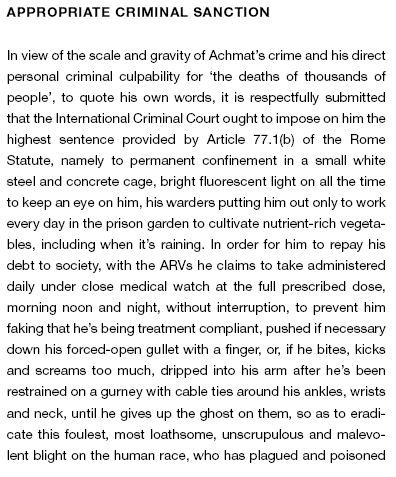
The first fifty-seven pages present familiar anti-medication and "AIDS-dissident" material. But then, on page fifty-eight, this "indictment" document suddenly deteriorates into something altogether more vicious and unhinged, as Brink sets out what he believes would be an appropriate punishment for Zackie. Because I do not wish to be accused of selective editing, I will now reproduce for you that entire section, unedited, so you can see and feel it for yourself.

APPROPRIATE CRIMINAL SANCTION

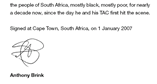
In view of the scale and gravity of Achmat's crime and his direct personal criminal culpability for ‘the deaths of thousands of people', to quote his own words, it is respectfully submitted that the International Criminal Court ought to impose on him the highest sentence provided by Article 77.1(b) of the Rome Statute, namely to permanent confinement in a small white steel and concrete cage, bright fluorescent light on all the time to keep an eye on him, his warders putting him out only to work every day in the prison garden to cultivate nutrient-rich vegetables, including when it's raining. In order for him to repay his debt to society, with the ARVs he claims to take administered daily under close medical watch at the full prescribed dose, morning noon and night, without interruption, to prevent him faking that he's being treatment compliant, pushed if necessary down his forced-open gullet with a finger, or, if he bites, kicks and screams too much, dripped into his arm after he's been restrained on a gurney with cable ties around his ankles, wrists and neck, until he gives up the ghost on them, so as to eradicate this foulest, most loathsome, unscrupulous and malevolent blight on the human race, who has plagued and poisoned the people of South Africa, mostly black, mostly poor, for nearly a decade now, since the day he and his TAC first hit the scene.

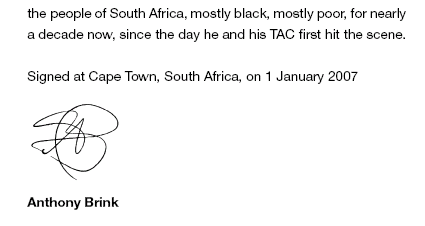
Signed at Cape Town, South Africa, on 1 January 2007

Anthony Brink
Appropriate Criminal Sanction A

Appropriate Criminal Sanction B

The document was described by the Rath Foundation as "entirely valid and long overdue".

This story isn't about Matthias Rath, or Anthony Brink, or Zackie Achmat, or even South Africa. It is about the culture of how ideas work, and how that can break down. Doctors criticise other doctors, academics criticise academics, politicians criticise politicians: that's normal and healthy, it's how ideas improve. Matthias Rath is an alternative therapist, made in Europe. He is every bit the same as the British operators that we have seen in this book. He is from their world.

Despite the extremes of this case, not one single alternative therapist or nutritionist, anywhere in the world, has stood up to criticise any single aspect of the activities of Matthias Rath and his colleagues. In fact, far from it: he continues to be fêted to this day. I have sat in true astonishment and watched leading figures of the UK's alternative therapy movement applaud Matthias Rath at a public lecture (I have it on video, just in case there's any doubt). Natural health organisations continue to defend Rath. Homeopaths' mailouts continue to promote his work. The British Association of Nutritional Therapists has been invited to comment by bloggers, but declined. Most, when challenged, will dissemble."Oh," they say, "I don't really know much about it." Not one person will step forward and dissent.

The alternative therapy movement as a whole has demonstrated itself to be so dangerously, systemically incapable of critical self-appraisal that it cannot step up even in a case like that of Rath: in that count I include tens of thousands of practitioners, writers, administrators and more. This is how ideas go badly wrong. In the conclusion to this book, written before I was able to include this chapter, I will argue that the biggest dangers posed by the material we have covered are cultural and intellectual.

I may be mistaken.

/.

Please distribute

This work is licenced under the Creative Commons Attribution-Non-Commercial-No Derivative Works License described here, you are free to copy it wherever you like as long as you keep it whole, and do please point people back here to badscience.net so that if they like it, they know where to find more for free.