Press B really quickly to kick the kittens to death

No, you don't get "points" for driving drunk in Grand Theft Auto IV (via). Driving drunk in the game isn't necessary, helpful or even fun, but the more serious problem with this claim is that you don't get points for anything in GTAIV. Like most modern games, it eschews the concept of overall point-scoring altogether.

Neither does GTAIV have "levels", for that matter, but I'm sure some child-protector out there is very worried about the "drunk driving level". Points, levels and the sound track from the Atari 2600 version of Pac-Man (which celebrates its twenty-seventh birthday this year!) are still commonplace... but only in the depictions of video games in movies and TV shows.

The problem all of the people who're worried about GTAIV have, of course, is that they have not read Excerpts from The Alarmist's Guide to GTAIV (do not miss the second page).

(Both pages NSFW, unless you work somewhere where people have a sense of humour.)

Video games are getting more and more realistic, and some of their creators are using that realism to make more and more confrontingly believable interactive depictions of violence, horror and depravity.

While this is happening, though, actual rates of violence among children in every First World nation I know of continue to slowly fall.

That doesn't make for much of a headline, of course. Much better to claim that when some kid does buck the trend and shoot up his school, it must have been Wolfenstein 3D and Redneck Rampage that made him do it.

Posted in Games. 1 Comment »

Your free mouse is waiting

Here in Australia, Atomic: Maximum Power Computing is a foolishly-named but actually-rather-good magazine for which I write.

I do occasional features, and two regular columns. One of those is the "I/O" question-and-answer letters column, which I reprint six months later on Dan's Data.

Allow me to share with you a secret about that letters column.

Hardly anybody sends in any bloody letters.

This certainly isn't the result of an actual lack of people with questions to ask. My interminable series of Dan's Data letters columns is evidence enough of that.

People just don't send questions in any more.

Seriously - there are, like, two letters a month to io@atomicmpc.com.au, and on average about 1.2 of those letters fall into the HELO WUT IZ DA BEST GFX CRD PLZ??!? category that gets them swiftly despatched to my "Atomic lousy letters" folder.

About 0.6 of the remaining 0.8 letters will describe, often at great and depressing length, some computer problem about which all I can think to say is "yep, your PC is really badly screwed up, all right".

This falls somewhat short of the high standard my readers have come to expect.

You might wonder, at this point, how it is that the I/O column keeps running in Atomic.

It keeps running because

1: People like reading it, and

2: I get tons of questions sent to me @ dansdata.com.

So I just skim the most "Atomic-y" of those letters off the top - yes if it's someone asking about using mercury as CPU coolant, no if it's someone asking about cheesecake - and use them to bulk out the I/O column.

I still e-mail my reply to the questioner as well as include it in the Atomic column, of course. So it's not as if a question from some guy in California falls silently into a magazine in Australia which he will never read.

Since the only misrepresentation involved in this is that it gives the impression that people who sent questions to one e-mail address actually sent them to another, I don't feel very guilty about it. Many of the people whose letters are repurposed probably do not actually read the magazine in which their letters and my answers will then be printed, but that's no big deal. Certainly not by the standards of letters columns in general.

The dirty secret of the letters pages of local - and not-so-local - newspapers the world over is that it's perfectly normal for them, like me, to not get enough interesting letters to fill the space.

Since they, unlike me, have no other source of material, they then just make stuff up.

Completely.

Sometimes there's something juicier, like one of the newspaper bosses forcing his partisan letter in under an assumed name or something.

But usually they just have a few beers and then make up something entertaining to fill the empty space.

I have never been driven to doing anything like that for the Atomic column. But one problem does remain.

The best I/O letter each month wins a prize. For ages now, it's been a shiny new Logitech G5 mouse.

But only "genuine" letters to the I/O address, from people who help to pay for the whole enterprise by buying the darn magazine, are eligible for the prize.

And, worse yet, I've a personal rule that if you've already won the prize once, you can't win it again for a very carefully calibrated period of time most elegantly describable as "however long it takes for me to forget your name".

Since so very few decent letters are coming from actual readers of the magazine, the I/O prize is at this moment very easy to win. Just send a good question to io@atomicmpc.com.au, and you'll be in the running.

"Aha", I now hear many devious people saying who live on the other side of the planet from Australia and have no interest at all in buying Atomic. "I shall send a letter, and win the prize, and nobody will know I'm not really a reader!"

Well, no, nobody will. But you won't know you've won, either, because (a) I won't tell you (I suggest a winner to the Atomic editorial team, but it's not up to me to actually definitely decide who gets the prize, and my Dan's Data column reprints won't tell you either), and (b) the Atomic prize-sending department tends to be a bit on the slack side. They often only actually send out the prize when the lucky winner reads the mag, lets out a happy cry and then sends an e-mail with his or her address in it.

(This means that some poor sucker has probably failed to buy that month's magazine, or something, and missed out entirely.)

If you go to all of the trouble of setting up a devious scheme involving an Australian friend who subscribes to the magazine and will tell you if you win and, I don't know, on-ship your mouse to you so nobody gets suspicious about some guy in Anchorage who isn't on the subscriber list winning the prize, then I say you deserve your plunder as much as any Australian.

Actual Antipodeans who actually read Atomic, though, should bear in mind that asking me things at io@atomicmpc.com.au rather than dan@dansdata.com may be unexpectedly profitable.

A tale of two power supplies

I started writing a whole big thing about a Flexiglow "Series Connect" power supply, but there's not a lot of point to that since I don't think it's possible to buy one new any more.

The 500W Series Connect had been sitting on my to-review pile since late 2005. The nice people at Anyware who sent the PSU to me might have been annoyed about that. But it's now clear to me that they should instead count their blessings that I didn't get around to looking at it until now.

This power supply turns out to have armour on all of its cables that's so thick that the main motherboard power lead feels like a garden hose under full mains water pressure.

If your computer layout happens to match where this PSU's ludicrous cables want to go, it'll work - though you may find it impossible to put the side back on the computer case.

For almost any other computer, it's likely to be physically impossible to plug this PSU in, even if you only need a few of its leads.

I managed to get the main motherboard connector to plug in as long as the PSU itself was six inches in position and ninety degrees in orientation from where it was meant to be. Any attempt to move the PSU closer to its proper mounting location threatened to wrench the motherboard socket right off the board.

I then tried just cutting the useless armour off the leads. I've got a pipe cutter that made short work of the outer rubber layer. Under that, though, there's braided shielding, which of course frays all over the place and stabs your fingers and is difficult to cut without cutting the conductors under it and it's all a horrible schemozzle.

Do PC power leads need braided shielding? Of course they don't. PC components expect to get a bit of RF noise on their DC input. It's possible that some marginal (or heavily overclocked) components will work slightly more reliably with slightly less noisy input, or that some cruddy sound card will be a little less noisy that way, but there's a reason why the ATX12V PSU standard does not require shielding for DC wires.

The standard does, however, prohibit PSUs from sending more than a certain amount of noise down their DC wires, because that noise can easily out-shout - by orders of magnitude - the amount of noise the wires can possibly pick up from the air.

Shielding the wires, in that case, simply ensures that the PSU's own noise remains uncorrupted by noise from elsewhere.

I still needed a PSU to replace a dead one in a home-server box, though, so I made a shortlist of power supplies with enough plugs to support the forest of drives inside the server, then stuck a pin into the list and ordered a Corsair TX750W.

Apparently this PSU actually can deliver 750 watts of power, which is (a) way more than this server will ever need, and (b) quite unusual in the consumer PSU market. "Generic" PSUs usually underperform their stated capacity by a truly shameful margin, and you shouldn't expect even a brand-name "750W" PSU to be able to deliver more than a constant 600W or so. Some do, but many don't, and the bad ones drive the good ones out of the market.

(The TX PSUs are made for Corsair by Channel Well Technology, who make similarly high-spec PSUs for other companies, like Thermaltake.)

This PSU also has far more connectors than the server will need - but it's got enough drive connectors, which is all I really care about. And it wasn't much more expensive than a much less capable PSU. And under-loaded PSUs generally live for a very long time, and are likely to be more efficient. So what the heck.

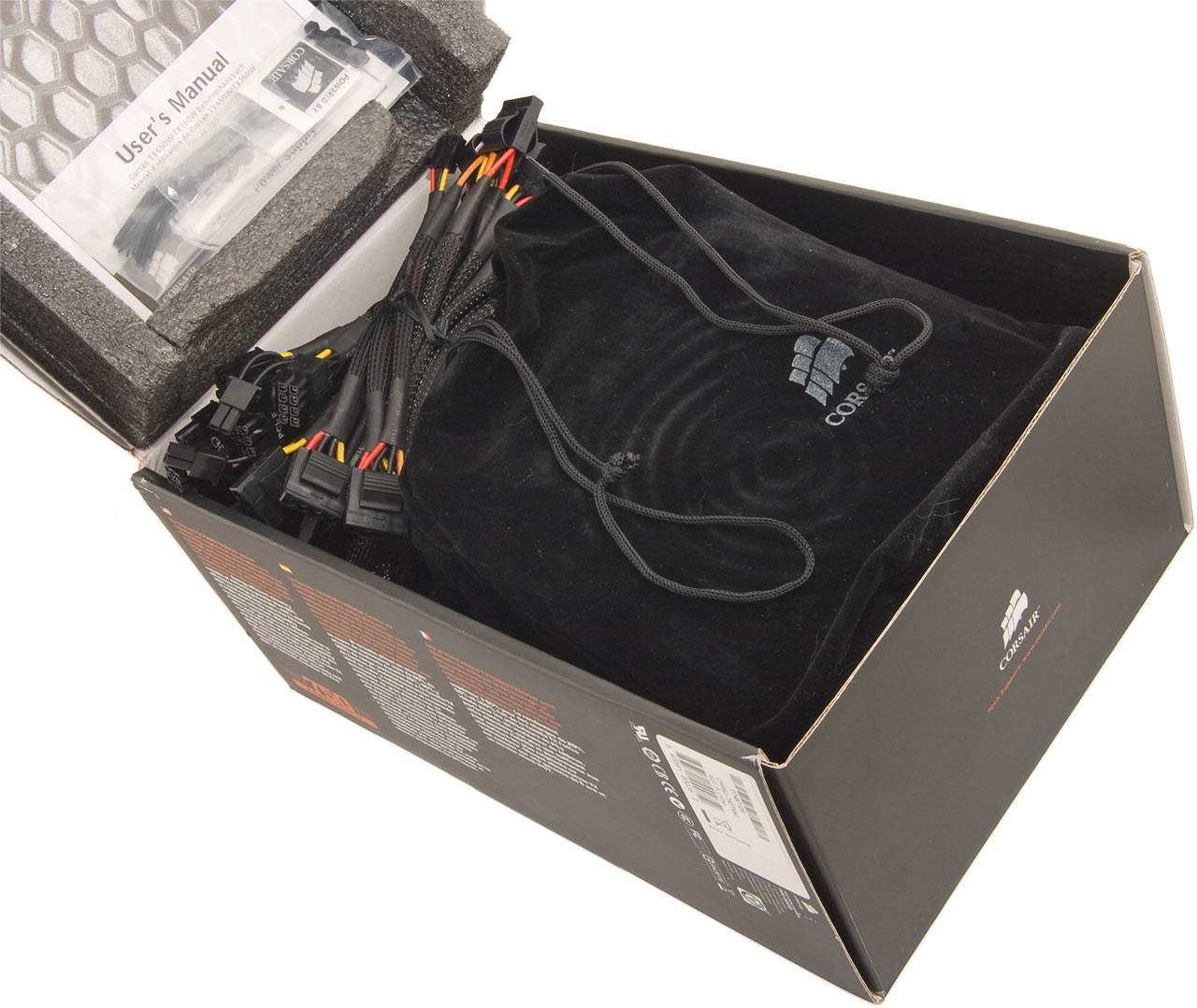
I'm already glad I bought the Corsair, because it gave me such a laugh when I opened the box.

PSU in handsome presentation bag.

Within the box, and within the foam anti-shock packaging, but outside the final clear-plastic-bag level of packaging, this PSU comes in a fuzzy drawstring bag.

It's a very cheap fuzzy drawstring bag; thin, with fuzzy pseudo-suede on the outside only, and redolent of the various outgassings of the fresh electronic components that've lived within it since the PSU was bagged up at the factory. It's not nearly in the same class as your traditional Crown Royal dice bag.

But it is, nonetheless, within the definition of the term, a fuzzy drawstring bag.

For a computer power supply.

So, like, if you feel the need to unscrew just the PSU from your computer and carry it around with you, you won't have to tuck it uncomfortably under your arm or carry it by the ATX cable like a big square dead rat or something.

No, man. Not you. Not the Corsair TX owner.

You can bag that sucker up, man!

And then, if any punk on the street should allege that your rig be insufficiently pimped, you can say to him "Yo, I gots my P-to-the-S-U right here in a bag, bitch! What you got? Well? You got a motherboard hangin' round yo' neck that I ain't noticed? Huh?"

(And yes, I'm pretty sure there's a factory worker out there who can't believe he's making these things. Previously.)

Here in Australia, you can buy your own TX750W from m'verygoodfriends at Aus PC Market for a mere $AU211.20 including delivery anywhere in the country. And you might as well; it looks to me, and to people who bothered to actually test it, as if it'd be a perfectly good piece of hardware for the money, even if you didn't get a fuzzy drawstring bag into the bargain.

Australian shoppers can click here to order one.

If you can't get better, at least get revenge

I just received, complained about and deleted an unsolicited commercial e-mail promoting "The Highland Hypnotist, Scott Burke".

I needn't post it here, because you can read the whole thing for yourself on prlog.org, one of those sites where people can upload press releases about whatever they like.

It's pretty standard woo-woo claptrap. Mysterious Scottish wizard Has The Power to Cure What Ails Ye, et cetera. Except for the headline.

Which is, just in case you've not yet read the prlog.org page: "Highland Hypnotist Uses His Powers To Avenge Bad Health....or Your Money Back!"

Avenge bad health?

So, what, he finds the guy who made you sick and beats the hell out of him?

I suppose that could account for the money-back guarantee - "OK, you've still got diabetes, but you didn't see the part when I totally avenged the dickens out of it!".

(Actually, money-back guarantees like this are de rigueur for quacks of all colours. Some of them just never return anybody's money, of course, but most rely on the low number of warranty claims that're likely to turn up when your audience is self-selected for gullibility and you're treating variable illnesses with indistinct end-points.)

Posted in Scams, Spam. 5 Comments »

SwashBot2: The Wiggling Continues

The previously mentioned SwashBot now has a page on the CrabFu site, featuring the original dome-headed creature, which includes this...

...the (much bigger) SwashBot2!

Stick with the video for more explanation of the concept.

Posted in Hacks, Toys. 1 Comment »

Pointless probabilities

Dice of limited utility

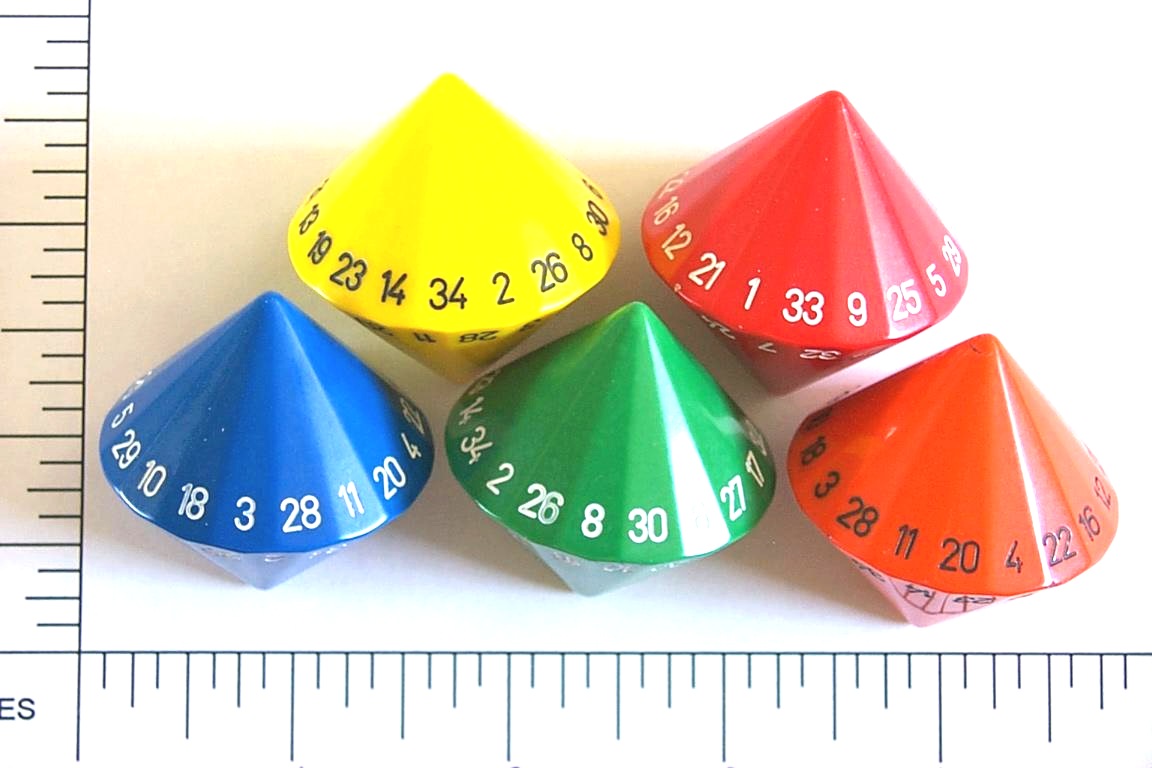
These are my Not Very Useful Dice.

The "crooked in every sense" red six-siders are oddly satisfying objects. They're classic, if rather large, sharp-edged casino dice, except for the obvious.

I haven't thrown them enough times to see what kind of result distribution the crooked d6s give. In the aggregate they're probably actually quite fair, since they're all somewhat close to cubic and they have the proper numbering scheme, with opposite sides adding to seven.

(I think they're actually likely to throw a bit low, since the smaller sides on four of them are all ones, plus one two and one six. Frankly, I just want to try sneaking them onto a craps table some day. If you want some of your own, here's an eBay search. A set of six shouldn't set you back more than $US15 delivered.)

The other three dice are perfectly fair. Just... not very useful.

The blue one's a d24, a tetrakis hexahedron (which is one of two possible shapes for a d24 - the other is, of course, the deltoidal icositetrahedron). In gaming, you actually can use a d24 to quickly determine on which hour of the day on some random event takes place. But you can also do that in various other ways on the rare occasions when you have to - like, for instance, a d4 to determine the quarter-day and a d6 to pick the hour of that quarter.

So the d24's appeal remains... specialised. Dungeons and Dragons used to use d24s for a few things, but it doesn't any more. (D12s seem to have been similarly deprecated.)

The larger polyhedron is a rhombic triacontahedron, a d30. It's the big brother of the surprisingly antiquitous, famously malicious, icosahedral d20 that's become the very symbol of gaming nerdery.

I think the d30 has a certain... machismo.

"Oh, you roll twenties, do you? Well, I beat that a third of the time."

It's hard to top that, if you don't have big brass ones.

The d30 can also be substituted for by other dice, though I don't think there's any terribly elegant way to do it - perhaps a rolling-pin d3 (itself substitutable by a halved d6; the cheapest "d3s" are just d6s with only three numbers on them, but "real" d3s aren't terribly more expensive) for the tens, plus a d10 for the units. This isn't something you're likely to need to do very often, though, since d30s are almost as unpopular as d24s. People use them now and then to represent some sort of boost (lucky artifact, you're the son of a god, you bought the DM a pizza) for what would normally be a d20 roll. That's about it.

(There's another design of d24, which is a cube with each face broken up into four flattened triangular facets. I'm not crazy about that type, but since you can get one along with a d30 for a quite reasonable price.)

The red sphere is a more commonly seen item. It is, of course, Lou Zocchi's hundred-sided "Zocchihedron".

Lou is probably royally sick of the sight of his d100, since he spent ages trying to make the darn thing work right, and it still doesn't, really.

(It's a bit hard to find these days, too; most "d100s" currently for sale seem to be just a couple of ordinary d10s. Sixty-siders, which are even less useful, seem to be going the same way. But here's a one-shot start to an odd-dice collection!)
The main problem with a 100-sider is that it's basically a golf ball, and so any sort of fair roll will take ludicrously long to settle compared with the normal "d100", which is just a pair of d10s, one for tens and one for units.

To address the rolling-across-the-room problem, Lou made his d100 hollow and partially filled it with teardrop-shaped metal weights, which slow its roll considerably, and also make it usable as a very small maraca. The d100 is still really only a curiosity, though, and may or may not be biased in favour of the more-widely-spaced numbers nearer its equator.

Companies like Chessex, Koplow Games and Lou Zocchi's Gamescience make a number of other impractical novelty dice. The d5, d7, d14 and d16, for instance, and even the majestic d34. Unfortunately, though, most of the weird-numbered dice that I don't already own are of the pyramids-stuck-together trapezohedron type, which as the side-count rises makes them look more and more like a spinning top rather than a die. The d34 has a particularly severe case of this disease.

I'm still tempted to acquire them, though, so I can have a whole Crown Royal bag full of dice that nobody can use.

If you're at all interested in the aesthetic appeal of dice, by the way, allow me to highly recommend sleight-of-hand grandmaster Ricky Jay's book "Dice: Deception, Fate, and Rotten Luck", a slim volume which alternates gambling - and cheating - history with a lot of gorgeous pictures of decaying six-siders.

Designers: Idiots, or morons?

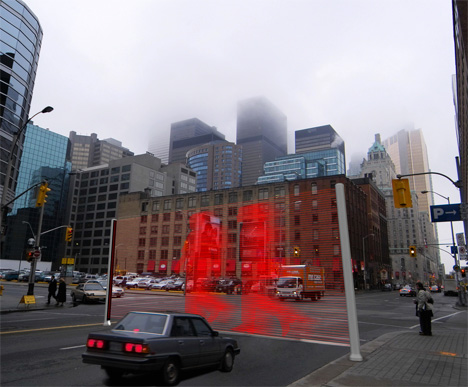
Behold, the "Virtual Wall"!

Impossible laser wall

It's a "barrier made up of plasma laser beams depicting pedestrians" to alert drivers to people crossing, more effectively than could a normal red light.

A magnificent idea, with only two minor drawbacks.

One, there's no way to make lasers do this, and two, there's no way to make lasers do this. I know that technically speaking that's only one drawback, but I thought it was such a big one, it was worth mentioning twice.

(OK, perhaps a "plasma laser" can do it. Who knows, since they don't exist. I bet a phased array of Star Wars blaster emitters would make a pretty good signage device too!)

A few of the commenters on the Yanko Design page have pointed out that you can't make a laser beam that's, I don't know, fatter in the middle, or something, unless you put optics out there in the display area. You'd either have to do that, or otherwise cause the lasers to scatter more light from one part of their beams than from another. This can't be done unless you blow something like smoke into the beam, and somehow magically make it hang there in the air in the shape of the image you want to create.

There are "displays" that do something rather like this with drops of water...

...metered out by solenoids in a sort of a giant skinny inkjet print head. But you can't do that with lasers unless you're happy with your images zooming across the display at the speed of light, which is generally a little too quick for motorists to notice.

I know that most designers are not blithering idiots, but there seems to be an endless supply of things like this, and that idiotic Gravia lamp, trying to persuade me otherwise.

Surely the absolute bedrock of design has to be making sure that what you're designing can actually exist in the real world. If you can actually get good marks in a design course by pulling the basics of your product out of your fundament and then concentrating on the packaging and presentation, aren't you really just doing marketing?

Video programming magic du jour

Behold: A way to automatically calibrate a projector to put a full image onto an arbitrarily aligned screen.

Even, thanks to the non-zero size of the image source, if that screen is facing slightly away from the projector.

(Via.)

This system can only lay as many pixels across the screen as the projector's lens would manage anyway, of course, but if the Carnegie Mellon researchers do manage to turn this into a real-time system, the image will be able to follow the screens around pretty much seamlessly.

So it'll be kind of like a real-world version of those augmented reality systems in which video images of specially printed objects "grow" extra stuff:

(Previous video magic.)