That was an outcome you could pretty much see coming three years ago (and again), just because of the game's idiotic name. But this is one of the better Zero Punctuations nonetheless.
And this time there's an extra piece on the end of the review.
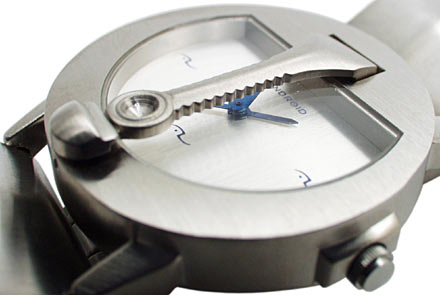
There are hordes of those things, each cooler-looking and less legible than the last. But I suppose this is just the harmless perversity that afflicts all obsolescent products. For years it's been possible to buy a $5 quartz watch that keeps time better than a $3000 Rolex Oyster, and almost nobody with a mobile phone needs a wristwatch at all any more. So, today, practicality is ruled out from the very start as a reason for almost anyone to purchase a wristwatch.
Anybody who wants to make expensive wind-up watches today, therefore, has to add more complications and curlicues to get attention. And anybody selling expensive quartz watches has to turn them into sci-fi escapees.
It's not the most straightforward, or mechanically efficient, way of achieving the same feat; it wouldn't even beat the human-powered punkin' chunkers. But point-and-click aiming for a trebuchet-type flinger (actually, this is more of a staff sling) is still a pretty nifty achievement.
More information, and one much more disgusting video (which is also rather surreal, thanks to inspired costume choices), at the Mana site.
A reader, coincidentally also called Dan, just sent me this:
Holy CRAP! How did we miss this amazing revelation?
[I'll spare you the enormous forwarded e-mail Dan tacked onto his message, but it started with the words "Do You Want To Know RIGHT NOW How You Can Drive Around Using WATER as FUEL and Laugh At Rising Gas Costs, While Reducing Emissions and Preventing Global Warming?"]
P.S. I didn't even bother to read through the whole thing, my obviously limited knowledge of chemistry, thermodynamics, entropy etc. made me feel like I had been purposely misled by my professors to support the great Oil Companies' conspiracy.
The text you forwarded is from the Easy Water Car site, but it's been copied all over the Web.
These scams are old, old, old, though they've gained new life as oil prices rise.
They always include some bulldust about electrolysis or fuel cells, then usually something about "HHO" gas or "Brown's Gas" (supposedly a magical special combination of hydrogen and oxygen that can somehow give you more energy than you used cracking water to make it), and then you make some gadget that pumps its tiny gas output into your engine's fuel input, and it doesn't do a damn thing, and that's about it. Unless you decide to tinker with the thing until you die of old age, which seems to be the choice of many people who're enthusiastic about this stuff.
I've written about the "HHO" sorts of scams before, here. There's a bit more about car-on-water scams, in the similarly ancient "turning water into gasoline" variant, here.
The versions of the scam that try to run the whole car off an electrolysis gadget always fall at the first hurdle, of course. It's theoretically possible, but you might as well take the tons of electricity needed to make enough gas to run an engine and use it to drive an electric car directly. Anything that can run off a normal car's alternator will not, duh, run a normal car.
The "hybrid" versions of the scam, though - which, like the Easy Water Car version, claim to use the mystic hydrogen generator to greatly decrease the fuel consumption of a normal car - can run just about as well as an unmodified car, because that's basically what they are. So there are plenty of options for the creative scammer to make a demo machine that looks as if it's working. Any slightly experienced race-car mechanic could make a car look as if it's running on nothing in a hundred ways.
Despite that, many of the scammers put on a very poor show. One of the front-runners, who's been pulling stuff like this for many years, is Dennis Lee.
A lot of the current "water car" excitement also has to do with the "Joe Cell", a rich and abundant source of very high-energy pseudoscience.
In the USA, marketing of "dietary supplements" - which pretty much means all over-the-counter edible "alternative medicines" in the USA - is regulated by the Dietary Supplement Health and Education Act of 1994, known for short as the DSHEA.
The DSHEA restricts the ability of the US Food and Drug Administration to regulate these "dietary supplements". It, essentially, means that the people who make and sell supplements do not need to demonstrate that their products are effective, or even safe. There is no pre-market testing at all. No effort whatsoever is made to determine that dietary supplements do what they're meant to do, or even that they contain what they're meant to contain.
This laissez-faire approach has had pretty much the effect you'd expect it to. Never mind debates over whether St John's Wort is actually of any use in the treatment of depression, or whether echinacea is any good against colds; it's perfectly normal for pills allegedly containing a given quantity of those substances to contain far more, or far less, or none at all. And until someone notices and makes a fuss, not a thing will be done about it. The FDA won't investigate by itself, because the DSHEA says it can't.
I present all this by way of an explanatory preface to this little Consumerist post, in which the manufacturing processes of one modern dietary supplement manufacturer are explained.
(The DSHEA is a clearly codified lack of regulation, but realistically speaking you don't seem likely to be able to buy better "supplements" in most other nations. Here in Australia, one major pill-maker was busted heavily in 2003 - but that's very much the exception rather than the rule.)
I just got a press release about an exciting new technology called "SmileCheck". It's supposed to give a digital camera the ability to look for "facial features associated with smiles" in the live viewfinder view. So, if you've got your camera in SmileCheck Mode, you press the button when everyone's in frame, but the shutter will only actually click when it reckons everybody in the frame is smiling.
This doesn't sound like the most useful camera gimmick ever, but it's more useful than "sepia mode". If it works.
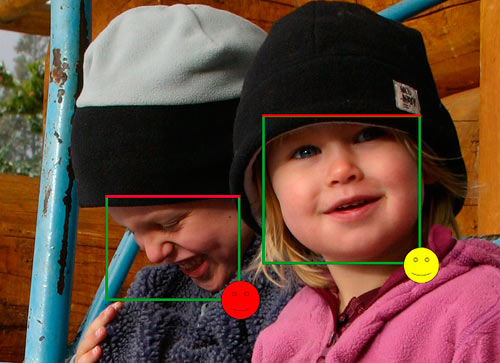
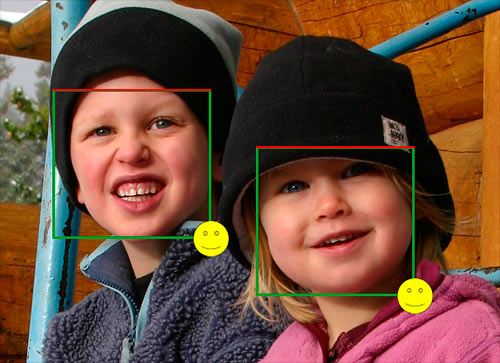
The PR company helpfully included "before" and "after" pictures, to show what a sterling job SmileCheck could do.
Here's the kind of picture that SmileCheck will, allegedly, prevent you from taking:
And here's what it'll let you take instead:
The more I think about this PR company's choice of images, the more my facial expression comes to resemble that of the kid on the left.
UPDATE: They've now produced a second press release, showing off the same technology but this time coupled with the camera's self-timer, and calling it "FaceTime". So you activate that mode on your camera, and it waits the usual several seconds (so you can get yourself into the frame) and then starts looking for smiles, and takes the picture when it thinks it sees them. The demo pictures are less hilarious this time.
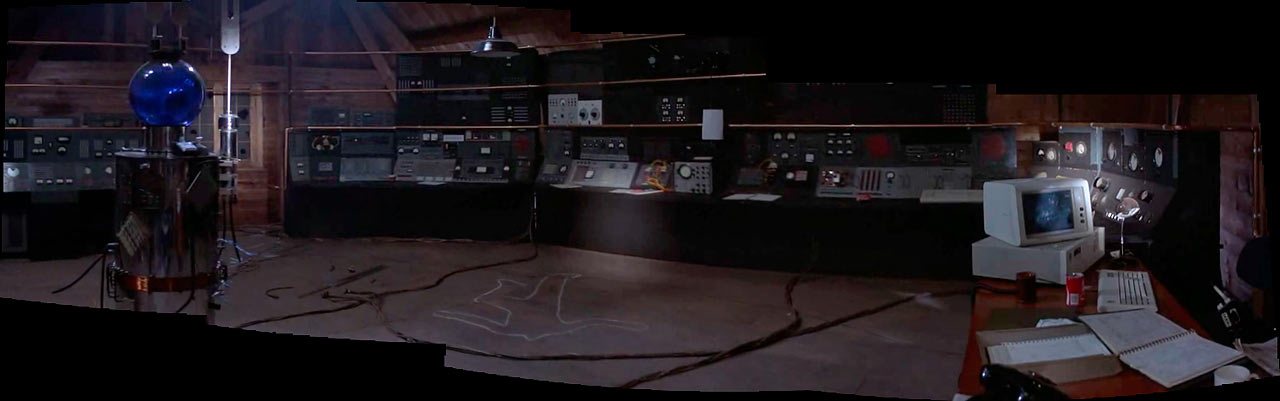
(There's an animated 2006 version of From Beyond, as well, but an IMDB rating of 1.7 doesn't tempt me.)
The movie didn't get off to a good start. Every automatic door in a hospital - including the glass swinging doors on the exit - made the Star Trek door noise.
(This movie also turned out to be the source of the "giving them drugs, taking their lives away" sample from Empirion's acid-house classic Narcotic Influence. Which is neither here nor there, but which I found surprising enough that I just had to mention it.)
The acting is also not a good reason to watch this movie. And the script has only the tiniest skerrick of a connection with the original Lovecraft story.
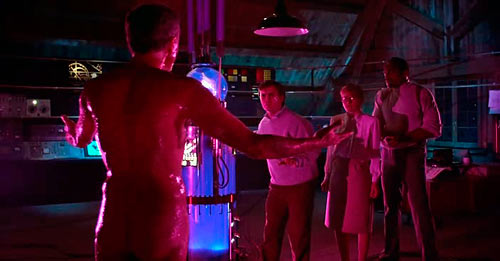
The special effects have their ups and downs, too.
(Actually, this beastie looks pretty good in motion.)
Oh, and then there's the bondage gear. And the supernaturally-induced horniness. I don't remember that from the original story either.
But, for all that, I quite liked it.
Like all good horror movies, From Beyond gives you the impression that there's some method to the madness even if you can't really figure it out. It also held my interest; there were no long predictable scenes with characters walking backwards into the grasp of a monster or failing to be believed by scornful, obviously-doomed townsfolk.
The movie's also got classic-horror stalwart Ken Foree, amiably tolerating a bit of light blaxploitation. And the silly bits of the ending are also the funny bits of the ending, so that's OK. I've watched far worse movies with far better production values.
As Neil Gaiman points out...
...visual media are not a good place to put Cthulhu Mythos stuff, because the whole idea is that the ghastly Things are as far beyond human comprehension as Jupiter is beyond the comprehension of an ant. But since this isn't really a Lovecraft-y story, that doesn't matter.
The version I watched is the unrated Director's Cut released only last year, which includes a couple of bits of footage that didn't make it past the censors when the movie was in theatres. Pay attention and you can spot the places, in a couple of particularly nutritious shots, where the recovered-from-the-cutting-room-floor footage was spliced back in.
When I read Michael Ciuffo's "Rip-off Photography" article, I did not immediately see everything wrong with the picture for which this unfortunate gentleman's mother paid hundreds of dollars.
OK, he looks like a huge dork. But I look like a caveman in photos. Big deal.
At a glance, you can see that the lighting on his face is strangely even, and he looks significantly airbrushed too. But there's more. Read the article for the rest. It's as entertaining as those Celebrities Before And After Photoshop pieces, in its own way.
By the usual standards of terrible studio portraits, though, Mike got off pretty lightly. List of the Day's Great Olan Mills Photos will scrub from your mind all memory of Mike's embarrassment, replacing it with things indescribable.
(When I was a kid, I had hair exactly like that of one of those children. Not for a thousand dollars would I tell you which one.)
What's a good portrait look like, you might ask?
Well, here's a picture my friend Katy took of me in 1998.
(I'm happy to say that I still look pretty much exactly like that, if a bit fatter now.)
On film, ambient light, subject significantly toasted on nitrous oxide at the time. Perhaps that's what warded off the Caveman Curse.
Katy's photo doesn't try to make me look like a matinee idol, or some insecure housewife posing for chaise-lounge-and-feather-boa "glamour" pictures. That, by itself, is half the battle.
I do feel obliged to mention, however, the pinnacle of my own experiments in self-portraiture to date.
If you click the mercifully small thumbnail, you'll get a 1024-pixel-wide version. I'm not even going to provide a link to the 2048-pixel-wide version; edit the URL yourself if you simply must see it.
All you need is a fisheye lens, and you too can see yourself as an urRu!