I am indebted to a Victorian reader for this extraordinary piece of news from the May '07 issue of the Royal Automobile Club of Victoria, here in Australia.
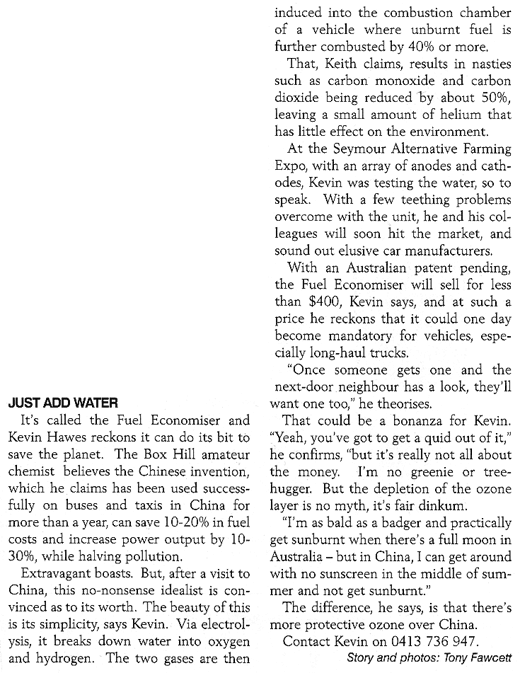
It contains so many little tidbits of complete off-the-wall wrongness that I can only surmise it's been deliberately written that way to amuse people who have some vague comprehension of scientific reality.
From the top:
The claims made are pretty standard for scam fuel saving products. 10 to 20 per cent less fuel consumption, 10 to 30 per cent more power, half the "pollution".
This is all meant to be achieved by using electrolytic hydrogen and oxygen to improve combustion. Which is pretty impressive when you realise that only one to two per cent of the input fuel is not already combusted by a decently tuned modern engine.
The pollution reduction claims are pretty hilarious, too. The only way to reduce carbon monoxide and dioxide output at the tailpipe, for a given amount of fuel going into the engine, is to do something else with those carbon and oxygen molecules. Apparently this device just makes them... go away.
Helium as a combustion product is impossible, unless there's hydrogen fusion going on in the combustion chamber. Helium is present in crude oil and natural gas, and passes through unchanged into the exhaust of anything that burns those substances, but I don't think any detectable amount of helium ends up in gasoline after the refining process.
Patents don't mean a device works. The Patent Office of most countries will let you patent anything that isn't obviously a perpetual motion machine, and some don't even draw that line. They protect your invention; they don't verify its usefulness.
And now comes the real punchline - the sudden change of track onto ozone depletion, which has nothing whatsoever to do with vehicle pollution. Ozone depletion is caused by chlorine and bromine compounds, and there's no chlorine or bromine in vehicle fuel, so no such compounds come out of the tailpipe.
And, finally, the ozone layer over China is much the same as the ozone layer over Australia, these days. Since the two countries are also at broadly similar latitudes, sunburn risks are also roughly the same.
I can only surmise that either Tony Fawcett (the alleged author of this piece) and his editors are all blithering idiots who're completely unqualified to write for any kind of motoring magazine, or this story was accidentally held over from the April issue.