Thrilling LED bulb replacement action!

LED lamps for standard low-power automotive sockets - things like interior lights, number-plate illuminators and brake lights - are now widely available and dirt cheap.

So I bought one, to see if it works any better than the standard interior light in my car.

There was nothing wrong with the standard interior light, but like a lot of low-power automotive bulbs, it's offensively inefficient.

The bulbs used in cars for things like interior lighting and instrument panel illumination have as their two chief design goals cheapness and durability. Both of these goals push manufacturers towards very low-efficiency devices. And the standard "dome" light in the middle of the ceiling of most cars generally doesn't even have much of a reflector behind its bulb, so something approaching half of the light just goes into warming up the light fitting.

So the dome light in my car looked like a fine candidate for LED improvement to me. Particularly now that one lamp will only cost you $AU8.98 delivered from Hong Kong.

(I got mine from this eBay seller.)

My car's interior light uses the small 31mm size of "festoon" bulb, the kind that look like a glass fuse but with points on the metal caps on each end.

The 31mm form factor doesn't give a lot of room for modern super-LEDs. You can now get 31mm lamps with a single allegedly-one-watt white LED in them...
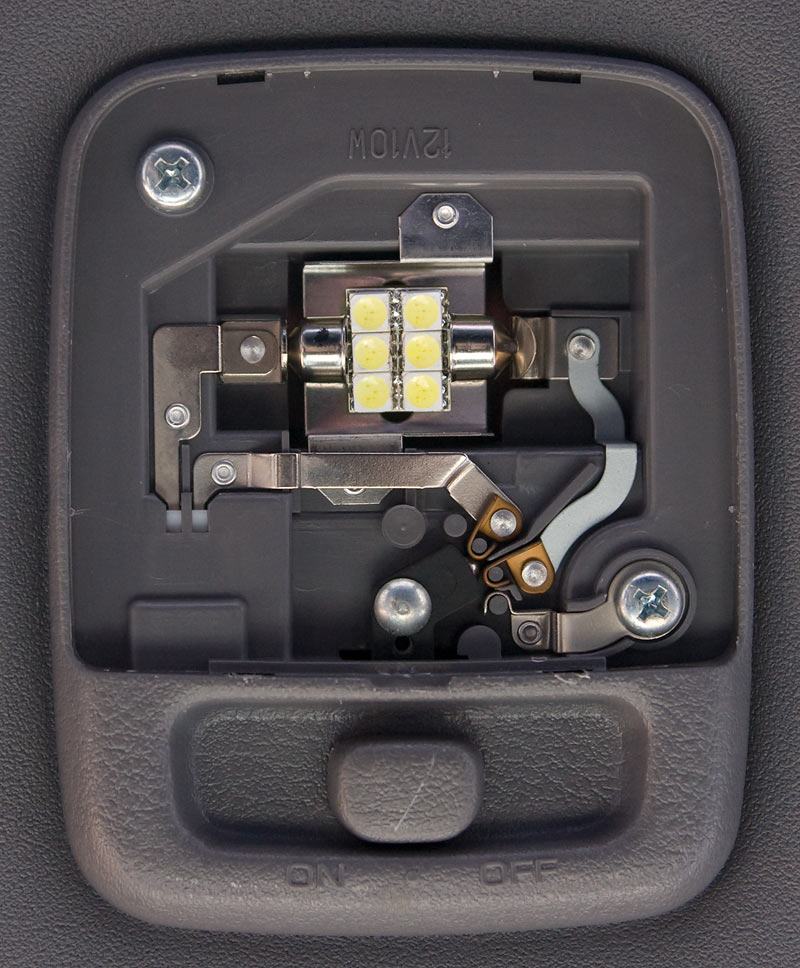
LED bulb

...or you can go for the type I got, with no fewer than six surface-mount sub-1-watt super-LEDs.

There are also replacement bulbs that use a cluster of standard 5mm LEDs. They may be OK for things like instrument panel lighting, but you shouldn't expect as much light as you'll get from a single 1W LED unless there are at least a dozen 5mm LEDs in there. Even then, it's doubtful.
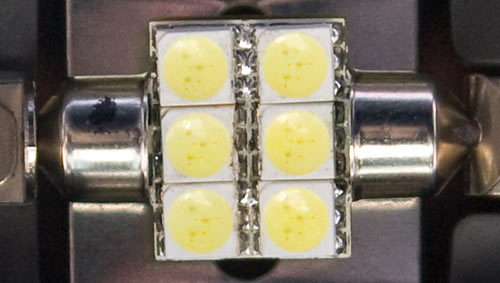
LED bulb detail

If you don't see a lot of yellow phosphor looking back at you, you're probably not looking at a very bright lamp.

I gave the new bulb a whirl on my bench power supply to see how much power it consumed. Then I tried the same thing with the (rather old) stock bulb.

The LED lamp drew only about 55 milliamps (mA) at twelve volts, for a power rating of only about 0.66 watts. Raising the supply voltage to 13.8V - which is what you'll get when the car's running and the alternator's turning - raised the current draw to about 105mA, for 1.45 watts.

The stock bulb has a nominal ten watt rating. From 12V it drew around 0.725A - that's 8.7W. From 13.8V it drew only a little more, about 0.785A (this is because the resistance of light bulb filaments rises with their temperature), giving 10.83 watts.

I expected the LED lamp to deliver much more light per watt than the incandescent bulb, and it also gets a big effectiveness boost from only throwing light out one side, wasting none of it by shooting it uselessly into the dome light fitting. But this was still a pretty huge power difference. At 13.8V, the old bulb draws 7.5 times as much power as the LED lamp; at 12V it draws more than thirteen times as much.

It was pretty easy to install the new lamp, although it did turn out to be a bit longer than it was supposed to be, making it a bit of a tight fit and also making it impossible to install it perfectly level. It ended up tilted a bit toward the left seat, though not enough to make a huge difference to the illumination on the two sides.

To cancel out any side bias, I tested the brightness of the two lamps with my somewhat accurate light meter sitting at the base of the gearshift (and with the standard plastic diffuser in place, too).

The light meter is calibrated in lux, a unit that's weighted to match human brightness perception. This gives the LED lamp another advantage, because the long-life low-temperature incandescent bulb gives very yellow light, while the LED lamp gives the characteristic blue-white of "white" LEDs. The blue-white has more energy around the green frequencies where human vision works best, so a given raw energy level of yellow-white light will appear dimmer, and read lower on a luxmeter, than the same energy level of blue-white.

Anyway, the stock bulb gave a reading of about six lux with the engine off (12V), and about nine lux with the engine running. Not a bad illumination level, given that it was being measured quite a bit lower than the place where you'd typically be, say, holding a map you were trying to read.

Swapping in the LED lamp gave... exactly the same readings!

My light meter isn't terribly accurate down in the single-digit lux, so I won't swear to you that there wasn't actually a bit of a difference one way or the other. But there clearly isn't a huge difference. And the new lamp, subjectively, lit up the cabin of the car just fine. Despite drawing around a tenth as much power.

This sort of thing can make a big difference in certain circumstances. If, for instance, you have a typical small car battery with about 25 amp-hour capacity before it starts getting very unhappy, a ten-watt interior light will drain it in thirty hours. Swap to a one-watt LED lamp and you'll probably still be able to start the car even if you leave the light on for ten days.

This doesn't matter much for normal automotive interior lighting, but if you've got a caravan or motor home or something that has a lot of friendly yellow incandescent bulbs in it, it could be a very good idea to swap them for the new cheap LEDs.
Wanna buy a porn blocker? Only $3000!

Remember those lame Internet filters which my faithful readers helped the smut-hungry youth of Australia to dismantle, last year?

Well, the whole taxpayer-funded content-control software handout program has now officially been declared (by Australia's new Federal Labor government) to be a miserable failure.

Apart from the fact that the NetAlert packages were quite easy to get around, it turned out that nobody actually very much wanted them.

The Government predicted that 2.5 million households, about 31% of the whole country, would want their free copy of one or another of the packages (which they'd paid for with their taxes already, of course).

As it turns out, they got a grand total of 144,088 CD orders and downloads.

And not all of the people who got the filter software bothered to use it. The ridiculously-named government department responsible says only about 29,000 of the packages were actually installed.

That's 1.2% of the target, for those of you keeping score at home.

The total price of the software filter scheme was 85 million Australian dollars. That's about $US78 million, at current exchange rates.

So this software ended up costing the taxpayer about $AU2930 ($US2685) per installed unit.

A copy of Net Nanny will cost you $US27 from Amazon. That's almost exactly one per cent of the effective price of the "free" software.

All that, to stop red-blooded Aussie kids from seeing boobies and doodles.

But have no fear - the new Federal government is much more sensible! They enthusiastically explain that their own very expensive scheme to implement "mandatory ISP-based filtering to deliver a filtered feed to all homes, schools and public internet points" will work far better. You know, just as it has in the other countries that've implemented secret Internet blacklists which, in effect, accuse lots of random innocent people of being child pornographers.

Never mind that, despite more than $15 million worth of advertising (including a booklet sent to every household in the country), it is now demonstrable that approximately three-fifths of bugger-all Australians have any interest in filtering their own Internet connection.

No, never mind that. We must be protected from filthy filthy porn, whether we want to be or not!

This is all more evidence that, as I've said before, it doesn't matter whether censorware works. Which is good, because it generally doesn't.

The purpose of censorware is not to Protect The Children, but to get some people elected and keep other people employed.

The MPAA will be very angry when they figure out what this is

DVD Jon's new application DoubleTwist looks completely awesome. I don't think it really does anything that you couldn't do before with umpteen tweaky utilities, but it aims to do it all in one simple program.

So I was all ready to download the beta and start freeing all of my DRM-ed media files from their corporate shackles... when I suddenly remembered that I don't have any DRM-ed media files.

I've got some DVDs, but they seem pretty happy where they are.

If you've got audio, video or even photos (on a stupid locked-down cameraphone, for instance) that you'd like to move somewhere else but can't, though, check DoubleTwist out.

My robot army grows

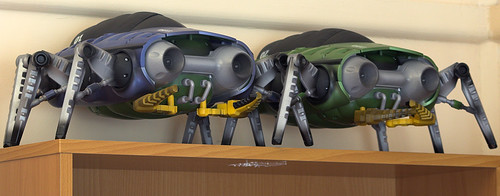
The Tyco N.S.E.C.T. Robotic Attack Creature comes - or came, since it's now discontinued - in two colours, and two frequencies.

Two Tyco N.S.E.C.T.s

Oh. Yeah.

I am, I assure you, perfectly aware that I am now required to make them fight.

I will do so, and of course make video of the result available to you, as soon as I find another radio-control warrior worthy of me.

(The real problem is getting copyright clearance for the only possible soundtrack.)

Plane porn

If you find yourself in danger of being excessively productive, I highly recommend visiting airliners.net and clicking one of the "Most Popular" links.

Every now and then, the most popular pics of the last X days will turn out to be particularly notable.

I just checked out the "last 7 days" listing, and found B-29 wreckage on a glacier in Alaska, the Caspian Sea Monster, an F-16 playing chicken with a tanker, a Hind heading off to kill someone, a very dramatic shot of an F-14's tailpipe, Concordski (previously mentioned in passing here) in repose, the first Qantas A380 still in primer, a fantastic view of the devices with which the TU-95 tortures its crew, a skeletal Sabre, a UFO and another one, one mighty Blackburn Beverley, and a ridiculously luxurious toilet.

"My wife, my children, and the nation of Romania."

YouTube comments should, of course, be ignored at all times. But the few comments for this video are works of incandescent genius compared with the usual collection.

One commenter, however, says "90,000 taxed out of 100,000. That wasn't a joke. One of the things that drove Reagan into the Republican party."

That commenter probably said that because he (or she) does not understand income tax brackets.

Income tax brackets seem to be one of those concepts that just slither out of people's mental grasp, like daylight saving time and aeroplanes on conveyor belts.

Another leading indicator of this misunderstanding is when someone expresses the opinion that making more money, so that you move into a higher tax bracket, means you'll have less money to take home than you would if you'd stuck with your lower income.

The simplest kind of progressive tax does indeed work this way, and imposing such a tax on income would indeed be crazy unless there were about a million tax brackets for incomes between $1 and $1,000,000. If the tax on income to $5000 is 20% but it shifts to 40% when you make $5000.01, you'll lose a lot of money if you get a raise from $5000 to $5100.

What actually happens, though, is that each bracket's tax rate only applies for the money you earn within that bracket.

So if you make $10,000 a year, and the country where you live has a $0-to-$5000 20% tax bracket and a $5000.01-to-$10,000 40% tax bracket, you'll pay a total of $3000 in tax.

The above sketch is from 1961, when the Internal Revenue Code of 1954 was still in force in the USA; it ran from '54 to '63. At that time, the top US tax rate was 91%.

But that only applied to the portion of your income above $200,000 a year. $200,000 in 1961 dollars would be worth an easy 1.4 million bucks today, and was worth even more in comparison to the average wage.

Which isn't to say that 90%-plus isn't a pretty hilarious top tax rate, but it's not as if some hardworking surgeon making $100,000 was taking home less money than a lazy plumber on fifteen grand.

In fact, the take-home pay of a person making $100,000 in 1961 in the USA, with no deductions, was $32,680. They would pay $67,320, not $90,000, in tax.

A 67.32% total tax rate still isn't anything to sneeze at. But it ain't 90%, either.

Security Through Inanity

So here I am signing on for the Australian Government's online Medicare thingy, which started out pretty secure. You do the first stage of the signup stuff, and then they send you a letter with your password for the next stage of the signup in it.

And then, after you log in using that password, you get this:

Dumb security question form

Make sure your Answers are only known to yourself! You know, like your mother's super secret maiden name that not even SHE knows!

(And yes, the missing apostrophe's the icing on the cake.)

I know this kind of crap is nothing new, but this is a pretty awesome implementation of it.

Not only do they tell you to use the archetypal, perfect example of an appallingly insecure "secret question", but they also tell you to set up four more such questions. So even if your first question is quite a good one, like "What poster did I have on my bedroom door before I had the Van Halen one?", you're likely to come up with something a lot less secure as you add more and more of the bloody things and run out of ideas.

(Here's another one that forces you to have five questions. Bonus points for the versions that won't let you enter an answer with fewer than six characters. Because nobody's called Smith or Jones.)

I came up with a properly obscure but memorable question for the first of the five on the Medicare form, then entered keyboard-mashing randomness for the other four. Then I wondered whether these "authentication" questions might be asked at some time other than when I'd forgotten my password - if they're used all the time, possibly even over the phone, then making one of them "Dummy question 3? / sdtrt45ruidhbioweyrvga34awe7du" is probably not a good idea.

So I tried duplicating my good first question and answer for the other four as well, despite the fact that the instructions tell you to record five different ones. That turned out to be fine.

(I've now discovered that the Medicare site uses the "security questions" when you want to change stuff like your contact details. It asks you two of the questions then, so it's a good thing I didn't just bang my face on the keyboard. Because all five of my questions are the same, the system of course just asked me the same question twice. It didn't seem to mind.)

It's possible to wring some security out of even a system that forces you to use mother's-maiden-name as an authentication question, by simply making up a novel answer for that question. But if you use the same oddball "maiden name" for authentication for every such site, then the first time the information that your mother's maiden name is "snorkel" gets out - which you should assume it's going to, because these people have demonstrated themselves to be idiots by their choice of this security system in the first place - you're just about as screwed as you would be if you'd used the real, matter-of-public-record maiden name.

To get around this, you have to come up with a different "maiden name" for every site that asks. You of course won't be able to remember them all unaided, so will need to store them along with your other passwords. Since the only time you're likely to need the "maiden names" is when you've lost the other passwords, though, this brings one face to face once again with the blatant stupidity of the whole concept.

And yes, the blithe suggestion of "maiden name" secret questions also skates over the issue of people whose family doesn't have a vanilla Western surname at all. Not to mention foundlings, people who had the hide to be born to unmarried parents, and that so-often-neglected portion of the information security marketplace, humaniform robots.

("My mother? Let me tell you about my mother.")

UPDATE: How did that guy "hack" Sarah Palin's Yahoo e-mail account?

That's right: By taking advantage of "secret questions" that were matters of public record, or otherwise trivially easy for anyone to guess.

(It's a shame that Palin didn't use that account to do anything very interesting. Wouldn't it have been awesome if it turned out that was the account she used to indulge her secret passion for Mythbusters slash stories?)

The Six Ugliest Space Lego Sets

I'm sure every kid who, like me, spent hours on end poring over Lego (or Meccano) catalogues, was not doing so in simple appreciation of the masterful design that went into the models.

No - we were looking at the parts. Looking, and evaluating.

"It's five more dollars for this spaceship over that one, but you get a big engine cone instead of the medium size, and one of the cool new blue spacemen instead of just another red one..."

And so on.

I developed a great enthusiasm for Technic Lego as well, but Space was my first love. And it had some weird sets.

Every now and then there'd be something that was just so super-cool that the parts in it hardly mattered, seeing as you never took it apart. The Tri-Star Voyager qualified in that category for me, and the old Space Shuttle (less confusingly called the Two-Man Scooter outside the USA) was a contender too.

The real entertainment was to be had at the other end of the aesthetic scale, though.

Sets that you built, looked at, said "I'm eight, and even my spaceships look better than that", and dismantled at once, lest their ugliness prove to be contagious.

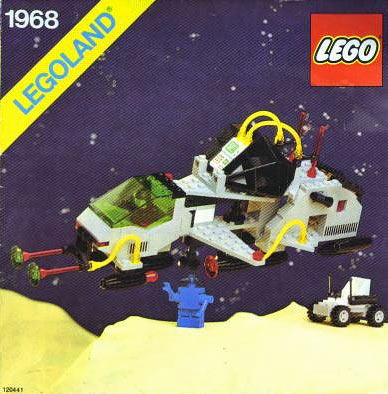
Let's kick off with Space Lego's greatest miss from 1985, the unmentionable, or at least un-named, set 1968...

Lego set 1968

...which was apparently built from the wreckage of one or two crashed Gamma-V Laser Craft (which look completely fantastic; my Gamma-V was another of my never-taken-apart models).

Lego Interplanetary Shuttle

And then there's this, the Interplanetary Shuttle. It's apparently a mail delivery vehicle... with a control panel in front of the driver, facing away from him.

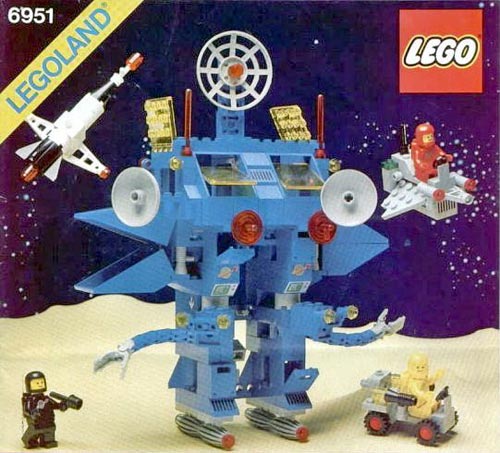
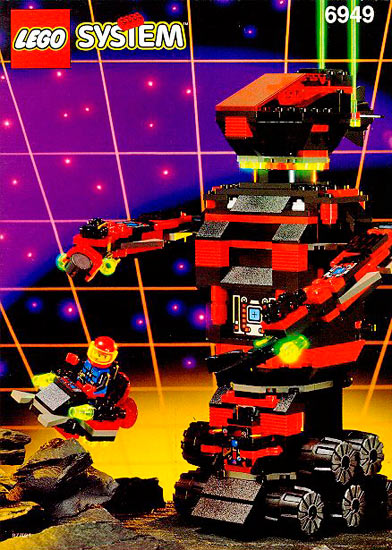
Different Space series had a whole genre of funny looking little robots, the king of which was the mighty 6951 Robot Command Center.

Lego Robot Command Center

The Robot Command Center is the only one on this list that I actually owned - because as a parts pack, it was superb.

As a model, though, it was atrocious. It was not only bizarrely misshapen; it also had things on it that didn't even make sense.

Those big blue double-canopy jaw things on the side were the most obvious. I suppose the grabber arms were meant to lob rocks into them or something.

(I used them as prison cells, and as spaceship canopies for ships flown by robots, who had no need for anything as primitive as looking out the window.)

More subtle were the finned rocket cylinders embedded, for no clear reason, in the Robot Command Center's ankles, just above the skid-jets (borrowed from a more sensible vehicle) on which it, presumably very unsteadily, skated across the landscape.

(Completely embedded rocket parts were unusual, but Lego made a habit of putting rockets on ground vehicles. OK, perhaps the nozzles on this dude's classic Shovel Buggy are actually a horn that plays The Yellow Rose of Texas, but I doubt it. I mean, that wouldn't work in a vacuum, would it?)

The Robot Command Center spawned some more Big Ugly Robots. 1994's Robo Guardian was a notable example...

Lego Robo Guardian

...with a total of ten wheels, four of which were unable to touch the ground.

(Did they at least touch the other wheels, and so rotate in the opposite direction? Surely they weren't just hanging there...)

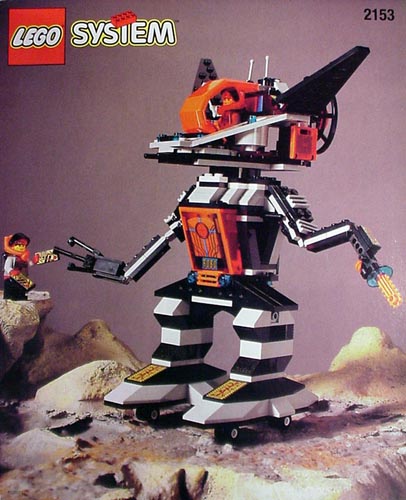
But unquestionably the Ugliest of the Big Ugly Robots hit the market three years later.

I present, with pride, the Robo Stalker.

Lego Robo Stalker

Egad.

But wait, there's one more.

One very special, very rare, very ugly spaceship.

Even most real Space Lego enthusiasts have never seen one of these in the flesh, because it was only available, in 1983, as a special promotion with (of all things) Persil laundry detergent. Well, that was the deal for the UK version of the set, anyway - it was apparently available in other countries with some similar deal.

On the plus side, you didn't have to send in any box tops - though you did have to send in £9.95, which is more than £24, about $US50, in today's money.

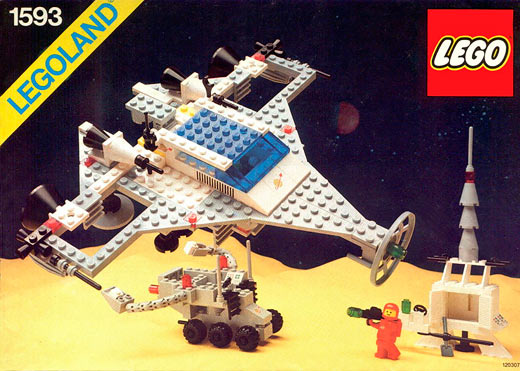
Lego set 1593

Behold - Set 1593!

(This is another one, like #1968, which has a set number but no name.)

Once you've finished wondering how drunk these little Lego men were when they decided to be seen in this thing, I really must insist you check out the full-size original image on the Lugnet site here, because this baby's just full of entertaining details.

The cockpit, for a start, has holes in it. Not just the ones you can see above the wing - there are two more on the sides below the wing, and one more gaping hole on the front of the cockpit under the wing. So it looks as if these little guys are going to have to keep their helmets on for the entirety of their mission. And they'd better watch out for space-birds.

Set 1593 also features two big main engines mounted on 2x2x2x2 brackets, which are flimsily attached to one-stud-wide rails. And there are ladder/grille pieces (radiators?) hanging down off the body in four places.

And, the finishing touch: On the top of the nose of the ship, directly behind the big skeletonised dish, is a two by two turntable.

With nothing on it.

It's just a little bit on the front of the ship that can turn round and round.

(Oh, and behind the front dish on the underside of the ship is what every sane Lego kid agreed was a dual laser gun... pointing backwards, at the pilot, through that hole in the front of the cockpit.)

As far as play value goes, this set is decent. That top-heavy land-crawler thing hooks onto the back of the ship (which doesn't make it look much better...), and there's a sort of base-station... cupboard... contraption, and various accessories.

But boy, is it ugly.

To make things even weirder, set 1593 apparently contains all of the parts from the perfectly decent 6880 Surface Explorer and the classic, Concorde-ish 6929 Starfleet Voyager. It would appear the latter crashed into the former at full speed, and 1593 - with its very own box and instructions - was the result.

But, as with every other one of these sets, you can always break it down for parts. And maybe build yourself a Surface Explorer and a Starfleet Voyager.

It's not as if even the ugliest of Lego sets is a stupid Death Star that turns into a giant Darth Vader robot for no reason at all. Any Lego set can be reassembled at will into whatever you want.

Which could be why they're still around, after fifty years.