Welcome back to Year 1 of the thrilling Firepower hearing

I'm sure you've all been waiting with bated breath to see what's happened since my last Firepower update.

Well, for one thing, Gerard Ryles' unassumingly-titled book about Firepower is now searchable on Google Books.

And Tim Johnston, the elusive boss of Firepower, has apparently been blessed with a complete remission of his travel-preventing illness. (Apparently, if you get arrested, it clears right up!)

Tim has duly been frogmarched into a hearing in Perth, to answer a few questions.

According to Tim, he's pulling down ten thousand UK pounds a month for "consultancy" work for Green Power Corporation, the London-based reincarnation of Firepower that will repay all of the investors and actually have products that work and give every child in the world an adorable puppy and so on.

(You may recall Green Power Corporation, and its unimpeachable principal Frank Timis, from last year. You may also recall The Australian's description of Timis as "a colourful Romanian-Australian businessman". Everybody involved with Firepower is so darn colourful it's like some kind of Pride Parade.)

Tim Johnston also alleges that he has been assaulted, and his daughter intimidated (by "cars driving around her house"), since he started giving evidence to the hearing. According to Tim, the people menacing him now are associated with his former business partner, one Warren Anderson.

Anderson has previously denied making any threats, and I presume will also deny sending the boys round (and round, and round). According to Johnston, Anderson demanded many millions of dollars of Firepower money with menaces; according to Anderson, that money was just payment for shares in Firepower, which Tim was buying from Warren, or something. (According to the ancient fuel-pill-company template, the shares probably weren't legal to sell in the first place, but were nonetheless hungrily snapped up by numerous people who now find themselves without a nest-egg.)

Oh, and Tim says that the fact that Warren pitched in to help Tim buy an 8.5-million-dollar house one day after Tim gave Warren four million dollars is not fishy in any way.

Hmm, what else... Oh yeah: "Firepower spent millions on travel, hotels and sponsorship". Astonishingly, the recipients of the free air tickets included Tim's kids.

And Tim also, in a completely straightforward and non-fishy way, handed an extra two million dollars and a hatful of soon-to-be-worthless shares, on top of a settlement payment, to the former chief executive officer of one of the numerous Firepower entities after some sort of court dispute.

After revealing this, Tim suddenly found himself struck by that most terrible of afflictions, Courtroom-Related Amnesia Syndrome, regarding exactly how the various Firepower business entities interacted. The syndrome is following its usual course; the larger the amount of money involved, the more difficult the sufferer finds it to remember where it went.

According to Tim, Firepower also appeared to have a less-than-thorough data backup policy. A server containing vital information was in someone's house, and then may have been pawned, perhaps, but Tim's not sure, his Courtroom-Related Amnesia Syndrome's playing up again...

We can only pray that Tim's illness does not develop into full-blown Ashcroft-Gonzales' Disease.

A very bright bad example

I used to have a really big light bulb hanging in the junk-storage/photo-studio/emergency-guest-accommodation room.
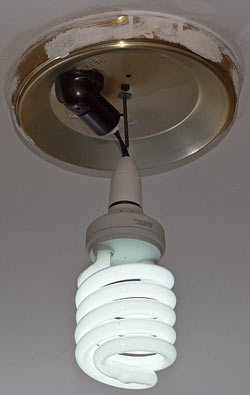
Big bare bulb

I wrote about it here, very early in the life of this blog.

Unfortunately, that 85-watt compact fluorescent lamp, which we came to affectionately call "the skylight", only lasted a couple of years. That might have been because it wasn't very well-made, but I suspect it just didn't like being turned on and off so often. I wasn't in and out of the junk room a dozen times every day, but CFLs only have so many on/off cycles in them.

After the eighty-five-watter died, I sighed and put a standard boring "100W-equivalent" bulb in the dangly hacked-together socket I'd used for the big lamp. And there that boring bulb stayed, for about another year.

But then, the other day, I noticed that this eBay seller had some new-old-stock Y-adapters, for Australian light-bulb sockets.

(In the USA, the most common light-bulb socket is the "E27", a 27mm Edison screw. Here in Australia, though, the large majority of our light bulbs use a 22mm bayonet mount, a.k.a. "BC".)

The eBay seller turned out to have a total of nine double-adapters, some with a switch for one of their branches, some without.

I don't like to miss a chance to go beyond the usual and construct something that'd make a home inspector turn pale and need to sit down for a little while. (The Cable that Should Not Be was the third post on this blog!)

So I bought all of the adapters.
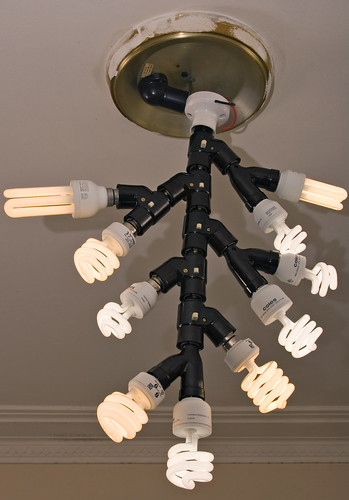
Ten-bulb CFL monstrosity

And now I have this!

Nine double-adapters, ten sockets.

In case you're wondering: No, this is not a good idea. Do not do it.

What you see in that picture is actually my third attempt to get everything working at once. I first tried a couple of "bushier" layouts, but the leverage of greater bulb-weight on the wider branches produced broken or, worse, arcing connections between the adapters. So I reconfigured the motley convocation into this vaguely Christmas-tree-ish shape.

The less bushy configuration puts the bottom bulb only about 204 centimetres (six feet, eight inches) above the floor. And this many stacked bayonet connectors becomes sort of... floppy. So a tall person bumping their head on the bottom bulb might manage to unplug half of the assembly. And I don't trust all of the connections to really be free of slow-overheating-causing extra resistance or tiny arcs. So I wouldn't leave this Photonic Agglomeration Mark I turned on when I left the house.

But, dodgy though this preposterous bricolage of brightness is, it's actually not as dreadful as you might think.

Light-bulb double-adapters were, in the olden days, a way to buy several tickets in that special lottery where the grand prize is burning your house down.

A light-bulb socket should remain safe, you see, even if you run a few hundred watts from it. But there are plenty of ceiling lamps that're blessed with cack-handed amateur wiring, old cables chewed by rats, old connections corroded by possum pee, ancient insecure aluminium wiring, flammable insulation batts installed right across the top of hot areas, or some combination of the above.

If you double-adapt a light-bulb socket that's hanging down from the ceiling on a cable, then you at least shouldn't be able to dangerously increase the temperature of the ceiling above the bulbs. But it's still perfectly possible that you'll overheat some wiring.

The whole point of compact fluorescent bulbs, though, is that they consume a lot less power than incandescents, for a given brightness. A "100-watt equivalent" CFL will probably draw only 18 or 20 watts. So you can double-adapt a whole bunch of CFLs onto one standard socket and run no more risk of disaster - from excess current, anyway - than you would if you'd plugged in only three or four incandescent bulbs.

In my illuminative monstrosity, there's one 23-watt CFL, five 18-watt, one 14-watt and three 10-watt, for a total of a mere 157 watts. You can buy single incandescent bulbs that draw that much - or 200 watts, even - if they've not yet been banned where you live. Those big bulbs will usually work fine in normal ceiling fixtures if they physically fit, and they also often have an extremely long lifespan. That's because they're built for toughness, not efficiency, though, which brings us back to the subject of light-bulb bans.

(Most standard incandescents are now effectively banned here in Australia, but there are specific exceptions for bulbs for which high-efficiency replacements do not yet exist, like the little lamps in fridges and microwaves. So nobody seems to have been terribly inconvenienced. In a few years, immortal LED bulbs ought to have stepped up to fill pretty much every niche that doesn't actually require a lamp that wastes power.)

157 watts of compact-fluorescent light is getting on for twice the power of my old 85-watt single bulb. It ought to add up to an incandescent-equivalent figure of more than 800 watts. So I whipped out the light-meter to see how the new fluorescence excrescence did.

Compact fluorescents don't give their full brightness until they've warmed up, and that can take a minute or three. Some CFLs are really dim when they're at even a comfortable room temperature, and all of them will be very dim if they're very cold (which can be annoying if you want to use them as a porch light in a cold climate, or to illuminate your meat-locker). So I measured the brightness of the new Lamp That Should Not Be at turn-on at the ambient temperature of about 20°C (68°F), and then again ten minutes later. I taped my light-meter's sensor to the wall about 195 centimetres from the middle of the array, looking at it from a bit below, but broadside-on. (A flat array of bulbs like this will, of course, be dimmer if you look at it edge-on.)

At turn-on, the multi-lamp managed a brightness of about 125 lux over there on the wall - already more than twice the usual brightness of domestic indoor lighting. Ten minutes later, it was 344 lux. Left to warm up even longer, it plateaued at 360 lux.

At the front of my photo-tent area (located, since the kitchen table is not available, in the second-most-traditional location for professional Web-site photography, a spare bed), the old 85W CFL managed about 205 lux. The new array manages about 345!

That's still not bright enough for general photographic use. It's more than enough for large-aperture portraiture, but for product shots you'll find yourself needing one-second tripod exposures. It's a really good light level for a workroom, though; bright enough for fine work, without the actinic glare of a 7-Eleven at two in the morning. (Which is exactly the same brightness as a 7-Eleven at ten at night, but always seems a lot brighter.)

At the standard measuring distance of one metre, by the way, the warmed-up ten-bulb Chandelier of Uncertainty manages better than 900 lux - overcast daylight brightness - when measured from a perfect broadside-on location. An edge-on view of the lamps one metre from the middle of the whole array is still about 900 lux, because the lamps at the near side of the array are now rather closer than one metre. Moving back to take that into account drops the brightness to around 700 lux.

The ten bulbs cast a rather pleasant light, too. Because the light comes from so many sources - and the sources themselves are the tubes of CFLs, not the little filaments of clear incandescent bulbs - the light casts the soft shadows that you can normally only get from efficiency-reducing lampshades or indirect lighting. And the random mix of colour temperatures from ten supermarket bulbs might drive pro photographers to distraction (because all shadows will have multiple soft fringes of subtly different colours...), but I think it makes the room look sort of sunset-ish, without actually being very yellow. The only problem is that when I come out of the junk room into the normally-lit house, I can't see where I'm going any more.

Early compact fluorescent lamps were widely hated, for good reason. They were quite expensive, and they gave light that was qualitatively inferior to that from incandescent bulbs. Their mains-frequency ballasts gave them noticeable flicker, which in turn gave people noticeable headaches, and early CFLS also often used the cheap high-efficiency "triphosphor" coatings. Triphosphor gives lots of light per watt - it's still pretty much ubiquitous in the cheap-straight-fluoro-tube market - but it has lousy colour rendering, so people look like corpses and you can't tell your jelly beans apart.

But modern CFLs, even cheap supermarket ones, now have high-frequency ballasts and pretty decent colour rendering. Especially if you combine lots of different lamps into one fitting!

(Current CFLs even have a good power factor now. So my irradiative congerie shouldn't be doing funny things to the mains waveform. They do still have mercury in them, but this is not actually a very big deal.)

Oh, here's another way in which a Dumb Light-Bulb Trick like this could go horribly wrong: The monstrosity weighs about 1.38 kilograms (three pounds), versus maybe 85 grams (three ounces) for a single "100W-equivalent" CFL. 85 grams is already heavy for a, ahem, light bulb; I just weighed a standard incandescent hundred-watter, and it was only 31 grams.

If I'd just hung 1.4 kilos from the poor horizontal socket of the old ceiling oyster-light in the junk room, like I did with the huge 85W CFL before, I wouldn't be at all surprised if the ten-lamp contraption yanked the socket bodily off the ceiling.

So, instead, I rigged up an extender that connects a standard "batten" bulb socket to the oyster-light socket. The extender, and the rest of the luminaceous imbroglio, hangs from the threaded rod that's meant to retain the ceiling-light's glass lamp-shade. You shouldn't assume that any particular fastener coming out of your ceiling is retained by more than a Rawlplug and hopeful thoughts, but this one seems pretty solid to me.

(I should probably put some tape over contacts on the top of the batten socket, seeing as it's not screwed onto a batten and they're just sitting there proudly naked. Nah - what could possibly go wrong?)

In case you haven't got the message yet: Don't do this. If you feel the need to run a ton of CFLs from one ceiling socket with a home-made contraption, make it a proper permanently-connected fitting, like a white-painted plywood circle with a bunch of parallel-wired batten sockets on it, and anchor it to the ceiling properly. "Properly", in case you're wondering, means "not with coat-hanger wire, sticky tape, picture-hooks or occy straps".

And all of my usual disclaimers also apply: Don't fool with mains-powered circuits as your first venture into amateur electronics. Don't make your own mains gear if it's not legal to do that where you live. Bear in mind that gimcrack electrics may not only set your house on fire, but also invalidate your insurance.

Bulb-socket double adapters are, I think, very acceptably safe if you only use one of them at a time. With CFLs, they'll let you easily get the equivalent of 200 to 250 watts of incandescent light into a room, with only about 40 watts of actual power consumption. There are probably cheesy light-bulb double adapters from scary Chinese factories that're unsafe at any speed, but the old-stock ones I got are all sturdy Bakelite and spotless heavy-gauge metal inside. They only become dodgy when you... iterate.

I think I'll stick with my illumination conglomeration for a little longer, then whip up something more solid, perhaps in the Hollywood-makeup-mirror form factor.

But then again, I did also buy a lot of in-line bayonet plugs and sockets from that guy on eBay.

Perhaps I should develop something based on the classic Australian cork hat.
"My client's too ill to come. And he's delusional. And, um, he doesn't exist!"

Recent developments in the soap opera that is legal authorities' attempts to get Firepower principal Tim Johnston to show up in court:

Firepower boss avoids night in jail, despite a warrant for his arrest having indeed been issued. "Our client has every intention to voluntarily appear before court on Friday", says his lawyer.

Firepower boss delusional, court told ("I'm sorry, m'lud, but it's entirely impossible for my client to attend these proceedings. He's hopelessly delusional, don't you know. The man actually believes himself to be innocent.")

Oh, and one Geoff McDonald, erstwhile spokesdude for Firepower's liquidators, has himself been struck off for two years over a conflict of interest.

I presume there's somebody, somewhere in the world, who had a business relationship with Firepower and wasn't in some way crooked. But I don't, off the top of my head, know who that somebody might be.

UPDATE: Tim's (finally) been arrested.

Your UFO sightings for today

The fewer blades a propeller - or helicopter rotor - has, the more efficient it is. (Essentially, this is because the more blades you have, the more turbulent becomes the air each blade's trying to push around. Helicopters with lots of rotor blades have so many because a rotor with fewer blades would be unmanageably large, or require a radical redesign.)

So, ridiculous though this sounds, one-bladed propellers are actually the most efficient kind. Just one blade sticking out from the hub, on one side. Like a football rattle.

I think one-bladed props have actually been used in ultra-fast control-line model planes for ages, with just a counterweight on the other side of the prop from the blade. (And yes, they do also use pulse-jets!) There's at least one swishy-looking counterweighted one-bladed ceiling fan, too.

If you want large size or high power from a one-bladed prop, though, you're out of luck, because the single blade creates unbalanced thrust that'll wear your shaft bearings away in no time. (You may also have some difficulty finding test pilots.)

The single-bladed helicopter may be coming into its own, though, now that we've got tiny, powerful jet and electric motors, and somewhat better batteries, and low-power super-lightweight computerised control systems.

All this means we can now make a one-bladed helicopter, on the "samara" or "sycamore seed" principle, except powered - it's spun by a little normal propeller, on an outrigger.

In the olden days there'd be no way for an aircraft like this, whose whole airframe spins, to do anything very useful. But nowadays... well, just look:


It's probably not even tremendously difficult to shoot video from such a thing, today. In the olden days it would have required a nicely constant rotational speed, at the very least - but now if you want to look in a particular direction, it's pretty easy to just grab a fast frame at roughly the same spot in the rotation each time. Then you rub a little cheap digital signal processing on the output, to stop it jiggling from side to side or "tearing" as the platform spins too fast for the sensor chip to grab a whole square frame.

It probably wouldn't even be hard to run a few-hundred-frame-per-second camera (or a few cheap 30fps ones) with no position detection at all, and just stitch all the video together into a 360-degree panorama, with variable frame rate in all directions, back at base.

I have this image of some game-company 3D artist trying to get a thing like this put in, as a recon tool, in a sci-fi shooter set in the year 2100, and everybody telling him it was way too crazy. I bet powered sycamore seeds will actually be dropping bugs through people's windows inside five years.

Ping-pong panelbeating

I have just discovered how to remove dents from table-tennis balls.

We don't have a ping-pong table here, but we do have a lot of ping-pong balls, because we've got four cats and ping-pong balls are great cat toys.

When ping-pong balls are everywhere, though, you'll often tread on one, and dent it. A dented ping-pong ball is of limited utility as a cat toy, and is of course no use at all for actually playing table tennis.

As I was making tea, it occurred to me that just holding a dented ball in tongs and immersing it in very hot water might un-dent it. Even if the heat didn't soften the ball (which, as it turns out, it will), the expansion of the heated gas inside the ball ought to push the dents right out.

And I'll be darned if that is not exactly what happens. The ball swells back up to perfect roundness, and once cooled and dried it seems to bounce pretty much as well as a brand new one.

The only time this trick won't work is if there's an actual hole in the ball, which can happen if a dent has sharp creases. Then, all you get when you immerse the ball is a trail of bubbles from the hole.

(If you subsequently immerse the punctured ball in cold water, the contracting gas inside will suck the water into the ball. This lets you partially fill a ping-pong ball with liquid through a tiny hole, but you could do that with a syringe anyway. I remember seeing a documentary about controlled burning in forestry; to reliably start fires from the air, they used a machine that took ping-pong balls that'd been pre-filled with potassium permanganate, and then syringed glycerine into them, just before dropping them.)

Interestingly, ping-pong balls also smell distinctly of camphor when you take them out of the hot water. That's because they're made of celluloid, which is principally composed of nitrocellulose and camphor. This is why they burn so well:


(Some very, very cheap ping-pong balls are made of plastic instead of celluloid. They're a bit squishy, bounce about as well as a grape, and often aren't even evenly thick all over, so they wobble when rolling. Still OK as cat toys, though.)

Sadly, it would appear that I am not the first person to have thought of this repair technique. But I'm still pleased that I thought it up all by myself.

(I also invented the differential, at about the age of nine. Unfortunately, someone else had already invented that, too.)

Now you see Tim, now you don't

If you read my last little piece about the delectable Tim Johnston, instigator of the Firepower magic-fuel-pill scam, and kept reloading it to keep up with the couple of updates, you would know:

1: For some reason, Tim came back to Australia, under his own name.
2: The authorities immediately took his passport away.
3: He went to court to ask for his passport back, so he could "travel for business purposes", whereupon...
4: ...the Firepower liquidators served him with papers ordering him to appear at a Federal-court civil hearing launched by the Australian Securities and Investments Commission, which body has been following Tim around for a while now, bolting each door behind him after he has galloped through.

Perhaps we'll eventually know why it was that Tim came back under his own name and then decided to appear in public to try to get his passport back; on the surface, these seem to be the actions of a crazy man. But it would appear that he's had another moment of clarity, because now he's decided to not turn up at the hearing.

(On the grounds that he's suddenly too ill to travel, which isn't very original.)

Johnston is also apparently headed for personal bankruptcy, an event that punctuates the lives of entrepreneurial scam artists with metronomic regularity.

But I like these weird, unexplained deviations from the standard scam-artist script that Johnston keeps coming up with. I wonder what he'll do next?

UPDATE: The liquidator has now applied for an arrest warrant, to encourage the suddenly-taken-ill Johnston to actually turn up in court. Oh, and apparently Mr Johnston is currently being legally represented by a man who says he's a lawyer, but does not appear to actually be one. I wonder what qualifications the doctor who wrote Johnston's sick note will turn out to have?

In a further shocking development, some bloke who gave Tim $450,000 and was "confident he would get a good return" is now a bit upset. This guy made his "investment" in 2007. I could see that Firepower was obviously a scam in 2006, and Gerard Ryle's first Sydney Morning Herald feature story about Firepower, which explained just how loudly the whole operation screamed "scam", came out at the very beginning of '07.

I can kind of understand the "mum and dad" investors who sink their life savings of $5000 or so into some charlatan's scheme without looking into it adequately. But what kind of person who doesn't own his own Middle Eastern nation would invest almost half a million bucks in something that five minutes with Google would show him is very similar to a long line of previous products, some sold by the same guy who's selling this newest one, that all turned out to be scams?

Achieve financial independence with boiling mercury!

On this blog and dansdata.com I've written about mercury, and, thanks to the very independent thinkers at Life Technology, also alchemy.

So I suppose I was just asking for this correspondence, from yesterday:

Respected Sir,

I have visited your website and then I am writing to you. so If you dont't mind then give me some opinon abuout mercury after reading below datail:

I have making mercury into solid shape in Zink and then I want to give it into golden color, I have packed it in a Copper small pots shaped " Male Female" and then put it into a ceramics Cup, then cover the Copper port with wett soil. when I heat it. after heating I made it cool and open the copper pots then I saw that due to leakage the mercury has flew up, only zink was in the pot.

I want to ask you that I want to block the leakage of copper pots so that mercury should heat and boiled but should not evaporates from the copper pots

what should i do to stop the the leakage from copper pots.

please give me some cheapest opinion. I am waiting for your good response.

Abdul

My reply:

I'm not exactly sure what you're trying to do here, but:

1. If you actually manage to seal the containers solidly, they may explode when heated. Mercury's boiling point is low enough to make this possible with relatively little heating.

2. You don't need to heat mercury much, or at all, to get it to form an amalgam with any of the many metals with which it will amalgamate. (This includes, by the way, the copper from which you are making the vessels...)

Warming the mercury over boiling water should be as much as is ever necessary, and I wouldn't even bother with that unless I'd already tried it at room temperature and it hadn't worked.

The mercury does need to directly touch the metal, though. Mercury amalgamates readily with, for instance, bare aluminium, but it will not amalgamate with ordinary zinc or copper, because of the thin layer of carbonate and oxide (respectively) on the surface of those metals. Brush the metal with a little dilute hydrochloric acid, though, and the mercury will suddenly "wet" it, and amalgamate. Metals that take a while to dissolve in mercury will dissolve faster if you chop, grind or file them into small pieces, to increase their surface area.

3. I presume you're doing this somewhere with good ventilation - preferably a standard laboratory "fume hood", but just doing it outdoors is a lot better than nothing.

You should not be doing any experiments with mercury in a poorly-ventilated area, or science will become harder and harder for you to understand, because your brain will be rotting away.

Abdul replied:

thanks for reply me. Actually I want to speak truth to you for more guidance. I belong to a poor family, and I have got a knowledge to make Gold with the combination of Zinc, Mercury with the normal temprature of Sulphur.
I have make Silver with the cmbination of Zinc and Mercury, the last Step is to Give this combination into Golden color. I have put the Prepared Silver into copper ( Male Female Pots) and then make plaster to copper with mud. then I heated the pots.

result is nearly to success but when I open the copper pots I saw there was no Mercury only burned Zinc was in the pots.

Please guide me if you can help me I will pray for you for the betterment of the world and the hereafter.

Thanks

Abdul

My reply:

Uh... do you mean you're making something that looks like gold, but isn't? You can't do that with zinc, mercury and sulphur, but there are a number of scams that're a bit like this. I'm sure, for instance, that some "alchemists" used fire-gilding, where you make a gold/mercury amalgam, rub that on what you want to gild, then boil off the mercury. That can make a lead brick look like a gold one. People have also hollowed out lead bricks and filled them with mercury, because it's a bit denser than lead and gives a fake gold brick a slightly more realistic weight.

If you think you're actually making gold, though - or have actually already made silver - then I am afraid you are mistaken.

Every possible combination of commonly-available substances under every possible combination of domestically-attainable conditions, and then some, has already been tried by alchemists, over many centuries. And all of them failed.

The alchemists didn't know why they never managed to come up with the Philosopher's Stone, but now we do; it turns out that there are very good basic physical reasons, supported by very, very large amounts of evidence including the functionality of devices which most of the world's population use every day, why turning base metals into gold is impossible.

(Well, OK, you can do it with a particle accelerator, but that requires immense amounts of electricity to make minute amounts of gold.)

Anybody who still tries to make alchemy work is like someone who declares that they don't care what astronomers say, stars really are just holes in the sky that let light through from heaven.

I feel I must repeat my warning about mercury poisoning. Alchemists who decided mercury was the key to finally making the Philosopher's Stone never made any gold, but did quite often give themselves mercury poisoning.

If you don't believe me, I suggest you take your "silver" to a precious-metals dealer and see if they want to buy it.

Abdul has not yet replied. I like to think that he's actually seeing if he really has made silver from base metals.

UPDATE: Abdul's latest, and I hope last, e-mail to me:

Respected Sir,

Thanks for reply me with kind attention.

Actually A herbal pharmacist purchased the that is called " Mercury with copper heated M aterial" at the rate of equal with gold.

My brother in law has adviced me and give me the procedure to prepare the Mercury.

I have prepared Mercury amalg with zinc but when I heat this thing in copper pots the result is opposite to his remarks.

my brother in law said that your copper pot should be leak proof so that Mercury should boiling in it but it should not evaporated or not leakage from this pot.

but I could not stop this leakage . every time all the Mercury leaked out of the copper pot when it boiled or heated.

if it is possible to stop leakage without any welding. then please guide me

I have seen that people prepare many things with Mercury then how is it possible? and how can we control Mercury and mould it in any shape or color.

I will be thankful to you.

Abdul

I told him again that these ideas are thousands of years out of date, and that we now know down to the subatomic particles why they cannot work, and that he might as well be trying to construct a ladder to the moon. I then asked him to think about why it might be that his brother-in-law is not the richest man in the world.

Perhaps it'll make some sort of impression upon him. As with this bloke who was using his twilight years to try to construct a perpetual-motion machine, I hope he finds something better to do with his life. Which could, of course, be drastically shortened if he spends a lot of time in a cloud of mercury vapour.

I wonder if there have actually been millions of people, over the millennia, who've thrown their whole life down the dry well of the Philosopher's Stone or the quest for the Fountain of Youth or perpetual motion. I suppose it'd have to be many millions, if you count all of the people whose extremely demanding religious observances leave them with little time to themselves, and few things their gods will allow them to do in their leisure time anyway. (Even if one agonising ultra-orthodox faith is actually correct, that only makes things worse for followers of all the others.)

Ronnie Biggs waited until he was 71

As a number of readers, Gerard Ryle's blog and my saved Google News search have informed me, Tim Johnston, former proprietor of the dramatically-failed magic-fuel-pill pseudo-company Firepower, recently flew back into Australia.

I am not alone in being entirely unable to figure out why he did this. Tim was quite successfully hiding from his creditors overseas, but then decided to waltz back into the country using his own passport. ASIC then told all of the airports to not let him out again. And then he surrendered his passport. But then, last night, he went for a little drive, evading process servers.

Don't worry - I'm sure we'll catch him soon. I mean, it's not as if there are many places to hide around here.

UPDATE: And now we hear that Johnston allegedly used a forged letter from ASIC to assure potential investors that he was not in fact being investigated, and had only fled to London for a holiday, or something. Which is kind of like discovering that John Dillinger was also guilty of failing to pay his council rates, but the more charges the merrier, I suppose.

UPDATE 2: The process servers managed to locate Tim and give him the order to appear at a civil hearing, which the Firepower liquidator hopes will lead to criminal charges. He actually turned out to be pretty easy to find, because he obligingly turned up in another court to ask for his passport back.