This fuel pill for sure, Rocky!

I'll try to keep this brief.

A reader has brought the melodiously-titled "Shot In The Gas" to my attention.

Shot In The Gas sell fuel additives - pills, and a liquid - which are, for the usual highly implausible reasons, supposed to improve fuel economy, reduce emissions, et cetera.

And, also as usual, these additives are supposed to work in both petrol and diesel engines, despite the large difference in operational principles.

Shot In The Gas's "Test Reports" page tells us that a truck achieved a massive 56% fuel-economy improvement when its fuel was treated with their liquid additive.

They say the truck was driven by a man called Brian.

And that's about all they say, as far as information about how well the test was controlled goes.

(There is, of course, also a page of testimonials. I don't see why they didn't put all of those on the Test Reports page, since they're all equally untraceable, and equally don't even pretend to be a properly controlled test.)

Apparently Shot In The Gas's products "have been tested for millions of driven miles" (emphasis theirs). But, as usual, nobody has at any point done any proper independent rolling-road, or even ad-hoc blinded, tests.

Such tests could unlock literally billions of dollars a year of income for whichever of the dozens, if not hundreds, of these miracle-fuel-additive companies actually turns out to be telling the truth.

But none of them ever do the tests.

The USA alone consumes about 380 million gallons of gasoline per day. That adds up to about a billion US dollars per day, even at the USA's low petrol prices, a bit more than $US2.50 per gallon at the moment.

If some miracle fuel additive reduced this consumption by a mere ten per cent, it'd be saving about a hundred million dollars a day, or around thirty-five billion US dollars per year.

(And this is just in the USA, and just gasoline. World petrol plus diesel consumption is of course quite a lot higher.)

But wait - Shot In The Gas have an explanation!

"This is not new technology. It has been around for 30 to 40 years". But "it wasn't cost effective to use the product until gasoline reached $2.00 a gallon".

Oooh, nice dodge!

Except... petrol has cost more than $US2 a gallon in most of the civilised world for, oh, a decade or three, right? I think petrol prices in the UK have, if you correct for inflation, never been below two US dollars per gallon. They've definitely almost never been below two inflation-adjusted UK pounds per gallon (PDF).

So even if Shot In The Gas hadn't been around to make a mountain of money in Europe for the last "30 to 40 years", one would presume someone would have.

Someone?

Anyone?

Solid gold minifigs still pending

The moment I discovered that "Inanimate Reason" sell Lego-compatible components machined from aluminium, I knew I had to get at least a couple of pieces. If only to gaze upon, and sigh happily.

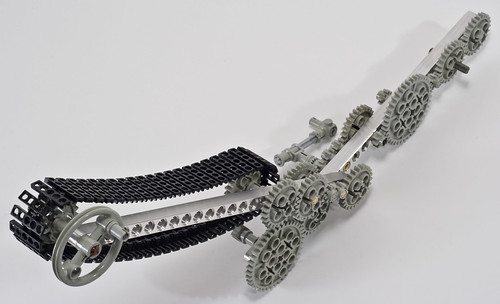
Pointless Lego contraption with aluminium beams

The two long beams are aluminium; the other pieces are standard Lego.

As you can see, everything fits. The holes are the right diameter and have the right little rebate around the edges; they're distinctly tighter to push pegs through than standard ABS pieces, but everything works as it should, and axles don't bind.

If you're a Lego purist, of course, then it is heresy to use "compatible" pieces of any sort - even Mega Bloks, the best of the usually-woeful Lego clones. It's a sin even worse than gluing pieces together (though probably not as bad as cutting them up). And if you're making something to enter in some sort of Lego contest, then non-Lego parts probably break the rules.

But if all you want to do is make cool things out of Lego, and you need, for instance, some long beams that won't bend as much for robot frame rails or something, these things are great.

(If you make large structures out of normal Lego, you have to use engineering skill to work around its limitations, which is a very educational exercise. Plastic in model-crane scales works not unlike steel in real-crane scales, so it takes real skill to build a huge crane or bridge (or, yes, short-lived house). Or, at least, a great deal of good old pre-scientific trial and error. But if you just want to knock together a chassis for a Lego Roomba or something, and no offensively gigantic Lego piece suits your needs, aluminium pieces are just what the doctor ordered.)

Inanimate Reason's products aren't even very expensive, by the standards of custom-machined gear. The smaller pieces only cost a few bucks each; my two 25-stud-length, 25-hole "liftarm" beams - the longest Inanimate Reason currently make - were $US11.99 each, plus a modest shipping fee.

The 25-length beams are not just stronger, but also about ten studs longer than any plastic beam Lego have ever made. I think the longest modern "studless" beam is the 15, unless you count the oddball 11-Duplo-stud-long one that came with this brilliant set. The longest old-style beam-with-studs is the 16. (And just because I know I'll get letters if I don't mention them, this very macho Scala building component is 18 studs long, and this recent bridge-frame piece is a gigantic 31 studs in length.)

Inanimate Reason have a Web shop here, and a BrickLink shop here. (Click "Show All Custom Items" for the metal parts - they sell normal Lego as well.)

Besides ordinary beams, they offer a variety of pieces in shapes and/or hole configurations that Lego don't make. You can get curved beams, beams with an even number of holes, holes with varying spacing to allow otherwise-impossible gear arrangements, beams with lockable hinges in the middle, heavy-duty shafting and gears for high-power drive applications, and adapters to let you easily use standard hobby servos in Lego machines.

(The abovementioned bizarre Early Science and Technology "Duplo Technic" line offers other possibilities for heavy-duty geartrains, but I think it's impossible to connect the chunky Duplo components to normal-sized Technic, and the sets are so rare and expensive that unless your intention is to force some Lego-robot-sumo contest to change their rules next year, you might as well buy the aluminium pieces anyway.)

Lego is already a surprisingly capable robotics prototyping system...

...but the bendiness of plastic means it can't get anywhere near the somewhat unsettling capabilities of "proper" modern robots.

Today, aluminium beams and drive components. Tomorrow, an all-stainless 8880!

(Or 928, of course.)

UPDATE: And now TechnicBricks has alerted me to the existence of Lego-compatible linear actuators, from this company. They integrate a motor and a linear actuator, come in two lengths, and work with both NXT and Power Functions.

They're expensive, though; one 100mm actuator costs as much as a whole 8294 Excavator.

Posted in Hacks, Toys. 6 Comments »

Your worthless fuel pills, or your life!

Nothing much was going on in the riveting Firepower imbroglio, until yesterday.

Before then, the wife of Firepower former-business-partner Warren Anderson said he attacked her, during an argument about a missing computer (there do indeed seem to be a lot of missing computers in this story...). She hauled Warren into court to face those charges, and then he said he didn't do it. Whoopee.

Now, though, Tim Johnston has said that Firepower - uh, well, the Firepower company that was selling possibly-illegal shares to Australian investors, anyway - never actually owned the intellectual rights to their products. See, it was one of the several other Firepower companies that owned the IP rights. That other company was run by a guy called Trevor Nairn, and Tim says he wouldn't give up the rights.

So, according to Tim, the abovementioned Warren Anderson rounded up some blokes to remonstrate with Mr Nairn, by taking him on one of those stimulating little day-trips that involve one or more large gentlemen with weapons, one unwilling participant, a shovel, and an isolated area.

You may have seen this procedure in a movie.

(If you haven't, allow me to recommend "The Magician"!)

Mr Nairn says that nothing of the sort ever happened.

This is all almost as mystifying to me as Mr Nairn says it is to him, since the Firepower fuel additives, just like the umpteen other such additives hucksters have sold over the years - and including of course the other additives that Tim Johnston himself previously sold in New Zealand - were and are completely worthless.

(Well, either that, or the people selling these things invariably try really really hard to make all of their "supporting evidence" look like a crock of crap. A product that did what their countless products are always said to do would be worth billions of dollars a year, but they never bother to take a lazy week to properly prove their claims and thus uncork the money-fountain.)

Who gives a damn if you've got the world rights to manufacture your placebo? Just make a new one, to a different formula, and go on with your upstanding legitimate business. No grave-digging, real or fictional, required!

Perhaps Johnston is just still trying to keep up the front that he believes his products actually work, and it's all a giant conspiracy by the oil companies and the Freemasons and Jehovah to make him look bad, or something.

It would still, of course, be simplicity itself to hand a couple of packs of Firepower pills - I think whoever's currently sitting on the cardboard box containing Firepower's surviving assets might be persuaded to give 'em up - to one of the dozens, if not hundreds, of organisations in Australia who could see if the claims were true.

I'll hold my breath for that, if you will!

The allegedly-wireless allegedly-RCA "Airnegy" alleged charger

A reader writes:

You're probably getting about a million questions on this gizmo from CES, but do you think the RCA Airnegy WiFi charger is anywhere near remotely practical?

Airnegy charger

They claim it will "harvest" energy from 2.4GHz devices, like wireless phones and WiFi devices. They say it can charge a cell phone from 30% to full in 90 minutes on the CES floor, which is confusing because of all the wireless devices on the CES floor and the fact that many cell phones report full early to make their batteries look better. Since a Wi-Fi device operates at 100mW and that shrinks with the inverse-square law, wouldn't any Wi-Fi power be trivial?

Would this only be practical if you had a lot of overlapping Wi-Fi hotspots and/or a huge charger, or am I missing something? They're even claiming they can integrate this into batteries in the future.

If this is a scam or borderline useless, why is RCA promoting it? I could understand this kind of trash from a fly-by-night operation like all the fuel-pill pages, but I would think RCA would want to keep some of its reputation.

Tim

Yes, I think this has to be some sort of hoax. I ain't no RF physicist, but I don't think the numbers add up at all.

(I am, unsurprisingly, not alone.)

The output of the very small charger for my very low-powered mobile phone (a Motorola F3) is specified as 6.4V @ 200mA, which is 1.28 watts. The output of a standard Wi-Fi access point is, as you say, limited by the spec to 100 milliwatts. And, again as you say, the laws o' physics dictate that even if this thing contains a beautifully-engineered rectenna that hoovers up 90% of the 2.4GHz-ish RF energy that impinges upon it, it'll still collect far, far too little power to do anything very useful. For the same reason, it is difficult for a device the size of a canoe to harvest much energy from the wake of a passing ocean liner.

It's actually not quite as bad as you might think from a pure inverse-square law calculation, because the "impossible antennas" used in normal access points have a sort of inverse-hourglass-shaped radiation pattern, concentrating output around the antenna at the expense of output above and below it. If you're lined up with the radiation pattern of one of the larger "omnidirectional" Wi-Fi antennas, you could easily be getting three or four times as much power as you'd get if it were a real omnidirectional antenna.

But unless the Airnegy is squished right up next to the antenna so it covers, and near-totally absorbs, some relatively large fraction of the entire radiation pattern (and, of course, thereby makes devices in its "shadow" unable to see the AP any more...), then the energy it'll receive even from several out-of-specification half-watt Wi-Fi adapters will be extremely low. Never mind charging a phone - you wouldn't even be able to light an LED.

(A crystal radio can run on the RF energy from its own antenna, but that's in the microwatt range, at best.)

I suppose a device with some sort of broadband fractal antenna in it, that can suck up everything from 50Hz mains hum to high-gigahertz radar beams, might be more practical. But the Airnegy is said to be 2.4GHz-only.

Oh, and there doesn't seem to be any mention of this product on the RCA site. And although the Airnegy CES stand looks professional, the products themselves look like quick mock-ups to me. Look at this battery, for instance. It looks as if they put a construction-paper wrapper around a standard battery.

(I presume someone's paid to have the stand there, too, unless CES was having trouble filling the floor and let in hoaxers for free, like the funny fake ads that fill holes in newspaper classifieds.)

Note also that RCA is now, I think, one of those "zombie brands" that has been reduced to nothing but a logo that's slapped on random Chinese flea-market gadgets. So even if it actually is a "real RCA product", that doesn't mean much any more.

This also isn't a new idea. Here's a piece about a "prototype Nokia phone" that's supposed to somehow harvest five milliwatts from incident RF.

Can any readers who've got some of that fancy book-learnin' about that thar electrickery help me out, here?

(Somebody on that Boing Boing post busted out the Friis transmission equation.)

Has anything at all like this thing ever actually been made to work?

(And no, inductive chargers don't count!)

Say hello to Michael

Regular readers of Dan's Data may have noticed I've been just a teensy bit burned out as regards reviews of computer hardware for, oh, the last few years.

This irks m'verygoodfriends, and sponsors, at the Australian online computer shop Aus PC Market. They seem to enjoy selling things, for some reason. My lack of review activity, along with the global economic slump, means AusPC haven't been selling as many things as they'd like.

So what I've decided to do is let Michael Vorstermans, who works at Aus PC Market, write some reviews for dansdata.com.

It's generally a really bad idea to let people review stuff that they sell. Like the paid-review business, it presents an obvious moral hazard.

In this particular case, though, I think it'll probably work out well, for the following reasons:

1: I've known, and trusted, Michael for many years. He's been at AusPC for more than ten years, and we met a few years earlier still, because he worked at the hobby shop into which I poured barrow-loads of money on that monstrous old R/C car of mine.

(If I wanted to be weaselly about this, I'd just blink innocently and say that Michael is not an employee of Aus PC Market. The whole truth, though, is that he has been an employee of AusPC for the abovementioned more-than-ten-years, before moving to an Australian IT-product distributor for a while. Right now, for someone who I think still doesn't technically work for Aus PC Market, Michael spends a surprisingly large amount of time in the AusPC office... working.)

2: Michael is not a tiny cog in a vast corporation who doesn't suffer if his actions, like writing misleading advertorial "reviews" of products, lead to unhappy customers. Aus PC Market is a small company, and Michael's on the phone with customers for a large slice of every day. He's in this for the long haul, and does not subscribe to the zero-sum game theory of sales. Aus PC are not going to upsell you a pile of gear you don't need, or even want, just to crank up this week's profits.

A fool and his money are as welcome at Aus PC Market as they are anywhere else, of course. If some guy insists on buying a system with triple video cards and a six-drive RAID array to do word processing and Web browsing, AusPC will be pleased to sell it to him. (And, more realistically, they are also very happy to sell top-of-the-line graphics cards and CPUs, even if they're only 20% faster than the 60%-cheaper low-end products.)

AusPC also, by the way, won't give you the stink-eye if you admit you intend to overclock the balls off of the CPU you just bought. Their mood may, however, deteriorate if, two days later, you want a warranty replacement for your still-smoking processor.

3: Michael is not paid on commission. Obviously he'd like people to buy lots and lots of stuff from AusPC, but there's no direct pay-out for him even if he actually does talk someone who wants to play World of Warcraft on a 17-inch screen into buying a GeForce GTX 999 Ultra Hyper.

(Michael also, by the way, won't be getting paid when readers click through from his reviews to Aus PC Market. I will!)

4: We're going to be completely open about who Michael is and where he works. This blog post is not going to be the only hint you ever see that Michael sells the stuff he's writing about. I will link his name on every review to this post (or some equivalent page that I make on dansdata.com), but there'll be a clear declaration in every review, too. And the reviews will be written, where appropriate, from the point of view of someone whose business is selling computer gear.

I think that this may actually make some reviews better. Michael's at the sales-and-support coalface every day, and has way more experience of what normal people actually do with normal computers, and what products solve their problems (or create new problems...), than I do. He also knows more than me about things like weird software-license pricing, which product's currently hard to buy because a faster, cheaper version is coming out in two weeks and nobody wants to be stuck with the old model mouldering in their warehouse, and so on.

Oh, and one other one, I think possibly the most important:

0: If Michael BSes you about some product that actually isn't very good, then as soon as he's back in the AusPC building, the person who'll have to deal with grumpy customers, rude things written on forums, and justified-or-otherwise RMAs is... Michael.

So we're not exactly getting an oil billionaire to file reports on climate change, here.

Plus, if it doesn't work out, we can just give up on the idea. But I really do think it'll be fine, given the numerous extenuating circumstances.

Your comments, gentle readers, are of course welcome.

[UPDATE: Michael's first review, of a USB 3 upgrade kit, is here!]

The End of Lousy Writing, With Any Luck

I just got to watching The End of Time, the two-part final instalment of Russell T. Davies' writing stint on Doctor Who (he's been at it since the series was reborn in 2005).

Spoilers below, et cetera.

Again, not very good. I pretty much agree with Frank at Cathode Ray Tube. And with the whingier commenters, too.

I even almost agree with the "gay agenda" criticisms this time. In the coda where the Doctor takes a moment to see all of his buddies for the last time, saving a life here, handing someone 20 million quid there, he stops in to a polyglot space cantina on Earth Music Sung In English Night to... set Cap'n Jack up with a hot guy.

Who Jack may need to be with in order to save the universe or something, but way to agree with fundamentalist preachers about the one and only focus of all gay men, Russell. Jeez.

The bit my inner fanboy latched onto as particularly obnoxious, though, was after Earth suddenly found itself populated by 6.7 billion Masters, at the end of the first instalment.

The next bit'll be rich, said I. A planet filled with billions and billions of "I am the Master and you will OBEY ME!!" megalomaniacs! It'll instantly granularise into millions of tiny warring fiefdoms, everyone scheming against everyone else, everybody with access to three tin cans and a bottle of bleach cooking up mind-controlling super-viruses, demons being raised right and left, legions of clanking K1s fighting pitched battles against pithed Silurians with Dalek beam-guns grafted onto their arms all slaved to the brains-in-jars of as many Masters as one lucky other Master managed to catch in a stasis trap...

But... no.

All of the Master-duplicates cheerfully stayed in exactly the position in the world's countless chains of command that the human they'd replaced was previously in. And they all happily took orders from the Masters above them. And said "Yes, sir!"

The new Masters in Donna's house didn't even seem to sodding move from their spots next to the dining table.

One can only presume that the Masters who took over the bodies of burger-flippers didn't bother to remove their paper hats.

And then they gave up all their technology and sent their ship into the sun, and a major character vanished into thin air.

(Wait. That might have been a different show.)

The new Masters had to act nothing like the actual character, of course, because otherwise the Grand Evil Scheme Davies had spent all of three minutes thinking up wouldn't work at all, and the Reset Button at the end when the human race all turn back into themselves would be hindered by the population of the planet having dropped by a factor of 100 in a couple of hours. But I like to think that even young viewers would have been wondering why The Crazy Baddie suddenly turned into The Peaceful... Obedient-ie.

TV Tropes calls this phenomenon Writer On Board, and has many examples. This one was an absolute corker, though.

My Roman Army knife

The other day I wrote about a knife switch that might actually be an antique.

Today, allow me to present a knife that could be 2000 years old!
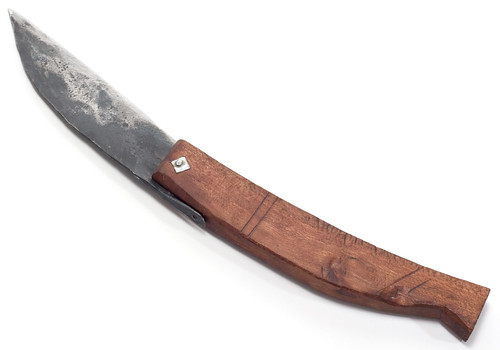
Reproduction ancient folding knife

It's not, though. It was probably beaten out of a bit of old leaf spring or something by some bloke in China only a few months ago.
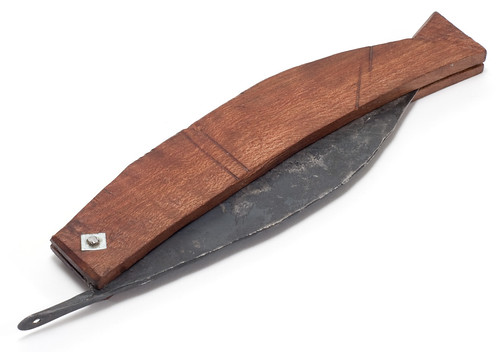
Reproduction ancient folding knife

It's about 235mm (9.25 inches) long when open, and cost me $AU11.50 delivered (about $US10.50, as I write this) from eBay dealer "The Medieval Shoppe" here in Australia. Here they are on ebay.com; here's a search that finds this "Rustic Foldable Iron Knife" in their ebay.com.au store (if they currently have any to sell), and here it is on ebay.com.

The wood of the handle was a bit rough and splintery, so I sanded it a little and applied some home-made beeswax polish.
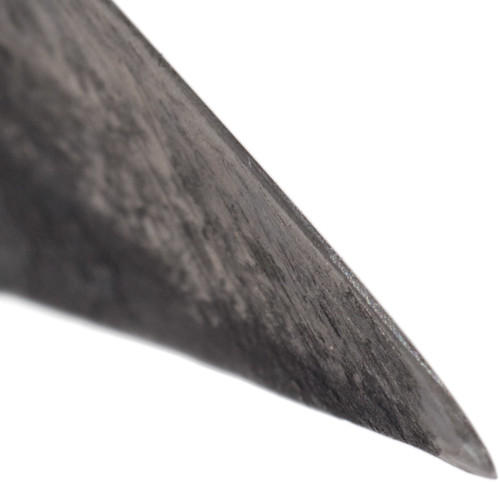
Reproduction ancient folding knife blade detail

The blade came with a usable edge on it. I straightened the edge a bit on a steel, then touched it up with my fancy sharpening doodads. It took longer than usual to remove a tiny amount of material, so the blade is probably pretty high-carbon steel. I wouldn't be surprised if there's a lot of variation in the steel used to make these things, though.

(I cordially invite readers to start a religious war in the comments about What The One True Knife-Sharpening System is. I'll start: If you're a beginner and/or clumsy, get a sharpening kit with some sort of angle guide, like the CRKT Slide Sharp or, for blunter blades that need more material removed, a Gatco sharpening kit.)

Even without extra sharpening, this slightly-mad-slasher-looking thing's not just a bit of renaissance-faire costume kit. It's a perfectly practical tool, with a nice slim blade profile that makes it good for slicing tasks, though not a great choice for really heavy cutting, and no use at all for prying things open. And if you were to hop in your time machine with it and go back to the Roman Republic, nobody would find it particularly remarkable.

Well, actually I suspect the cap on the hinge rivet may be a bit of aluminium or stainless steel, which'd be a giveaway if someone examined the knife closely. But apart from that, this is a decent ancient replica.

(You could be onto a nice little earner there, actually. Scour handle and blade with dirt for a while, soak it in wine, soak it in oil, put it in a low oven for a little while, then bury it in the garden and water it daily for a week. And then dig it up and put it on eBay with a $500 reserve as Roman Pocket Knife Miraculously Preserved In Peat Bog. Just hope they don't carbon-date the wood.)
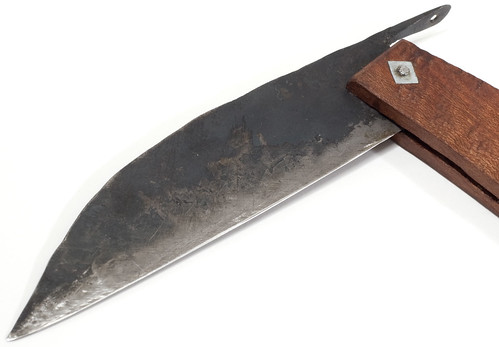
Reproduction ancient folding knife half-open

More intelligent readers may have figured out, from this, that folding pocket knives have been around for a surprisingly long time. Fixed-blade knives are stronger (provided they have a decent-sized tang), and simpler, and so have always been much more common. But the ancient Romans did indeed have folding pocket knives - some of quite sophisticated design.

The ancient folding knives, and indeed every known folding knife until about the 15th century, don't "lock". The blade is only held open, or closed, by friction between itself and the handle. This design makes it easy for the knife to close unexpectedly and seriously injure you if you push the blade hard into something (or someone), or if you're cutting something and the blade jams on a push stroke. A simple friction-joint knife can also come open in your pocket; hilarity may ensue.

For this reason, it's now possible to get a variety of Swiss Army knives (find more with the SOSAK "SAK Selector"!) that have a proper lock for their main blade, and not just the standard "slipjoint" arrangement that resists opening or closing of the blade, but doesn't positively lock the blade in either position.

(And yes, I am aware that some law-and-order geniuses in the UK decided to one-up the similar geniuses here in Australia and make it illegal to carry any knife with a locking blade in a public place, unless you have a "good reason". The list of acceptable "good reasons" does not appear to include "not wanting to cut my own fingers off, or stab myself in the scrotum while running for a bus".)

I wouldn't be surprised if someone 2000 years ago came up with at least a simple locking mechanism for a folding knife - like the rotating collar on the classic Opinel knife, for instance. A sliding ring, a peg that goes through holes in the handle and a slot in the blade; there are lots of possibilities that wouldn't require the precision fabrication techniques and tough steels upon which modern locking knives depend. But if someone did come up with a locking folder in 100 BC, it apparently didn't catch on.

(It's possible that many such knives were made, but didn't survive to the present day. Iron and steel items of all sorts are hard to find in archaeological digs, because iron easily rusts away to nothing over time, leaving archaeologists puzzling over the stain the rust left, and whatever parts remain, to figure out what the now-lost iron parts looked like. Older bronze-bladed knives and swords often fare a lot better. Early iron blades were actually clearly inferior to the bronze alternatives; iron was much more common than the copper-and-tin used to make bronze, but until we figured out how to make proper steel, iron swords were made of wrought iron. That material makes dandy door hinges, but lousy blades.)

My replica has a neat pseudo-lock system, though:

Reproduction ancient folding knife half-open

Reproduction ancient folding knife

There's a flattened spike on the back of the blade that stops it from opening too far, and is also easy to grip when you grip the handle, and thereby prevent the blade from closing. It's not a real lock, and it sticks out awkwardly when the knife is closed, but as a safety feature it's a lot better than nothing.

(The spike also has a little hole in it, through which you could tie a lanyard.)

Making your own knife, often from some cast-off piece of steel like an old file or a railroad spike, is a popular simple metalworking/blacksmithing project. I think a lot of people are put off the idea, though, by thinking they have to make something that's somewhere near modern commercial quality, or at least as good as a Douk-Douk or K55K.

You don't, though. You can make a knife like this with basic hand tools, a gas stove and the very cheapest of eBay Anvil-Shaped Objects, if you've already got a chunk of steel.

Or you can just buy one, of course. Either way, it's another very satisfying object.
On Art

I await with interest the bizarre innovation that'll cause me to undergo the mental inversion so many people suffer, which leads one to conclude that The Stuff The Kids Listen To These Days, It's Just Noise, Not Like Bach/Haydn/Britten/Miles Davis/The Beastie Boys.

This leads me into thinking about the nature of art.

Thus far, I have concluded that art is whatever someone is pointing at when they say "that's art!"

Here are some of my other provisional conclusions:

"Bad art" is not the same as "not art".

"Low art" is not the same as "not art".

Art is still art even if it's easy to make.

Art is still art even if it makes its lazy and/or incompetent creator a lot of money.

Art is still art even if you don't know what it's supposed to be.

Art is still art even if you don't understand how it's made.

Art is still art even if it's not very original.

Art is still art even if you personally don't like it.

Art is still art even if unpleasant people made it.

Art is still art even if unpleasant people like it.

Art is still art even if the people who made it and/or like it are wankers.

Art is still art even if nobody seems to like it.

Art is still art even if it was created as a joke.

Art is still art even if it is the product of fraud.

Art is still art even if it's made by a machine.

Art is still art even if it's not entertaining.

Art is still art even if it is entertaining.

Posted in Art. 20 Comments »