Scams, glorious scams

It wasn't too bad from time to time seeing you answer questions about scams and hoax devices, but now it seems like a lot of your energy and brain power is wasted on that stuff. As a long time reader, every time I see a new letter answered that ends with "I'm sure it's a hoax but I just wanted to ask you" I die a little inside. You'd think by this time, with as much as we are all connected to the world, news, and technology we would just realize that if it's too good to be true it probably is... and if it ends up being true, we'll know about it soon enough. Anyway, take that how you will, I'll still idolize you in any case.

Jordan

That'd better be a golden idol, and a damn big one, if you know what's good for you.

Unfortunately for Jordan, though, I find scams and hoaxes fascinating. Not so much when it's the the same scam over and over, like those ridiculous "power saver" things, of course. But there's always something new.

Just today, for instance, I discovered that New York City currently contains hundreds and hundreds of locksmiths. Do a Google Maps search and it looks as if the city has a life-threatening case of the measles.

It turns out that almost all of these companies are fake. They get themselves listed as "emergency locksmiths" in the phone book, Google Maps and so on at a fake address (which may be the address of a legitimate locksmith). And then, when someone has one of those special lock-related emergencies and calls the "local" company, the rip-offs commence.

Apparently, what they usually do is make you wait while they drive to your place from wherever they actually are, and then charge you way more than they quoted. In this respect, they're a bit like the numerous rip-off camera stores that also infest NYC.

But there's a lot more a crooked locksmith could do. I imagine burglary and locksmithing go together very well - it's ever so much more civilised to let yourself into a victim's house through the front door while he's at work, rather than break a window. Many of the bogus locksmiths seem to be completely incompetent, though, so I suppose there aren't all that many gentleman thieves among them.

Bogus-locksmith disease appears to be more communicable than the bogus-camera-store version. The camera stores are still pretty much restricted to New York, but the locksmiths are spreading right across the USA.

The novelty in this scam is the intersection with online mapping systems, which are being made useless by the tide of fake-company spam that makes it impossible to see which "local" locksmith is actually real. Word of mouth has always been the best way to find good local tradespeople, but until someone comes up with a way to filter the fakes out of services like Google Maps, there's now no other option.

(I wouldn't like to be the person trying to fix this. If the fake-filtering accidentally removes some real locksmiths from the map, I bet someone's going to get sued. Perhaps people could just call locksmiths at random, and whenever one arrives demanding far more money than he quoted, shoot him. That could work.)

Apart from the mapping thing, the locksmith scam is just boring overcharging of captive customers. It doesn't have the elegance of a classic grift, like the one where a door-to-door salesman sells elderly people a safe for their valuables that's disguised as a Bible, then breaks into the house a week later to retrieve the safe and its contents.

Some of the classic scams have been made impossible by advancing technology. Look at the "replace all your light bulbs for only $5" one, for instance. The scammer in this case actually started out with only one house-worth of bulbs, and from then on he just moved used bulbs from each house to the next, collecting his fee each time. Now that people are using expensive compact fluorescents, though, that one doesn't really fly. (There's still this dumb variant and the Robin Hood version, but that doesn't make any money.)

Some scams that seemed to die have been reborn, though. For a while there it seemed that the boiler room, for instance, was dead, because you couldn't get away with faking stock trades after everybody switched to Internet brokers. But now it turns out that the boiler rooms just got much bigger and took a new name - "hedge funds".

My (irradiated) balls are always bouncing

A reader writes:

Do you ride motorcycles or know anything about them? Please take a look at the RiderSaver™ EMF Shielding for Motorcycle Seats.

It's a bit of a long read, and I will not cover my nutts with aluminium foil anyway so you don't need to read it, but in case you do, is there really some bad radiation on motorcycles that could harm my precious balls?

Vlaho

This remarkable item appears to be the product of one Randall Dale Chipkar, who has a Web site for the product and his "Motorcycle Cancer Book" here. And whaddaya know - yet again, here's a proudly-displayed patent for a device, once again exploiting the general public's belief that you can't patent a thing unless it works. (You can actually patent pretty much anything you like, however crazy, as long as it's sufficiently different from other patented things.)

The nutty-sounding stuff on the RiderSaver product page about how the "outstanding magnetic field attenuation results from a unique heating/cooling process within a hydrogen reactive atmosphere" means that RiderSaver EMF Shielding is - or is at least supposed to be - "mu-metal", which is indeed commonly used for magnetic shielding.

There are some problems with using it for this purpose, though.

Problem one: Mu metal doesn't just "soak up" magnetism, like heavy drapes soak up sound. To use mu-metal to "contain" a magnetic field, you have to form the metal into a casing right around the field source. (You can do the same thing with ordinary mild steel, by the way - it just won't work as well.)

Just putting a mu-metal "hat" on top of a field source won't do this, though. It'll do something, but it's quite possible that you'll actually end up with the magnetic field lines being pulled down and concentrated right where your arse meets the seat, which I'm given to understand includes a piece of the anatomy known technically as the Bollockular Region.

(There's more info on all sorts of shielding as it applies to electronics, with helpful diagrams, here.)

Problem two: Mu-metal is for screening low-frequency, or static (i.e. just a permanent magnet) magnetic fields. The higher the frequency at which a field is oscillating, the less effective mu-metal will be.

If you've got a two-cylinder four-stroke motorcycle chugging along at 3000 RPM, its spark-plugs will be firing fifty times per second, giving an electromagnetic field around the plug wires that oscillates at that same 50Hz. And changes shape too, depending on the ignition-system layout.

50Hz isn't high-frequency - it actually qualifies as "extremely low frequency", or ELF, and ELF magnetic fields are what bother a significant portion of the people who're worried about the effects of non-ionising radiation on health. Mu-metal is often used to shield EMR in the 50-60Hz range, which is what you get from mains electricity.

[Although, as commenters point out below, the radio-frequency energy emitted from spark-plugs and their wires is broadband RF noise from DC to daylight, because that's what sparks do.]

The 50-60Hz fields from overhead power lines are a big concern for the EMR-avoiders, though I don't think anybody's ever demonstrated there to be any real risk. Yes, people who live under power lines have a higher incidence of many diseases including cancer. But people who live under power lines also tend to be poorer than people who live somewhere more picturesque, and poor people get many diseases, including cancer, at higher rates than rich people. If you do a proper test that controls for these "confounders", the health "effects" of power lines approach zero.

When you start digging into stuff like this, you'll soon find people using for support reports that say things like "the risk was elevated but not statistically significant". This is an unfortunate choice of words, because to Joe Average it means "the risk was only a bit higher". Statistical significance is actually what tells you if a result is likely to reflect reality, or just be due to chance.

A lot of medical studies use a "confidence interval" of 0.95. If something is statistically significant to this degree, there's only a one in twenty chance that it's just a fluke (and if different 0.95-interval studies all find the same thing, the probability of error drops rapidly).

Something that isn't statistically significant is something that doesn't achieve a decent confidence interval. A measurement with a confidence interval of 0.6, for instance, is only 60% likely to be a real result not due to chance. It's not wise to make decisions based on lousy confidence intervals, and what you should say if you're talking about dubious results like this is "there was no statistically significant difference in risk".

Getting back to engines, it's easy for them to produce magnetic fields at higher frequencies. If you've got a four-cylinder four-stroke bike pushing a bit hard at 8000RPM, for instance, the spark-plug field will now be oscillating 266.7 times per second, and mu-metal shielding will be less effective.

The other significant electromagnetic-radiation source in a bike or car is the alternator, which is all made out of electromagnets (alternators are related to field-coil electric motors, which were the only game in town in the days before good permanent magnets). Half of the electromagnets in an alternator are whizzing round and round; the alternator therefore creates a complicated rapidly-changing high-frequency magnetic field which mu-metal is probably not very good at shielding at all.

Problem three: Mu-metal actually needs to be hydrogen-annealed when it's in its final form. This is part of the reason why mu-metal shielding is expensive; you can't just buy a flat sheet of it and wrap and hammer it around whatever you want to shield. But the Web site for the allegedly-mu-metal stick-on RiderSaver stuff says it "can be cut and is bendable and pliable to accommodate intricate motorcycle seat internal base pans". As soon as you cut or bend mu-metal, you'll work-harden it, and its magnetic permeability, from which comes its high shielding ability, will be decreased. If all you do is wrap mu-metal foil around a box then it'll still work pretty well, only failing on the bent edges, but if you change the shape of most of the surface so you can jam your seat back down on top of it, you may well end up with no better a result than you would have gotten from some cheap sheet steel.

(All modern hard drives have a couple of high-powered rare-earth permanent magnets inside them. There's close to zero field outside or even impinging on the platters right next to the magnets, though, because the magnets are on the inside of an iron pole-piece assembly. Mu-metal would work even better, but it's not needed.)

Problem four: There's not actually any good reason to suppose that any of the clearly-understood risks of sitting on a motorcycle seat, above a spark-ignition engine, have anything to do with magnetic fields or electromagnetic radiation.

Motorbikes are dangerous, but that danger comes from Newtonian, not electromagnetic, physics. (I like the observation that if motorcycles had only just been invented, there's no way they'd be legal.) Per distance travelled, motorcyclists are something in the order of 35 times as likely to die as car drivers. (These numbers are the aggregate for all motorcyclists, though; if you ride a sedate commuter or cruiser bike then you're actually pretty safe. Crotch-rocket sport-bike riders apparently have a death rate ten times that of other motorcyclists, and they affect the statistics accordingly.)

If I had a bike, I'd be focussing my attention more on heavily armoured clothing than on any theoretical danger to my precious bodily fluids from non-ionising radiation. A factory-fitted device that disabled a bike's ignition if it detected that the rider was only wearing jeans and a T-shirt would do quite a bit to reduce bike-related deaths and injuries.

There's no way to convince some people that non-ionising radiation from phones or powerlines or wireless networks or whatever does not seem to be a significant health risk. "It's still radiation, isn't it?", they say. "And I read that Wi-Fi causes autism, too!"

Similar reactions to "nuclear magnetic resonance imaging" are what caused the name to be shortened to just "magnetic resonance imaging", or MRI. MRI machines have nothing to do with nuclear weapons, of course, but "nuclear", just like "radiation", equals "bad" for most people. Explaining that visible light is also a form of radiation doesn't seem to help. It's all forms of non-visible radiation that're considered to be dangerous. (See also people who won't eat food that has "chemicals" in it.)

There's a whole family of bizarre products and books having to do with the terrible dangers allegedly posed by all kinds of invisible radiation, empirical evidence be damned. "Electrosensitivity" - the alleged deleterious effects of non-ionising radiation of one kind or another - is a big market at the moment. Look at those "radiation shield" stickers for cellphones, for instance, which work every bit as well as the "antenna stickers". There are also cellphone anti-radiation products that may actually work; there's just not much reason to suppose that they're necessary.

(L. Ron Hubbard was ahead of the radiation-scare trend, in his inimitable style.)

But there are also plenty of people who believe that static or pulsed magnetic fields are good for you. There's some actual very narrow scientific support for this - pulsed magnetic fields may have some effect on the healing of fractured bones, for instance - but it is largely a crock, about as believable as the old electric belts. (Though presumably less harmful than the old health devices that used ionising radiation.)

Over and over, alleged "electrosensitives" have failed to demonstrate that they can even perceive electromagnetic fields and radiation, much less that those phenomena cause any ill effects. But that doesn't stop them from buying products like the RiderSaver that claim to protect them.

I find the RiderSaver much more amusing than most bogus radiation-blocking doodads. Worrying about whether EMR is in some unknown-to-science way barbecuing your bottom while you ride your donorcycle strikes me as being like making sure you put on extra sunblock before you participate in the Running of the Bulls.

Library, bumper-sticker shop... what's the difference?

I get a lot of link-farm spam, of varying levels of ingenuity.

This one's got a new twist, though.

From: Alicia
[sending server located in some craphole]
To: dan@dansdata.com
Subject: An Idea/Suggestion for 404 link on http://www.dansdata.com/usbadapt.htm
Date: Tue, 3 Mar 2009 08:10:42 -0600 (CST)

Hey :-)
I happened to noticed that on the page http://www.dansdata.com/usbadapt.htm you have an outgoing external link to http://www.archive.org/movies/movies.php, however I found that it is a broken link (doesn't look like that page exists anymore or is temporarily down). I found this page to be a good replacement if you just wanted to change the link.
http://www.filmposters.com/articles/evolution-horror-movies.asp
Hopefully this adds another resource to your page if anything.

Hope this is of some help, thought it was a good site to reference. Hope it proves to be useful

Thanks,
Alicia

This really does look like an actual e-mail from a human being, doesn't it?

Of course, a human being would probably have noticed that although the Internet Archive's moving image collection page has moved since I wrote that review in 2004, the old URL redirects to the new one.

A human being might also be able to detect a slight difference in content between the place I was linking to and the place "Alicia" wanted me to link instead.

The Internet Archive moving image collection lets you download, for free, tons of movies that're out of copyright or otherwise free to distribute. Nosferatu, His Girl Friday, Night of the Living Dead, Reefer Madness, old computer TV shows, cartoons, vintage educational films, "ephemeral" films; you name it. It's great.

Filmposters.com, in contrast, is pretty much what you'd expect filmposters.com to be. The page "Alicia" wanted me to link to isn't the usual meaningless link-farm robo-content, though; it's about "The Evolution of Horror Movies", and seems to be a perfectly valid page with real content. But it also seems to not be in the Google database at all, which suggests that it's brand new.

Perhaps the idea behind this spam is to make actual valid content pages on sites that want the PageRank boost that all link schemes are about. Then you scan for broken links on Web sites and shoot off these seemingly-from-a-human e-mails, suggesting people update their link to point to your page.

The only problem is that, as usual, it's all based on software that's trying, unsuccessfully, to find targets that're relevant to the stuff the spammer is trying to advertise.

If this really is the scheme, it's a step forward from normal link-farm sites, which exist only to trick searchers into clicking on ads. But I'm still not going to help "Alicia" do it.

Posted in Scams, Spam. 4 Comments »

The Loch Ness Carburettor

From a reader:

I was browsing the Internet and came upon this website:

http://www.himacresearch.com/books/secret.html

You've got a interesting ability to dissect stuff and determine if it's a lot of crap or not. It seems all very dodgy to me, but interested in your thoughts.

Leon

The 200-mile-per-gallon carburettor - in this case, it's only meant to be a 100-mpg carburettor - is, obviously, one of the golden-oldie corporate myths. (Where would you even put a 200-mpg carburettor on a modern engine?)

This site is a great example of the breed; among other things, it mentions the famous (in certain circles) Charles Nelson Pogue patents from the 1930s. You can patent almost anything, of course, whether it works or not, but the fact that those patents do exist is still, frequently, used as evidence that the Pogue carburettor worked as advertised.

Because the miracle carburettor is such a classic automotive myth, there are many excellent articles about it. Here on Snopes, for instance, and here on The Straight Dope.

Tony of fuelsaving.info has a page about atomisation gadgets, too, in which he explains why no possible carburettor could work any better than fuel injectors do, as can be proven by, for instance, looking at engines that run on gaseous fuel.

(It's also been pointed out that the steady progress of automotive technology means that lots of cars on the road today actually could be 100mpg vehicles. But as engines have improved, more and more heavy safety and luxury stuff has been added. If you strip that stuff out of a modern car and perhaps add some alarming aerodynamic mods, a hundred miles per gallon is not out of the question.)

There are other things that make these supposed devices look very unlikely, too, beyond the basic objection that people have been talking about it for decades, but the Giant Car Industry Or OPEC Or Masonic Or Something Conspiracy has managed, even in this modern age of the Internet, to prevent anybody from ever even sneaking such a car into a technical-college garage for tests. (The many people who've actually tried it and been disappointed are, of course, all actually just part of the Conspiracy.)

The maximum theoretical efficiency for any heat engine, including internal-combustion engines, is equal to the absolute-temperature difference between the hot and cold ends divided by the temperature at the hot end. To put it another way, a heat engine takes a high-temperature thing and extracts some energy from it, sending whatever energy it can't extract to its heat-sinking exhaust. For an internal-combustion engine, the hot thing is the fuel burning in the cylinders and the heat-sink is the atmosphere - and, to get the calculation right, that "absolute temperature" thing means you need to use Kelvin or some other starts-at-absolute-zero scale for the temperatures.

The bigger the temperature differential, the more efficient the engine. This is why steam engines need their steam to be so very hot, and also why Smokey Yunick's Hot Vapor engine quite possibly got better mileage than even the most advanced car engines do today. Shame about that little "setting everything else in the engine bay on fire" problem.

Anyway, even if aliens have given you a perfect internal-combustion engine, its ceiling efficiency is still cappped by this calculation.

Given the combustion temperature in internal-combustion engines and typical ambient temperatures, the maximum possible thermal efficiency for an internal-combustion engine is up around seventy per cent. No real engine actually manages much more than 25%, but about 70% is the limit.

The "200 mile per gallon" carburettor is supposed to work on ordinary big dumb American engines, whose fuel-efficiency without the magic carburettor is, let's say, 25 miles per gallon. If you boost a 25-mpg engine to 200-mpg, you must have improved its thermal efficiency by a factor of 200/25, which is 8. But we can empirically calculate, by measuring combustion-chamber and exhaust temperatures, that its initial thermal efficiency is about 20%. Multiply that by 8 and you get one hundred and sixty per cent, way off the end into perpetual-motion territory.

Even if it was a really fuel-efficient engine to start with, getting 40 mpg, and you're only talking about a one-hundred-mile-per-gallon miracle carburettor, you're still improving by a factor of 2.5. This is, at least, theoretically possible - assume 20% efficiency to start with, multiply by 2.5, and you get only 50%, below the theoretical maximum. But in all the engine labs of all the world, in all the sheds and garages and universities and giant car companies, there is no evidence that anybody's ever made an internal-combustion engine that is that efficient, unless it runs at spectacularly unmanageable temperatures.

It's perfectly possible to make a car, or even a motorcycle, that contains a very very hot engine of one kind or another. But the "miracle carburettors" never say anything about that. They're just bolt-on devices for normal engines, promoted with the usual BS about making the fuel burn better or swirling it around or something. Modern engines provably burn fuel very nearly optimally, so there's not anything to actually gain there.

But the myths will never die. The miracle carburettor is like the Loch Ness Monster; no amount of scientific investigation or logical argument can ever prove it's not out there, somewhere, in the mist.

Greener Gadgets: This time for sure!

Last year, one of the award-winners in the Greener Gadgets design competition wasn't all that it might have been.

To summarise: It didn't exist, and was physically impossible.

This year, the winner is an actual object that actually works. It's the "Tweet-a-Watt" prototype, a system that gives wireless computer access to as many power-usage meters as you like, so you can have your Internet washing machine - or, at least, the power-monitoring feature thereof - without having to wait for an appliance company to make one.

Some of the other shortlisted entries seem quite good, too. You can't argue with something that's actually built and working, for a start. And I spent a while trying to think of something wrong with this little cardboard PC case, but couldn't (here's a bigger one).

This roll-up solar flashlight wouldn't be cheap to make with current tech, but it looks workable. And the BugPlug looks fun and useful, while these evil eyes for standby LEDs are hilarious - I don't care if the light-guide design doesn't seem quite right.

The Zeer evaporation cooler looks good, too. As do the WattBlocks, except for the slightly embarrassing detail that they seem to be turning off "vampire" standby devices by adding a bunch of little doodads that must themselves be in standby mode all day. The clockwork Vampire Plug looks like a better bet, but doesn't do the same job.

Many of the other candidates seem to be the usual "cool design project" things that look really neat at first but become less and less appealing the more you think about them.

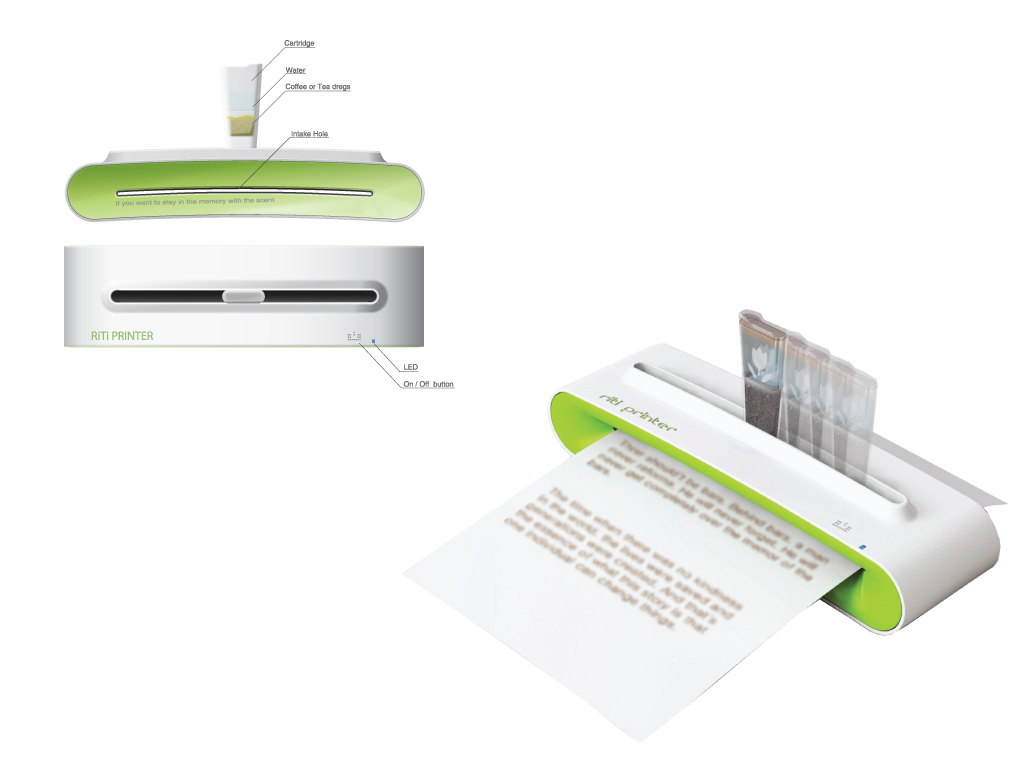
Take the RITI printer, for instance, which uses "coffee or tea dregs" for ink.

What a great idea! Make the coffee-ring work for you!

Except that dregs are full of particulates, which I strongly suspect would instantly clog any printer nozzle capable of output resolution better than that of a nine-pin dot-matrix. I suppose they could put a filter in the thing, but that'd have to be a frequently-replaced consumable for your "eco-friendly" printer.

(And apparently the whole thing's run by the user moving the print head back and forth by hand. So it doesn't just need sub-millimetre head-tracking accuracy to know when to squirt out a dot - which would seem to rule out the usual rubber-belt system - but apparently when you're sending a document to it, you have to whip the head back and forth so the printer can hear you. And yet it still features an on/off button.)

This neighborhood intercom doodad might perhaps work, but there'd be non-trivial security issues, unless you made setting the system up no easier than just instant-messaging your neighbours. (Not that it wouldn't be great to just drive through the city with a spare "Eco-Neighbuzz" transmitter broadcasting "Big dog-fight this evening at number 29! No homos, negroes, fat chicks or Jews!")

Some of the entries are more art object than realistic product (this one's on the border line), which is fine by me. I've got no complaints about those, unless they win prizes.

But then, along with various solar devices that don't seem to have enough cells to perform as advertised, there's this solar battery charger, which does not appear to have any solar cells at all. Perhaps the green block in the middle is Kryptonite, or something.

The Urban Fan is entertaining, too. It's a ceiling fan that plugs into a light-socket. Commenters predict rather unpleasant failure modes when you try to hang it from a loosely-anchored socket, and I'd like to add that if it uses an Edison screw fitting, it may unscrew itself after a few on/off cycles.

Oh, and then there's the Enviro'clock Bandage, which commenters observe appears to be a sticker with mental telepathy.

And it wouldn't be an eco-gadget competition without yet another dodgy small wind turbine. This time, there's one that has one little turbine that's meant to work in both wind and water. And the "Wind-Helmet" seems to be trying to set a record for personal-wind-turbine smallness and uselessness.

(Some commenters on both of those entries are, again, unimpressed.)

This solar-powered air-cleaning fan is only mildly stupid. This home 12VDC socket idea could work, but seems to me to be almost completely unnecessary (it's remarkable how many of these proposals have glaring spelling errors). And then there's PpMm pre-perforated paper, which aims to end the endless nightmare that is... tearing up a piece of paper.

If you find any other howlers in the top 50 candidates, please point 'em out!

But what if it gets sunburn?

Presented as received, emphasis theirs:

From: "rachel" <rachel@infronts.com>>
To: <dan@dansdata.com>
Subject:
Date: Mon, 2 Mar 2009 01:39:08 +0800

Dear Dan,

Have a nice day£¡

I am happy to present hot selling items for you reference. A lot of clients are interesting in this item, so I try to send them for your reference. Hope it is helpful for you!

Here is our Solar USB Dick for your reference,hope you are interexted in.

Feature:Animation Display
Operating sysrem:Windows 98/SE, Windows ME, 2000 XP and Mac OS9.1
Drivers: Only Windows 98/SE need the driver

Logo is made by Pc software and displayed on LCD screen, when there is light logo blink thus to attract people's attention.

[blah blah blah, picture of USB thumb-drives with a solar-powered capacity-display thing on the side]

Pirce: FOB shenzhen

500PCS
128MB USD3.15
256MB USD3.45
512MB USD3.75
1GB USD4.25
2GB USD4.65
4GB USD7.60

MOQ:500pcs , More qty will be more cheaper.
Product material: Plastic Housing
Product size: 62*25*13mm
Packing: each in a color box,100pcs/48*36*29cm; G.W./N.W.:12.5*11.7

This offer is firm for 1 week.
Please add USD0.30 for ROHS.
Printing logo: logo set up charge: USD100.00/design.
Sample delivery time is 3-5 day after order confirm.
Delivery time: 7-10 day after sample approval.

Should any of the items be of interest to you, please let us know. We shall be glad to give you our lowest quotations upon receipt of your detailed requirement.

Rachel
IFS electronice company limited

Web:www.infronts.com

Solar dick!

Yep, that's an electronice solar dick all right.

(I bet they'll print whatever famous computer-product-company logo you like on your 500 solar dicks.)

I'm a Twitter... critter?

I just got me one of them Twitter things that the kids are so crazy about.

I have a serious, serious problem with turning things I'm writing into very lengthy projects, so Twitter actually looks like a good idea to me. I understand why a lot of people view it as pure granulated pointlessness, but it gives me a chance to toss off the occasional bon mot without any real time investment, and perhaps some of you will enjoy the result.

(In the unlikely event that anybody reading this doesn't get the title joke: La.)

(Pennypacker also found this when I searched for "Twitter". I don't know why, but it's another good one, so what the heck.)

You don't often see Lego this muddy

Lego models are usually too fragile to cope with outdoor play. Especially off-road outdoor play.

This one isn't.

Lego off-roader

(Via, once again, the excellent TechnicBricks.)

And yes, those are pneumatic remote-control tubes going to this particular vehicle. Here are lots more pictures from the "Czech Lego Technic Truck Trial Championship 2008", organised by members of this Czech Lego forum.

(Scale-model rock crawling has, by the way, quietly become quite popular. There's even a Tamiya chassis for it now. Here's Kyosho's spider-ish contestant.)

Making off-road Lego models is, I think, a good introduction to real full-scale engineering. A Lego truck trying to negotiate one-inch pebbles is taking similar risks to a full-sized vehicle trying to get over boulders. The Lego truck's much more likely to fail, for much more realistic reasons, than a "normal" off-road toy truck.

This is because of the square-cube law, which makes it easy to make a model that's far stronger than a full-sized version would be. The connections between pieces of Lego are weaker than the connections between the components of a normal off-road R/C toy, which makes the challenge more realistic.

If you build a small bridge out of Lego, you can just stick together a few layers of beam pieces using nothing but the standard stud connectors, and it'll work. This sort of thing doesn't scale at all, though, as many kids facing the classic "Spaghetti Bridge" challenge have discovered. In scale terms, spaghetti behaves like steel.

As, for that matter, do the engineering components available to you in the old Bridge Builder game and its descendants. In those, the girders are stiff and strong, but they're nowhere near long enough to bridge the gaps all by themselves. And the joints with which you stick girders together are all perfect hinges, and not very strong in tension.

Getting a tracked Lego vehicle to work properly offroad, and not throw a track every time a tiny stick or pebble gets jammed in there, would be a serious challenge. It might also give you some sympathy for the people who have to spend three hours with a sledgehammer, a two-by-four and who knows what else, fixing full-sized tracked vehicles that've done the same thing, in some delightful place or other.