Not a jury in the world would convict you

Given the desperation of the various cop shows to find new stories "plucked from the headlines" (translation: "we'd rather not have to write our own plots"), I'm surprised that none of them seem to have featured Awful Vengeance wreaked upon a series of spammers.

I remember one Law & Order SVU episode (well, that's probably what it was, they all kind of blend together) featured a child molester tempted into offending again by "Lolita" porno spam. This episode was of course every bit as plot-holed-below-the-waterline as every other computer-related plot on mainstream TV, but I'd forgive the usual "I tracked his traceroute to a ping from 374.257.-111.999, which means he's using 5-bit ASCII..." stuff as long as enough spammers were finding other spammers' ears in their mailboxes.

I've got the plot outline for them right here.

Former Special Forces guy loses a leg somewhere he's not at liberty to talk about, uses his disability payments to start a little Internet Service Provider in his home town, and gets into one of those horrible legal battles with a spamming customer who forces him to keep hosting their server. Then goes on murderous crusade.

He can't just kill the guy he's having problems with, of course. He'll be the first suspect. If he kills eight other spammers first, though, then keeps on killing more spammers afterwards, he'll be harder to catch.

(Preferable murder technique: Cutting something valuable off the spammer and commenting on how it doesn't seem nearly as big as the advertisements promised, while they bleed out.)

The actual spammer-homicide rate is miserably low. There was that one Russian guy in '05, and a couple back in 1999, and that's about it as far as I know. (Anybody know of any others?)

So if nobody can make this happen in the real world, it should at least happen on TV.

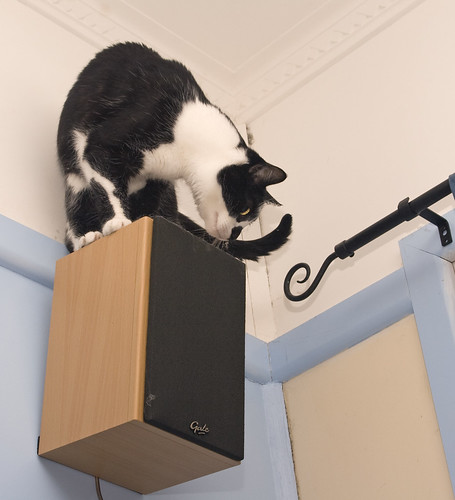
High-altitude cat observation

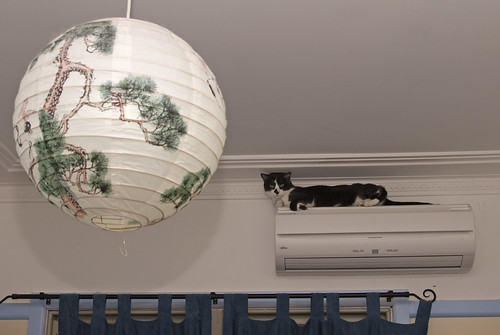
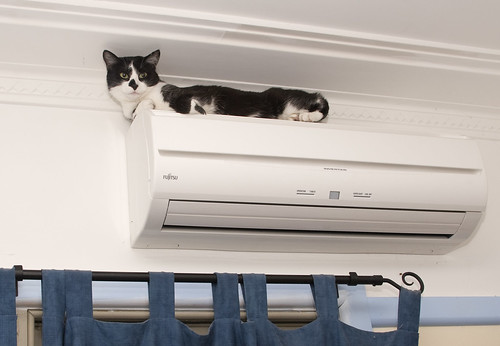
Joey on an air conditioner

Yep, that's a cat on an air conditioner all right.

Joey on an air conditioner

Right up next to the ceiling.

Joey's not just the Amazing Fetching Cat, he's also the Amazing Exploring Cat. A preposition isn't just anything a rabbit can do to a hill; it's anything Joey can do to a cardboard box, curtain rail, wardrobe...

Twice, now, Joey's managed to end up stuck at the bottom of the square vertical well created by two bookcases I've screwed together for stability in a corner. I've stuffed a cushion in the top of the hole now, to reduce the chance that I'll have to shift furniture to rescue a small miaowing thing again.

(It usually seems to take him a few hours to start miaowing. If Joey finds himself stuck somewhere, he usually just goes to sleep for a while.)

[UPDATE: As of September 2009, he's done this three times. He got past the cushion.]

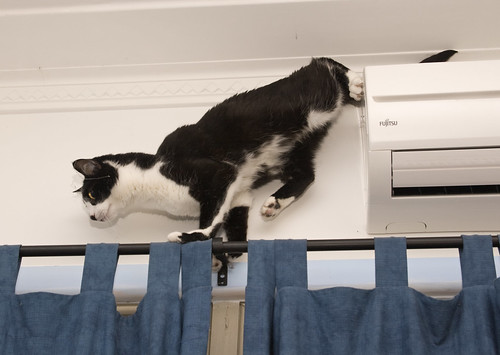
My office air conditioner was a new Joey-perch, though. He'd gotten there from the curtain rail.

Joey at his ease by the ceiling

(I'll say one thing for adventurous cats: They do a great job of removing cobwebs from hard-to-dust places.)

Despite the slipperiness and downward curve of the top of the unit, he seemed quite happy there for a little while. But then he wanted to get back down.

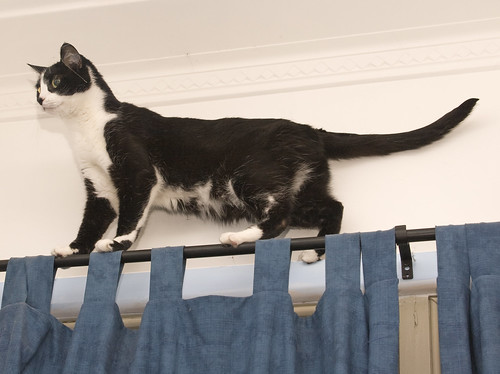
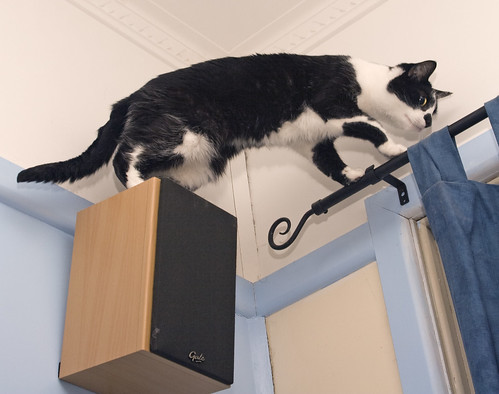
Joey the tightrope walker

So far, so good...

Joey the tightrope walker

"Hang on a minute lads, I've got a great idea!"

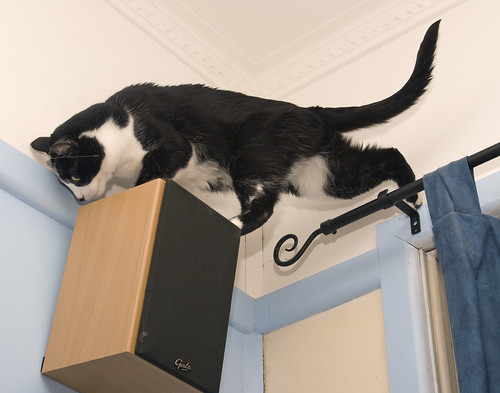
Joey on speaker

This little bookshelf speaker is suspended from an ordinary picture-hook.

Joey on speaker

I'm glad I stuck rubber feet on the back of the speaker to stop it wobbling.

Joey leaves speaker

The speaker turned out to be of limited interest.

I'd been helpfully tapping the top of the printer to alert Joey to its usefulness as a landing pad. He looked, he thought about it... and then he decided to just hurl himself onto my shoulder, for a 100% successful claw-arrestor-hook landing.

You might think that'd be painful, but I'm pretty much numb, these days.

Kha'ak-mongers

TV shows about computer games are, as a very reliable rule, terrible.

So when I read on Rock, Paper, Shotgun that "X-Play's review of X3: Reunion single-handedly validated that show's existence", I had to check out said review.

I wholeheartedly agree that X-Play did not miss this wonderful opportunity to grab the Kha'ak with both hands.

(The people who made that game are German, but the game has voice actors in it, for Pete's sake. So I can't help but think they must have done it deliberately.)

It's not the size of the track, it's what you do with it

One of my readers was delighted to discover this Google ad on this very site:

Girl impressed by big thick masculine track.

I agree with him that it is completely awesome.

(I've linked the above image to the online store of "Radmeister", the people responsible. That's not a paid link, of course; you can click on it without costing Radmeister any money. If you happen to see the same image to the right of this page, then that'll be a real ad. Do tell me if something even better crops up.)

The ad was, no doubt, attracted by my recent series of posts about Lego tracks.

You wouldn't think the nice lady in the bikini would find Lego tracks very impressive. But quantity has a quality all its own, and after the last post I was as good as my word and did indeed buy yards of new-style tracks on BrickLink. The only reason why you haven't yet seen a picture of them lying there like Worf's spare baldric collection is that the BrickLink dealer accidentally sent me a mere 400 links instead of the 480 I paid for.

When the rest of them show up - giving a total length of 5.76 metres, versus the lousy 4.8 I've got now - I shall make them into a fly-curtain or something while I design a vehicle worthy of them.

Even better than a banana in the tailpipe

Because my readers know I'm completely fed up with fuel-saving gadgets and potions, and want me to suffer, several of them have e-mailed me today to alert me to this Gizmodo piece about "Blade Exhaust Filters".

The Sabertec Blade is a doodad that you bolt onto the end of your car's exhaust pipe to "reduce emissions of CO2 and toxic particulate material, and it improves fuel economy to save you hundreds of dollars per year on gas"!

It is alleged to achieve this feat by doing something to the series of pressure pulses coming out through the exhaust system, thereby:

1: Increasing the efficiency of the catalytic converter. For the few minutes after you start the car, by restricting exhaust flow and thus letting the catalyst heat up faster. Whoopee.

2: "Increasing the Volumetric Efficiency (VE) of the engine"; allegedly allowing the engine to more easily get fresh air into its cylinders. The explanation given for this once again has to do with the pressure pulses of the exhaust; apparently the Blade is meant to act sort of like a tuned pipe for a two-stroke engine. It strikes me as rather implausible that a device attached to the end of the exhaust pipe shared by all of the cylinders can significantly (positively...) affect the breathing of each cylinder in turn.

The Blade is also claimed to be a filter that "physically captures gasoline and hydrocarbon particulates, as well as other solid inorganic emissions".

Pretty much zero "gasoline" should be making it past the catalyst anyway, which is just as well, because I can't imagine that a filter for volatile hydrocarbons would do anything other than stop a pulse of unburned fuel (when, for instance, you've just started a beat-up old engine) from all escaping at once. It'd just absorb it like a sponge and then let it slowly escape over time. Net gain, zero.

As far as filtering for particulate matter goes, "soot filters" for large diesel engines are quite common, but - as you'd expect - get clogged pretty quickly if they're not able to burn the soot off somehow (giving slightly higher CO2 emissions, but lower particulate emissions). The Blade has a replaceable filter cartridge - a new and a used one are shown in the pictures on this page. Apparently you're meant to replace the filter every seven to ten thousand miles; replacement filters cost $US19.99, while the Blade device itself costs $US199.

The Blade filter is, however, somehow supposed to decrease CO2 emissions as well, by "up to 12%". This strikes me as a very peculiar claim. What's it doing with the CO2? Cracking it to carbon that stays in the filter and oxygen that's released?

Let's assume, for the sake of argument, that this near-magical feat is in fact what it's doing. Doing this with nothing but exhaust heat to work with would, I think, be a Nobel-prize-winning achievement, but never mind. How much carbon would the thing actually have to catch, even if you replaced it every 7000 miles on the dot?

Well, the carbon dioxide molecule contains two oxygen atoms (atomic weight 16) and one carbon (atomic weight 12). So by weight, it's about 27.3% carbon.

7000 miles of driving is 11265 kilometres. If you're driving a car which emits a mere 100 grams of CO2 per kilometre, it'll emit a total mass of 1126.5 kilograms of CO2 over that period. The total mass of the carbon atoms in that much CO2 is 307.2 kilograms. Let's say that in this case the Blade's "up to 12%" CO2 catching turns out to mean "6%". 6% of 307.2 kilograms is 18.4 kilograms.

So if there isn't eighteen kilograms of soot in the filter when you replace it, you haven't caught six per cent of the carbon.

Note that carbon also isn't very dense. Even diamond only weighs about 3.5 grams per cubic centimetre. So even if the magic filter turned the magically extracted carbon into diamonds, you'd still end up with 5267 cubic centimetres, 312 cubic inches, of them clogging up the filter in the above situation. Graphite is only about 2.2 grams per cubic centimetre; that'd be 8379cc, 511 cubic inches, 2.2 US gallons, all somehow having to fit in the filter.

You could deal with the gallons of carbon clog by just burning off the carbon, but that would of course defeat the purpose of collecting it in the first place. Or you could just blow the soot out the exhaust pipe, but this would increase particulate matter emissions, which the Blade, you'll recall, is meant to reduce.

As far as improved fuel economy goes, it's uncontroversial that you can reduce the fuel consumption of internal combustion engines by restricting the air intake or, less elegantly, the exhaust. Restricting air intake is exactly what you're doing whenever you don't have the throttle wide open.

If you add more restriction one way or another, the airflow to and from the engine will fall for a given throttle setting, and at that throttle setting you will now use less fuel. But you'll also get less power. All you're really doing is saying "from now on, pushing the throttle all the way will do what pushing it four-fifths of the way used to do". You can achieve the same result by simply driving with less gusto, and never using full throttle.

This could be related to the fact that the Blade installation manual quietly says "The BLADE is not recommended for performance cars".

Oh, and what do you get if you search for the address of the one lab that allegedly found the Blade to work wonderfully well, in the single test of the device that's apparently ever been published?

Well, as I write this, you get the Web sites of people selling a crankcase ventilation doodad, the Fitch Fuel Catalyst, some concoction that's meant to give you a "more efficient and complete fuel burn" (when fuel is already almost 100% burned in modern engines...), and one of those electrolytic-hydrogen "combustion enhancers". I hope this lab will soon tell us all what it is that they do to get all of these devices to work so well, since they seem much less impressive when most people test them.

(Oh, and the Gizmodo piece says "Blade does have support from both the California Air Resources Board and the EPA". This is not true. What Blade actually say is that the laboratory that did the tests is "accepted by" the EPA and licensed by the CARB. This may indeed be the case, but it doesn't mean the government's checking their work, or has ever even seen the Blade test results. Treehugger made the same mistake when they wrote about the Blade and interviewed the CEO. Commenters there, and a couple of months earlier at AutoblogGreen, were unimpressed.)

As usual, if the Blade works as advertised it'd be worth hundreds of millions of dollars a year. But instead of getting it properly tested by a variety of labs and then licensing it for gigabucks to car manufacturers, major fleet operators, huge industrial concerns and so on, Sabertec instead sell it directly to motorists. Just like the Fitch Fuel Catalyst, fuel-combustion-improvers, hydrogen generators, and the Firepower pill.

If you believe those things work, then the Blade will be another fine belief to add to your portfolio. Use all of this stuff on your car at once and I bet it'll start creating petrol while you drive.

Posted in Cars, Scams. 9 Comments »

He has trouble in sand traps

This little guy's hilarious.

(Yet another Crabfu creation, of course.)

Death of RAID predicted, film at 11

From a reader:

Love to hear your take on this: Why RAID 5 stops working in 2009.

That article by Robin Harris is more than a year old, but was suddenly linked hither and yon in the last few days. Its thesis is that because RAID array capacities are approaching unrecoverable read error rates, if one disk in your RAID fails, you'll very probably get a read error from one of the other disks in the course of rebuilding the array, and lose data.

This basic claim is true, but there are three reasons why this problem is not as scary as it sounds.

1: Losing one bit shouldn't lose you more than one file. Consumer RAID controllers may have a fit over small errors, but losing one file because a drive failed is seldom actually a serious problem.

2: Putting your valuable data on a RAID array and not backing it up is a bad idea even if disk errors never happen. One day, you are guaranteed to confidently instruct your computer to delete something that you actually want, and RAID won't protect you from that, or from housefires, theft of the drives, and so on. You still need proper backups.

3: If you're going to build a story on statistics, it helps a lot if you get the statistics right.

Robin Harris says it is "almost certain" that 12 terabytes of disk drives with a one-in-12Tb read error rate will have an error if you read the whole capacity.

This statement is wrong.

Actually, the probability of one or more errors, in this situation, is only 63.2%. When you know why this is, you discover that there's less to fear here than you'd think.

(Robin Harris is not the only sinner, here. This guy makes exactly the same mistake. This guy, on the other hand, says one error in ten to the fourteen reads gives you "a 56% chance" of an error in seven terabytes read; he's actually done the maths correctly.)

The mistake people make over and over again when figuring out stuff like this is saying that that if you've got (say) a one in a million chance of event Y occurring every time you take action X, and you do X a million times, the probability that Y will have happened is 1.

It isn't.

(If it were, then if you did X a million and one times, the probability that Y will have occured would now be slightly more than one. This is unacceptably weird, even by mathematicians' standards.)

What you do to figure out the real probabilities in this sort of situation is look at the probability that Y will never happen over your million trials.

(If it matters to you if Y happens more than once, then things get more complex. But usually the outcomes you're interested in are "Y does not happen at all" and "Y happens one or more times". That is the case here, and in many other "chance of failure" sorts of situations.)

To make this easier to understand, let's look at a version of the problem using numbers that you can figure out on a piece of paper, without having to do anything a million times.

Let's say that you're throwing an ordinary (fair!) six-sided die, and you don't want to get a one. The chance of getting a one is, of course, one in six, and let's say you're throwing the die six times.

For each throw, the probability of something other than one coming up is five in six. So the probability of something other than one coming up for all six throws is:

5/6 times 5/6 times 5/6 times 5/6 times 5/6 times 5/6.

This can more easily be written as five-sixths to the power of six, or (5/6)^6, and it's equal to (5^6)/(6^6), or 15625/46656. That's about 0.335, where 1 is certainty, and 0 is impossibility.

So six trials, in each of which an undesirable outcome has a one in six chance of happening, certainly do not make the undesirable outcome certain. You actually have about a one-third chance that the undesirable outcome will not happen at all.

It's easy to adjust this for different probabilities and different numbers of trials. If you intend to throw the dice 15 times instead of six, you calculate (5/6)^15, which gives you about a 0.065 chance that you'll get away with no ones. And if you decide to toss a coin ten times, and want to know how likely it is that it'll never come up tails, then the calculation will be (1/2)^10, a miserable 0.00098.

In the one-in-a-million, one-million-times version, you figure out (1 - 1/1000000)^1000000, which is about 0.368. So there's a 36.8% chance that the one-in-a-million event will never happen in one million trials, and a 63.2% chance that the event will happen one or more times.

OK, on to the disk-drive example.

Let's say that the chance of an unrecoverable read failure is indeed one in ten to the 14 - 1/100,000,000,000,000. I'll express this big number, and the other big numbers to come, in the conventional computer-y form of scientific notation that doesn't require little superscript numbers. One times ten to the power of 14, a one with 14 zeroes after it, is thus written "1E+14".

The chance of no error occurring on any given read, given this error probability, is 1 - 1/(1E+14), which is 0.99999999999999. Very close to one, but not quite there.

(Note that if you start figuring this stuff out for yourself in a spreadsheet or something, really long numbers may cause you to start hitting precision problems, where the computer runs out of digits to express a number like 0.99999999999999999999999999999999999999 correctly, rounds it off to one, and breaks your calculation. Fortunately, the mere fourteen-digit numbers we're working with here are well within normal computer precision.)

OK, now let's say we're reading the whole of a drive which just happens to have a capacity of exactly 1E+14 bits, at this error rate of one error in every 10^14 reads. So the chance of zero errors is:

(1 - 1/(1E+14))^1E+14

This equals about 0.368. Or, if you prefer, a 63.2% chance of one or more errors.

Note that the basic statement about the probability of an error remains true - overall, a drive with an Unrecoverable Read Error Rate of one in ten to the fourteen will indeed have such an error once in every ten to the fourteen reads. But that doesn't guarantee such an error in any particular ten to the fourteen reads, any more than the fact that a coin comes up evenly heads or tails guarantees that you'll get one of each if you throw it twice.

Now, a RAID that's 63.2% likely to have an error if one of its drives fails is still not a good thing. But there's a big difference between 63.2% and "almost certain".

(Note also that we're talking about a lot of data, here. At fifty megabytes per second, ten to the fourteen bits will take about 2.8 days to read.)

Getting the statistics right makes the numbers look proportionally better if the error rate can be reduced.

If drive manufacturers manage to reduce the error rate by a factor of ten, for instance, so now it's one in every ten to the fifteen reads instead of every 1E+14, the chance that you'll get no such errors in a given ten to the fourteen reads improves to about 90.5%.

If they reduce the error rate all the way to one in ten to the sixteen, then ten to the fourteen reads are 98.9% likely to all be fine.

I'm not saying it's necessarily easy to make such an improvement in the read error rate, especially in the marketing-bulldust-soaked hard-drive industry.

But neither is the situation as dire as the "almost certain" article says.

All who commit such crimes against mathematical literacy are hereby sentenced to read John Allen Paulos' classic Innumeracy.

(This is not a very severe sentence, since the book is actually rather entertaining.)
John Lennon's alien ice cube

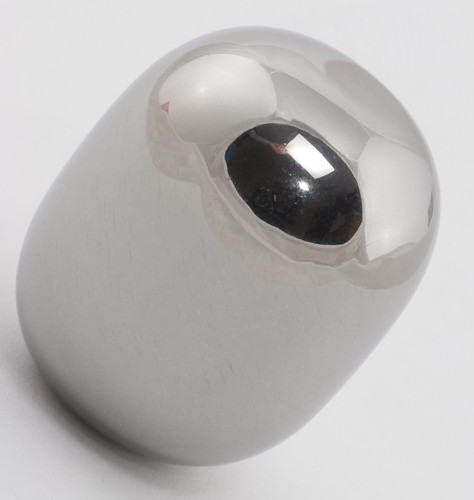
On the subject of objects that look like alien technology, I've got a Piet Hein "Super Egg" drink cooler, too.

Piet Hein drink cooler

I got it at a decent discount when ThinkGeek were clearing their stock; they don't have them any more, but the cooler and umpteen other "superellipse"-shaped products have been on sale from various overpriced homewares places for decades.

The superellipse is like a hybrid between synthetic-rectangular and natural-circular, as explained in this Scientific American article, which was written by the inimitable Martin Gardner more than forty years ago (I just re-read Fads and Fallacies the other day).

And Mr Hein had a real bee in his bonnet about superellipses. He designed superellipse-shaped salt-shakers, bowl sets, candlesticks, plates... you name it.

(Sorry about the stupid window-within-a-window thing in the piethein.com links, by the way; that's just the way that site works.)

Piet Hein drink cooler

Despite all the folderol in the Super Egg drink cooler's rather tongue-in-cheek instruction sheet, as far as I can see it does not actually seem to be very good at cooling drinks. The enthalpy of fusion of water ice is hard to beat; a little stainless-steel egg with a mysterious liquid inside just can't achieve much, unless you chill it so far that it'll crust itself up with ice after you put it in your glass.

But it's nonetheless a neat little object, being both geometrically interesting and mysterious-sounding, on account of the liquid that sloshes around inside when you shake it. And it does indeed neither dilute your drink, nor change its flavour in any other way.

(Many sites say the liquid inside the cooler is meant to freeze, but I don't think that's likely to happen at home-freezer temperatures. Perhaps that's what you have to do to get the cooler to work properly.)

Uri Geller was, apparently, given a gold Piet Hein cooler by John Lennon, who (Uri says) spun a brilliant tale about how the object was given to him by bug-faced aliens.

I suppose it's possible that Lennon had a weird hallucination (in this case, possibly even without chemical assistance...), then found the drink cooler lying around.

I prefer, however, to think that Lennon knew exactly what the mysterious object was, and was just taking the piss out of Uri.