STOP PRESS: Pixie dust unsuitable for household lighting

A reader pointed this page out to me, about the recent Greener Gadgets Design Competition $1000-second-prize-winning Gravia "floor lamp powered by gravity".
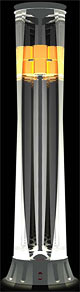
Gravia lamp

It's a funky looking thing, which was widely reported around the gadget blogs, and was alleged by its designer, Clay Moulton, to give the equivalent light output of a 40-watt incandescent bulb for four hours from the energy of a weight dropping about four feet, or 122cm. When the weight gets to the bottom, you just lift it back to the top and away you go again.

Now, it stands to reason that a mere 1.2-metre drop isn't going to give you forty actual watts for four hours unless the weight is incredibly heavy. Ignoring losses, it would by definition take forty watts of power over another four hours to lift the weight back up again, which is 160 watt-hours, which is quite a lot. A normal adult human in reasonable shape can manage about 75 watts of output when pedalling away on a bike connected to a generator; it'd take more than two hours of such pedalling to raise that weight back to the top of the Gravia light's tube, if the weight were heavy enough to make a constant 40 watts on the way back down.

So I just assumed the lamp's brightness was greatly overstated, and wasn't even four-watts-of-LEDs-that-are-sort-of-equivalent-to-forty-watts-of-incandescent. But since they'd clearly actually made the thing and it'd won an award, I presumed it did work, if only as a night-light. Fair enough.

But neither Clay Moulton nor anybody else has, actually, built a Gravia.

The damn thing doesn't exist.

And Mr Moulton, who apparently designed the thing as part of his Virginia Tech master's thesis, didn't even bother to check whether his design could possibly bloody work at all, even if you built it with LEDs from ten years in the future.

Looking at the schematic for the Gravia shows that the falling weight is defined as fifty pounds, which is 22.7 kilos, which is indeed about as much as a variety of humans could reasonably be expected to be able to lift back to the top of the tube every few hours.

22.7 kilograms falling 1.22m in gravity of 9.8 metres per second squared gives you a grand total of 271.4 joules.

That, once again ignoring losses (which are likely to be considerable, seeing as there's a ball-screw and an electrical generator in the Gravia), will by definition run a one-watt lamp for 271.4 seconds, or four and a half minutes.

If you downgrade the lamp to one tiny 0.1-watt LED night-light, you get three-quarters of an hour.

The maximum possible luminous efficacy for any kind of lamp that will ever exist - if every quantum of energy going into the thing is used to make visible photons that come out - is 683 lumens per watt. And that's for a lamp that emits monochromatic 555-nanometre green light, not white (the world record for white LEDs in the lab so far is less than 150lm/W), but never mind that for now.

So if your tenth-watt lamp is just such a perfect device that can never actually exist, it will emit 68.3 lumens of light.

There's no standard lumen rating for an incandescent 40-watt bulb - generally speaking, the ones that last longer have lower output - but something like 400 lumens is in the ballpark. Actually, the Gravia has been alleged to output 600 to 800 lumens, but even if you only shoot for 400, 68.3 lumens is 17% of the target.

So instead of the output of a 40-watt incandescent bulb for four hours, we've got the output of a 6.8-watt incandescent bulb for 45 minutes. And that's with a perfect lamp and no other losses in the system. With the best white-light lamp that humans will actually ever be able to make and million-dollar hardware for the rest of the thing giving the lowest possible losses, I think you'd actually be talking the output of a two-watt incandescent flashlight bulb for about 30 minutes. At best.

Looking at it from another angle, 271.4 joules is 271.4 watt-seconds, 683 lumens per watt is the physical limit, so by definition 271.4 joules of energy can only produce 185,366.2 lumen-seconds of light. Four hours is 14,400 seconds; 400 lumens for four hours is 5,760,000 lumen-seconds. So 271.4 joules into a perfect lamp can only possibly ever give you 3.2% of the required light. Or 1.6%, if you take the 800-lumen ceiling figure for the Gravia's output.

These facts have not evaded other observers, and have now also been communicated to the Gravia's designer. That pesn.com page now features, in the comments, about a minute worth of these back-of-an-envelope calculations that anybody with a basic physics textbook could have done, and it also now features an apology from the designer of the Gravia, who now concedes that the thing could not actually be made and that he did not deserve, and will be returning, the prize.

Actually, I reckon he did deserve the prize, since the Greener Gadgets people are clearly a bunch of idiots (see also: The New Inventors) and their prize is therefore worthless.

I hereby propose magical light paint, which glows harmlessly at 200 lux for 500 years (power source: A D battery filled with the blood of saints) and costs a buck a gallon. Tah-daaah! I just won first prize in the next Greener Gadgets Design Competition! Drop me a line, guys, and I'll tell you where to send the money!

The original press release about the Gravia on the Virginia Tech site now also contains a disclaimer from Moulton, though without any mention of him giving back the prize. I think it's worth mentioning one line he uses on both pages, though: "I was told it was not possible given current LED's, but given the rapid pace of innovation in low powered lighting, it would be a conceptual challenge."

Yes, Mr Moulton, it certainly bloody would be a "conceptual challenge" to make a lamp that produces more than thirty times as much light as the laws of physics say is possible from the energy you put into it. That would be a pretty damn impressive achievement. I propose Virginia Tech not permit you to graduate until you do it. How's that grab you?

The Gravia is very far from alone, of course. There's a veritable plague of these entirely imaginary "concept" devices. The gadget blogs are rotten with 'em. But usually these things have the decency to obviously just be a 3D render of some stupid concept that couldn't possibly work (image-intensifying sunglasses, say...). Sometimes it looks as if at least a mock-up has been created. Only seldom does an impossible device actually win an award for "design innovations for greener electronics".

(I suppose a lamp that doesn't work is, in a manner of speaking, quite "green". It reminds me of that Goodies episode in which string is a "safer and cheaper" subsitute for electrical wiring, "because it doesn't work".)

One bit on the Gravia's design competition page is particularly priceless: "Gravia is also [a] metaphor for an understanding of social activism."

Yes, Clay, it is. If you just sit on your arse and make shit up without paying any attention to the actual nature of the world, you will not succeed in social activism or lamp design.


The chugga-chugga-chugga mobo

MSI Stirling engine motherboard fan

Yes, this MSI motherboard northbridge fan powered by a teeny little Stirling engine is very neat.

I hope it makes it into production, and I also hope it's well enough made that it'll last at least as long as the crappy electric fans you usually get on a northbridge heat sink.

Small Stirling engines like this have very little power, and they need to be manufactured to very fine tolerances if you want them to run on a small-ish temperature differential - like, on top of a CRT or even LCD monitor, or on the heat of your hand for fancier models.

I've got one that runs fine on a cup of tea, but it isn't smooth enough for anything better. You need something like the above engine, with glass cylinders and graphite pistons, to get really low-temperature-differential operation.

A modern motherboard main-chip, though, will easily give enough heat to run a small Stirling fan, and it shouldn't need much wind over a good-sized heat sink like this to keep it at an acceptable temperature (actually, the Stirling fan may pretty much be just tinsel - the normal air flow through the case may be plenty to keep the northbridge cool, with a heat sink that big).

So the goofy MSI rig actually ought to work quite well even with a relatively cheaply-made Stirling engine. And if the engine craps out after a few months, you can always bodge a normal fan in there to replace it.

(Or do so immediately, so you can take the engine out and display it on top of your coffee cup instead.)

The product this little fan most reminds me of is the Heat Wave wood stove fan, which takes advantage of the large temperature differential between the top of a combustion stove and the ambient air to run a robust, long-lived Stirling engine with enough power to circulate air quite effectively, which can considerably improve the room-inhabitant-heating effectiveness of the stove. There are similar, cheaper products based on Peltier elements and boring electric motors, but c'mon, stump up the extra for the piston motor. You know you want to.

Dammit. Now I want a glass-and-graphite low-temperature Stirling engine.

Or maybe one of the Böhm kits.

Or the Gakken version, to add to my collection.

Or their steam car (note, regrettably, that neither this kit nor the Vacuum Engine car actually come with a Wondermark-ish top-hatted figurine to ride them).

(Note that all this does not mean that PC-powered steam engines are just around the corner.)

None of these minifigs are smiling

Abhorrent Lego entity

This is just one of numerous Giger/Matrix/Lovecraft things from Lego's upcoming series, tentatively titled "Mummy, why is sleep now all teeth and bones?"

(Actually the Black Fantasy Contest on the Classic-Space forums.)

Web security through threats of violence

The Daily WTF just ran a story about a company that sells listings in one of those highly questionable "business directories", and has a Web site with hilariously poor security.

(Hint: If you want to "password protect" a Web page, don't put the hard-coded username and password in the source code of the login page. Oh, and don't put the URL of the otherwise wide-open "protected" page in plaintext in the source either, or people - by which I mean, "bright eight-year-olds, or unusually well-trained monkeys" - may just copy and paste that URL to their browser's address bar.)

So far, so unremarkable.

But you need go no further than the Featured Comments below the story to find the start of a good old-fashioned Internet flameout by the owners of the site.

How dare you "hack" our site, this directory is our livelihood and we forbid you to say you think it's overpriced, we know where you live you druggie bitches, et cetera.

If you like this sort of thing, then this is the sort of thing you will like.

Thrilling LED bulb replacement action!

LED lamps for standard low-power automotive sockets - things like interior lights, number-plate illuminators and brake lights - are now widely available and dirt cheap.

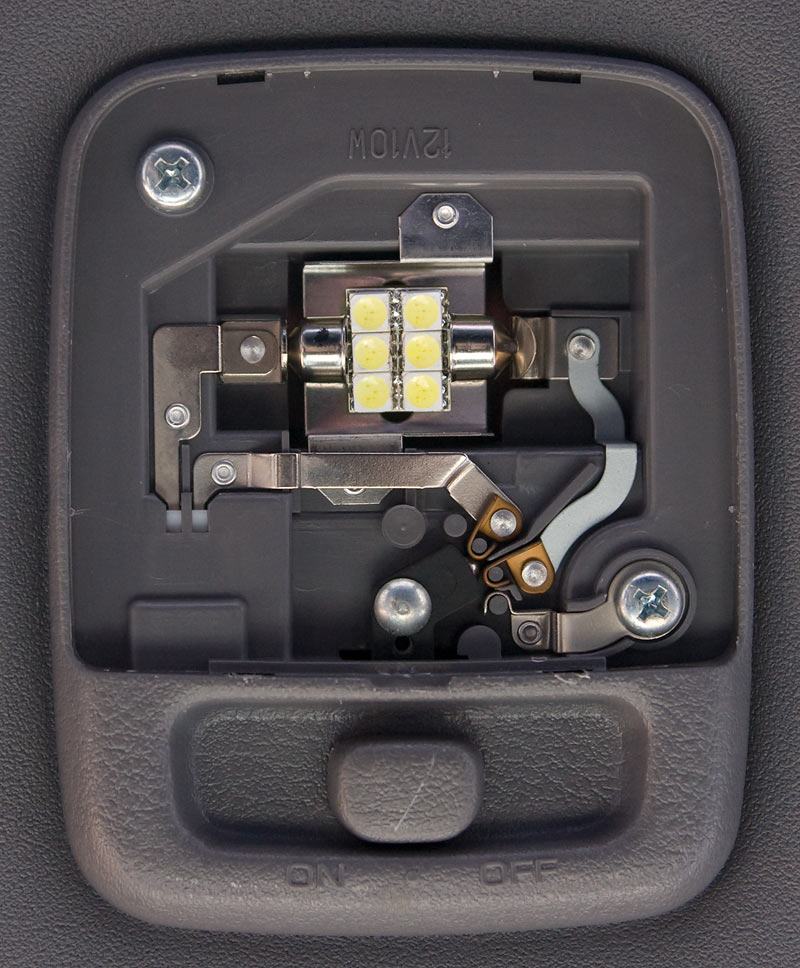
So I bought one, to see if it works any better than the standard interior light in my car.

There was nothing wrong with the standard interior light, but like a lot of low-power automotive bulbs, it's offensively inefficient.

The bulbs used in cars for things like interior lighting and instrument panel illumination have as their two chief design goals cheapness and durability. Both of these goals push manufacturers towards very low-efficiency devices. And the standard "dome" light in the middle of the ceiling of most cars generally doesn't even have much of a reflector behind its bulb, so something approaching half of the light just goes into warming up the light fitting.

So the dome light in my car looked like a fine candidate for LED improvement to me. Particularly now that one lamp will only cost you $AU8.98 delivered from Hong Kong.

(I got mine from this eBay seller.)

My car's interior light uses the small 31mm size of "festoon" bulb, the kind that look like a glass fuse but with points on the metal caps on each end.

The 31mm form factor doesn't give a lot of room for modern super-LEDs. You can now get 31mm lamps with a single allegedly-one-watt white LED in them...

LED bulb

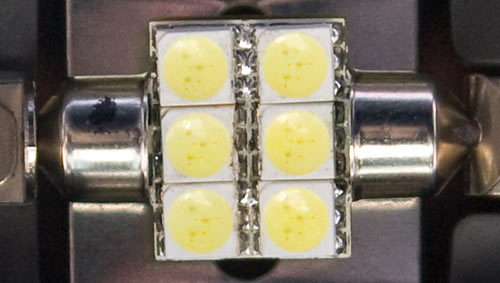
...or you can go for the type I got, with no fewer than six surface-mount sub-1-watt super-LEDs.

There are also replacement bulbs that use a cluster of standard 5mm LEDs. They may be OK for things like instrument panel lighting, but you shouldn't expect as much light as you'll get from a single 1W LED unless there are at least a dozen 5mm LEDs in there. Even then, it's doubtful.

LED bulb detail

If you don't see a lot of yellow phosphor looking back at you, you're probably not looking at a very bright lamp.

I gave the new bulb a whirl on my bench power supply to see how much power it consumed. Then I tried the same thing with the (rather old) stock bulb.

The LED lamp drew only about 55 milliamps (mA) at twelve volts, for a power rating of only about 0.66 watts. Raising the supply voltage to 13.8V - which is what you'll get when the car's running and the alternator's turning - raised the current draw to about 105mA, for 1.45 watts.

The stock bulb has a nominal ten watt rating. From 12V it drew around 0.725A - that's 8.7W. From 13.8V it drew only a little more, about 0.785A (this is because the resistance of light bulb filaments rises with their temperature), giving 10.83 watts.

I expected the LED lamp to deliver much more light per watt than the incandescent bulb, and it also gets a big effectiveness boost from only throwing light out one side, wasting none of it by shooting it uselessly into the dome light fitting. But this was still a pretty huge power difference. At 13.8V, the old bulb draws 7.5 times as much power as the LED lamp; at 12V it draws more than thirteen times as much.

It was pretty easy to install the new lamp, although it did turn out to be a bit longer than it was supposed to be, making it a bit of a tight fit and also making it impossible to install it perfectly level. It ended up tilted a bit toward the left seat, though not enough to make a huge difference to the illumination on the two sides.

To cancel out any side bias, I tested the brightness of the two lamps with my somewhat accurate light meter sitting at the base of the gearshift (and with the standard plastic diffuser in place, too).

The light meter is calibrated in lux, a unit that's weighted to match human brightness perception. This gives the LED lamp another advantage, because the long-life low-temperature incandescent bulb gives very yellow light, while the LED lamp gives the characteristic blue-white of "white" LEDs. The blue-white has more energy around the green frequencies where human vision works best, so a given raw energy level of yellow-white light will appear dimmer, and read lower on a luxmeter, than the same energy level of blue-white.

Anyway, the stock bulb gave a reading of about six lux with the engine off (12V), and about nine lux with the engine running. Not a bad illumination level, given that it was being measured quite a bit lower than the place where you'd typically be, say, holding a map you were trying to read.

Swapping in the LED lamp gave... exactly the same readings!

My light meter isn't terribly accurate down in the single-digit lux, so I won't swear to you that there wasn't actually a bit of a difference one way or the other. But there clearly isn't a huge difference. And the new lamp, subjectively, lit up the cabin of the car just fine. Despite drawing around a tenth as much power.

This sort of thing can make a big difference in certain circumstances. If, for instance, you have a typical small car battery with about 25 amp-hour capacity before it starts getting very unhappy, a ten-watt interior light will drain it in thirty hours. Swap to a one-watt LED lamp and you'll probably still be able to start the car even if you leave the light on for ten days.

This doesn't matter much for normal automotive interior lighting, but if you've got a caravan or motor home or something that has a lot of friendly yellow incandescent bulbs in it, it could be a very good idea to swap them for the new cheap LEDs.

Test Your Gullibility, installment #4731!

I hope you don't need me to tell you whether there's any reason to buy those Kinoki, and various other, "detoxification" patches which you're supposed to stick to your feet.

Yes, they go all black and stinky if you stick 'em on your feet for a few hours; that's supposed to be evidence that they've sucked heavy metals, carcinogens, parasites, body thetans and poltergeists out of the soles of your feet, by some means unknown to science that apparently has something to do with "bamboo vinegar". Or tourmaline. Or fairies.

Fortunately for the continued survival of every human on the planet, skin is not a semi-permeable membrane. So the stuff the patches are supposed to be extracting cannot pass through the skin at all, unless you'd be sweating it out anyway. And why any of that stuff would be attracted to a vinegary pad is also left unexplained.

(Oh, and then there's the fact that the substances allegedly being extracted are probably not present in your body in quantities sufficient to turn anything black in the first place. The alternative-medicine kind of "detoxification" is, in brief, a big fat scam.)

Similar pads turn brown if you just pour some tap water on them, because they contain a powder that goes nasty when it gets wet. They're like those "ionic foot bath" things (which have even more hilarious advertisements!), that go just as brown and yucky even if you don't bother to put your feet in them.

All of this means I wouldn't even bother to mention the darn foot patches, were it not for a post I just read on the excellent Hanzi Smatter.

As anybody familiar with that blog will know, there's only one way to get mentioned there.

And yes, it turns out that the kanji the Kinoki company have chosen to put above their company name doesn't really mean much.

"Wood tree sap", if anything.

In no language do those kanji sound like "ki-no-ki", and they are also not the name of some ancient Japanese herbal concoction.

The "wood tree sap" interpretation makes some sense, since the modern "detox" pads are apparently just the descendants of humble de-odorising pads which also contain "bamboo vinegar". Bamboo vinegar is not actually tree sap; it's an acidic liquid which is a byproduct of bamboo charcoal production. Like normal vinegar, it's got acetic acid in it (so I'd hazard a guess that any significant amount of it on your feet wouldn't actually smell that great), but it's the product of pyrolysis of bamboo, not fermentation.

(If you dry-distil wood in the same way, you get "wood vinegar", a very similar substance which was once a commercial source of acetic acid. To my knowledge, no carpetbagger has gotten around to saying wood vinegar is good for what ails you as well - but I'm sure it's only a matter of time. Pyrolisis of wood will also yield methanol; chug enough of that and all of your problems will be over!)

Bamboo vinegar works - or, at least, can in theory work - as a deodorant because it's about as acidic as normal vinegar, and most bacteria can't cope with that low a pH. Hence the effectiveness of vinegar pickling. But bamboo vinegar is not the "juice" or "sap" of the bamboo in any normal sense, any more than coal tar is the "sap" of coal. And nobody's demonstrated that it has any particular medical utility.

That doesn't stop the foot-pad people from implying there's some sort of mystic Eastern wisdom involved in their magical detox stickers, though.

It is... the FORBIDDEN link!

Australia is not alone in having some pretty hilarious copyright laws. But the Australian Copyright Council site presents some quaint little variations on the common themes which have just given me considerable entertainment.

The ACC's a non-profit company, largely government funded, whose purpose it is to provide Aussies with advice about our somewhat dotty local copyright laws. Their information sheet on "home taping" (the Australian government hasn't quite noticed hard disk video recorders yet) is about as straightforward as I reckon it could be (PDF here). It makes clear that the ACC's as bewildered by the current legislation's weirdness as all the rest of us. Fair enough.

But that weirdness seems to be leaking out, into the ACC's own brains.

I can't really say I'm surprised. Get this, for instance:

Here in Australia, it is currently legal to make exactly one backup copy of software which you have purchased, as long as there's no copy protection on that software, because Australia now has DMCA-ish anti-circumvention laws.

So far, so (relatively) sane.

But you're not allowed to back up anything but the actual program files.

To quote the Australian Copyright Council Information Sheet on that subject (PDF here), "you would be entitled to make a backup copy of a disk or CD-ROM that only contained computer software, but not a disk or CD-ROM that included other copyright material, such as a computer game, music, text or images" (emphasis mine).

So, apparently, you can copy anything that ends in .exe or .com off your program disc... but nothing else. Not even the readme file.

Which means, going by what they seem to be quite clearly saying, you can't actually make any kind of real backup of something like a game disc, which these days is likely to contain only a few per cent of executable code by volume, the rest being taken up by the all-important graphics and sound data, without which the game will not work.

Actually, it's likely to be impossible to legally back up anything but the installer program on most game discs, since the rest of their content is likely to be a few giant compressed files containing all of the stuff which the installer unpacks and copies to your hard drive. Some will be "software" by the copyright-law definition; most will be "other copyright material", and you probably can't separate them. Not that it'd be worth doing if you could.

Thinking about this sort of thing on a day-to-day basis appears, as I said, to have affected the Australian Copyright Council's grip on reality.

I base this assessment on the fact that they forbid the world to directly link to any of their information sheets, or apparently even to any of their Web pages, unless you ask first.

So, because I'm sad to say I neglected to ask them (what if they said no?!), I was not in fact allowed to do this. Or indeed even link, without asking, to the page that forbids you to link to pages without asking.

People all over the world have been laughing about stupid linking policies since long before the Stupid Linking Policies site was established in 2002, but the darn things just keep popping up. They're legally ridiculous and don't even serve a social function, since anybody can tell in a matter of seconds who's linked to them (well, as long as someone's clicked the link) by just looking at their server logs, or using Google Analytics or any of a zillion other Web stats services. So you don't even need to put a "if you link to me, please send me an e-mail" note on your site, much less angrily FORBID people to link to you unless you've explicitly permitted it.

You're also, by the way, not allowed to print more than one copy of any of the ACC's documents, without asking them for permission.

So if you print a copy and lose it, remember to ask before printing another one!

I suppose this is marginally better than the companies that refuse the world permission, under any circumstances, to link to all but one of the various pages which they carefully and deliberately made available for the world to see on the Web server they carefully and deliberately connected to the Internet, and didn't even "protect" with a cockamamie page of legalese with an "I agree" tickbox at the bottom.

(It is, of course, also easy to make your Web server refuse deep links. If you don't, then I suggest that you must not actually be terribly serious about FORBIDDING them, no matter how many capital letters you use).

But the Australian Copyright Council are supposed to be staffed by "experienced specialist" intellectual property lawyers. And yet here they are pretending that it's possible to forbid people with whom they have no contractual relationship at all from downloading a file from their Web server without clicking through from the front page.

(And they've been doing it since 2006. Back then they said "Please ask us before linking to this website so that we can tell you about our URL and descriptors policy". That's less rude, but no less dumb.)

If someone's harvesting content from your site and presenting it as their own, or hotlinking your images, or even just framing your whole site within their own (has anybody actually done that since, like, 1998?) then you have grounds for complaint, at the very least.

But "link policies" are like putting a statue in your front yard and then telling passers-by to sign a contract before they look at it.

My advice to people considering a linking policy: Mix it up a little. How about forbidding people from viewing your source code, linking to any page on your site or even mentioning that your site exists?

Awesome!

Wanna buy a porn blocker? Only $3000!

Remember those lame Internet filters which my faithful readers helped the smut-hungry youth of Australia to dismantle, last year?

Well, the whole taxpayer-funded content-control software handout program has now officially been declared (by Australia's new Federal Labor government) to be a miserable failure.

Apart from the fact that the NetAlert packages were quite easy to get around, it turned out that nobody actually very much wanted them.

The Government predicted that 2.5 million households, about 31% of the whole country, would want their free copy of one or another of the packages (which they'd paid for with their taxes already, of course).

As it turns out, they got a grand total of 144,088 CD orders and downloads.

And not all of the people who got the filter software bothered to use it. The ridiculously-named government department responsible says only about 29,000 of the packages were actually installed.

That's 1.2% of the target, for those of you keeping score at home.

The total price of the software filter scheme was 85 million Australian dollars. That's about $US78 million, at current exchange rates.

So this software ended up costing the taxpayer about $AU2930 ($US2685) per installed unit.

A copy of Net Nanny will cost you $US27 from Amazon. That's almost exactly one per cent of the effective price of the "free" software.

All that, to stop red-blooded Aussie kids from seeing boobies and doodles.

But have no fear - the new Federal government is much more sensible! They enthusiastically explain that their own very expensive scheme to implement "mandatory ISP-based filtering to deliver a filtered feed to all homes, schools and public internet points" will work far better. You know, just as it has in the other countries that've implemented secret Internet blacklists which, in effect, accuse lots of random innocent people of being child pornographers.

Never mind that, despite more than $15 million worth of advertising (including a booklet sent to every household in the country), it is now demonstrable that approximately three-fifths of bugger-all Australians have any interest in filtering their own Internet connection.

No, never mind that. We must be protected from filthy filthy porn, whether we want to be or not!

This is all more evidence that, as I've said before, it doesn't matter whether censorware works. Which is good, because it generally doesn't.

The purpose of censorware is not to Protect The Children, but to get some people elected and keep other people employed.