I started writing a whole big thing about a Flexiglow "Series Connect" power supply, but there's not a lot of point to that since I don't think it's possible to buy one new any more.
The 500W Series Connect had been sitting on my to-review pile since late 2005. The nice people at Anyware who sent the PSU to me might have been annoyed about that. But it's now clear to me that they should instead count their blessings that I didn't get around to looking at it until now.
This power supply turns out to have armour on all of its cables that's so thick that the main motherboard power lead feels like a garden hose under full mains water pressure.
If your computer layout happens to match where this PSU's ludicrous cables want to go, it'll work - though you may find it impossible to put the side back on the computer case.
For almost any other computer, it's likely to be physically impossible to plug this PSU in, even if you only need a few of its leads.
I managed to get the main motherboard connector to plug in as long as the PSU itself was six inches in position and ninety degrees in orientation from where it was meant to be. Any attempt to move the PSU closer to its proper mounting location threatened to wrench the motherboard socket right off the board.
I then tried just cutting the useless armour off the leads. I've got a pipe cutter that made short work of the outer rubber layer. Under that, though, there's braided shielding, which of course frays all over the place and stabs your fingers and is difficult to cut without cutting the conductors under it and it's all a horrible schemozzle.
Do PC power leads need braided shielding? Of course they don't. PC components expect to get a bit of RF noise on their DC input. It's possible that some marginal (or heavily overclocked) components will work slightly more reliably with slightly less noisy input, or that some cruddy sound card will be a little less noisy that way, but there's a reason why the ATX12V PSU standard does not require shielding for DC wires.
The standard does, however, prohibit PSUs from sending more than a certain amount of noise down their DC wires, because that noise can easily out-shout - by orders of magnitude - the amount of noise the wires can possibly pick up from the air.
Shielding the wires, in that case, simply ensures that the PSU's own noise remains uncorrupted by noise from elsewhere.
I still needed a PSU to replace a dead one in a home-server box, though, so I made a shortlist of power supplies with enough plugs to support the forest of drives inside the server, then stuck a pin into the list and ordered a Corsair TX750W.
Apparently this PSU actually can deliver 750 watts of power, which is (a) way more than this server will ever need, and (b) quite unusual in the consumer PSU market. "Generic" PSUs usually underperform their stated capacity by a truly shameful margin, and you shouldn't expect even a brand-name "750W" PSU to be able to deliver more than a constant 600W or so. Some do, but many don't, and the bad ones drive the good ones out of the market.
(The TX PSUs are made for Corsair by Channel Well Technology, who make similarly high-spec PSUs for other companies, like Thermaltake.)
This PSU also has far more connectors than the server will need - but it's got enough drive connectors, which is all I really care about. And it wasn't much more expensive than a much less capable PSU. And under-loaded PSUs generally live for a very long time, and are likely to be more efficient. So what the heck.
I'm already glad I bought the Corsair, because it gave me such a laugh when I opened the box.
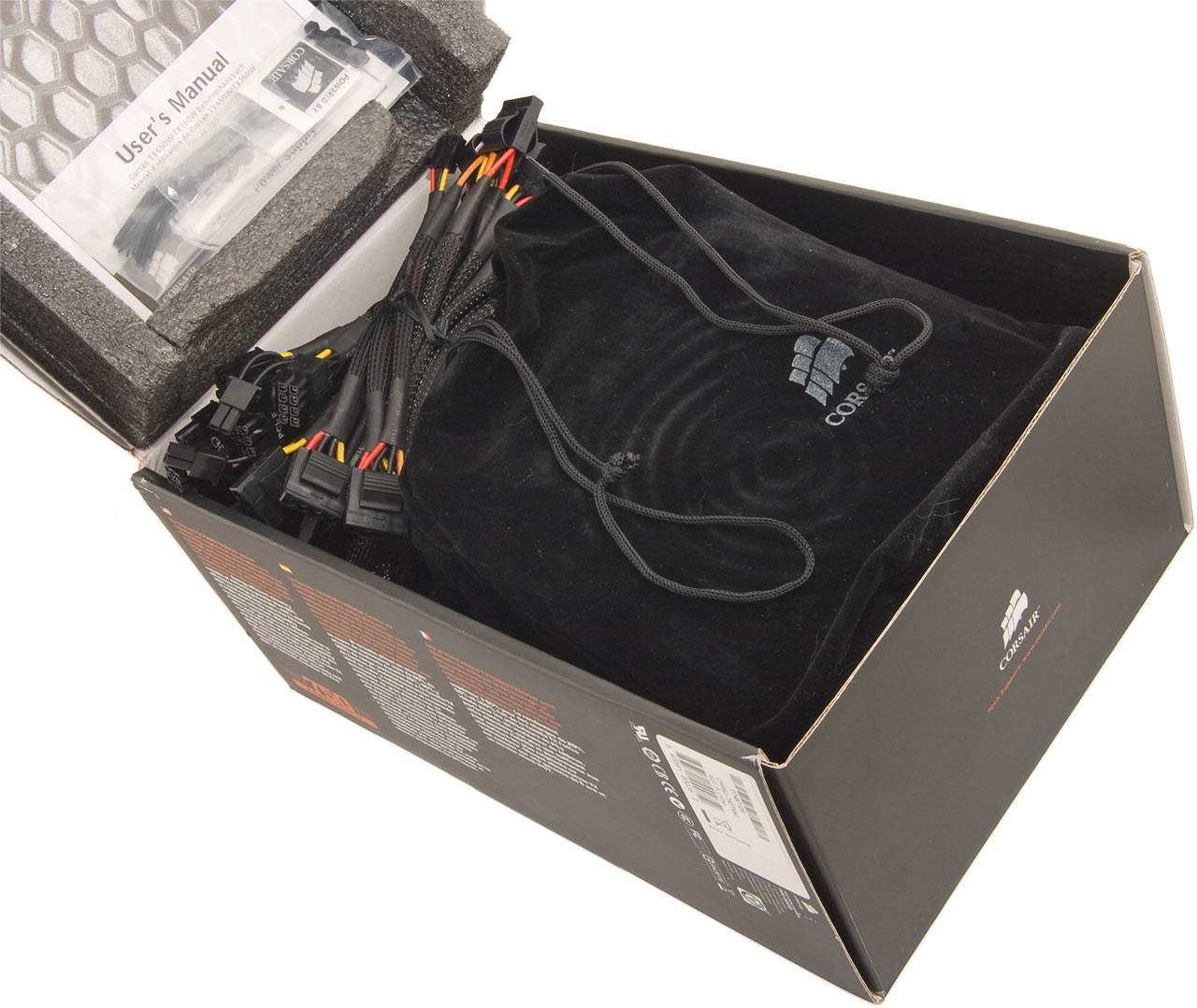
Within the box, and within the foam anti-shock packaging, but outside the final clear-plastic-bag level of packaging, this PSU comes in a fuzzy drawstring bag.
It's a very cheap fuzzy drawstring bag; thin, with fuzzy pseudo-suede on the outside only, and redolent of the various outgassings of the fresh electronic components that've lived within it since the PSU was bagged up at the factory. It's not nearly in the same class as your traditional Crown Royal dice bag.
But it is, nonetheless, within the definition of the term, a fuzzy drawstring bag.
For a computer power supply.
So, like, if you feel the need to unscrew just the PSU from your computer and carry it around with you, you won't have to tuck it uncomfortably under your arm or carry it by the ATX cable like a big square dead rat or something.
No, man. Not you. Not the Corsair TX owner.
You can bag that sucker up, man!
And then, if any punk on the street should allege that your rig be insufficiently pimped, you can say to him "Yo, I gots my P-to-the-S-U right here in a bag, bitch! What you got? Well? You got a motherboard hangin' round yo' neck that I ain't noticed? Huh?"
(And yes, I'm pretty sure there's a factory worker out there who can't believe he's making these things. Previously.)
Here in Australia, you can buy your own TX750W from m'verygoodfriends at Aus PC Market for a mere $AU211.20 including delivery anywhere in the country. And you might as well; it looks to me, and to people who bothered to actually test it, as if it'd be a perfectly good piece of hardware for the money, even if you didn't get a fuzzy drawstring bag into the bargain.
Australian shoppers can click here to order one.

 for a quite reasonable price.)
 a one-shot start to an odd-dice collection!)