To cure alcoholism, drink vodka!

Do you want to tackle your alcohol addiction with safe and effective herbal medicine?

Look no further than Great Home Remedies' How To Prevent Alcohol And Drug Addiction page!

I particularly liked the part that says:

"Very effective remedy: Take 1 lovage root and 2 laurel leaves, add 250 ml of vodka and leave it in a dark place for 14 days. Let an alcoholic drink a whole glass. Usually even 1 time is enough to stop an alcohol addiction, but you may do it 2-3 times."

I suppose it must be the laurel that does the trick there, since lovage is one of the flavouring ingredients in Bénédictine liqueur. Which has not demonstrated a strong tendency to cure people who drink it of wanting to drink. Although if you polish off a whole bottle, you may not very much desire to drink Bénédictine any more.

(I call this situation a "I haven't drunk X since Y" story. Popular Xs include black Sambuca, ouzo, and any pre-mixed cocktail based on Baileys Irish Cream, especially if it's a generic copy thereof. The Y part of everybody's story is usually very similar.)

250 millilitres of 80-proof vodka will, of course, also give you about the same amount of alcohol as a six-pack of beer. In one belt. But any proper alcoholic should be able to handle that, with a water chaser.

(If you leave the vodka in an open container for the 14 days then a significant amount of the alcohol may have evaporated off, of course. But they don't tell you to do that.)

More seriously, one problem with this and various other herbal remedies is that the amount of active ingredients in a given plant can vary widely even within the one species. Different plants can have different concentrations depending on their strain and how and where they grew, and fresh bits of the plant can be very different from dried bits, too.

And, even more importantly, instructions that tell you to use "2 laurel leaves" do not specify which of the thousands of members of Lauraceae family they're talking about. Some members of Lauraceae are not known as laurels - cinnamon and avocado, for instance - which makes it a little easier. But there are several other "laurels" that aren't members of Lauraceae at all.

When you're playing a computer game, you know that when you pick a "nightshade mushroom", or whatever, you've definitely got the right thing, because there are only a dozen species of pickable plant in the whole game, so anything that looks like ginseng or mandrake root must be. In the real world, though, almost no plants have a common name that's not applied to many other quite different plants.

In this case, the "laurel leaves" they're talking about are probably "bay leaves" from the Bay Laurel. But then there's the entirely unrelated California Bay Laurel, whose leaves are poisonous. But maybe where you live, "laurel" means Camphor Laurel (mildly poisonous, but utterly different from Bay Laurel), or Cherry Laurel (berries edible, everything else poisonous).

You'll face the same problem with most other medicinal, and even simple food, plants. Something that looks like fennel, or like a parsnip, or (of course) like an edible mushroom, can kill you. And it even applies to the other ingredient in the anti-alcoholism six-pack cocktail; buy "lovage root" and you'll very probably get the usual kind of lovage, Levisticum officinale, but then there's the related "Alexanders", a.k.a. "Black Lovage", and Laserpitium latifolium, "Bastard Lovage", and even a poisonous lookalike sometimes called "Water Lovage". And that's not even all of the lovages!

Take-home message: Use herbal medicines if you like. Make herbal medicines if you like. But make sure you pin down the full Latin name of your ingredients before you eat them, and don't trust any source that doesn't give you the exact names.

High-altitude cat observation

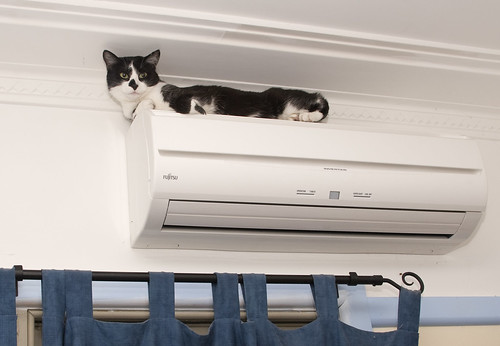
Joey on an air conditioner

Yep, that's a cat on an air conditioner all right.

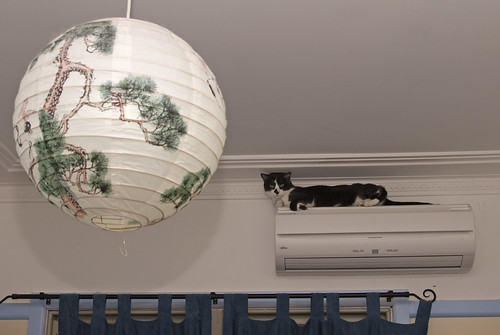
Joey on an air conditioner

Right up next to the ceiling.

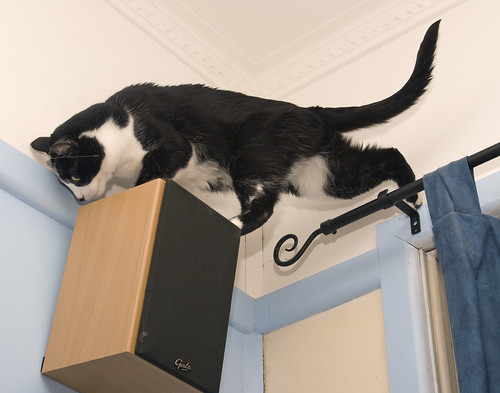
Joey's not just the Amazing Fetching Cat, he's also the Amazing Exploring Cat. A preposition isn't just anything a rabbit can do to a hill; it's anything Joey can do to a cardboard box, curtain rail, wardrobe...

Twice, now, Joey's managed to end up stuck at the bottom of the square vertical well created by two bookcases I've screwed together for stability in a corner. I've stuffed a cushion in the top of the hole now, to reduce the chance that I'll have to shift furniture to rescue a small miaowing thing again.

(It usually seems to take him a few hours to start miaowing. If Joey finds himself stuck somewhere, he usually just goes to sleep for a while.)

[UPDATE: As of September 2009, he's done this three times. He got past the cushion.]

My office air conditioner was a new Joey-perch, though. He'd gotten there from the curtain rail.

Joey at his ease by the ceiling

(I'll say one thing for adventurous cats: They do a great job of removing cobwebs from hard-to-dust places.)

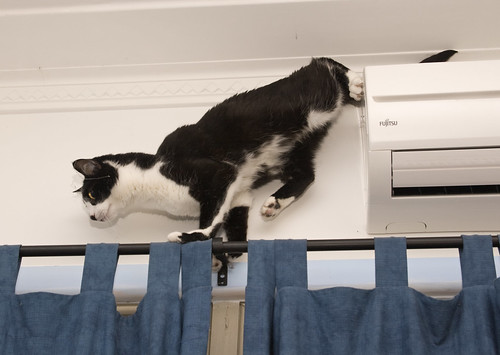
Despite the slipperiness and downward curve of the top of the unit, he seemed quite happy there for a little while. But then he wanted to get back down.

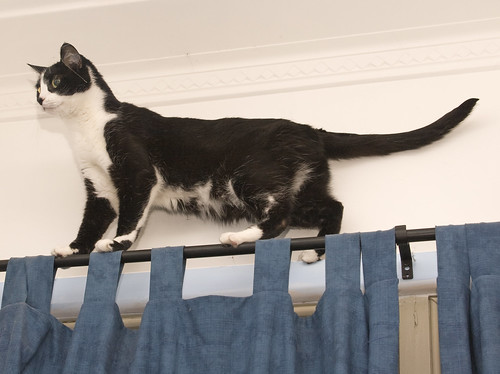
Joey the tightrope walker

So far, so good...

Joey the tightrope walker

"Hang on a minute lads, I've got a great idea!"

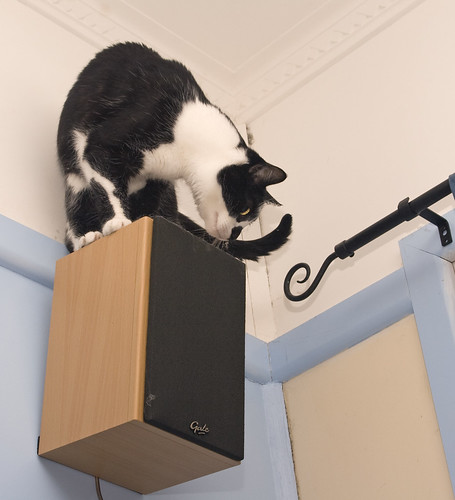
Joey on speaker

This little bookshelf speaker is suspended from an ordinary picture-hook.

Joey on speaker

I'm glad I stuck rubber feet on the back of the speaker to stop it wobbling.

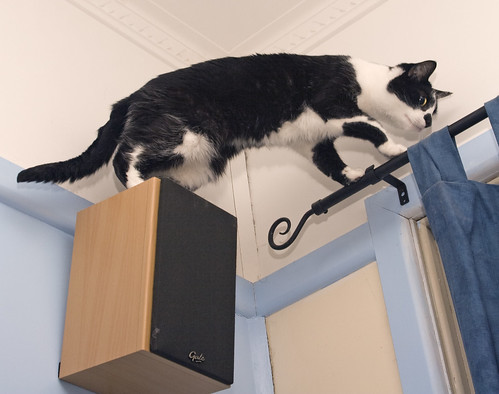
Joey leaves speaker

The speaker turned out to be of limited interest.

I'd been helpfully tapping the top of the printer to alert Joey to its usefulness as a landing pad. He looked, he thought about it... and then he decided to just hurl himself onto my shoulder, for a 100% successful claw-arrestor-hook landing.

You might think that'd be painful, but I'm pretty much numb, these days.

John Lennon's alien ice cube

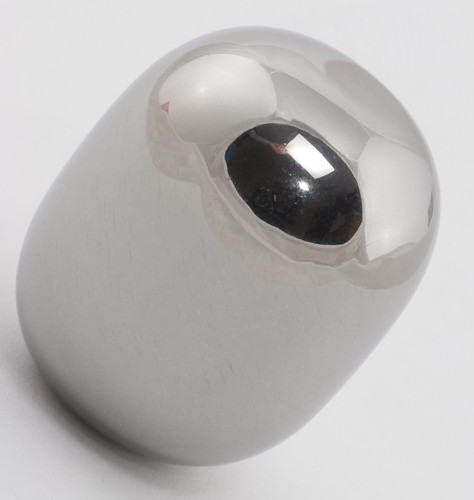
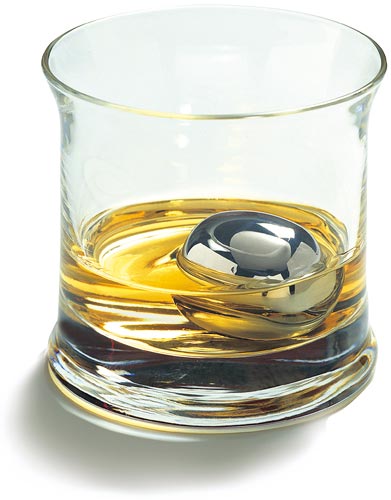
On the subject of objects that look like alien technology, I've got a Piet Hein "Super Egg" drink cooler, too.

Piet Hein drink cooler

I got it at a decent discount when ThinkGeek were clearing their stock; they don't have them any more, but the cooler and umpteen other "superellipse"-shaped products have been on sale from various overpriced homewares places for decades.

The superellipse is like a hybrid between synthetic-rectangular and natural-circular, as explained in this Scientific American article, which was written by the inimitable Martin Gardner more than forty years ago (I just re-read Fads and Fallacies the other day).

And Mr Hein had a real bee in his bonnet about superellipses. He designed superellipse-shaped salt-shakers, bowl sets, candlesticks, plates... you name it.

(Sorry about the stupid window-within-a-window thing in the piethein.com links, by the way; that's just the way that site works.)

Piet Hein drink cooler

Despite all the folderol in the Super Egg drink cooler's rather tongue-in-cheek instruction sheet, as far as I can see it does not actually seem to be very good at cooling drinks. The enthalpy of fusion of water ice is hard to beat; a little stainless-steel egg with a mysterious liquid inside just can't achieve much, unless you chill it so far that it'll crust itself up with ice after you put it in your glass.

But it's nonetheless a neat little object, being both geometrically interesting and mysterious-sounding, on account of the liquid that sloshes around inside when you shake it. And it does indeed neither dilute your drink, nor change its flavour in any other way.

(Many sites say the liquid inside the cooler is meant to freeze, but I don't think that's likely to happen at home-freezer temperatures. Perhaps that's what you have to do to get the cooler to work properly.)

Uri Geller was, apparently, given a gold Piet Hein cooler by John Lennon, who (Uri says) spun a brilliant tale about how the object was given to him by bug-faced aliens.

I suppose it's possible that Lennon had a weird hallucination (in this case, possibly even without chemical assistance...), then found the drink cooler lying around.

I prefer, however, to think that Lennon knew exactly what the mysterious object was, and was just taking the piss out of Uri.

Unnatural act of the day

There are rats under our floor.

I don't care about that, per se. I think it's cute when I put the mouldy end of a bread-loaf in the compost bin and the next day the inside of it's all been eaten out into a cosy little cave-of-food.

(Anne does not think this is cute in any way at all.)

I think rats are cute too, even ordinary brown ones that want to bite you.

(Anne believes I may need to adjust my medication.)

Unfortunately, though, the rats keep weeing conductively on important parts of the heating system, and chewing other important parts of it.

There are four cats in this house.

So a solution suggests itself.

But that would (a) mean, at best, slow death by torture for little fuzzy creatures which I do not want to eat and (b) expose our own precious furry child-substitutes not only to the risk of loss of self-esteem, should they find themselves unable to catch even the doziest rats, but also to the dangers of the outdoors. Never mind being hit by cars; for all we know, there's some toxic something-or-other growing somewhere around the house that killed poor Mickey.

So from now on, no cat of ours goes outdoors unless escorted by at least six Secret Service agents.

But the rats have got to go.

So I purchased no-kill traps (from this guy; the traps are cheap and work fine, but they come flat-packed and must be cable-tied into shape). A bit of peanut butter on bread for bait, and bang, one rat was caught in almost no time.

Into the car (on some newspaper...) the trapped rat went, and he or she and I enjoyed a brief but stimulating drive to Kingsford Smith Memorial Park, from the verges of which the rat has by now almost certainly darted into somebody else's house.

When I got back, re-baited the trap and set it up again, I found a rat in the other trap.

Lather, rinse, repeat.

When I took that second trap back down, the first one was still empty. So I presume we have now caught the two stupidest rats, and will never catch another.

Perhaps we should get a goanna, or something.

Still no sign of enchanted Prince Albert rings

Vendors of "haunted" objects have apparently diversified from merely selling spooky dolls. Now there are about a billion other "haunted" things for sale on eBay.

(Actually, as I write this, there are only about ten thousand hits for non-Halloween "haunted" things in ebay.com's ever-entertaining "Everything Else" category. There's similar nonsense scattered around various other categories, but Everything Else, especially the wall-to-wall-BS "Metaphysical" subcategory, is where the real winners are to be found.)

You name it, someone's selling it. Ordinary glass marbles that've allegedly "captured the energy at the moment of all sunspot explosions that have ever happened on the surface of the sun". Dime-store rings that allegedly come with an "astral plane incubus", guaranteed to "bring you pleasure during dreams". A "Powerful Amulet" enchanted by a "psychic witch" to bring in "MASSIVE AMOUNTS OF MONEY & CASH FAST".

Some of this stuff costs less than ten dollars all told - the money-amulet is fifteen bucks delivered, but just think how fast you'll make it back. And the "HAUNTED MOST POWERFUL ASTRAL TRAVEL ORB IN THE WORLD!" costs thirty bucks delivered. But c'mon, it's "SUPERCHARGED WITH ASTRAL TRAVEL ENERGY!"

It's possible to spend a fair bit more, though.

"HAUNTED 7 DEVATA PENDANT MOST AMAZING ITEM ON EBAY"? Yours for $149.99.

"Haunted Demon Ring and much more! Money, Power, Love"? $160 delivered.

"HAUNTED WICCAN MARID GENIE DJINN MASSIVE BINDING RITUAL"? $369.99.

"DJINN SON OF OSIRIS HAUNTED RING MARID/EFRIT JINN GENIE"? Fifteen hundred bucks.

"Haunted Ghostly Hand Asylum Window Black & White Photo" or "HAUNTED- THE RING OF UMBRA - THE SEAL OF THE SUMMONER"? Each $2500.

(But the photo doesn't apparently do anything, while the Ring of Umbra is just dripping with "ISHAB MalFatah & Muhamad-Dal-Jafi Magic". This will apparently pretty much turn you into Mister Mxyzptlk.)

"FORTUNATE MISS CLEMENTINE HAUNTED AND LUCKY JEWELRY"? Seventeen thousand dollars.

"AUSTRALIAN BLACK OPAL GEMSTONE 14K GOLD PENDANT HAUNTED"?

Twenty-seven thousand, nine hundred and ninety nine dollars. And thirty cents.

Ladies and gentlemen, I give you:

The voting public.

Steady as she goes, toward the cliff

Everybody else gets to sound off about the global financial crisis without actually knowing much about it, so I was pleased when a reader invited me to take my turn:

What's your take on the global financial crisis? You've never indicated you know anything whatsoever about finance, but you're usually "pretty on the ball" about everything else, so I though maybe you'd feel like blogging on this.

Ryan

Indeed I do not know a lot about economics. My knowledge pretty much stops at how tax brackets work, and that copper is not a precious metal. But since readers of this blog know pretty much everything, I presume there will soon be some +5 Insightful comments at the bottom of this page, correcting the ghastly errors I am surely about to make.

(Or maybe there'll just be one guy saying that this is what we get for not listening to Lyndon LaRouche.)

I've no real opinion about what's going to happen to the US and/or global economies in the short term. Fortunately for me, I'm in Australia, which doesn't look like being squashed too hard. Australia has a healthy commodities sector, and major Australian financial institutions don't seem to have much exposure to the US problems. Yet.

In the long term, though, the USA and countries that depend upon it economically - which means just about all of them - are going to have to feel a lot of economic pain.

Both Presidential candidates know this, on account of how they're not idiots (so yes, I do suspect that only one of the vice-presidential candidates knows it too). But they wouldn't say a word about it even if you tortured them, on account of the great American allergy to ever paying more than about half of the tax that people in much nicer countries seem quite happy to pay.

Because the USA is taking on such colossal government debt, for the war(s) and the various bailouts, it seems to me to have only three options.

1: Just keep doing what it's doing, paying interest on the old debt by taking on new debt.
2: Jack up taxes and/or reduce spending so it doesn't have to increase its level of indebtedness, or may actually be able to pay the debt down.
3: Say "screw it", get drunk, and print more money.

The second approach is a sure-fire vote-loser. If it were me then I'd start out by taxing the absolute balls off the owners of any house of worship that seats more than a thousand people, but the USA is a country where 21% of the atheists apparently believe in God, so that probably wouldn't work too well.

The third option is what people often seem to think the USA is doing now - "creating" new money to bail out the financial sector. It's an awe-inspiringly dumb thing to do, though, and even the Bush administration isn't stupid enough to try it. (Robert Mugabe seems just fine with it, though.)

What the USA is actually doing, and what I presume they'll continue to do, is option 1, steady-as-she-goes. As long as people are reasonably confident that the government isn't going to fall on its sword by refusing to pay up when bonds mature, and that inflation isn't going to start running fast enough that a bond with a lousy 4% return will be worth less than you paid for it when it matures, then people will keep buying bonds, and the Treasury can just issue more and more of them and hope there's enough of a market to get 'em all sold. China is as addicted to selling stuff to Americans as Americans are addicted to buying it, so I presume it'll keep that economic perpetual-motion machine rolling, even if inflation does make bonds lose real value over time.

The borrow-more-to-pay-your-loans-off approach is an obvious loser for normal personal finance, but I think whole countries - and businesses, for that matter - can actually make it work, if their increase in national productivity means that their debt is not increasing, proportionally speaking. If you used to owe a million dollars and make 20 million dollars, and now owe two million and make 50 million, then proportionally speaking you've reduced your debt. You should find it easier to service, or pay down, the second debt than the first one.

During the terms of Republican presidents since Reagan, though, the USA has been taking on debt much faster than it's been increasing production, no matter which way you look at it (some people apparently regard this as a good thing).

The exact numbers are squirrelly - like unemployment statistics, they get harder and harder to measure the closer you look - but the cost of the wars and the 2008 bailouts will unquestionably greatly exceed Reagan's Savings and Loan "jackpot".

All of this has just got to shake through into a serious quality-of-life reduction for the average American some time soon. Either jacked-up taxes or a severely devalued currency, I think. The US national debt is overwhelmingly in US dollars, so if the $US drops to five Euro cents, it'll be much easier to dig enough stuff out of the ground to pay off the debt. (But a Toyota Camry will cost half a million dollars.)

There are ways in which the USA could spectacularly reduce governmental spending and thus make the situation far easier to handle, but I strongly doubt the most obvious one - giant military cutbacks, including closing many of the USA's more-than-700 military bases all over the world - has any chance of flying. The USA could cut four 400 billion dollars out of its annual military budget and still be spending twice as much as anyone else, but this sort of thing is so far-out that you won't even find the option to do it in "budget simulators".

Sci-fi writer Charles Stross wrote a very interesting essay about the current situation the other day. I agree with him that the USA's determination to not bend before the economic hurricane means we may see the world situation change far faster than anybody would have predicted only a few years ago.

(This Gawker piece is excellent, too.)

Yes. Yes it does.

I have just, by idly clicking through from the Wigu/Overcompensating guy's pictures of his righteously necrotic brown-recluse-spider bite, discovered that there is a Flickr group called "Does this look infected to you?"

That is all.

One of these things is not like the other

I'm a bit late on this one, but it's so hilarious that I simply must tell you about it, just in case you haven't seen it yourself.

This is, if you ask me, even funnier than the well-documented evolution of that Intelligent Design textbook.

I hadn't actually read Richard Dawkins' blog post about the hilarious stupidity of Turkish creationist Harun Yahya's glossy but rather poorly fact-checked book "Atlas of Creation".

(If Harun hasn't gotten around to sending you one for free yet you may be able to find a seller on Amazon!)

"Harun Yahya" is the pen name of one Adnan Oktar, a leading light in the burgeoning field of Islamic creationism, in which Muslims strive to demonstrate that their newer and more vibrant religion can outdo Christianity in every field, the stupider the better. Islamic creationism has found a de facto home in Turkey, and a de facto leader in Harun/Adnan. He has a Web site.

The problem Dawkins found with Atlas of Creation (instantly, upon opening the book at random) is not the usual distortions, misquotes and plain old lies that are the stock in trade of the jobbing creationist. The problem, rather, comes from the fact that the book contains many comparisons between fossil organisms and modern ones that're supposed to demonstrate that those organisms have not changed at all over millions of years. That is the entire thesis of the book.

That, in itself, would only actually be an argument against evolution if it were hard to find organisms which have changed over the years, which is of course not at all the case. Environments and ecological niches tend to change, applying selective pressure to the species that live there, which then change, or become extinct. Most organisms are not ferns or crocodiles, pretty much as adequate to their task today as they were before the first mammal had drawn breath.

The standard creationist tactic to deal with this awkward situation is to declare anything that looks as if it's changed to actually be two, or three, or as many as are necessary, entirely different species with no relationship at all. Any time you find a "missing link", they can therefore just say that now there are two more gaps that remain tellingly unfilled.

(In related news, it is physically impossible to close a door.)

But never mind that, because Dawkins found that the Atlas of Creation frequently fails to actually compare a fossil creature with a modern version of the same thing at all.

The first such mistake he found, where he first opened the book, was the claim that a fossil eel hadn't changed at all when compared with... a modern sea snake, which is actually a very different species.

There were many more. Sometimes the book fails to even compare a fossil with a living creature in the same subkingdom.

But the very finest comparisons were discovered by entomologist Steve Lew.

The makers of the Atlas of Creation, you see, apparently kept production costs down by just lifting pictures from all over the Internet. The problem with doing this - besides the tedious copyright-infringement stuff - is that you can't reliably tell what organism a picture is of just by looking at it. (Especially if you've got the level of knowledge about biology that's typical among famous creationists.) Go to a proper stock-photo outfit (or, in this case, some biology-photos resource, I suppose) and you're likely to find that when you ask for a picture of a caddis fly, you get a picture of a caddis fly.

If, on the other hand, your image requests are made in a more informal, Google-Imagey sort of way, you may give yourself away just a teeny bit.

As I write this, the third Google Images hit for "caddis fly" is from grahamowengallery.com - specifically, this page. If you go to that page, you shouldn't need even a rudimentary command of the English language to see that Graham Owen makes wonderfully realistic fake insects, using fly-tying techniques. A lot of his work is actually, in theory at least, usable for actual fishing, because it's tied around a hook like any other fly.

This detail escaped the worthies putting together the Atlas of Creation.
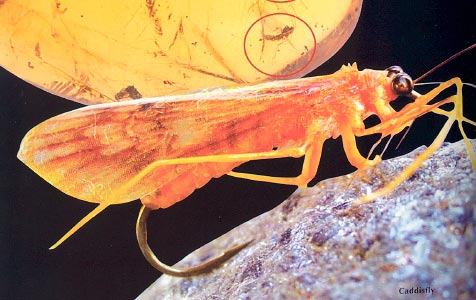
Creationism at its finest

So there it is, bold as brass in the middle of their glossy book: A fly in amber in the background, and a fishing fly with a bloody great hook sticking out of its arse in the foreground. They just Photoshopped out the background of Graham Owen's picture.

They also knocked off Mr Owen's "Red Hardy Spider" image from the same page. The hook's much harder to see there, but the nature of the page the image came from is just as bloody obvious.

(UPDATE: I e-mailed Graham Owen about this, and he told me that he's made a Web page about the image thievery! it turns out that they also knocked off his picture of a mayfly. And Graham confirmed for me that the makers of Atlas of Creation didn't even ask permission to use the pictures, much less pay to license them. Graham's now asked them about it, but they apparently can't take any time off from their busy job of being very pious and respectable followers of God to send him an answer about why they copied his photos without paying.)

Mr Oktar spoiled all the fun by writing a reply to Richard Dawkins, a Turkish newspaper that picked up the story, all the cool kids at school who won't play with him, et cetera, complaining about Dawkins' "terrible ignorance". He argues that "whether or not it is a model makes no difference", since the picture represents something that does actually exist, and then goes on to say "The fact that demolishes evolution is that the creature has remained unchanged for millions of years and that it completely refutes evolution."

Well, if it completely refutes evolution then I suppose it must demolish it as well, not to mention contradict it, destroy it, pulverise it and give it a very stern talking to. But I think I must have missed the part where evolution says that the phenotype of an organism must change over time.

The only reason to think this is the case is if you believe in the frequently-espoused but completely stupid "ladder" kind of evolution, where everything's striving to get "higher" all the time, and will surely achieve this goal. This is preposterous on its face - all these billions of years, and we've still got bacteria - but it's ubiquitous in lousy sci-fi. There, "evolutionary level" is a property that can be freely pushed one way or the other, so a ray gun or a defective time machine or whatever can "de-evolve" people into apes, or "evolve" them into huge-brained psychic ectomorphs or similarly super-intelligent "beings of pure energy".

If you don't get all of your knowledge of evolution from that one God-awful episode of Voyager, though, the fact that Richard Dawkins "never goes into the question of whether or not the caddis fly is still alive today" is not, as Yahya says, a dead giveaway that evolution is completely bogus.

Dawkins is, I think, reasonably sure that people already know that caddis flies still exist, and that ancient ones looked much like modern ones. If there's no great selective pressure on an organism, you shouldn't expect it to change much. If a particular organism was already very well adapted to its environment, and its environment has not greatly changed, then neither does the organism. Stop me if I'm going too fast for you here, creationists.

I think it still matters that they made such lousy image choices, though, because it's an entertaining case in point of the sloppiness of most, if not all, creationist arguments. Comparing fossils with unrelated animals, or fishing flies, is like your candidate making a speech in front of a picture of a military hospital... that turns out to actually be a picture of a similarly-named middle school. It shows that you're just not paying attention, even when you'll look like idiots if you get it wrong.

This doesn't, of course, matter to the creationist target market, who can't be expected to make it through any book that doesn't have pretty pictures (frequently including whatever holy book they claim to so fervently believe).

Adnan Oktar actually does, of course, believe that no species has ever significantly changed over time. (He's also pleased to point out that all terrorists are atheist "Darwinists"! I suppose that'd explain why they hate American soldiers so much.)

It's a little difficult to defend these beliefs logically, so he's taken the popular option in this situation and defended them legally instead. Richard Dawkins' site is, therefore, now unavailable in Turkey (or supposed to be, anyway), along with a variety of other sites that've irritated someone there. (Oktar's lawsuits are currently protecting Turkish Internet users from the whole of WordPress.com and Google Groups; the Turkish government blocks several other sites. At one point, the Turkish block list apparently included, on account of a typographical error, the unused imbd.com domain instead of the Internet Movie Database.)

Oktar's probably a bit too busy to start shooting off more lawsuits at the moment, since he's appealing his recent conviction for "creating an illegal organization for personal gain"; this is the latest instalment of a particularly distasteful story.

(When looking for more info about that, I found this thread on James Randi's forum, where one commenter points out that one of the numerous defective comparisons in the Atlas of Creation is between a fossilised spider crab and a contemporary crab spider. Next stop: A horseshoe crab, and a horseshoe!)

Once Oktar's dealt with his little legal problem, though, I presume he'll issue a flurry of lawsuits demanding that every site that's discussed this tragically hilarious story also be blocked in Turkey.

Sooner or later, Turkish Web browsers will only let you see harunyahya.com and discovery.org.