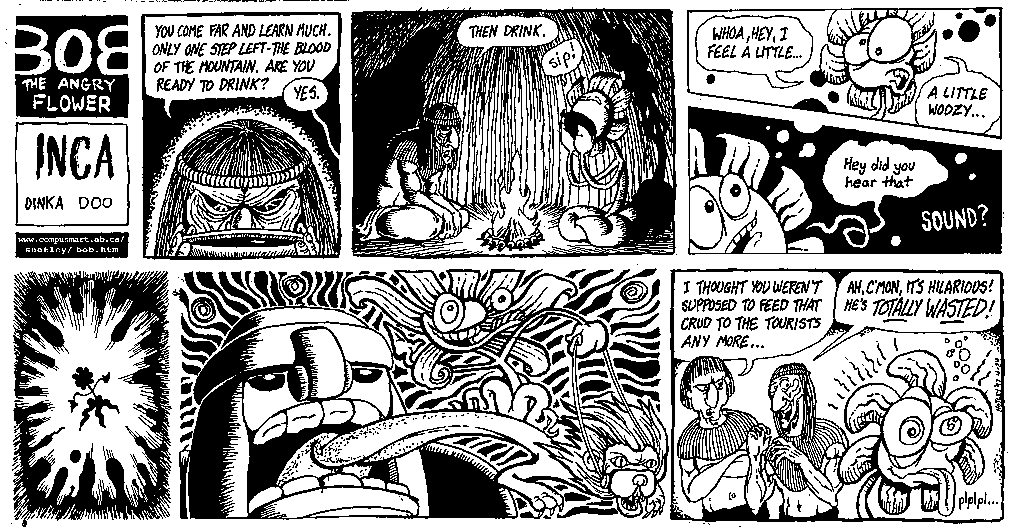
"Wow. Moth balls. So, what's for dinner?" "Plastique."

This MetaFilter post reminded me that just owning a common Casio wrist watch is now being used as evidence of terroristic intent. The post links to this Seattle Post-Intelligencer article, in which a retired FBI agent points out that this "evidence" is every bit as preposterous as you'd think.

That model of watch may be popular for use as a bomb timer, but there are hundreds, if not thousands, of other watches - and non-watch timer devices - that'd work just as well. The Casios show up so often merely because Casios are easy to find, and cheap.

Similarly, most terrorists have eaten bread on several occasions before committing their crimes. So if you find some bread in the kitchen of a guy called Achmed... do I have to draw you a picture, people?

At the end of the article, though, the ex-FBI guy goes on to say "You give me a half-hour in a supermarket and I can blow up your garage."

It's great to point out that bad people cannot be prevented from doing bad things by banning certain commonplace but allegedly magically dangerous items. But I think claims like this don't help. The idea that any kid can find a recipe for an honest-to-goodness building-smashing bomb on teh internets and be blowing up their school tomorrow is a common one, and it fans the fire of unreasoning fear that's screwing the Western world up so badly.

I'm ready to be corrected, but I don't think it is, actually, possible to build a proper bomb out of stuff from the supermarket. No matter how easily Kyle Reese did it in The Terminator.

(Note that the above does not apply if your local "supermarket" is a Wal-Mart that sells guns and ammo.)

I think the closest you could get to a genuine "supermarket bomb" would be fertiliser (if your supermarket actually has some fertiliser product that's reasonably pure ammonium nitrate) and motor oil. But then what're you going to use as an initiator? I don't remember seeing a "Blasting Caps" aisle the last time I was in the supermarket.

The most feasible initiator would probably be the dangerous but widely-used TATP, which you can almost make from supermarket supplies.

The problem with TATP - and HMTD too; HMTD is what the rather implausible "liquid bombers" apparently intended to use as their main explosive - is that you need concentrated hydrogen peroxide to make it. I don't think there's any way to concentrate "drugstore" peroxide - which tops out at about 6% concentration - that's easier than synthesising peroxide (which is hardly a complex molecule, after all) from scratch.

Apparently the unsuccessful London July 21st bombers thought they could concentrate peroxide by just boiling it down, but I think that's hopeless. Hydrogen peroxide will constantly decompose into water and oxygen even at room temperature, after all; the hotter you make it, the faster that happens, leaving you with nothing but water. Perhaps you could concentrate hair-bleaching 6% peroxide a bit by simmering it, but you need to get it up past 50% concentration to make it useful for whiz-bang sorts of applications. That's just not going to happen on the stove.

(The result of the July 21st bombers' incompetent work was, of course, that none of their bombs went off. So much for "supermarket terrorism".)

There are various other teenage-mayhem sorts of possibilities with supermarket ingredients. You could make rather nasty gas - though not any sort of explosion - with ammonia and bleach. Pool chlorine plus anything acidic will give you chlorine gas; that's poisonous too, and if you cork the mixture up tightly the bottle will explode, though not with enough force to damage anything bigger than a badly-built doghouse. And there are umpteen different supermarket flammables with which one could simply burn a garage down.

But I don't think that even if you visited the supermarket and then the hardware store, you'd be able to make anything more deadly than a pipe bomb full of match-heads. Which you wouldn't want to go off under your chair, or anything, but which isn't going to blow away a garage either.

If all you've got to work with is off-the-supermarket-shelf ingredients, I think the most impressive result you can hope for is that achieved by that schmuck who hoped to destroy Glasgow Airport by setting his Jeep on fire.

Some or all of the above has been independently discovered by every 14-year-old boy who's ever downloaded the notoriously incompetent "Jolly Roger's Cookbook". The take-home message for them, and for everybody else, is simple:

Yes, ordinary household products can be dangerous, as has been discovered by many people who mixed ammonia and bleach and then woke up in hospital. Or didn't wake up at all.

But there's no reason to wet yourself in terror if you come home early and find your kid mixing drugstore peroxide and nail-polish remover in the kitchen.

People who intend to commit crimes of violence via a method that can't possibly work - "I'm going to kill the Prime Minister using my powers of mental telepathy!" - should still be investigated, because it's possible that after trying the telepathy thing for a few weeks, they'll just go and buy a rifle.

But worrying about terrorists making bombs out of groceries is foolish.

Explosives are actually difficult to make, and domestic terrorists in the Western world are (a) clearly not very bright and (b) so rare that even if their idiotic schemes worked every time, you'd still be far more likely to die because you fell off something.

Relax.
Firepower: Just a fricking misunderstanding

"You will see: we will eventually be vindicated and our investors will be well rewarded", claims Firepower boss Tim Johnston in an interview with The Australian. He also insists that he hasn't been hiding at all. (He just hasn't been anywhere the people who want him to pay what he owes have been looking. Oh, and not answering the phone, either.)

Johnston insists he's perfectly innocent, all of those never-shown-to-do-anything Firepower "products" work fine, Four Corners' report was a vile calumny, the investors will all get their money back, et cetera.

He also, at one point, is reported to have used the word "fricking".

And now, another link-dump of news stories about Firepower that've come out since my last update, in roughly chronological order, newest first:

Apparently Rose and Willie Porteous, or maybe only Rose, also bought into Firepower, and are as a result now one step closer to the penury which anybody which who cares to read up on them will, I think, agree they deserve.

The Australian High Commissioner in Pakistan is reported to have "acted unwisely" when she bought 200,000 shares in Firepower, but has been judged to have suffered enough, and so kept her job.

And there was a brief flap over a gaggle of Australian Defence Force chiefs who, apparently, invested in Firepower, and then became rather kindly disposed to the company. To the point where they let Firepower use the Navy frigate HMAS Sydney for a function in 2006, for free.

The function was to launch the basketball season for the Firepower-sponsored Sydney Kings, who followed Firepower down the plughole and no longer exist.

(The above Herald report is excellent, except for the part where it says "Firepower employees at the function literally swept from one person to the next generating confidence". One would think they used brooms for this purpose, but they were on a ship, so perhaps they swabbed the deck with mops.)

Firepower, by the way, gave people attending the above Frigate Function goodie bags including some of their magic pills, the unimpressiveness of which started the ball rolling at the Herald.

The previously-mentioned Warren Anderson said that people who'd lost money on Firepower were just "greedy". This statement was received with a certain amount of astonishment by the company's liquidator, who pointed out that expecting an investment to appreciate is kind of... the only reason why anybody invests.

Anderson's point was that many Firepower investors had "accountants and bloody lawyers and Christ knows what", and so should have been able to tell that the company wasn't on the level. And, one presumes, should then have sold on their foolishly-purchased shares for a handsome profit before Firepower folded. You know - like Warren Anderson himself did.

The above-linked article isn't primarily about the liquidator; it's about some un-named "Sydney man" who's alleged by a large group of small shareholders (presumably not including the ones who had "accountants and lawyers"...) to have embezzled five million bucks from Firepower. And therefore impeded Firepower's efforts to keep all of that money for itself.

The creditors are chasing this guy because, according to local litigation-funding company IMF, they've got bugger-all chance of squeezing any cash out of Firepower's entirely straightforward and above-board international operations. The liquidator previously said that unless the investors find someone to sue, they're not going to get a penny.

And then there's one Frank Timis, described in The Australian as "a colourful Romanian-Australian businessman", who says he's starting a new business that'll repay (plus ten per cent!) all of the ripped-off investors.

Timis and his new company, the entirely-unconfusingly-named "Greenpower" (or perhaps "Green Power"), scores a mention in the recent Johnston interview piece, too. Apparently Tim and Frank will be issuing free shares in the new company to shareholders in the old, so don't you worry about that.

(About 25 seconds after Timis said investors would be paid back, the IMF litigation-funders pointed out that this promise might just possibly not be worth an awful lot. IMF, like others, advises investors to consider their money to be gone, gone, gone.)

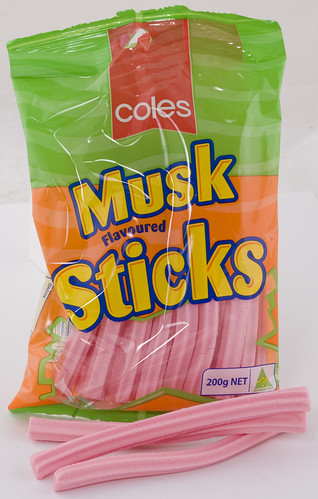
What does pink taste like?

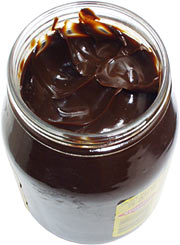
Musk sticks

Musk sticks are, I think, a peculiarly Australian sweet.

Actually, I think the whole "musk" flavour may only exist here.

I used to love musk sticks when I was a kid.

(I'll spare you the tediously wholesome story about carefully buying lollies with my pocket money on the holidays and making them last as long as I could and the milkman's cheery whistle and so on.)

So I bought some, the other day. Every Australian supermarket has them.

It turns out that I still like musk sticks. But because the sticks I ate when I was a kid had been sitting, unwrapped, in the shop for some time, I prefer them a bit dried out and crusty. The second comment on this post about musk sticks at Candy Blog indicates that I am not alone in this preference.

(I found that putting the sticks in a colander on top of a heating vent for a couple of hours dried 'em out nicely.)

That Candy Blog post, though, and the previous one about musk Life Savers, alerted me to the strangeness of these sweets.

Here in Australia, there are musk sticks, and musk Life Savers, and little hard musk pellets too. They're all pink, and they all taste the same, and I cannot for the life of me tell you what they taste of.

"Musk", here, does not indicate some flavour that started out being squeezed from some animal's glands. Well, not unless that animal had a sort of... flowery... smell, anyway.

I haven't actually smelled any natural musk, so perhaps it's amazingly similar to the candy smell. People grasping for words to describe lolly-musk often say it's "perfume-y", after all, and natural musk was used as a perfume component.

But since natural musk is alleged to smell "animalic, earthy and woody", I don't think it can really be much like the lolly musk.

I agree with the memorable observation that musk lollies smell a bit like an old lady's handbag.

But that doesn't really get it right, either.

Musk sticks actually smell, and taste... like musk sticks.

If pressed, I might venture the opinion that they taste pink.

It's sort of like that weird "bubble-gum flavour" that emerged as an entity unto itself at some point.

If you've never tasted "musk" and get the opportunity - without having to pay $25 for an air-mailed bag of the things, of course - I highly recommend it. You probably won't be crazy about the taste, but this is not one of those confrontational "local delicacies" like salted liquorice. (Which is, of course, not salted with mere sodium chloride - it's got ammonium chloride in it!)

The taste of a musk stick will hang around in your mouth for rather a while, but you probably won't be unhappy about that. It's pretty inoffensive.

This all reminded me that here in Australia, we really don't have any big guns in the "local delicacy" wars.

No hákarl...

...no lutefisk, no hundred-year-old eggs or casu marzu or balut.

OK, there are witchetty grubs, but it's not as if most of the Australian population have ever even seen one of those. And in any case, I'm told that witchetty grubs are actually quite delicious, if you can get over your irrational fear of eating an arthropod that doesn't happen to live in the sea.

Vegemite.

Vegemite is the ISO Standard Weird Australian Food, but I'm here to tell you that it's really not that peculiar. Wipe a smear of Vegemite on a cracker and bite into it and you'll be experiencing an odd savory foodstuff, not some incredible brain-flipping toxic creation.

I was born and raised on Vegemite and so spread it on my bread like mortar on a brick, but in more moderate amounts, Vegemite is really not that big of a deal.

And I think that's pretty much it for weird Aussie food. I mean, what else is there for even the least adventurous tourist to get bothered about? Meat pies? Pie floaters? Sausage rolls?

Heck, even Chiko Rolls aren't that bad if, as with the witchetty grubs, you don't think too hard about what you're eating.

And not a lot of people find themselves retching after being cruelly forced to eat a lamington or pavlova, or even a Moreton Bay bug.

Am I forgetting anything? Has Australia actually managed to come up with any truly confronting food?

Here's something you don't see every day

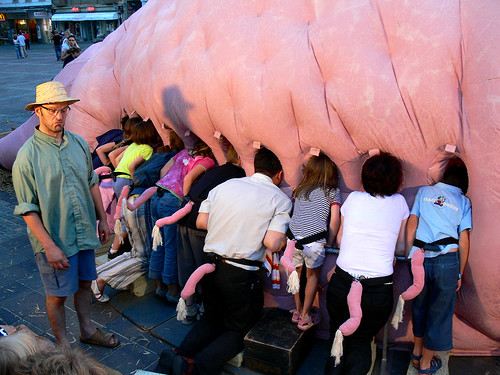
Very odd picture.

I found this picture on Flickr while looking for something quite different. I think it's fair to say that almost anything is quite different from this picture.

I invite you to look at the picture for some time. Feel free to click through to the bigger version on Flickr. Turn it round and round in your head a bit.

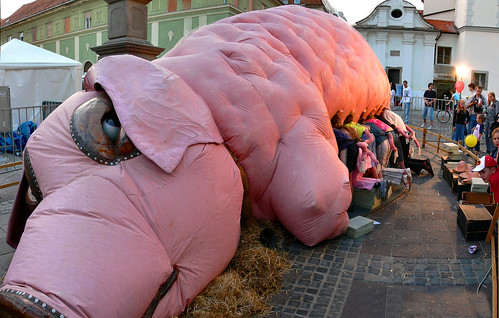
Here's another angle:

Another very odd picture.

In a moment, I will tell you how this strange tableau came to be. But you may prefer to read no further. Not because the explanation is as unsettling as the explanation for such a scene honestly ought to be, but merely because the explanation, like an explanation for a magic trick, may leave your perception of the world poorer than it found it.

I'm reminded of the Penn and Teller trick where Penn says that Teller, who just magicked his way out of a box he'd been sealed in, is about to do it again, but this time so that the audience can see how the trick is done.

Penn then commands the audience to make a choice.

They can close their eyes, and thereby preserve the mystery and astonishment of the trick.

Or they can leave their eyes open, and watch a middle-aged man get out of a box.

If you'd prefer to preserve the magic, do not scroll down.

.
.
.
.
.
.
.
.
.
.
.
.
.
.
.
.
.
.
.
.
.
.

Greetings, fellow spoilers of jokes.

So far as I could glean from the comments on the Flickr picture pages, the explanation is:

There is something interesting inside the giant pig. Presumably real pigs.

The children have their faces pressed to windows, which allow them to see in.

You are not allowed to look through a window unless you first put on a tail.

The guy in the foreground in the first picture is probably not actually about to start butcherin' young 'uns.

The end.

Just Say No to broken typography!

From the local fishwrap:

Anti-drug ad

"The New South Wales Police: We Can't Even Get Kerning Right."

("Oh, man... I was sooooo high when I made that ad. Look, it's all screwed up, man! It's hilarious!"

I particularly like the new letter Overlaid N and Y. It should be the logo for a New York rave, or something.
I am also intrigued by the choice of the picture of two adorable little girls.

Are we to presume that little girls are being called upon to stop messing around with dolls and step up to do their part in the War on Some Drugs?

Perhaps dealers are using them as runners. Who'd suspect little girls in school uniform?

(You would, citizen, now that you've seen this ad!)

No, wait! Perhaps there's a way to turn little girls into drugs!

Keeping Australia safe from cat toys

The other day, I bought two little laser pointers on eBay, for a grand total of $US3.76 delivered.

I intended to use them as cat toys, since the only red pointer we've got here that doesn't run from those useless button batteries is a bit flaky.

I chose those particular pointers because they were the very cheapest AAA-powered lasers I could find. They were promoted as "Ultra Powerful Red Laser Pointer Pen Beam Light 5mW", but they almost certainly actually had an output of only one or two milliwatts, like almost every other cheap pointer.

This power level presents pretty much zero eye risk, according to the rather complex risk calculations I explained at great length in my review of a much more powerful pointer.

A genuine five-milliwatt laser certainly can damage your retina if you stare into it from close range, and it's theoretically possible for glance exposure to cause eye damage at ten to maybe twenty metres, given the beam characteristics of cheap lasers.

A cheap two-milliwatt laser can't possibly hurt your eyes if you're more than ten metres away - probably closer, actually - and the one-milliwatt output you'll get from the very cheapest lasers and from those ubiquitous button-cell keyring lasers when the batteries have more than a few minutes of use on them will probably not hurt you even if you do stare into them at zero range.

Not that you should do it just to see, but the hazard calculations start looking pretty stupid as you drop below 5mW.

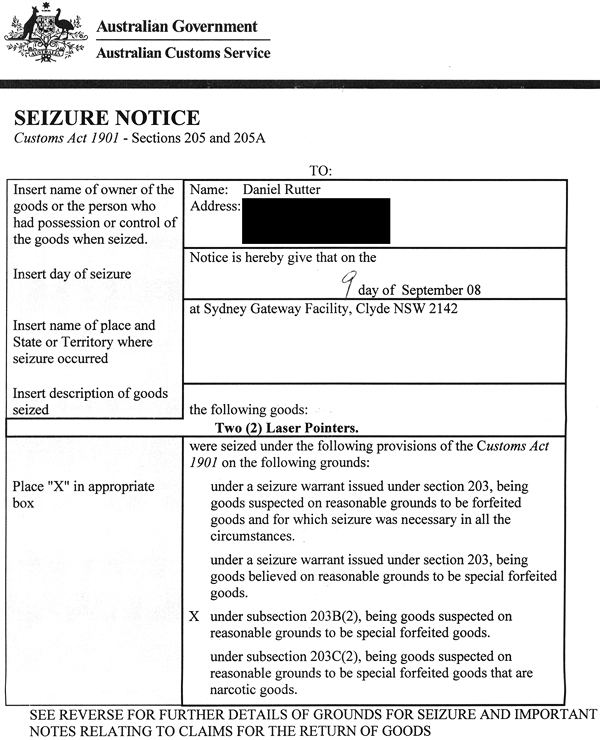
Australian Customs seizure notice

Naturally, Australian Customs chose to protect the Australian people from these terrifying devices, by seizing them under subsection 203B(2) of the Customs Act.

(This only the second time this has happened to me. The other time was when Ron Toms tried to send me an inexpensive Airsoft gun along with a box of other toys for review. The Customs guys left me the instruction manual, battery and charger, so I presume they really did incinerate the gun itself.)

Should I wish to contest the seizure, it would appear my first step would be to obtain Form B709B from the Firearms Registry of the New South Wales Police, which I could of course not actually do, after which I would be able to lodge a "B710 Application to the Minister for Permission to Import Weapons", which he would of course not grant.

At least I didn't have to go to bloody Clyde to pick up the package, as I've had to a couple of previous times when Customs were doubtful about something I'd bought.

(The second of those times, the item in question was a Gerber multitool. The nice Customs lady went into the back room to make sure it wasn't actually a switchblade or something. Her experience with tools in general may have been somewhat limited, since she came back bleeding. But she was very good-humoured about it, especially after I gave her one of the Band-Aids I keep in my wallet where less practical, or perhaps just more interesting, people keep a condom.)

This foolishness happened, of course, because a couple of geniuses shone green lasers at planes coming in to land here in New South Wales. And, immediately, our sagacious elected protectors made new laws which caused ordinary laser pointers - including low-powered red ones that have almost no ability to dazzle anyone more than a stone's throw away - to be classed as weapons.

Now, anything with output above one milliwatt is a prohibited import.

Actually, in New South Wales and elsewhere, it would appear that all lasers above one milliwatt output are now Controlled and/or Prohibited Weapons, like military flame throwers and rocket-propelled grenade launchers. The maximum penalty for merely possessing a perfectly normal office laser pointer would, therefore, now appear to be fourteen years in prison.

I'd like to say that I'm sure that a judge would recognise that the assortment of silly ninja weapons and quite inoffensive items - like ordinary handcuffs, for instance, or even a home-made cardboard replica of a Sidewinder missile - that one or another drum-beating politician has added to the list of prohibited weapons, are not the same as an actual working RPG-7. And that of all the ridiculous things on the list, a $2, 2mW, laser pointer may be the most ridiculous.

But you shouldn't be up in front of a judge over just owning a 2mW laser pointer anyway. And, given the way things have been going lately, I don't know how much sanity is left in the system.

You'd think that even the docile beta apes who can be counted on to support frank fascism when presented with the simple stimuli so famously explained by Hermann Goering would, by now, have started to realise that just this once, for the very first time in human history, they are being lied to.

But no. Not so much.

Hating everyone and everything that's slightly different from you still seems to play pretty damn well out in the sticks where they marry their cousins and have sex with the cows. By which I mean, a one hour drive from the Sydney Opera House.

We still do not seem to have reached the point where any electable candidate for public office in Australia - or, of course, in the USA - will come within a hundred miles of saying that making little old ladies take their shoes off is not an essential measure to prevent conquest of the world by radical Islam.

Oh, and do note that while 2mW laser pointers are now super-illegal death rays here in New South Wales - instantly making felons of, what do you reckon, maybe a third of the population? - laser diodes with the same or more power which happen to be part of ultrasonic tape-measures, laser levels, Blu-Ray players, barcode scanners or any of approximately one billion other classes of device are all still perfectly legal, and expected to stay that way. Because we all know that terrorists do not own screwdrivers, or know how to find Instructables.com.

I remind you, at this juncture, that Wicked Lasers and their spin-off TechLasers continue to offer a 100% delivery guarantee for lasers the size of a billy-club that cost a thousand dollars and have at least a few hundred times the output power of the ones Customs seized from me.

Techlasers have a "100% Money Back Guarantee if for ANY reason your product cannot be delivered to your door, no questions asked", while Wicked Lasers will give you your money back plus a hundred dollars if a laser doesn't make it to you.

So I think it's safe to say that Australian Customs isn't perfectly watertight as regards even lasers with which you could beat a man to death.

But they sure confiscated the hell out of those cat toys of mine. Well done, lads!

The only even slightly rational justification for the new laws is that it's now possible for police to confiscate a laser from you if you cannot give a good reason for having it on your person. So the cops don't have to prove that this particular dork they just caught is the same one who was shining a laser at an air ambulance an hour ago, and can at least take his laser away even if they can't charge him with anything.

(Although the 1mW legal limit seems to mean they can charge you with a serious offence just for owning almost any laser pointer. Does anybody know whether this has actually been done yet?)

But even if you feel that this particular security-versus-freedom trade-off is a fair one, it doesn't justify stopping everybody else from even buying a plain old $2 cat-toy laser.

I, for the record, do not believe this to be a fair trade-off. There are similar laws here in New South Wales covering knives; if you cannot give a good reason for having even a tiny Swiss Army knife in your pocket if challenged by a policeman, he can confiscate it. But it is easy to justify having any normal sort of pocket-knife, and I do not strongly object to confiscation of a steak knife from some goon wandering around outside the cinemas on George Street in Sydney on a Saturday night, whether or not he's actually suspected of doing or intending to do something bad with it.

I don't think the knife laws have actually achieved a damn thing, but I also don't think they're a great assault upon our freedom, since all they really do is increase the number of ways a policeman can make your life miserable, if he chooses, from a million to a million and one.

The NSW laser ban, in contrast, is an excellent example of the new wave of arbitrary, fear-based laws to Protect the People from the Movie-Plot Tactics of the Scary Domestic Terrorists who Don't Actually Exist.

The practical results of the ban, despite the outrageous classification of harmless tiny lasers as being like flamethrowers, appear to be mundane and minor; nobody's being hauled off to be tortured in Syria over possession of Laser-Guided Scissors.

But I think the mundanity of the ban is what makes it a particularly good example of the Death by a Thousand (Laser-Guided Scissor!) Cuts that's being suffered by the civil liberties of citizens of Western nations.

One little thing after another's being taken away, none of them a big deal by themselves. Day by day, it further restricts the kind of life that's legally permissible, and makes us more and more accustomed to living in this slowly-tightening straitjacket. The idea is to make us all keep our heads down and do anything and everything we're told, lest we slightly annoy a policeman and then actually be charged with some of the new and ridiculous "crimes" which we cannot avoid committing.

An excellent, and simultaneously terrible, tool

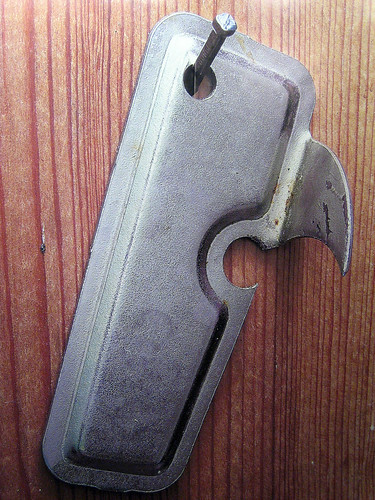
P-38 can opener

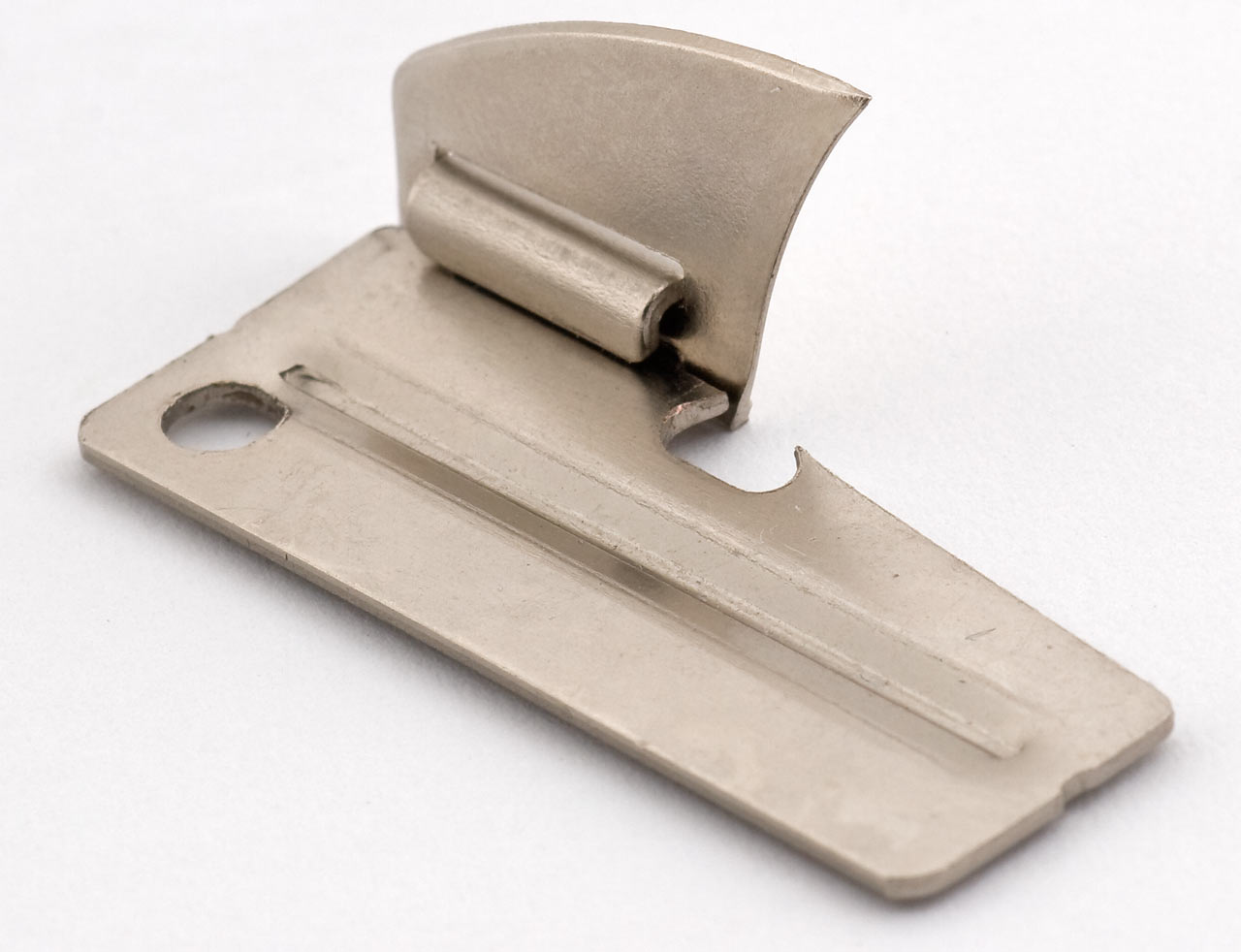
The P-38 can opener is something of a design classic. Tiny, inexpensive and extremely reliable, it's been cracking cans open since the Second World War.

But I'd never even seen one, and was interested to find out how well this iconic military tool actually worked.

So I bought four of 'em, for $US2.25 plus $US4.50 postage to me here in Australia, from this eBay seller. Their only sin was that they packed a worthless cell-phone booster sticker in with the can openers. But that was free.

(Here that seller is on ebay.com instead of ebay.com.au.)

[UPDATE: That seller's gone now, but there are tons of other eBay dealers with P-38s and their larger cousins, P-51s, for sale.]

Herewith, my in-depth review of the P-38:

It does, indeed, open cans.

It does so quantifiably better than would a sewing needle, a rubber chicken, or a silver dollar.

Opening a can with a P-38 is, I'm fairly sure, on the whole generally preferable to starving to death.

The P-38 is, however, a quite serious pain to use. Clip onto can rim, twist hard to make initial puncture, slide a little, twist again. Repeat many times. It requires considerable strength, and you can just feel the repetitive strain injury growing in your hand.

But the P-38 is only an inch and a half long, folds flat, weighs close to nothing, and can be manufactured in great quantities very cheaply. Given these limitations, I can't imagine how you could make a more elegant or effective opener for all sorts of cans.

So, fair enough. Case closed, right?

Wrong.

I'm told, you see, that P-38-type can openers are actually the normal kind of opener, for everyday domestic purposes and not just camping and the military, in some countries. Finland, for instance, and apparently also Brazil.

The versions they use are generally non-folding solid-metal types...

Finnish can opener

...which are more durable than the lightweight P-38, and are often also a bit bigger, for better leverage and less pain. (There's a larger version of the P-38 as well, called the P-51.)

But, based on my experience with the P-38, I'm here to tell you that making this same device somewhat larger and from one piece of heavier metal will not solve its serious problems.

This sort of opener is a bloody awful thing to have to use.

Why in heaven's name would significant portions of the population of any even slightly affluent country prefer it, and - as is apparently also the case in Finland and Brazil - often believe that the much faster and far easier-to-use turn-the-knob "rotary" type of can opener is likely to be an unreliable piece of crap?

Well, unreliable-piece-of-crap rotary can openers definitely do exist. There's one in this house, which I've had to use when I couldn't find the MagiCan.

Even though that crappy opener tends to lose the thread and have to be restarted a couple of times to puncture the lid all the way around, though, I solemnly attest that it is still better than the P-38. I think it'd beat a bigger, one-piece P-51-type opener too, though that might be a close-run thing.

You do not, however, have to spend a lot of money to get a rotary opener which, like the MagiCan, will open many hundreds, if not many thousands, of cans quickly, easily and completely reliably.

Yes, electric can openers for domestic use are stupid if you're not afflicted with arthritis or severely short of the most popular number of fingers, and the very cheapest dollar-store clones of the good rotary openers are not reliable.

But the can-opener design problem has been a thoroughly solved one for many years now. For the first half-century of the history of the can, they were made from such thick metal that no hand-held opener short of a hammer and chisel would do to open one. It didn't take terribly long after the metal got thinner for a variety of purpose-built openers to be designed, though. The first rotary opener was invented in 1870.

If people in Finland and Brazil think that a P-38-ish opener may perhaps open even more cans, without breaking, than a high-quality rotary type, then I suppose they may be right. But the number of cans you'd have to open with your twisty spiky thing to see the difference would, I think, have long since led you to employ that pointy little blade to slit your own throat.

I invite enlightenment on this subject from any readers who live in places where twist-spike openers are the norm.

(If you want to buy a P-38, they start from approximately no dollars on eBay. The P-38's larger and less painful cousin, the P-51, is also easy to find on eBay, for approximately no dollars plus 20 per cent.)

Thank you for coming in and being so time-consuming, Blathers.

Now that I know that Stephen Fry owns a pink Nintendo DS, I cannot help but visualise him playing Animal Crossing: Wild World and writing exceedingly genteel letters of apology to teddy bears.

While wearing reading glasses.

(Actually, I think it'd be funnier if he were running around pwning n00bs in Halo 3.
m3g4d3aTh: "Fag!"
JeevesMelchett: "I really don't think that's relevant.")