The £795,000 paperweight

I get one or two e-mails a week from someone who's discovered the donation page on dansdata.com, and immediately decided that all I do is beg for money.

Sometimes they ask me what my secret is. Sometimes they ask me for a cut of the (presumably massive) take. Sometimes they try to get me to join some questionable scheme, or just send me a PayPal money request.

And sometimes... well, sometimes I get something like this.

From: "k.macleod"
To: dan@dansdata.com
Subject: google old ladies face (Eternity Stone) value estimated 96.000.000 yen CHINA currencey
Date: Fri, 18 Dec 2009 22:04:44 -0400

Dan the Man' no douth u probably make money on your site, but i am talking huge money here' C that old ladies face well i discover rock's and stone's like that, unfortunatly not near as great' but what I do have' I can honestly say 2 u r as good or better then any1 else's collection in the World and the world is a pretty big place Dan as u know' i am broke' not a cent coming in 2 my household other then my wife's income. I need a computer savvy warrior Dan' I swear 2 U' in my Heart i truly believe my treasure's r thee best in the world, there's a stone on e-bay of a alien face' asking price 795.000, now i can relate that stone 2 some of mine only i think mine r better and Dan i have countless speciman's, here Dan i will throw u a carrot 2 intice u more ? i have bernie madoff - hitler- and the big big guy (Kong) all made by the hand's of mother earth. thanks -the MimiKKing

So... "K" is in the rocks-that-totally-look-like-faces-or-something business, I guess.

K's unusual form of expression suggests to me that his world-class collection of rocks that look like things may not actually be quite as world-class as he believes.

He's right about there being rocks that look like faces and have huge price tags, though. I mean, check this one out. (That's an eBay listing, which will disappear some time after the auctions finishes; here's a local copy of the listing. And while I'm at it, it's here on ebay.com, and here on ebay.com.au.)

What you might foolishly mistake for a stone the size of a softball with a hole through it is actually a "distinctive human face/skull", and an "impressive show piece with its dazzling detail and endless enchantment". With a price tag of £795,000!

Expensive rock

For... this.

"K", and the I-sincerely-hope-joking seller of the above rock, both profess to be very excited about this "eternity stone" thing, which seems to trace back to this story on a Chinese Web site. That story, which totals 64 words including the headline, says that a rock that vaguely resembles an old lady's face was in 2004 said, by "experts", to be worth 96 million yuan. (Or, according to the eBay listing, "£12 Million Dollars!!")

It doesn't tell us who's ever paid 96 megayuan (or twelve million pound-dollars) for this paperweight, though. This remarkable story also appears, for the last five years, to have escaped the notice of the rest of the world's news services. So has the "China Rare Stone Expo" at which the remarkable rock was supposed to have been exhibited; that seems to only be mentioned in reprints of the story about the near-priceless grandma-rock.

I fearlessly predict that if anybody clicks the Buy It Now button on the £795,000 eBay "skull" listing, that person will run giggling out of the auction-room as soon as they're asked to pay up.

Perhaps I should advise my correspondent to try selling "haunted" or other "magical" things on eBay, rather than sets of all-natural Hitler/Madoff book-ends.

Are you troubled by yellowed, lifeless Lego?

There I was, idly scanning eBay for Lego baseplates to maybe give to one or another child for Christmas (HOW CAN THEY NOT MAKE CRATER PLATES ANY MORE WHY WAS I NOT CONSULTED), and I noticed that most, if not all, of the plates on offer weren't very close to their original colour.

This reminded me of a thing from the other month about de-yellowing the casings of old computers and video games.

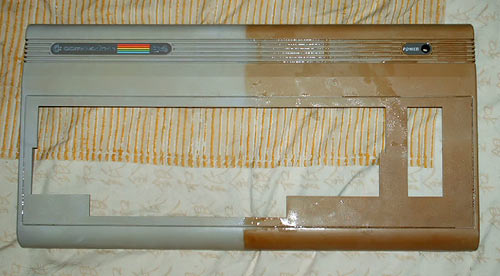
Retr0bright!

If you don't want to paint over the yellowed plastic, you can soak it in a hydrogen peroxide solution, with a dash of one or another kind of bleach. (Note that the popular "oxygen bleach" products are based on sodium percarbonate, which when added to water just gives you hydrogen peroxide plus washing soda.)

If you want to get fancy, you can make a gel concoction dubbed "Retr0bright", which'll stay where you put it. So you can bleach things without having to remove all the electronics so you can dip the casing, or bleach the outside of a thing but not the inside, et cetera.

Apparently even plain few-per-cent peroxide will often do the job if you leave the pieces to soak overnight. If you want faster results, you need 10%-to-20% peroxide, which you may or may not be able to get from a pharmacy.

(I must, at this juncture, digress and recommend Armadillo Aerospace's old video - 56Mb MPEG here - of what happens when you put high-test rocket-fuel-grade hydrogen peroxide on various common substances.)

Does this technique, I wondered, work on Lego?

Apparently, yes, it does! Even on clear pieces!

(Bleach can apparently attack the paint on some printed bricks, though.)

I don't think this will actually do the plastic any harm, either. Or any more harm, anyway. The reason why plastic discolours in the first place is because something - ultraviolet light and/or atmospheric oxygen, usually - reacts with one or more of the constituents of the plastic. The material that yellows may be the polymer itself, or it may be flame-retardant additives, or plasticiser, or something. In any case, bleaching already-damaged substances back to white shouldn't do any more damage.

[Update: I just remembered that a couple of years ago I wrote this piece, about the making of Lichtenberg figures in clear acrylic. It involves a rather unusual way to discolour plastic.]

You don't have to bother with this at all, of course. A yellowed Amiga 500 is still an Amiga 500, and yellowed Lego is still Lego. Some builders have even...

'Weathered' Lego 'mech

...used yellowed pieces to "weather" models!

The tragedy of Conservapedia

Every now and then I visit RationalWiki, to see what the crazy kids of Conservapedia are up to.

(I strongly recommend doing it this way, rather than injuring your brain on Conservapedia's own Recent Changes page. For a precis, check out RationalWiki's Best Of Conservapedia!)

Yesterday, this process led me to an excellent summation of Conservapedia's core problem, which I hadn't figured out before.

It turns out to be the same core problem that many cults, dictatorships and even owner-operated businesses have.

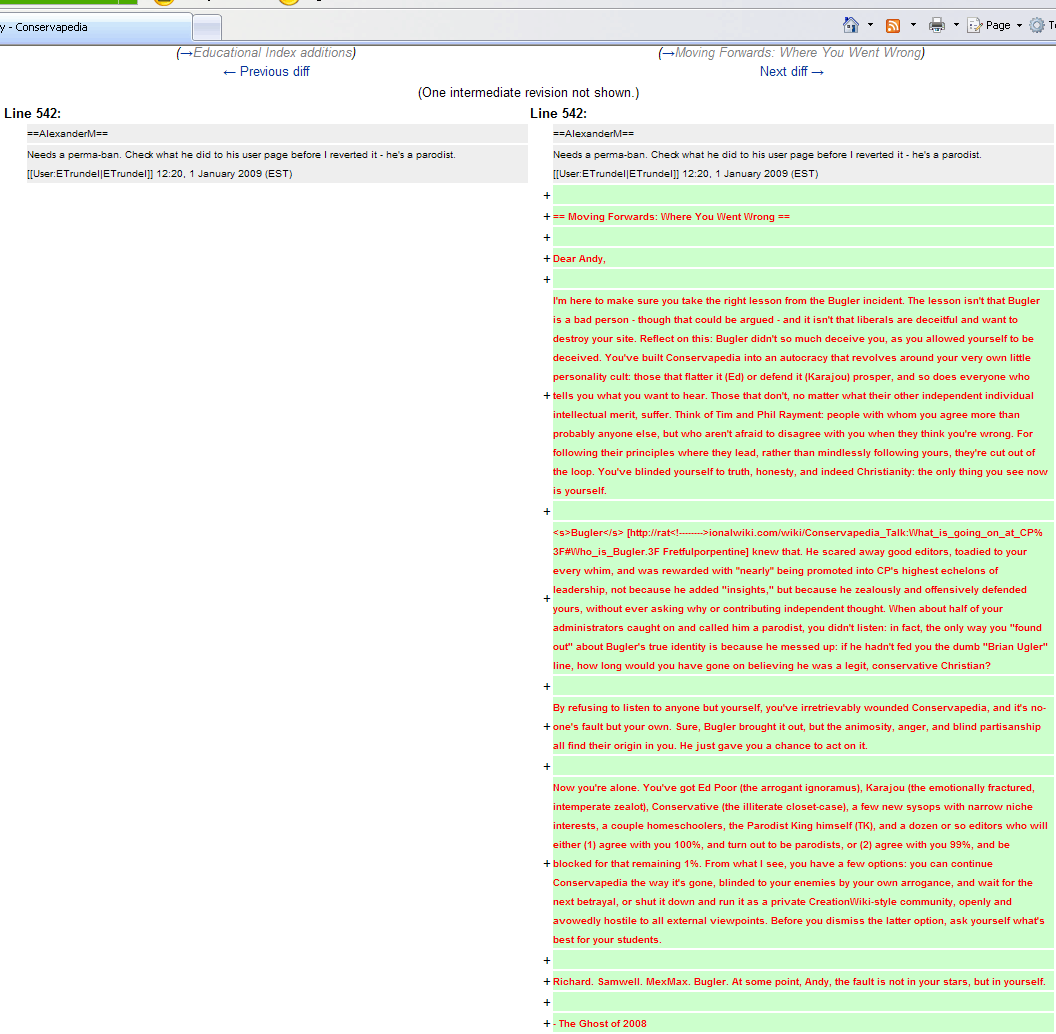
Constructive criticism of Andrew Schlafly
(click for legible version)

Conservapedia is, you see, constantly besieged by "parodists", people who're only there to pretend to be "radical conservatives", when they're actually writing satire. It's like Pretend Office, except malicious.

If Conservapedia were actually what it appears to be on the surface - just another manifestation of the USA's bizarre radical-conservative movement - then this wouldn't necessarily be a fatal problem. As a general rule, vandalism of Wikis is pointless (NSFW link), because it's so easy to fix. All you need is a decent population of sincere editors, plus maybe an automated tool or two (to easily deal with blatant stuff like page-blanking, single edits that make an established article 100 times its previous size, et cetera).

Unfortunately, though, Conservapedia isn't just "Wikipedia for neoconservative nutcases". It's actually a dictatorship, ruled by Andrew Schlafly.

(Who made it onto the Colbert Report the other day! Note that Stephen Colbert actually is a Sunday School teacher, and is... intrigued... by Schlafly's recent "Conservative Bible Project". The CBP is a "translation" of the Bible that's mainly being created by people who, like Schlafly, don't actually know Hebrew or Greek or Aramaic, but nonetheless feel up to the task of making the Good Book more aligned with radical-conservative ideology. The CBP is one of those things that's pretty much beyond parody; only if you've got Colbert's chops should you attempt to satirise it.)

Andrew Schlafly's problem is the same as that of various dictators and cult leaders: He rules his domain with an iron fist, and brooks no disagreement.

If you agree with Andy 99% of the time, and don't back down over that last one per cent, he'll ban you from editing Conservapedia.

If Andy were one of the great polymaths of our age then this would be a problem - because nobody knows everything - but could still kind of work. Unfortunately, Andy just thinks he's one of the great polymaths of this (or any!) age.

So when someone happens along who actually knows stuff that Andy doesn't about, let's say, relativity, and insists that Andy is actually wrong, Andy will briefly argue with them, and then ban them. (Andy pretty much seems to think that relativity as a "Liberal" plot. I kid you not.)

The above-screenshotted commentary...

Constructive criticism of Andrew Schlafly
(click for legible version)

...came in the aftermath of yet another long-term, trusted Conservapedia editor "coming out" as a parodist. It points out this fatal flaw; the only people who actually will agree 100% with Andy, going along with him on all of his weird quarter-baked notions and backing down instantly at the first sign of any disagreement, are the parodists. (Well, them and people who don't actually know anything at all, who may not be exactly the people you want contributing to your encyclopedia.)

So Andy's own egotism is destroying the greatest product of his ego. It's like a tragic play, except the audience is cheering at the end.

This is even worse than the problem expressed in the classic aphorism, "First-class men hire first-class men. Second-class men hire third-class men."

(I know that's sexist, but I think the original wording more clearly conveys the antiquity of the sentiment. And that saying always conjures up, for me, an image of some Stephen-Fry-ian chap showing a young colleague the ropes over cigars and brandy at the club. I find that image fundamentally incompatible with gender-neutral pronouns.)

Even with the occasional extension "...and third-class men fire first-class men", that aphorism doesn't cover the dreadful situation at Conservapedia, where a second-class (at best...) man is in charge of the whole shebang, and utterly determined to winnow the workforce down to nothing but people who won't do a lick of real constructive work at all.

In dictatorships and cults where the man (only occasionally the woman...) in charge will tolerate no disagreement at all, the result will be a bunch of yes-men who do, at least, have some interest in advancing the project, if only so that they can be promoted into more powerful positions.

On a Wiki, though, control-freak egotism from the boss is even more of a disaster, because it's easy for anybody in the world to casually throw a spanner in the works whenever they have a spare moment. And if your Wiki is about a contentious topic - in which category "the whole of human knowledge" probably qualifies - there'll be plenty of people who're eager to mess with you.

The reason why the above advice to Andy (as I write this, it's the eighth-highest-voted entry on Best of Conservapedia) is a screenshot and not just a link to the Conservapedia talk page is that Andy's response to this criticism was the same as it always is. He erased the criticism, and banned the user.

And on it goes.

Welcome back to Year 1 of the thrilling Firepower hearing

I'm sure you've all been waiting with bated breath to see what's happened since my last Firepower update.

Well, for one thing, Gerard Ryles' unassumingly-titled book about Firepower is now searchable on Google Books.

And Tim Johnston, the elusive boss of Firepower, has apparently been blessed with a complete remission of his travel-preventing illness. (Apparently, if you get arrested, it clears right up!)

Tim has duly been frogmarched into a hearing in Perth, to answer a few questions.

According to Tim, he's pulling down ten thousand UK pounds a month for "consultancy" work for Green Power Corporation, the London-based reincarnation of Firepower that will repay all of the investors and actually have products that work and give every child in the world an adorable puppy and so on.

(You may recall Green Power Corporation, and its unimpeachable principal Frank Timis, from last year. You may also recall The Australian's description of Timis as "a colourful Romanian-Australian businessman". Everybody involved with Firepower is so darn colourful it's like some kind of Pride Parade.)

Tim Johnston also alleges that he has been assaulted, and his daughter intimidated (by "cars driving around her house"), since he started giving evidence to the hearing. According to Tim, the people menacing him now are associated with his former business partner, one Warren Anderson.

Anderson has previously denied making any threats, and I presume will also deny sending the boys round (and round, and round). According to Johnston, Anderson demanded many millions of dollars of Firepower money with menaces; according to Anderson, that money was just payment for shares in Firepower, which Tim was buying from Warren, or something. (According to the ancient fuel-pill-company template, the shares probably weren't legal to sell in the first place, but were nonetheless hungrily snapped up by numerous people who now find themselves without a nest-egg.)

Oh, and Tim says that the fact that Warren pitched in to help Tim buy an 8.5-million-dollar house one day after Tim gave Warren four million dollars is not fishy in any way.

Hmm, what else... Oh yeah: "Firepower spent millions on travel, hotels and sponsorship". Astonishingly, the recipients of the free air tickets included Tim's kids.

And Tim also, in a completely straightforward and non-fishy way, handed an extra two million dollars and a hatful of soon-to-be-worthless shares, on top of a settlement payment, to the former chief executive officer of one of the numerous Firepower entities after some sort of court dispute.

After revealing this, Tim suddenly found himself struck by that most terrible of afflictions, Courtroom-Related Amnesia Syndrome, regarding exactly how the various Firepower business entities interacted. The syndrome is following its usual course; the larger the amount of money involved, the more difficult the sufferer finds it to remember where it went.

According to Tim, Firepower also appeared to have a less-than-thorough data backup policy. A server containing vital information was in someone's house, and then may have been pawned, perhaps, but Tim's not sure, his Courtroom-Related Amnesia Syndrome's playing up again...

We can only pray that Tim's illness does not develop into full-blown Ashcroft-Gonzales' Disease.

A very bright bad example

I used to have a really big light bulb hanging in the junk-storage/photo-studio/emergency-guest-accommodation room.
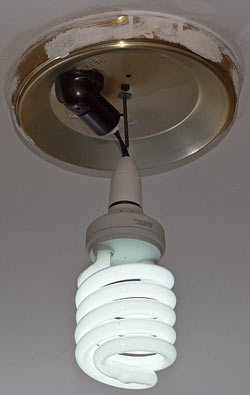
Big bare bulb

I wrote about it here, very early in the life of this blog.

Unfortunately, that 85-watt compact fluorescent lamp, which we came to affectionately call "the skylight", only lasted a couple of years. That might have been because it wasn't very well-made, but I suspect it just didn't like being turned on and off so often. I wasn't in and out of the junk room a dozen times every day, but CFLs only have so many on/off cycles in them.

After the eighty-five-watter died, I sighed and put a standard boring "100W-equivalent" bulb in the dangly hacked-together socket I'd used for the big lamp. And there that boring bulb stayed, for about another year.

But then, the other day, I noticed that this eBay seller had some new-old-stock Y-adapters, for Australian light-bulb sockets.

(In the USA, the most common light-bulb socket is the "E27", a 27mm Edison screw. Here in Australia, though, the large majority of our light bulbs use a 22mm bayonet mount, a.k.a. "BC".)

The eBay seller turned out to have a total of nine double-adapters, some with a switch for one of their branches, some without.

I don't like to miss a chance to go beyond the usual and construct something that'd make a home inspector turn pale and need to sit down for a little while. (The Cable that Should Not Be was the third post on this blog!)

So I bought all of the adapters.
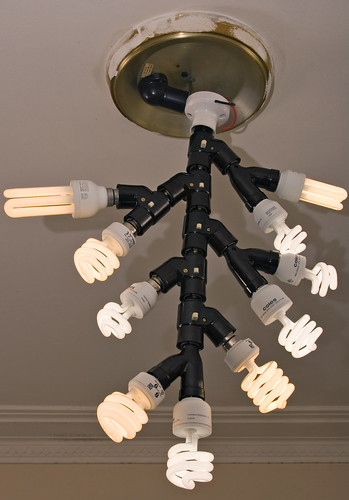
Ten-bulb CFL monstrosity

And now I have this!

Nine double-adapters, ten sockets.

In case you're wondering: No, this is not a good idea. Do not do it.

What you see in that picture is actually my third attempt to get everything working at once. I first tried a couple of "bushier" layouts, but the leverage of greater bulb-weight on the wider branches produced broken or, worse, arcing connections between the adapters. So I reconfigured the motley convocation into this vaguely Christmas-tree-ish shape.

The less bushy configuration puts the bottom bulb only about 204 centimetres (six feet, eight inches) above the floor. And this many stacked bayonet connectors becomes sort of... floppy. So a tall person bumping their head on the bottom bulb might manage to unplug half of the assembly. And I don't trust all of the connections to really be free of slow-overheating-causing extra resistance or tiny arcs. So I wouldn't leave this Photonic Agglomeration Mark I turned on when I left the house.

But, dodgy though this preposterous bricolage of brightness is, it's actually not as dreadful as you might think.

Light-bulb double-adapters were, in the olden days, a way to buy several tickets in that special lottery where the grand prize is burning your house down.

A light-bulb socket should remain safe, you see, even if you run a few hundred watts from it. But there are plenty of ceiling lamps that're blessed with cack-handed amateur wiring, old cables chewed by rats, old connections corroded by possum pee, ancient insecure aluminium wiring, flammable insulation batts installed right across the top of hot areas, or some combination of the above.

If you double-adapt a light-bulb socket that's hanging down from the ceiling on a cable, then you at least shouldn't be able to dangerously increase the temperature of the ceiling above the bulbs. But it's still perfectly possible that you'll overheat some wiring.

The whole point of compact fluorescent bulbs, though, is that they consume a lot less power than incandescents, for a given brightness. A "100-watt equivalent" CFL will probably draw only 18 or 20 watts. So you can double-adapt a whole bunch of CFLs onto one standard socket and run no more risk of disaster - from excess current, anyway - than you would if you'd plugged in only three or four incandescent bulbs.

In my illuminative monstrosity, there's one 23-watt CFL, five 18-watt, one 14-watt and three 10-watt, for a total of a mere 157 watts. You can buy single incandescent bulbs that draw that much - or 200 watts, even - if they've not yet been banned where you live. Those big bulbs will usually work fine in normal ceiling fixtures if they physically fit, and they also often have an extremely long lifespan. That's because they're built for toughness, not efficiency, though, which brings us back to the subject of light-bulb bans.

(Most standard incandescents are now effectively banned here in Australia, but there are specific exceptions for bulbs for which high-efficiency replacements do not yet exist, like the little lamps in fridges and microwaves. So nobody seems to have been terribly inconvenienced. In a few years, immortal LED bulbs ought to have stepped up to fill pretty much every niche that doesn't actually require a lamp that wastes power.)

157 watts of compact-fluorescent light is getting on for twice the power of my old 85-watt single bulb. It ought to add up to an incandescent-equivalent figure of more than 800 watts. So I whipped out the light-meter to see how the new fluorescence excrescence did.

Compact fluorescents don't give their full brightness until they've warmed up, and that can take a minute or three. Some CFLs are really dim when they're at even a comfortable room temperature, and all of them will be very dim if they're very cold (which can be annoying if you want to use them as a porch light in a cold climate, or to illuminate your meat-locker). So I measured the brightness of the new Lamp That Should Not Be at turn-on at the ambient temperature of about 20°C (68°F), and then again ten minutes later. I taped my light-meter's sensor to the wall about 195 centimetres from the middle of the array, looking at it from a bit below, but broadside-on. (A flat array of bulbs like this will, of course, be dimmer if you look at it edge-on.)

At turn-on, the multi-lamp managed a brightness of about 125 lux over there on the wall - already more than twice the usual brightness of domestic indoor lighting. Ten minutes later, it was 344 lux. Left to warm up even longer, it plateaued at 360 lux.

At the front of my photo-tent area (located, since the kitchen table is not available, in the second-most-traditional location for professional Web-site photography, a spare bed), the old 85W CFL managed about 205 lux. The new array manages about 345!

That's still not bright enough for general photographic use. It's more than enough for large-aperture portraiture, but for product shots you'll find yourself needing one-second tripod exposures. It's a really good light level for a workroom, though; bright enough for fine work, without the actinic glare of a 7-Eleven at two in the morning. (Which is exactly the same brightness as a 7-Eleven at ten at night, but always seems a lot brighter.)

At the standard measuring distance of one metre, by the way, the warmed-up ten-bulb Chandelier of Uncertainty manages better than 900 lux - overcast daylight brightness - when measured from a perfect broadside-on location. An edge-on view of the lamps one metre from the middle of the whole array is still about 900 lux, because the lamps at the near side of the array are now rather closer than one metre. Moving back to take that into account drops the brightness to around 700 lux.

The ten bulbs cast a rather pleasant light, too. Because the light comes from so many sources - and the sources themselves are the tubes of CFLs, not the little filaments of clear incandescent bulbs - the light casts the soft shadows that you can normally only get from efficiency-reducing lampshades or indirect lighting. And the random mix of colour temperatures from ten supermarket bulbs might drive pro photographers to distraction (because all shadows will have multiple soft fringes of subtly different colours...), but I think it makes the room look sort of sunset-ish, without actually being very yellow. The only problem is that when I come out of the junk room into the normally-lit house, I can't see where I'm going any more.

Early compact fluorescent lamps were widely hated, for good reason. They were quite expensive, and they gave light that was qualitatively inferior to that from incandescent bulbs. Their mains-frequency ballasts gave them noticeable flicker, which in turn gave people noticeable headaches, and early CFLS also often used the cheap high-efficiency "triphosphor" coatings. Triphosphor gives lots of light per watt - it's still pretty much ubiquitous in the cheap-straight-fluoro-tube market - but it has lousy colour rendering, so people look like corpses and you can't tell your jelly beans apart.

But modern CFLs, even cheap supermarket ones, now have high-frequency ballasts and pretty decent colour rendering. Especially if you combine lots of different lamps into one fitting!

(Current CFLs even have a good power factor now. So my irradiative congerie shouldn't be doing funny things to the mains waveform. They do still have mercury in them, but this is not actually a very big deal.)

Oh, here's another way in which a Dumb Light-Bulb Trick like this could go horribly wrong: The monstrosity weighs about 1.38 kilograms (three pounds), versus maybe 85 grams (three ounces) for a single "100W-equivalent" CFL. 85 grams is already heavy for a, ahem, light bulb; I just weighed a standard incandescent hundred-watter, and it was only 31 grams.

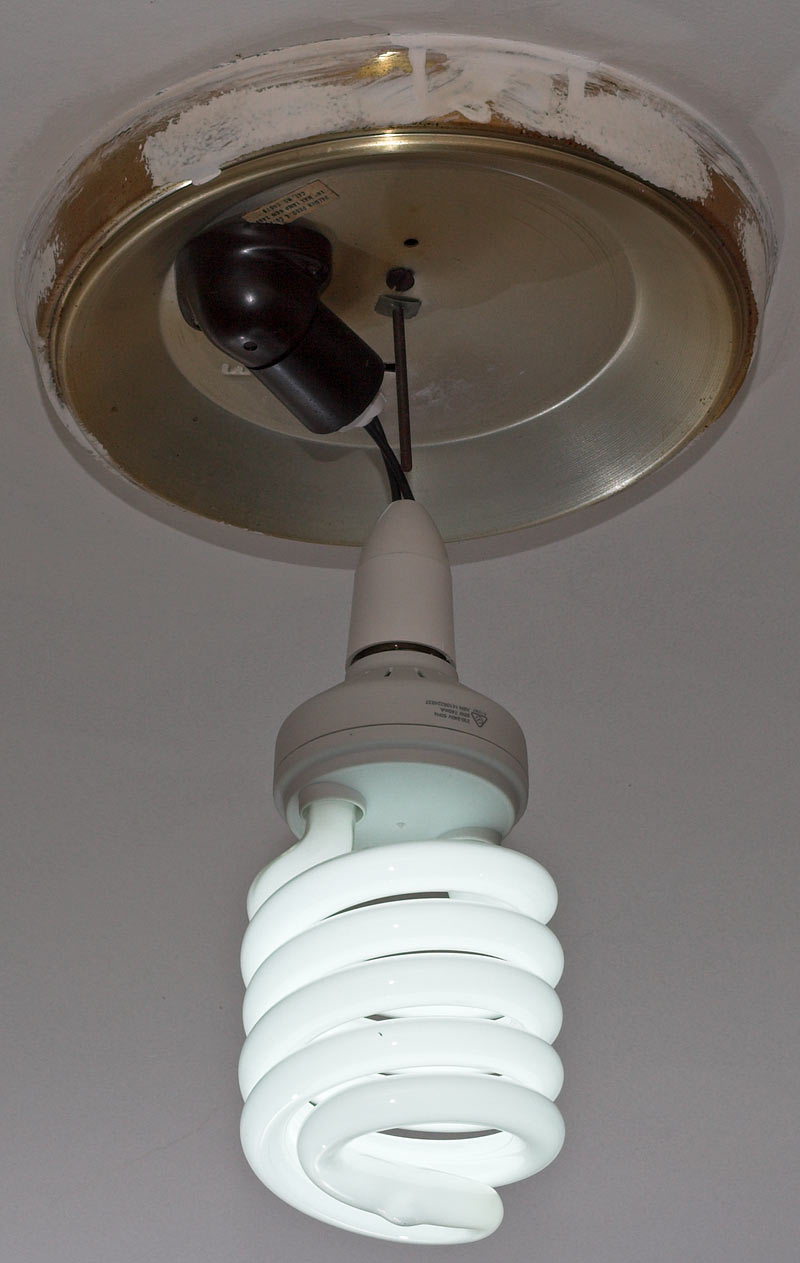
If I'd just hung 1.4 kilos from the poor horizontal socket of the old ceiling oyster-light in the junk room, like I did with the huge 85W CFL before, I wouldn't be at all surprised if the ten-lamp contraption yanked the socket bodily off the ceiling.

So, instead, I rigged up an extender that connects a standard "batten" bulb socket to the oyster-light socket. The extender, and the rest of the luminaceous imbroglio, hangs from the threaded rod that's meant to retain the ceiling-light's glass lamp-shade. You shouldn't assume that any particular fastener coming out of your ceiling is retained by more than a Rawlplug and hopeful thoughts, but this one seems pretty solid to me.

(I should probably put some tape over contacts on the top of the batten socket, seeing as it's not screwed onto a batten and they're just sitting there proudly naked. Nah - what could possibly go wrong?)

In case you haven't got the message yet: Don't do this. If you feel the need to run a ton of CFLs from one ceiling socket with a home-made contraption, make it a proper permanently-connected fitting, like a white-painted plywood circle with a bunch of parallel-wired batten sockets on it, and anchor it to the ceiling properly. "Properly", in case you're wondering, means "not with coat-hanger wire, sticky tape, picture-hooks or occy straps".

And all of my usual disclaimers also apply: Don't fool with mains-powered circuits as your first venture into amateur electronics. Don't make your own mains gear if it's not legal to do that where you live. Bear in mind that gimcrack electrics may not only set your house on fire, but also invalidate your insurance.

Bulb-socket double adapters are, I think, very acceptably safe if you only use one of them at a time. With CFLs, they'll let you easily get the equivalent of 200 to 250 watts of incandescent light into a room, with only about 40 watts of actual power consumption. There are probably cheesy light-bulb double adapters from scary Chinese factories that're unsafe at any speed, but the old-stock ones I got are all sturdy Bakelite and spotless heavy-gauge metal inside. They only become dodgy when you... iterate.

I think I'll stick with my illumination conglomeration for a little longer, then whip up something more solid, perhaps in the Hollywood-makeup-mirror form factor.

But then again, I did also buy a lot of in-line bayonet plugs and sockets from that guy on eBay.

Perhaps I should develop something based on the classic Australian cork hat.

Oh, awesome! Another problem with dansdata.com!

Suddenly, I've got a few readers - who are presumably, as is usually the case, representative of a lot more people - complaining about "fake antivirus" malware pop-ups when they visit dansdata.com.

Some people will see crapware pop-ups when they visit any random site, because they installed some crapware in the past, and now it's wedging itself into their browser all the time, showing them porno ads or asking them to install more crapware. (Or it may just be quietly waiting for them to type some interesting-looking usernames and passwords.)

This is not like that. This really does seem to be some actual malware associated directly with dansdata.com.

The only reader who managed to see what the bad ad did in any detail reported that it:
1: Apparently opened a PDF file in the Internet Explorer Adobe Reader plug-in
2: Used some exploit in that to install crapware called "Antivirus Live"
3: Popped up tons of fake system errors and immediately made his life very miserable

Another reader didn't see what the heck actually happened, but swears he never clicked an "OK, install whatever the hell it is you want to install!" button, also received a delicious heaping mouthful of brown and steaming fake antivirus software.

Yet another reader also had the experience that's more normal among drive-by banner-ad crapware-installer victims, which is to say:
1: Reader is peacefully reading one of my pages.
2: Reader clicks on a link to another of my pages.
3: Reader suddenly gets a bunch of terrifying popups about viruses.
4: Reader employs the sure-fire highly technical hacker-neutralisation technique.
5: Reader comes back to computer later, and spends hours on end trying to remove all of the malware that installed itself entirely without reader's knowledge. This can be a huge pain.

(Note that that post is three years out of date, and about me dealing with a really mild crapware problem. I presume that current crapware swims up your urethra and then flicks out a crown of asbestos thorns.)

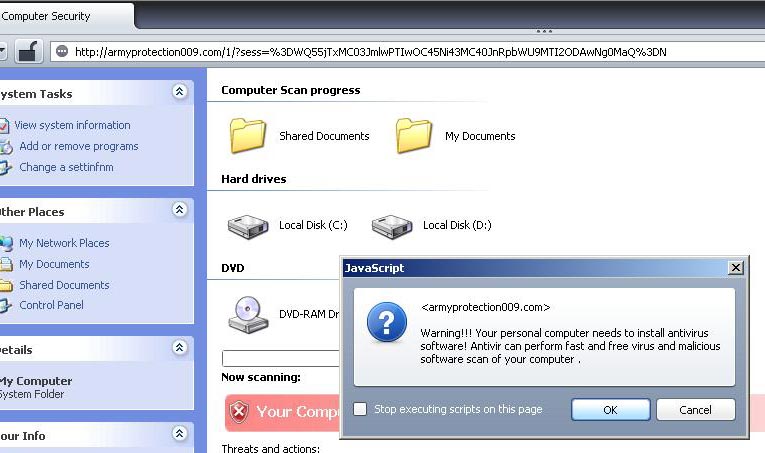
Another reader reported that the bad ad, or whatever the heck it is, tried to redirect to armyprotection009.com, which is on Firefox's "Attack Site" list (and also Chrome's, and I presume recent versions of various other browsers too).

That site's purpose in life...

Fake antivirus site

...seems to be to pretend to be a Windows folder with a scary security warning in it, and get you to click OK to install "Antivir", which may or may not be the same BS malware antivirus as the apparently-installed-via-PDF "Antivirus Live" above.

I don't know for sure what it is, though, because armyprotection009.com is as I write this not resolving to anything any more. (I presume this is another of those weird hosting deals where sites, and the very nameservers that resolve them, come and go like the unlocatable voices of invisible summer insects. It's all very poetic.)

Even if I can find one of the redirected-to sites, that doesn't help much, because I need to know where the nasty redirecting ads are coming from. I presume it's either some exploit on the actual Web server, or an ad being served by one of the two outfits that serve ads to dansdata.com, Burst and Google.

(There are other ads on the site, most notably all the click-here-to-buy ones from Aus PC Market, but they're just a static image and link, not something all rich-media-y being served from somewhere far away.)

I know Burst have "subcontractors" who run ads not entirely under Burst's control; that's caused some scammy ads to show up from time to time, but never any actual malware. I don't know whether Google does a similar subcontracting thing. And it's made even harder to figure out by the way these crap-ads works. You see, like legitimate advertisers who try to avoid advertising the new season's Buicks to people who live in Sweden, crapware-servers serve different things to different IP addresses.

So even if it's a Burst subcontractor - not that I'm saying that it is - that's serving the ad entirely deliberately and not because some server of theirs has been compromised, it's perfectly possible that even if Burst carefully screen every single thing served in their name, they'll never see the malware, because the malware authors have Burst's whole IP range on a "do not serve malware to" list.

(This may fall down when a Burst employee goes home and uses his home ADSL connection to look at some site that runs his company's ads, of course.)

So now I'm e-mailing Burst and Google and my Web hosts. And with any luck, this post will crowdsource some more info.

I know there are people reading this who have a computer full of sacrificial virtual machines, and/or serious TCP/IP-and-Web chops. If any of you would like to dangle an unsuspecting virtual PC's Internet Explorer 6 in front of dansdata.com for a few force-refreshes, or (more importantly) trace where the hell this shit is actually coming from, then please, please do.

Criminals? In MY fuel-pill company?

In accordance with Gerard Ryle's fearless prediction, a new Sydney Morning Herald story by... Gerard Ryle... has added another colourful business identity to the ongoing Firepower fiasco.

This one is obviously going to run and run. If you found the 2008 US Presidential campaigns to be far too full of intelligent nuance and over much to soon, I'm sure you'll be delighted by this Firepower court case, and then the next one, and then the one after that...

Science Sunday

Here's something that it never occurred to me to do: Using yet another thermite reaction to make metallic sodium!

(I think that technically a thermite has to be a metal powder plus a metal oxide; in the above test of the temperature tolerance of a picnic table, the experimenter is using sodium hydroxide drain cleaner, rather than sodium oxide. But it's clearly still a thermite-ish reaction.)

This is way more fun than the way I would have chosen to split the sodium out of sodium hydroxide, by merely electrolysing the molten NaOH, as Humphrey Davy did.

This technique is, of course, an eminently suitable first step into chemistry for Cub Scouts, very drunk people and trained chimpanzees. Preferably all at once.

If you'd like to make it a little less dull, try doing it in the rain!

(That whole page is pretty darn entertaining. See also "By good fortune the molten sodium hydroxide was so hot that it had vaporized the water in my skin and sloughed off without burning me chemically", from a gentleman who went on to win a Nobel Prize... but not for chemistry.)

And now, a bloke whose voice doesn't sound as if it's really meant to be that deep, using yet more molten NaOH to dissolve some glass!

In comparison, it's a positive letdown when all he does is stick his hand in liquid nitrogen...

...make potassium permanganate at home (take that, War On Some Drugs!)...

...freeze some acetone...

...or make a calcium acetate solution by reacting vinegar with antacid tablets, and then use it to gel some alcohol.

And finally, the piece on potassium (it's one louder than sodium) from the inimitable University of Nottingham Periodic Table of Videos: