Half theremin, half Stylophone

Gakken SX-150

I bought a Gakken SX-150. It's the first electronic musical instrument from their brilliant "Otona no Kagaku" line of "magazine kits", which all come in a funny box with a magazine attached to it that contains instructions for building whatever the thing is.

(Gakken also make the Cross Copter and Mechamo Centipede about which I have previously written.)

The instructions, like Gakken's Web sites, are always in Japanese, but this seldom poses much of a problem. Particularly not in the case of the SX-150, which is quite trivial to put together. As I write this, the Hobbylink Japan page for the SX-150 says "It requires both cement and painting to complete or use. 124 parts" is incorrect. You actually only have to screw the circuit board into the casing, screw down the contacts for the two ends of the ribbon controller and the stylus, and screw down the edges of the little speaker. And put four AAs in it. And cut out and attach the cardboard back panel, if you like.

(I found that Hobbylink Japan had it the cheapest, for Australian shoppers anyway, at about 4380 yen delivered, which is under $US50 as I write this. But it's also out of stock at the moment. The Make: store has it for a higher price, though, as do several other dealers.)

Herewith, a quick SX-150 FAQ.

Does it have to sound like a Stylophone?

No.

The SX-150 doesn't have what you'd call a huge palette of tonal variety - mainly pitch and resonance variations on a, yes, distinctly Stylophone-ish screech - but you can also coax a decent bass tone out of it, as well as various sweeps and bleeps of no use for melodies.

This discussion on monome.org mentions people not seeing the point of the SX-150 until they heard a "mid 90's acid track"; I concur.

Apparently, someone at Gakken said "Let's make a small device with which people will be able to approximately recreate the lead-synth line from Da Hool's "Meet Her At The Love Parade", and somebody else said "Well, it'll need at least a Resonance knob, then", and the SX-150 sort of grew from there.

(Their next product will presumably be the Europa-8, purpose-built to allow you to play the lead synth line from "Axel F".)

The tiny built-in speaker is of course not a bass-monster, but it's easy to plug the SX-150 into other speakers. Its "Output" socket is a fairly hot line-level, so can't drive full-sized headphones very loudly. (It'll probably be OK with little earbud headphones.) It should work fine with any guitar amplifier or effects pedal/unit, though, or with hi-fi gear and headphone amplifiers. I have already connected it to the stereo through an old cheesy digital reverb unit, with entertaining (for me, anyway) results.

Can you actually play a tune on it?

Yes. I was very pleasantly surprised by how musical this tinny little thing actually is.

The standard pitch control on the SX-150 is the prominent black resistance "ribbon" on the front, which you play with the little wired stylus. Left is bass, right is treble, and the total pitch range of the ribbon is a bit more than four octaves.

Some people have achieved tune-playing on an SX-150 by hacking an actual keyboard onto it, with keys connected to the stylus terminal that make contact with the stock ribbon controller at the appropriate points. But you don't need to do that. Even with the standard ribbon, someone with reasonable dexterity can play actual repeatable notes.

The ribbon makes the SX-150 a "fretless" instrument, like a violin or fretless bass. So you'll never actually hit exactly the same note twice. But the pitch-change-per-millimetre is constant - an octave is about 19mm, no matter where on the strip you're playing - and this makes the SX-150 much easier to play than many real fretless instruments. In all regular string instruments, the notes get closer and closer together as they get higher - you can see this effect in the spacing of the frets on fretted instruments.

So in this respect, the SX-150 is like the ondes Martenot or its younger, poorer cousin the Electro-Theremin, which can both make very theremin-y sounds (that's an Electro-Theremin in "Good Vibrations", for instance, not a proper theremin), but are operated by simply moving your hand a set distance for a set pitch change, no matter what pitch you're starting from.

(And then there are trombones, which I have yet to be persuaded do not produce entirely random tones.)

I don't know much about electronics. Can I still do interesting things with an SX-150 (besides just trying to play it)?

Yes. Adding actual new non-trivial features to the SX-150 isn't for beginners, but this thing is genuinely educational, in the very best way. It can teach you things about electronics, and about analogue synthesisers.

Some basic facts: The probe is negative, and the probe-to-strip voltage varies from about 1.6V at the high end of the strip to about 0.8V at the low end. The end-to-end resistance of the strip is about 50 kiloohms.

What this means is that when you connect the probe to the top end of the strip through a multimeter, as I did to get the above numbers, the SX-150 will play a very low note, as a tiny amount of current passes through the multimeter's voltage range.

Many similar tricks are possible. Hold the probe-end in one hand, for instance, lick a finger on the other hand and press it to the top of the strip, and you'll get a low-bass note. Sliding your finger down from there will get you lower and lower bass, far beyond the ability of the tiny speaker to reproduce.

Use a paper-clip as a second stylus, touching the lengthy bit of bare metal on the proper stylus to the paper-clip and then disconnecting it again, with the other end of both stylus and clip touching the ribbon, to create a yodelling effect!

Observe the small but noticeable change in pitch and noise when you hold the stylus close to the tip - so your skin touches the stylus metal - as opposed to holding only the plastic handle!

And the SX-150 is a very limited instrument, of course, of very little use for "real" music. But limitations focus you on what you can do, and this really is a bonsai analogue synthesiser to play with, not just a Stylophone.

Does the "EXT.SOURCE" socket actually do anything?

Yes, imaginary questioner, it does. How convenient that you just asked exactly the right question for me to be able to continue what I just wrote.

The EXT.SOURCE input is a simple example of what all the fuss is about with analogue synthesisers, and the modern software simulations thereof. If you plug a very "hot" signal into that input, it converts amplitude to pitch. Line-level isn't good enough (which is why many people seem to have concluded that it doesn't do anything at all), and most headphone sockets won't go loud enough either; Gakken made this input to interface with their little Theremin. If you've got a loud enough input, though - like a headphone amplifier, or a normal amp turned up only a little bit - there it is; the louder the input, the higher the tone from the SX-150.

This is not very useful, if you don't have the little Theremin. Actually, I think it's probably not terribly useful even if you do. But it helps you make the one great conceptual leap of the analogue synthesiser, especially the modular analogue synth that's a wall of separate "modules" connected together with a spaghetti of patch leads.

That conceptual leap is to realise that audio signals, when conveniently converted to electricity, can readily be transformed in this sort of way. If amplitude becomes pitch a "BOOM tish BOOM tish BOOM tish" drum line becomes "peep boop peep boop peep boop".

That's the whole point of the modular synth. It's all just voltages that different modules create or modify in different ways, and how and where those voltages become actual sounds is entirely up to you.

The SX-150 doesn't take you all the way back to Jean-Jacques and Delia, recording individual oscillator-noises on tape and then endlessly dubbing and splicing. But no mere human has the patience for that. It does, however, give you a real little insight into the dawn of the true synthesiser. So even if you have to pay $US75 for it, I reckon it's a pretty good deal.

UPDATE: Here's someone playing an SX-150.

(The reverb effect later in the clip is, of course, being created by outboard hardware.)

Here's one of many modified versions:
A case study in involuntary magnetic body-modification

A few people have e-mailed me about this.

Big rare-earth magnets: They want to hurt you.

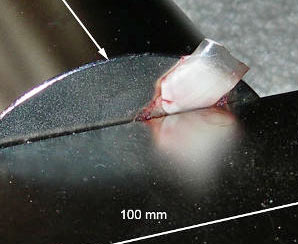
What you're looking at, here, is a sandwich. The sandwich's components are:

1: One large neodymium-iron-boron ("NIB") magnet.

2: The fingernail and finger-tip, mashed down to negligible thickness, of a gentleman called Dirk.

3: Another large NIB magnet.

Hackneyed though it is to say this, Dirk was lucky. He could have been luckier, I grant you, but he could also easily have lost a whole hand to rare-earth magnets this large.

You can read the whole grisly story here on the MagnetNerd.com site, the front page of which shows a couple of little half-inch-cube NIBs attracting each other through the thickness of a man's hand.

(The Magnet Nerd also has good pages about magnetic perpetual-motion machines and the various other evergreen magnet scams. And a line of chunky wooden implements to let you handle large NIBs, and pull the blighters apart, without losing any digits.)

The mutual attraction between magnets of all types increases, all other things being equal, exponentially as the magnets get bigger, and approximately with the inverse-cube of the distance between them. (That last part is the bit that really sneaks up on you.) So you can make an instant earring by sticking a couple of small NIB discs together with your ear-lobe in between, or you can smash your whole hand into wafer-thin steak tartare with a couple of magnets the size of cigarette packets.

I think it's brilliant that anybody can buy fist-sized NIB magnets from a variety of dealers - Forcefield ("WonderMagnet"), Engineered Concepts ("SuperMagnetMan"), and of course umpteen eBay dealers. I think the people selling them are generally very responsible, too; in product listings for the big buggers, there's usually a BE CAREFUL YOU IDIOT warning. And to my knowledge NIB magnets are generally very well packaged, too - collections of small magnets get a mild-steel wrapper, and really big magnets get great big double-boxed packaging, firmly holding the magnet in the middle of a large box.

The biggest magnets in this house are the two-inch-square trapezoid and two-by-one-inch cylinders from this old review. I don't know whether you could actually smash all of the bones in your hand by putting one of the cylinders on one side and one on the other. You'd probably just get a very nasty bruise. I'll leave the experiments involving gauntlets, eye protection and supermarket poultry to someone else, though. And the two-inchers ain't nothin' compared to what's on offer these days.

As I write this, a quick eBay search (if you use the not-often-useful "Price + Postage: highest first" sorting option) turns up a 4-by-1.5-inch disc for $US169.99 ex shipping, 2-by-2-inch cylinders for $US109.99, and, most terrifyingly, a two-inch sphere for $US139.99.

Spherical magnets have the problem that only a tiny area of their surface can be in contact with any other object - like another magnet - that isn't concave. For little sphere magnets - the quarter-inchers, for instance, that you can use to make impromptu rings or bracelets - this just means that they need extra-thick nickel plating so the little contact patches between the spheres won't quickly wear down to the brittle black ceramic of the magnet material itself.

A big NIB sphere, though, is aching to smash itself into other magnets just like every other big NIB, but is fated to deliver all of its terrifying impact energy to that one tiny contact point.

I imagine the X-rays of that victim would look quite interesting.

If you reckon it's time for everyone to start calling you "Lefty" or "Stumps", NIB-magnet dealers stand ready to assist you. The Engineered Concepts guy currently has a 6-by-1-inch ring magnet for $US425, 6-by-4-by-0.75-inch blocks for $US325, and wedges for the bold wind-generator maker (find info about this at Forcefield's other site, Otherpower.com) at $US720 for half of an eight-inch-outside-diameter ring.

Forcefield, meanwhile, will be pleased to sell you wedges suitable for making a 14-inch ring, for $US30 each. The rest of their range tops out around the two-inch size class.

(If you're for some reason not seized by an uncontrollable urge to maim yourself in an unusual way, I suggest Forcefield's $20 Grab Bag. It contains an assortment of different NIBs, none of which are big enough to give you anything worse than a blood-blister. If you're buying for a child - preferably one who's old enough to avoid swallowing more than one magnet - I suggest getting a large number of quarter-inch-or-smaller discs or cubes. They're cheap these days, and a lot of fun.)

"The suspect is 1,828,800 microns tall, and his irises reflect 465-nanometre light..."

A reader wrote to tell me that he'd replicated my ice-resistance-measuring experiment, with the same results - about ten million ohms per inch. Then he said:

...although in Oz, shouldn't that have been centimetres?

This pressed one of my numerous Talk Buttons, so I thought I'd pour my canned rant on this subject out into a blog post where you all have to put up with it, rather than only favouring that one correspondent with my deathless wisdom.

Because nobody's forcing me to stick to a style guide, I freely mix metric and imperial units - doing my best to avoid the traps that lie therein - when I think it's appropriate.

Fractions of inches are seldom useful for anything (to me), and are a pain to work with too - I've got a lovely little German Imperial-unit vernier caliper that confuses the heck out of me every time I try to use it. Metric vernier scales are easy, but the imperial one is another of those things that slither out of my brain as soon as I put the caliper down.

But metric units just don't come in the right sizes for some measurements. "About an inch", as in the ice-resistance measuring, clearly conveys the rough-eyeball-distance-measuring I was doing. The metric equivalent either suggests an excessive level of precision ("about 2.5cm" gives the impression that the range is no more than 2.3 to 2.7...), or is cumbersome ("between 2 and 3cm").

My favourite example of not-so-useful metrication is in measuring human height. Australian publications usually have a style guide that forbids feet and inches, or at least requires metric equivalents to be added in brackets. So "the suspect in the Brooklyn Slasher murders has been described as being about 6 feet tall" becomes "...about 183cm tall", which again suggests more precision than actually exists in the measurement.

Some people might even say "182.9cm" in this situation, giving the impression that someone's measured the suspect with a micrometer. Since a person's height can easily change by more than an inch depending on what shoes they're wearing and slight changes in posture, I think most human height measurements with precision beyond the inch level are actively misleading.

(Wikipedia has a good little article on "false precision". And here's a piece on seeing false precision where it in fact does not exist. I ramble on about the limits to precision in real-world measurement here.)

Science Sunday

I just measured the electrical resistance of ice.

Ordinary water-ice is a conductor, but not in the usual way. The charge-carriers in most electrically conductive substances are electrons and/or ions, but in water-ice they're protons - mobile hydrogen nuclei. Technically those protons do still count as ions, since they're a hydrogen atom without its electron, but proton conductivity is a distinctly different phenomenon from the usual kinds.

(I am indebted to the inimitable Bill Beaty - previously - for this information.)

So I was sitting here, and I thought, "let's see how conductive ice actually is".

First experiment: Plug multimeter probes into bench power supply.

(Just yesterday, I discovered that you can plug "shrouded" banana-plug multimeter probes into the usual sort of knobs-with-banana-sockets outputs from a power supply; just unscrew the knobs, and the probe-shroud fits neatly around the bare socket!)

Get ice cubes from fridge.

Wind power-supply up to maximum voltage (31V, for this eBay-cheapie supply). Stab probes into ice.

Current-display reading: Zero.

The scale on the bench supply bottoms out at 0.01 amps, though. Perhaps the resistance is just too high for 31 volts to be able to push 10 milliamps through it.

OK, let's try again.

Grab $10 yellow multimeter which for some reason I use much more often than my much more expensive Protek meter.

Set yellow multimeter to its highest resistance scale, which tops out at two megaohms. Stab probes into ice.

Reading: Off the scale, just like when the probes weren't touching the ice.

Suddenly remember that there is a reason why the Protek meter cost more. Its resistance mode tops out at 40 megaohms.

Set it to resistance mode, stab probes into ice.

Eureka! A reading!

With the probes separated by about an inch and only sticking into the ice a millimetre or two, I got a reading of about ten megaohms.

(I took care to avoid letting liquid water bridge the gap between the probes. The ice cubes were made from ordinary tapwater, and clean tapwater is a very lousy conductor - but once you're talking megaohms, all sorts of unlikely things are conductive enough to mess up a test like this.)

No wonder I didn't get a reading on the bench supply. 31 volts across ten million ohms gives a current of only 3.1 microamps. Even with the bench-supply probes really close together I was a few orders of magnitude short of the 10 milliamps that's the least the bench supply can display.

Perhaps it's not surprising that there are all those magic-water quacks. Water may seem to be a straightforward enough substance, but look just a little closer and it becomes as strange as electromagnetism. Hydrogen bonding, proton conductivity, a multitude of different kinds of ice, weird high-temperature, high-pressure behaviour... it goes on and on.

But I think there'd actually be just as much water woo-woo if water didn't do a single unexpected thing, not even expand when it froze. Crackpottery spontaneously generates all over the place, and bothers with scientific evidence only when some portion of that evidence can be used to support it.

(On the subject of ice, by the way, I highly recommend this book. It's full of gorgeous pictures of snowflakes, but it's not just another glossy coffee-table picture-book; it also has a lot of information about how ice forms and why it looks the way it does.)

You should see what it does to whiskey

Yet another reader leads me somewhere I'd rather not go:

Science Illustrated magazine is running an ad for the John Ellis water machine which I'm pretty sure is a big pile of steaming crapola. This ad is billed as a medical discovery, and contains testimonials from people who supposedly recovered from incurable diseases in just days. I've attached a scanned copy of the offending ad:

Water gizmo ad

Normal I'd just scoff at such ads, but this was in a science magazine, so I wrote the email below to the magazine. Could you confirm that I'm correct when I say this product is nothing but snake oil and voodoo science?

David

-------------------------

Hello Science Illustrated Magazine Staff,

Your magazine was recently included as a bonus gift with Popular Science magazine here in Australia. Your magazine was a good read but I cannot take it seriously as a science magazine because you carry a full page advertisement for the John Ellis water machine which is obviously nothing but snake oil.

You insult your readers by running such ads. Worse, by taking money to run such ads, you are complicit in offering false hope to terminally ill people with discredited voodoo science.

Any magazine should be ashamed to run such an advertisement, especially a science magazine. Your legitimate advertisers should be appalled to be seen in the company of John Ellis.

David
Melbourne Australia

------------------------

There's a long tradition of ads for questionable devices in the backs of magazines like Popular Science. "Build Your Own Flying Saucer", et cetera. I agree, however, that outright full-page quackery is not at all the same thing as the usual "Make Big Bucks By Raising Minks" sort of ad.

And yes, this is, so far as I and the entirety of the world's evidence-based scientists and medical practitioners can tell, bollocks.

There's a surprisingly large number of other "clustered" or "energised" or "oxygenated" water products out there. I've written about them myself from time to time (see also, The Wine Clip), as have others. See, for instance Penta Water, a classic clustered-water product sold by classic clustered-water salesmen.

The John Ellis "Electron Water Machine" is a bit unusual, because it is a machine, essentially a still, with which you can convert the lethal product of your kitchen cold tap into a transcendental substance alleged to have the usual long list of peculiar qualities.

The Electron Water Machine is, for instance, alleged to create "a water freed of diseased memory plus extra electrons and oxygen, lowered surface tension and enhanced hydration". The "extra electrons" are classic water quackery; a Nobel Prize in physics - or accidental destruction of the planet, whichever comes first - could be yours if you actually managed to make "extra electrons" just sit there in bulk water. And the "lowered surface tension" part is the sort of thing that a young child could measure, were it true.

The thing that really makes people selling the Ellis machines different from every other water nut is that "diseased memory" thing. Apparently the fact that any given water molecule on this planet is rather likely to have passed through a lot of human and animal kidneys before it makes it to your glass is very, very bad, and this terrible ju-ju must be exorcised to make the water not actively injurious to health. (Take that, you eight-glasses-a-day fools!)

Like almost all other water woo-woo, though, the output of an Ellis machine is likely to be harmless, which is more than can be said for a lot of quackery. People selling magic water, and people selling devices that shine coloured light on you to treat every disease under the sun-through-a-stained-glass-window, and people who're just practising homeopathy for that matter, usually get to do their thing without interference from the government. That's because the regulatory bodies are usually understaffed and overworked, and are flat out just trying to deal with the really monstrous quacks.

I would also venture the opinion that if a given person can't figure out that there's something fishy about John Ellis from the 5000 words of large-text ranting that currently comprises the johnellis.com front page, then that person is likely to hand their money over to some other quack soon enough.

And the Ellis distilling machine probably does make perfectly good distilled water, though I wouldn't be surprised to see a less-floridly-advertised still that does the same thing for half, or less, of the $US1500 price of the base-model Ellis device.

If you're interested in the burgeoning field of water woo-woo, allow me to recommend Stephen Lower's "Water-related pseudoscience, fantasy and quackery". He breaks the various varieties of H2O scammery down into categories - there's "ionized" and alkaline water, for instance, a category which includes Australia's own "Unique Water". (That stuff was going to revolutionise medicine some years ago, but never quite managed it, for some reason.)

The John Ellis Electron Water Machine gets its own page on Lower's site, here. Lower addresses the bizarre advertising claims that Ellis made until recently - like, for instance, that "Fifty years ago the hydrogen bond angle in water was 108° and you rarely heard of anyone with cancer. Today, it's only 104° and, as a result, cancer is an epidemic!!"

Had the angle of any hydrogen bonds actually changed, the fundamental chemical and/or physical properties of water would have changed with them and there's a good chance life on earth would have died out, Vonnegut style. And note that the Science Illustrated ad talks about breaking hydrogen bonds in water, not changing their angle.

In a trivial sense, of course the Ellis device breaks hydrogen bonds; the plethora of hydrogen bonds in water is what gives the tiny water molecule such a high boiling point compared to other small molecules like, for instance, carbon dioxide (boiling point -78.5° Celsius) or methane (b.p. -161.6°C). So to boil water, you have to break the hydrogen bonds, and all normal distillation gear does boil whatever it's distilling, so duh, his thing does too. But so would a kettle, or an appropriately-modified cat-food tin. Presenting the breaking of hydrogen bonds as being something special and unique is like saying "Only the '09 Datsubishi Grapefruit reduces exhaust nitrogen oxide to nitrogen and oxygen, and oxidises carbon monoxide to carbon dioxide, at the same time!"

(Oh, and just for the sake of completeness: Overall cancer rates have indeed, generally speaking, increased over the last century - but, one: Cancer incidence neatly tracks increases in life expectancy, on account of most cancer being a disease of the elderly; would you rather live to 87 and then die of cancer, or die at 12 of smallpox? And, two: Cancer treatment today is far better than it was in the 1950s. We don't have a cure for all cancers, but we certainly do have cures for a lot of them.)

As Stephen Lower's article points out, Ellis has now changed his selling strategy, no longer mentioning impossible quantum physics and switching to impossible biology instead. Ellis now alleges that ordinary stills let through all sorts of dreadful substances - drug residue, germs, those mysterious things he calls "disease markers" - which his special machines block.

These claims are not hard to test. It is easy to prove that various off-the-shelf benchtop water distillers do in fact give you distilled water with tiny-to-zero content of undesirable substances. Well, except for "disease markers", which I suspect do not mean the same thing to Ellis as they mean to everyone else.

Ellis's old nutty quantum-physics claims survive here and there on his site, too. Just look at the order form (PDF). It informs you that different models of "LWM Electron" machine can be had for between $US1500 and $US2800 (all apparently big discounts on the retail price!), but it also babbles on about "clusters of water molecules" that "pick up more electrons". And on he goes with the bizarre statements about air oxygen levels "as low as 10% near the traffic in major cities!", which is what us professionals refer to as "not true".

(Ellis is, however, amazingly enough actually right when he says that atmospheric oxygen levels, as measured from air trapped in prehistoric amber, were much higher in the distant past. That was well before even the first mammals evolved, though; the air's current 21% oxygen content has been nicely steady for a very great deal longer than humans have existed. This is a detail that Ellis, like the numerous carpetbaggers who base their business on oxygen rather than H2O, does not feel the need to mention.)

And then there's a document on Ellis' site called "A Picture is Worth 1,000 Words..." (PDF). The "picture" in this case is a rather hideous scan, talking about how the Ellis "Electron Machines" are the only ones that remove "disease markers", modify the bond angle of water, et cetera et cetera as per his previous front-page selling points.

The exact wording (minus the painful ALL-CAPS) of what seem to be the critical part of this rather confusing document is:

"NOTE: By breaking down the hydrogen bonds in water, the CEA marker went down the water went into the blood stream (94% water)!! No other water can do this and it can be seen under a microscope that the red blood cells are nice and round with plenty of movement caused by electron energy!"

This seems to be saying that red blood cells, among other things, are chronically dehydrated, or something, in people who drink ordinary water. One or another version of this is a frequent claim among water weirdos, and so far as I can see, it's yet another quivering hairy sack of bollocks.

The human body, like the bodies of every other form of cellular life, is indeed quite critically dependent upon the water content of its various fluids. Generally speaking, it's important for many bodily fluids to have neither too little nor - and here's the important part - too much water in them.

The process by which your body keeps the fluids at the right level of dilution is a subcategory of homeostasis, called osmoregulation.

There is not the slightest reason to believe that you need to drink some special kind of water to make osmoregulation work properly. On the contrary, in fact: If someone did manage to make a form of water that "goes through a membrane" more effectively than the ordinary kind, plumping up all of your red blood cells until they were indeed "nice and round", then you would be suffering from hypotonicity, gravely ill and probably well on the way to death from hyperhydration.

Fortunately, the special water from these Electron Machines is in fact just ordinary distilled water, so I'm pretty sure that drinking it will not plump up your blood cells and kill you dead.

But the plump-blood-cells stuff sounds pretty good to the average punter on the street, who is unlikely to know anything in particular about osmoregulation or atomic bond angles or the difference between polar and non-polar molecules. So it's easy for water quacks like Ellis to come up with a line of quantum flapdoodle that sounds good enough to sell even very expensive allegedly-therapeutic thingummies.

The same strategy doesn't work nearly as well when you're talking about things that ordinary people actually understand, like for instance the basic characteristics of cars. Fuel-additive scammers must carefully restrict their claims to areas where an unscientific investigation can leave the customer thinking there's been an improvement, like fuel economy. You're guaranteed a healthy flow of testimonials if you sell mothballs as a guaranteed fuel-economy booster, because customers can't test them properly. Someone who's inclined to buy your mothballs in the first place may also, for instance, be inclined to drive more gently after popping the pills into the petrol tank, on account of how he wants to make sure that he doesn't accidentally drive much faster and thus unfairly erase the pills' effects. And then hey presto, there's your testimonial.

If the sellers of potions and gadgets for cars used the same promotional techniques as the sellers of water woo-woo, they'd say stuff like "The ThunderPower WonderPill improves power in V6 and V8 engines by increasing the angle between the cylinder banks!", or "MegaCam enlarges and multiplies your camshafts!"

And then there's the medical scammers who toss their scientific word-salad really thoroughly and thus babble on about tightly-wound quantum-entanglement dimension-brane conjugance. The automotive equivalent of that sort of sales spiel would be something like "The Alchemagic Performance MaGNeT makes your car go faster, because it puts an extra carburettor in the semi-boloid luggage manifold!"

(Actually, I'm sure there are some car gadgets that do make claims like this. The "Magic Power System Power Shift Bar", which plugs into the cigarette-lighter socket, is supposed to not just "tune-up" your car, but also clean it. And I'm honestly not exactly sure what the "Car Drive Power Igniting Ignite Engine Air Power Plus" is supposed to do, but it says something about the "piston pressure", which suggests a compression-ratio change, which cannot be done without changing the shape of major engine components. There are probably a few more of these sorts of products in the California Environmental Engineering filing cabinet. But the successful magic car gadgets do not make claims that're so obviously idiotic.)

This sort of self-evident nonsense - self-evident, that is, to anybody who knows what at least some of the "quantum" words actually mean - does, however, remain adequate to get at least some people to buy really expensive magic health gadgets, like the Ellis Electron Machines.

And sure, most of these things are, in themselves, harmless. But every penny someone spends on one of them is a penny they could have spent on something that would actually make them more healthy - or at least more happy. And it all stops being funny rather suddenly when you start making straight-faced claims (oh, I'm sorry, when your happy customers start making straight-faced claims...) that your nutty gadget can, in as many words, cure cancer.

So don't worry about orthodox therapy, which that evil oncologist told you gives a 90% chance of complete remission for the rest of your life, as long as you act quickly. Don't you know that guy's one of the "Cut! Burn! Poison!" crowd? Just get yourself a magic still, and drink your way to perfect health!

I run MY ThinkPad from a Leclanché cell

Back in the day, you couldn't spit without hitting someone saying something completely wrong about memory effect. But today, really loopily idiotic writing about batteries is quite hard to find.

So I am indebted to the reader who just pointed me to one Dave Thompson's article in the Sydney Morning Herald, entitled "The big fat lie about battery life". (It also appeared in the Melbourne Age - the two papers are published by the same company and share a lot of material.)

My correspondent gave his heads-up e-mail the title "Worst. Battery. Technology. Article. EVER.", and I am delighted to say that I concur.

Mister Thompson is apparently under the impression that "average" laptops currently come with nickel-cadmium batteries. This hasn't actually been the case for more than ten years. Laptops with NiCd batteries were still easy to find as late as the mid-Nineties; the famous ThinkPad 701, for instance, apparently straddled the gap, with a NiCd battery for early-production 701s.

Nickel-metal-hydride batteries superseded NiCds, and then lithium-ion or lithium-polymer (generally a distinction without a difference; see this piece, from 2001, for more...) took over in the last few years of last century. The demise of NiMH in the laptop market was quite rapid, even though early lithium-ion batteries had a distressing tendency to drop dead after only a couple of years. But lithium batteries gave a lot more capacity per kilogram, and laptops were expensive enough items that manufacturers could put cutting-edge battery technology in them without greatly - proportionally speaking - increasing the price of the computer.

I don't think it's actually physically possible to buy even a NiMH-powered laptop any more, let alone a NiCd-powered one. Lithium-ion dominates the market, including the low end, and I don't just mean laptops. $20 Chinese Picoo-Z-knockoff helicopters, $12.50 tiger-shaped MP3 players, entry-level mobile phones, $US300 netbooks, you name it. I have a mobile phone that retails for a flat fifty bucks unlocked, and it has a lithium-ion battery. I cannot imagine how Dave Thompson has come by his view of the world.

All undaunted, though, Dave ploughs on with a number of fascinating details about the "NiCads" he alleges are still the standard power source for laptops.

Like, apparently they have a limited lifespan. Well, yeah, everything does, but NiCds are actually likely to work fine for many years if not abused. Few rechargeable lithium batteries are likely to be useful for more than five years.

"If not used properly they simply stop working". I thought he might have been thinking of memory effect or something, but no, he reckons they die if you don't use them, and need regular cycling.

You hear this all the time - it's not right out of left field like the bit about NiCds still being in common use - but it's not actually true. NiCds are actually known for their very long shelf life. If they've been on the shelf for a year then most of the charge will have leaked away, but even if they've been on the shelf for ten years you'll probably just be able to give 'em a charge and put 'em to work.

All you achieve by cycling most NiCd, NiMH or lithium batteries is wearing them out faster. There are certain situations where emptying and refilling a battery can be good - NiCds suffering from voltage depression, say, or LiI batteries whose monitoring hardware has lost track of how much capacity the battery actually has - and I think lithium-ion often hits its shelf-life limit before even someone like Dave can cycle it to death. There are special cases in the radio-control world, too, where absolute battery capacity may be less important than high current delivery and a shallow discharge curve, so your electric car or plane is almost as fast at the end of a four-minute race as it was at the beginning. But as a general rule, cycling your batteries is like "cycling" your car's fuel tank, by driving round the block until it's empty then filling up again.

Dave is, at least, correct that NiCds are a pollution risk if you throw 'em out. Cadmium is quite a lot more toxic than lead, and I think there's still no good way to recycle NiCd batteries, here in Australia at least.

So it's a bit of a shame that he's encouraging everybody to wear their NiCds out faster. Good thing laptops aren't actually powered by NiCds any more, ain't it?

The toxicity issue is one of the big reasons why the much-less-toxic NiMH batteries became popular; nickel pollution is a problem too, but nickel is rather less toxic than lead, and far less toxic than cadmium.

Fortunately, old dead NiCds aren't particularly dangerous just sitting there. So you might as well just toss any dead NiCds you have into a sealable container, put it under the house and forget about it, until someone comes up with a way to recycle them that doesn't involve sending them to China to poison people there.

Dave has noticed that, sometimes, someone who last used their laptop on battery power a long time ago discovers to their dismay that it now has "20 seconds" of battery life. He thinks this is because the battery hasn't been cycled. It's actually because modern laptops have lithium-ion batteries, and lithium-ion batteries have a relatively short lifespan (improving all the time, though - things aren't as dire as they were when I wrote this in 2004). If your laptop battery had 25% of its capacity left when you last disconnected the mains power, a year ago, then yes, it's very likely to be completely dead now, and there's nothing anybody could have done over the intervening months to avoid this. (It's possible that the battery is actually OK but the capacity-monitoring hardware has gone nuts, though; cycling might actually help, there. It's also possible that the laptop has a dumb charger circuit that's slowly barbecued the battery; cycling would in this case be a waste of time.)

Well into the article, Dave remembers that NiMH batteries exist - but then immediately refers to "NiCad's well-known memory effect", resetting the clue-meter to zero just when it looked as if he was making some progress. And then he signs off with "All batteries like to be used, so run them down every few weeks and charge them back up properly just to keep them in top shape", cementing his position in the I Hate The Environment, Die, Environment, Die, Coalition.

Maybe, I thought, Dave just had a small stroke while writing this article and is usually quite sensible. So I had a little look around for other examples of his work.

Apparently cameras, wireless peripherals and "pen-drives" can reasonably be expected to work only once, which is news to people who've been using the same wireless Logitech mouse-and-keyboard set for the last ten years.

Oh, and wireless input devices "eat batteries like a cop in a donut shop".

If current wireless-desktop gear is only as good as the devices I reviewed in 2001, this means police officers have listened to their cardiologists and reduced their consumption of doughnuts to maybe one every two months, tops. Good for them!

He has also written... a thing... about Linux. I wouldn't call it an article. I'm not sure what it is.

(This piece has the brilliant subtitle "Dave Thompson gives his take on Google's new search engine, Chrome", but that's probably the work of a subeditor, not Dave. Mr Thompson tried his best, though, complaining about the usage-tracking feature of Chrome without figuring out that you can turn it off any time you like, and don't have to turn it on in the first place.)

The end of Dave's wonderful battery article says Dave "runs a computer-services company in Christchurch, New Zealand". I think this is it. I wonder if his workmates have some stories?

I don't know how Dave's managed to end up with the ideas he's got. Mere incompetence is common enough in all branches of journalism, but Dave's version of it is odd. Perhaps he just fixes his opinion of every computer technology when he plays with version 1.0, and assumes that 20 years later it'll still be the same. Who knows.

(Oh, and here his battery article is on the Stuff.co.nz site, in case the Herald/Age people do another of their embarrassing-article disappearing acts. Here are other sources, from a Google search for a string from the article.)

Today's DealExtreme-RSS-feed-spawned post

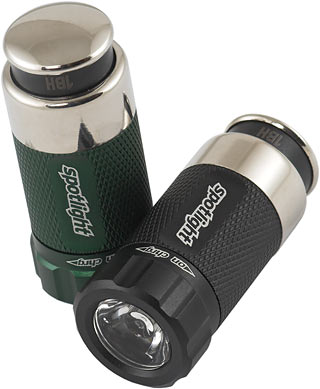
Spotlight flashlight

I'm sure you usually only visit DealExtreme (previously) for their delightfully wide range of prophylactics, but they now also stock the "Spotlight" cigarette-lighter-charged flashlight that I reviewed a little while ago.

It's yours for $US18.80 including delivery to anywhere, PayPal only. The standard price is $US14.95 ex delivery, so unless you've got a bricks-and-mortar shop nearby that stocks it, the DX option is very likely to be cheaper, for people outside the USA at least.

(The two vendors I originally mentioned in my review are JTSpotlight and 12VSpotlight.)

If you're outside the USA you'll probably get the light about as fast from DealExtreme as you would from anybody else, too. DealExtreme usually take a while to deliver stuff (I've not yet received my tiny plastic Buddha, for instance), but that's because they're drop-shipping, just telling the Chinese factory that makes whatever you've bought to send it to you. With perhaps some minimal amount of cobbling-together of orders on the actual DealExtreme premises as well, just to add a few more days to proceedings.

Drop-shipping means you get to wait however long each factory takes to get stuff packed and posted. But DX is presumably selling Spotlights direct from the manufacturer, too, and I think the Spotlight makers don't also make a wide range of three-dollar Chinese oddities, so they ought to respond faster.

(If you order a Spotlight and it arrives seven months later, packaged between two Zebu cowpats that're held together with a strand of barbed wire, I accept no responsibility. But do feel free to vent in the comments.)

UPDATE: As reader Changes points out in the comments, DX now also have a brandless "OEM" version of the Spotlight, for a princely $US8.50 delivered.

Still smarter than most spammers

There's an "Ask Dan" button on all of Aus PC Market product pages, that allows people to ask me stuff about AusPC products, in the hope that I may perhaps answer them and then put the correspondence on my site as an Ask Dan page.

We haven't been able to make it completely clear that this feature is for people asking, for instance, whether Video Card A or Video Card B is better for Fallout 3, rather than stuff I don't know like how long something's power cord is. But even without a How Not To E-Mail Me scare page, by and large the Ask Dan buttons work quite well.

In the last few days, some spambot has latched onto Ask Dan. It's clearly mistaken the send-me-an-e-mail form for a Web-forum comment form, and is attempting to use it to post comment spam.

So now I'm getting mail from sukmishelpfs@yahoo.com and lcfwasolzg@gmail.com and so on that says stuff like

<a href= http://viagraonlinebest.50webs.com/viagra-for-woman.html|viagra for
woman ></a>
[url=http://viagraonlinebest.50webs.com/viagra-for-woman.html|viagra for
woman][/url] <a href=
http://viagraonlinebest.50webs.com/viagra-price.html|viagra price ></a>
[url=http://viagraonlinebest.50webs.com/viagra-price.html|viagra price][/url]
<a href= http://viagraonlinebest.50webs.com/viagra-generic.html|viagra generic
></a> [url=http://viagraonlinebest.50webs.com/viagra-generic.html|viagra
generic][/url]

or

<a href= http://casino-best.bebto.com/on-line-casino.html >on line casino</a>
[url=http://casino-best.bebto.com/on-line-casino.html]on line casino[/url] <a
href= http://casino-best.bebto.com/no-download-casino.html >no download
casino</a> [url=http://casino-best.bebto.com/no-download-casino.html]no
download casino[/url] <a href=
http://casino-best.bebto.com/online-casino-gambling.html >online casino
gambling</a>
[url=http://casino-best.bebto.com/online-casino-gambling.html]online casino
gambling[/url] <a href= http://casino-best.bebto.com/casino-game-online.html
>casino game online</a>
[url=http://casino-best.bebto.com/casino-game-online.html]casino game
online[/url]

(The above is quite heavily abridged.)

The funny part is that the spambot has decided to post its mis-aimed comments in the Ask Dan form for exactly one AusPC listing, for this defunct server. Because that product is no longer available, the product page now has no Ask Dan button on it; there is no way for anybody to actually navigate to that product's Ask Dan form. And yet, the spambot keeps Asking Dan about it!

So somehow it's gotten it into its tiny little brain that the Ask Dan page for that product - URL http://www.auspcmarket.com.au/popup/email_dan.php?product_code=SY-CSPC-7045A-TB, which I just created by pasting the server's product ID in place of the ID of another product - is the gateway to bold new markets for online casinos and pills that probably aren't Viagra.

I hope it doesn't discover any of the thousands of other Ask Dan forms. It's much easier to filter this way!