10,537 bytes with which I do not agree

Never let it be said that I don't give people who disagree with me a fair suck of the saveloy.

(Amazingly enough, that's actual genuine Australian slang, though a bit old-fashioned these days.)

My post the other day about anti-vaccinationist Jock Doubleday attracted some feedback from him, culminating in a comment of epic dimensions. Since I've an innate sympathy for anybody who, like me, appears to buy ink by the barrel, and because this is such a brilliant example of the breed, I hereby award said comment a post of its own, just as I did with the last one.

(My own comments on this comment, of course, follow.)

I understand if you believe it's a waste of your time to argue with someone who has stepped out of the vaccines-as-salvation paradigm.

Your belief in vaccines as the greatest good stems from decades of institutional indoctrination -- indoctrination which I also had but which I was allowed to break free from by a chance encounter with someone who had also broken free.

You can continue on with your beliefs -- and with your endless making-it-about-me -- but the truth about vaccines is waiting for you in over a century of scientific research.

Commenter #8 mentioned smallpox. Regarding this disease, please take time to read Dr. Tim O'Shea's article:

http://www.thedoctorwithin.com/smallpox/Smallpox-Bringing-a-Dead-Disease-Back-to-Life.php

Below are the sources I used for my article "Into the Labyrinth: Discovering the Truth about Vaccination" . . . for your consideration.

If you or anyone commenting here would prefer to have a discussion about vaccine efficacy somewhere other than this blog, I can post all discussions on my site. I have had the following URL up for several years with no takers:

"The Great Vaccination Debate"
http://spontaneouscreation.org/SC/OpenLetterToBelieversInVaccination.htm

Or we could carry on a conversation on another site of your or one of your commenters' choosing.

If anyone wants to discuss vaccines, you may first want to read these MDs and medical historians:

http://www.whale.to/m/critics.html

If you would prefer to hear nothing more from me here on vaccination, I will be happy to refrain from posting here again. Just let me know.

You are always welcome to write to me at:
director@spontaneouscreation.org

Vaccine info sources below.

In health,
Jock Doubleday

VACCINE EFFICACY?

http://www.vaclib.org/sites/debate/index.html

http://www.thinktwice.com/

http://www.whale.to/vaccines.html

http://www.909shot.com/

http://vaccineinfo.net/

http://www.foundationforhealthchoice.com/

http://www.avn.org.au/

http://www.vaclib.org/

http://www.thedoctorwithin.com/

http://www.vaccinepolicy.org/

http://www.whale.to/v/obomsawin.html

http://www.know-vaccines.org/

http://www.vaccine-info.com/

http://www.vaccines.bizland.com/

http://www.geocities.com/Heartland/8148/vac.html

http://www.informedparent.co.uk/

http://www.vaccinationnews.com/

VACCINE INGREDIENTS

http://www.vaclib.org/basic/vacingredient.htm

http://chemfinder.camsoft.com/

AIDS LINKED TO MASS POLIO VACCINATION

http://www.uow.edu.au/arts/sts/bmartin/dissent/documents/AIDS/

http://www.uow.edu.au/arts/sts/bmartin/dissent/documents/AIDS/River/Hooper_00/

ANIMAL VACCINES

http://www.healthy.net/library/articles/ivn/animals.htm

http://www.ahvma.org/

http://cyberpet.com/cyberdog/articles/health/vaccin.htm

http://www.canine-health-concern.org.uk/

http://www.shirleys-wellness-cafe.com/petvacc.htm

http://www.animalhomeopathy.net/

ANTHRAX VACCINE

www.gulfwarvets.com/anthrax.htm

ANTIBODIES AND VACCINES

http://www.whale.to/vaccines/antibody.html

http://vaclib.org/intro/qanda3.htm

ARMY VACCINES

http://www.gulfwarvets.com/winds.htm

http://www.all-natural.com/gwi-1.html

ASTHMA AND VACCINES

http://www.whale.to/vaccines/asthma.html

http://www.whale.to/v/asthma3.html

AUTISM AND VACCINES

http://articles.mercola.com/sites/articles/archive/2008/01/02/vaccine-induced-autism.aspx

http://articles.mercola.com/sites/articles/archive/2000/10/01/autism-mercury-part-one.aspx

http://articles.mercola.com/sites/articles/archive/2001/02/24/autism-mercury-part-two.aspx

http://www.wellbeingjournal.com/index.php?option=com_content&task=view&id=491&Itemid=77

http://www.unlockingautism.org

http://www.taap.info/articles.asp

http://www.autismuk.com/

http://www.mercola.com/2001/mar/7/autism_vaccines.htm

http://www.garynull.com/Documents/autism99b.htm

CHILD ABUSE (shaken baby syndrome) AND VACCINES

http://www.falseallegation.org

http://www.freeyurko.bizland.com/contents.html

CHURCH OF VACCINATION

http://www.healthy.net/asp/templates/article.asp?PageType=Article&ID=1121

CONFLICT OF INTEREST AND VACCINES

http://articles.mercola.com/sites/articles/archive/2000/05/21/research-for-sale.aspx

http://articles.mercola.com/sites/articles/archive/2000/09/24/vaccine-approvals.aspx

http://www.wellbeingjournal.com/index.php?option=com_content&task=view&id=52&Itemid=65

http://www.mercola.com/2000/oct/15/congress_conflicts.htm

http://www.mercola.com/2001/sep/15/vaccines.htm

http://consumerlawpage.com/article/vaccine.shtml

http://www.cspinet.org/new/200303101.html

DIABETES AND VACCINES

http://www.nvic.org/vaccines-and-diseases/Diabetes/congressionalhearing.aspx

http://www.nvic.org/vaccines-and-diseases/Diabetes/juvenilediabetes.aspx

DIPHTHERIA (DPT) VACCINE

http://www.whale.to/v/asthma3.html

DPT VACCINE LINKED TO PARALYTIC POLIO

http://www.pnc.com.au/~cafmr/online/vaccine/polio.html

DISEASE THEORY AND VACCINES

http://www.pnc.com.au/~cafmr/reviews2.html#pasteur

http://www.pnc.com.au/%7Ecafmr/reviews2.html

EXEMPTIONS / WAIVERS FOR VACCINES

http://www.geocities.com/titus2birthing/VacRefuse.html

http://www.nccn.net/~wwithin/exemptions.htm

http://www.geocities.com/titus2birthing/WhyChoose.html

http://www.know-vaccines.org/exemption.html

http://www.gval.com/exempt.htm

FLU VACCINE

http://www.healthy.net/library/articles/ivn/flu.htm

FORCED VACCINATION

http://www.naturalnews.com/022384.html

http://www.youtube.com/watch?v=r6Vj0EX_STU

http://www.wnd.com/news/article.asp?ARTICLE_ID=54095

http://www.globalresearch.ca/index.php?context=va&aid=1117

http://www.disinfo.com/content/story.php?title=Help-Stop-Forced-Vaccination-Children

http://www.naturalnews.com/022384.html

GARDASIL (HPV) VACCINE

http://www.wnd.com/news/article.asp?ARTICLE_ID=54095

HEPATITIS B (HEP B) VACCINE

http://www.vaccinationnews.com/DailyNews/June2001/HepBVaxReactOutnumbCases.htm

http://www.vaccinationnews.com/DailyNews/July2001/HepBDis&VaxFacts.htm

http://www.vaccinationnews.com/DailyNews/August2001/HepBVaxForNewborns.htm

HOMEOPATHY AND VACCINES

http://www.healthy.net/library/articles/moskowitz/vaccination.htm

http://www.healthy.net/library/articles/moskowitz/unvaccinated.htm

http://www.tinussmits.com/english/

http://www.animalhomeopathy.net/

IMMUNE SYSTEM AND VACCINES (autoimmune disorders)

http://www.healthy.net/library/articles/neustaedter/immune.htm

MMR VACCINE (Measles Mumps Rubella)

http://www.nvic.org/vaccines-and-diseases/MMR.aspx

http://cryshame.net/index.php?option=com_search&searchword=pport

MMR AND AUTISM

http://www.autismuk.com/

POLIO VACCINE

http://www.vaccines.plus.com/

http://thinktwice.com/s_polio.htm

http://www.uow.edu.au/arts/sts/bmartin/dissent/documents/AIDS/

RUBELLA VACCINE

http://thinktwice.com/s_rubell.htm

http://www.garynull.com/Documents/autism99b.htm

SIDS (sudden infant death syndrome) AND VACCINES

http://www.pnc.com.au/~cafmr/coulter/sids.html

http://www.pnc.com.au/~cafmr/coulter/vacc-deb.html

http://www.pnc.com.au/~cafmr/newsl/kalo.html

TETANUS VACCINE

http://www.whale.to/a/tetanus.html

http://www.whale.to/vaccines/tetanus.html

http://www.ncbi.nlm.nih.gov/entrez/query.fcgi?db=PubMed&cmd=Retrieve&list_uids=1565228&dopt=Abstract

TUBERCULOSIS AND VACCINES

http://www.whale.to/m/point1.html

UNVACCINATED CHILDREN

http://www.healthy.net/library/articles/moskowitz/unvaccinated.htm

VACCINE ADVERSE REACTIONS

http://www.gn.apc.org/inquirer/vaccio.html

VACCINE ARTICLES

http://www.ivanfraser.com/articles/health/vaccination.html

http://www.curezone.com/art/1.asp?C0=735

http://www.icpa4kids.com/pediatric_chiropractic_articles_immunizations.htm

http://www.healingwell.com/library/health/thompson2.asp

http://www.wellbeingjournal.com/index.php?option=com_content&task=view&id=52&Itemid=65

http://www.mercola.com/2003/jul/12/vaccine_procedure.htm

http://www.healthy.net/clinic/familyhealthcenter/children/vaccination/articles.asp

http://www.korenpublications.com/

http://www.wellbeingjournal.com/index.php?searchword=vaccines&option=com_search&Itemid=

VACCINE CHALLENGE (Jock Doubleday's)
http://www.spontaneouscreation.org/SC/$75,000VaccineOffer.htm

VACCINE CHALLENGE (Viera Scheibner's)

http://vaccinationnews.com/DailyNews/October2001/VaccinationChallenge.htm

VACCINE CRITICS

http://www.whale.to/m/critics.html

VACCINE HOAX

http://www.whale.to/a/hoax.html

VACCINE LINKS

http://www.vaclib.org/links/vaxlinks.htm

http://wolfcreekranch1.tripod.com/human_vaccines.html

http://www.industryinet.com/~ruby/vaccinations.html

VACCINE PACKAGE INSERTS (pdf files)

http://www.vaclib.org/chapter/inserts.htm

VACCINE SITES (GOVERNMENT) Vaccine Adverse Event Report System (VAERS)

http://www.fda.gov/cber/vaers/vaers.htm

VACCINE QUOTES

http://www.whale.to/a/hoax.html

VACCINE BOOKS

Jamie Murphy, What Every Parent Should Know about Childhood Immunization

Tim O'Shea, The Sanctity of Human Blood: Vaccination Is Not Immunization

Neil Z. Miller, Vaccines: Are They Really Safe and Effective?

Robert Mendelsohn, How to Raise A Healthy Child in Spite of Your Doctor

Walene James, Immunization: The Reality Behind the Myth

Tedd Koren, Childhood Vaccination: Questions All Parents Should Ask

Randall Neustaedter, The Vaccine Guide: Risks and Benefits for Children and Adults

Raymond Obomsawin, Universal Immunization: Medical Miracle or Masterful Mirage?

Ethel Douglas Hume, Pasteur Exposed: The False Foundations of Modern Medicine

Harris L. Coulter and Barbara Loe Fisher, A Shot in the Dark: Why the P in DPT Vaccination May Be Hazardous to Your Child's Health

Leon Chaitow, Vaccination and Immunization: Dangers, Delusions and Alternatives

Harris L. Coulter, Vaccination, Social Violence and Criminality: The Medical Assault on the American Brain

Viera Scheibner, Vaccination: 100 Years of Orthodox Research Shows that Vaccines Represent a Medical Assault on the Immune System

Neil Z. Miller, Vaccines, Autism, and Childhood Disorders

Neil Z. Miller, Immunizations: The People Speak!

Catherine J.M. Diodati, Immunization: History, Ethics, Law and Health

Epidemics: Opposing Viewpoints (Opposing Viewpoints Series, Unnumbered) by William Dudley, Ed., Mary E. Williams, Ed., Greenhaven Press (January 1999)

VACCINE BOOK SITES

http://www.know-vaccines.org/reading.html

http://thinktwice.com/vaccine.htm

http://www.korenpublications.com

http://www.cure-guide.com/Vaccine_Guide/vaccine_guide.html

http://www.noamalgam.com/vaccinations.html

http://www.vaclib.org/sites/debate/about.html

AUTISM BOOKS AND ARTICLES

http://www.autismwebsite.com/ari/index.htm

http://www.impossiblecure.com

http://www.baps-online.co.uk/28.html

VACCINE BOOK REVIEWS

http://www.pnc.com.au/%7Ecafmr/reviews2.html

VACCINE VIDEOTAPES

http://www.vaclib.org/basic/products.htm

Comment by jockdoubleday — May 11, 2009 @ 5:20 am

Phew.

To other readers of this site, not to Jock:

The above comment is a fine example, if you haven't encountered one before, of the "quantity of evidence" or "filibuster" approach, in which a person attempts to justify their beliefs by presenting an enormous number of references which are claimed to - and sometimes actually all do - agree with their point of view. It's a great technique for people who're opposed to the scientific consensus, because it gives people who disagree a huge task - "Don't comment before you've read them all!" - while relieving the claimant of the task of actually forming an argument, or even of saying with which of the numerous sources he or she agrees.

Given the large number of human beings in the world and the very long time that some people have spent believing just about any odd thing you care to name, though, it is unsurprising that you can come up with a long list of books and papers and pamphlets and speeches and Web pages from people who believe just about anything you like. Einstein was wrong, the speed of light is infinite, the colour of human of your choice is superior to the other colour of human of your choice (with the "superiority" arrow pointing in all possible directions between "black", "brown", "white", "yellow", "very importantly different kind of yellow" and "red"), the MMR vaccination causes autism, abstinence-based sex education works, et cetera.

I have a suggestion for any readers who're enthusiastic about giving Jock a fair hearing, but who also have, you know, stuff to do other than spend months digging for a nugget of truth in the above large pile of... data. I suggest you randomly pick one or more of the above, and see what they have to say.

I stuck a metaphorical pin into the above list, avoiding the ones whose names I already recognised (like the ones who say that "shaken baby syndrome" can be caused by vaccines; how delightful!), and settled on "Pasteur Exposed: The False Foundations of Modern Medicine", by one Ethel Douglas Hume.

Thanks to this helpful review from a believer, I know that this work was originally published in 1923, and advanced the views of one Professor Antoine Béchamp over those of Pasteur.

Ethel took a while to finish her book about Béchamp, seeing as he died in 1908, at the end of a long and productive life in which I feel safe in saying his dispute with Pasteur was not the high point. Béchamp believed in pleomorphism, the view that in certain conditions, animal cells can turn into different animal cells. This much is not incorrect; certain cells, like stem cells, certainly can "differentiate" into other kinds of cells.

But Béchamp took this further. He believed that when you get a particular illness, and a particular kind of bacteria are then found in your body, those bacteria were actually created by tiny "microzymas" in your body which have been caused, by the disease you have, to turn themselves into bacteria rather than into the normal cells of your body.

Here's a believer's page about Béchamp's theory, which says it's "never been refuted". I take exception to that, because we have now studied human cells and bacteria at all scales down to individual molecules, and have abundant evidence that bacterial infection causes bacterial diseases, and that bacteria arise solely from other bacteria, and that there does not seem to exist anything that looks even slightly like a "microzyma".

It has, for some decades now, been quite easy and inexpensive for ordinary people to do biology experiments at home. If you happen to have a placenta handy, you can isolate amniotic stem cells from it; you can even sequence your own DNA at home.

So even if you, like Jock, believe science to be a form of evil religion, you can fiddle about with bacteria in the privacy of your own home in ways that Béchamp and Pasteur could only dream of, and establish for yourself which one of them had the right end of the stick.

(We're also, unfortunately, getting some more plain-as-day hard evidence of the importance of vaccinations, courtesy of people who believe the anti-vax arguments and don't vaccinate their children. As herd immunity falls, more kids get sick, and people are reminded why it was that we started vaccinating against diseases like measles, mumps and rubella, which can be deadly. I'm sure the antivaxers have a very good explanation for this.)

The publishers' blurb on this Amazon page for the 1988 reprint of "Pasteur Exposed" says:

"This extraordinary history of the germ theory, among other things, shows that vaccination far from saving millions of lives has cost millions. In destroying Pasteur's ideas, the author has introduced us to Bechamp, whose experiments produced the first scientific evidence of how homoeopathy, acupuncture and all holistic therapies can cure disease while conventional medicine can only treat it. The implications of Bechamp's discoveries are far reaching and have yet to be realized, and it is hoped that this book will be an inspiration to scientists, therapists and the general public who are beginning to sense the futility of the conventional approach."

Humankind's ever-increasing life expectancies would seem to me to militate against this view that "the conventional approach" is "futile"; I actually suspect that most people who held this opinion in 1924 would, if they saw today's world, admit that they'd got it wrong. I mean, never mind all the people whose cancer has been cured before it became more than a little lump, let alone what used to happen; we've got a smallpox-free world, which notably also does not contain thousands of children doomed to spend the rest of their lives in an iron lung, I'm sorry but the allegation that the polio vaccine had nothing to do with this always makes me just a little bit fucking angry.

The anti-vaccinationists a hundred years ago were all saying that vaccination would never achieve a damn thing and we should all use their homeopathy or other "holistic therapies". Well, we haven't used those therapies, we have used vaccination, and the evidence is there to see for anybody who doesn't still insist on waving books from 1923 in the air as if their projections of what might happen in their future are more valuable than our direct knowledge of what happened in our past.

There's a wonderful pull-quote above the publishers' blurb, too:

"This plagiarist (Pasteur) was the most monumental charlatan whose existence is disclosed to us in the entire recorded history of medicine." - M.R. Leverson

Oh, my! And who is M.R. Leverson when he's at home, I wondered?

Well, here Montague R. Leverson is in a New York Times story from 1901, refusing to report smallpox cases to the NY Board of Health, on the grounds that the government would only lessen their chances of recovery. Here he is again, opposing public-school vaccinations in 1895, and complaining about them in the Journal of the American Medical Association in 1897. Leverson was a doctor... of homeopathy. (And is alleged to have been a bit of a charlatan himself, but this is neither here nor there.)

Homeopathy, I remind you, is the idea that water can remember substances it used to be in contact with, when it is shaken by a person who intends it to remember those substances, and will after this become more and more powerful the more strongly it is diluted, and cure whatever diseases are caused by the substance which the water was once in contact with would cause, in large doses. (Got that?)

Homeopathic doctrine, unlike scientific medicine, has stayed pleasingly static ever since Samuel Hahnemann first discovered that giving people water described as medicine worked better than the orthodox medical treatment of his time, which was the year 1796.

Grab a sawbones from 1796 and put him in a modern hospital and he'd be completely mystified, but a homeopath from the turn of the 19th century would be right at home in a modern homeopath's office, after a brief refresher course on the strange ways in which homeopathic remedies can today be "proven".

It's still easy to find homeopaths who claim to treat cancer, autism, diabetes, you name it; but strangely enough, the world-shaking news that serious ailments with clearly-defined endpoints can be cured by something that orthodox science says is just water, or a sugar pill, has not been forthcoming. Once again, these practitioners don't follow up on their patients, and there's no evidence beyond the say-so of the practitioners that their patients are any better off, for diseases that aren't amenable to treatment by placebo.

Homeopathy today has lots of remedies that are "proved" in strange, metaphorical, poetic ways. As with other areas of human endeavour that're essentially just sympathetic magic, this means that any homeopath can claim anything about anything, if they're clever enough. It's like postmodern literary criticism.

Homeopathic "preparations" of straightforward poisons like arsenic can, by this mechanism, end up with a hilarious laundry list of conditions for which they're meant to be effective.

"Arsenicum Album" is, to be fair, not usually quoted as a homeopathic cure for cancer - but it is normally quoted as being effective against the paralysing fear of death suffered by terminal disease patients!

The reason for this is that, wait for it: If a homeopathic remedy doesn't treat the actual illness (in this case, death) that the homeopathically-diluted-out-of-existence substance it's based on (in this case, arsenic) causes when administered in macroscopic doses, it must treat that which is psychologically associated with that illness!

Poetry, right there!

(Some "homeopathic" remedies, of course, simply and rather boringly contain pharmaceutically effective concentrations of real drugs. Nobody can figure out how this happens.)

Amazon has a listing for another book by Ethel Hume, "Béchamp or Pasteur? A Lost Chapter in the History of Biology", with some "Look Inside" pages to give you a peek at its content. (These people are selling a modern impression of that book, and offer some downloadable sample chapters, but the server's currently down.)

And all this fun came from only one of Jock's references! Just imagine how much entertainment can be had from the rest!

(Do feel free to add your comments about any of the other sources in Jock's huge list.)
I'm still waiting for mail from Jenny McCarthy

I was pleased to see the anti-vaccinationist Jock Doubleday's comment on a post here.

(I was less pleased to see that he'd added the same comment to a post that has nothing to do with his thesis. I've deleted that one.)

Comments on past posts aren't very frequently read, so I've taken the liberty of reproducing Jock's comment here:

Hi Dan,

If you want to link to my actual vaccine challenge, as opposed to a psychopath's lies and speculations about it, you can link to this URL:

http://www.spontaneouscreation.org/SC/$75,000VaccineOffer.htm

Have a vaccine-free day!

In health,

Jock Doubleday
Director
Natural Woman, Natural Man, Inc.
A California 501(c)3 Nonprofit Corporation
http://www.SpontaneousCreation.org
director@spontaneouscreation.org

Jock Doubleday is the author of
"Spontaneous Creation:
101 Reasons Not to Have Your Baby in a Hospital, Vol 1:
A Book about Natural Childbirth and the Birth of Wisdom and Power in Childbearing Women"

Comment by jockdoubleday — May 9, 2009 @ 5:01 am

Do feel free to explore Jock's bold hypotheses about human health, and his above-linked "Vaccine Offer".

Jock unaccountably failed, however, to link to the entirely reasonable terms to which prospective challengers have to agree. Strangely, he doesn't even link to the terms from the Vaccine Offer page itself. Perhaps he was too busy crowing over how he's had no takers for the Offer, which is odd, because as I said, the terms are entirely reasonable and completely not the sort of thing that no human could ever possibly pass.

Summarised, the terms are:

Prospective challengers must be doctors who administer vaccines, or the CEO of a pharmaceutical company. They must be evaluated by three consecutive psychiatrists, named by Jock but paid for by the challenger, who will report their findings in secret to Jock. Then the challenger must provide records of their entire mental-health history to Jock. Then they must pass an e-mail exam about vaccinations, getting all answers right, with the rightness of the answers being determined by Jock, whose strange opinions about vaccines are the source of this whole thing in the first place. Then the challenger must purchase five anti-vaccination books. Then the challenger must take a written exam, once again marked by Jock. Then the challenger must be physically examined by a "medical professional" named by Jock. Then the challenger must not gain more than five pounds of weight between the examination and the actual challenge. Then the challenger has to find three more "medical professionals", who'll get together with another three "medical professionals" provided by Jock, to put the vaccine-challenge dose together. Then the challenger has to provide Jock with risk/benefit documentation they provide to patients they vaccinate. Then the challenger has to appear on television at least five times with Jock, on stations and at places named by Jock, with all of the challenger's travel, food and accommodation costs paid for by the challenger.

That's all just too easy, I'm sure you all agree, so you'll be pleased to learn that all of the above comprises only "Part A" of the contract!

Part A is to be followed by an "Agreement-in-Full". If the challenger finds the terms of the Agreement-in-Full to be unacceptable, whatever they turn out to be, all they have to do is, per Part A, donate $US5000 to Jock's anti-vaccination organisation.

It really couldn't be simpler, could it? I can't understand for a moment why so very many people think Jock's just another crank.

(Jock would also like you to know that the state of the world today is the result of an Illuminati conspiracy. Which, I suppose, may include your family doctor and the World Health Organization.)

[Jock got back to me again after this post, leading to this further post.]

Basic electronics to make your organ glow

A reader writes:

Thanks for your Embarrassingly Easy Case Mod page.

Sorry to be such a techno-dummy, but: You said that because each color-changing LED was 3V, you could connect 4 of them in series to a 12V source. So the LEDs divide the voltage between them? If that's true, how can you connect multiple AC devices to an exension cord and have each of them receive 117v?

Anyway, I'm converting an electronic theater organ to MIDI, and would like to add 20 color-changing LEDs to the console. (Thought you'd appreciate the details, eye-candy-wise.) How do you suggest I do that? If I wire them in series, what sort of DC power would I need?

I know you're a busy guy, so thanks very much for giving me a clue about this. I promise I'll do my best not to blow myself up.

Andy (Vancouver, BC)

Yes, you can run a string of four RGB LEDs from a 12V power supply. They're odd little critters, though, and it's important to understand why this works as well as just the fact that it does. You can make electronic things that work by just blundering around with no understanding of what's really going on, but it really does pay to spend some time learning the basics of at least DC electronics before you start on any electronic project. Hence, this lecture.

In the four-RGB-LEDs-from-12V situation, the LEDs can be regarded like ordinary passive DC-circuit components, like resistors or batteries. But LEDs can't usually be treated that way. Two-leg 5mm RGB LEDs may look like the usual kind of LED, but they're actually three LED dies with a tiny controller circuit, all in a normal 5mm LED package.

If you make a string of simple resistors that all have the same value - let's say, five two-ohm resistors - and hook one end up to the positive terminal of your DC power supply and the other to the negative, a current will flow that's determined by the total resistance and the voltage, according to Ohm's Law: Voltage in volts equals current in amps multiplied by resistance in ohms, or V=IR.

(Ohm's Law is usually written with "I" as the symbol for current, rather than A-for-amps, because when Georg Ohm came up with the Law nobody really knew what current was, and it was referred to as "Intensity". Feel free to write it with an A if you like.)

If the power supply is outputting, let's say, 12 volts, a string of five two-ohm resistors in series will work out as follows:

12 = I*2*5
12 = I*10
12/10 = I
I = 1.2

So the current in this circuit would be 1.2 amps. Because the resistors all have the same resistance, each one "drops" the same voltage. If you measure the voltage "across" the central resistive element of one of the five resistors in this circuit, it'll be 2.4 (12/5) volts. Measure across two resistors and you'll see 4.8V, three will be 7.2V, et cetera. (If the resistors in the chain have different values, they'll drop different amounts of voltage, and dissipate different amounts of power, making you use a polynomial equation if you want to figure out which resistor's doing what.)

To visualise this, think of the current as a flow of water in a hose and each resistor as a narrowing, or kink, in the hose. The higher the resistance, the narrower the path for water flow, and the more pressure (voltage) you'd need to achieve a given flow rate (current). (I've got water analogies for capacitors and inductors, too!)

To really get a grip on all this, I highly recommend that you get a little "breadboard" that you can plug components into without soldering (this sort of thing), and a selection of jumper wires (like this, or you can of course make your own), alligator-clip leads, resistors, capacitors, inductors, LEDs, battery holders etc to play with. And destroy - blowing up resistors, caps and LEDs can be very educational. Wear eye protection, especially when playing with electrolytic capacitors:

A proper adjustable bench power supply would also be nice, but would cost way more than all of the rest of this stuff put together. A lantern battery or hacked-up plugpack or PC power supply would be an adequate substitute, for this elementary stuff.

(You'll also need a multimeter, of course. A $10 cheapie like this will be fine.)

The gold standard for basic electronic education is a "science kit" sort of setup, like the classic Gakken My Kit 150 and Electric Block EX-150. But, again, they're a bit expensive.

OK, back to LEDs. Ordinary LEDs do not behave like simple DC components; they don't just have a "resistance" where hooking them up to a given voltage will cause a given amount of current to pass. A blue or white LED might be specified "3.6V, 20mA", but if you connect it directly to a 3.6-volt power supply, it'll get warmer and warmer and pass more and more current - "thermal runaway" - until, if the power supply's internal resistance is low enough, the LED burns up. This will happen for series strings of LEDs as well; if you make a string of ten "1.8V 20mA" red LEDs and connect it to an 18V power supply, it will probably not last long.

(Power supplies that have high internal resistance are a special case; you can connect LEDs directly across such a power supply and they'll work fine. This is why Photon lights and "LED throwies" work; they connect an LED directly across a lithium coin-cell watch battery, but the battery's internal resistance keeps the LED safe.)

The simple solution to this, as I explain in my old piece about building a caselight, is to put a resistor in series with your LED or LEDs. It's easy to figure out what resistor values to use for a single LED or even an array, but again, doing this without understanding what you're doing is not a great idea.

Series and parallel are bedrock concepts, here, with direct application to a number of everyday situations. Take your question about the powerboard that delivers full mains voltage - in your case 117V, a nominal 230V where I live - to everything plugged into it. It does that because the powerboard's outlets, like the wall outlets in your house, are all in parallel. (There are some tricky things about household power wiring in some countries, but they need not detain us now.)

Now, consider the old-fashioned kind of Christmas lights, with a long string of little bulbs that all go out if one bulb blows, so you have to replace every bulb in turn with a fresh bulb until you find the one that's actually died. That sort of behaviour is a dead giveaway that you're dealing with devices wired in series. In the Christmas-lights case, they're a string of low-voltage bulbs whose total voltage adds up to mains voltage, and they "share" the voltage between them just like a string of resistors. If mains is 240V, twenty 12V bulbs in series will run from it happily.

(Mains power is, of course, alternating current, not direct current. The two are very different, but incandescent light-bulbs don't care.)

OK, now let's finally get to your specific application, adding trippiness to an electronic organ. If the organ is at all modern, it'll run from low-voltage DC inside, and contain a power supply that converts the AC mains to whatever voltages it requires, just like a computer PSU. This doesn't mean it's safe to go fiddling around in there while the organ is turned on, but it does mean that there's probably some supply rail you could easily use to power plenty of LEDs, since they don't draw much power.

You will probably have to fiddle with the organ's guts while it's powered up to find a suitable power rail (unless you've got a schematic or service manual, or the innards of the organ are unusually well-labelled), so all usual safety disclaimers go here, along with my traditional link to the Sci.Electronics.Repair FAQ. But I wouldn't be surprised if you could easily find a 12V-ish rail across which you could connect a string of RGB LEDs, or even multiple strings in parallel.

That last bit is a "series-parallel" array. If you've got 12V and want to run more than four 3V RGB LEDs, you make up multiple strings of four and connect them all in parallel. People often seem to find this concept a bit slippery, but it's another of the things that it's important to grasp if you're to know what you're doing.

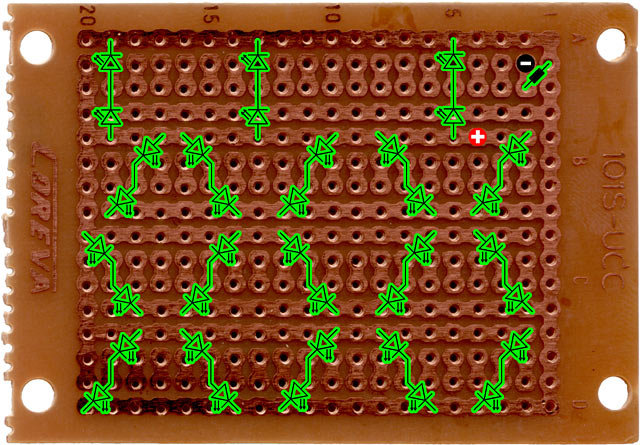
Here's how I wired that LED caselight:

LED-array board layout

Those are 18 2-LED strings - and just one current-limiting resistor for the whole thing - all connected in parallel with each other. The little piece of "strip board" I used to make the caselight curls all of the copper traces around to make a rectangle and so is a bit confusing-looking, but electrically it's the same as two long wires, one positive and one negative, connected by 18 two-LED strings like the rungs of a ladder. (Rob Arnold's above-linked LED array wizard is very handy for figuring out LED array configurations, but remember that two-leg RGB LEDs aren't normal LEDs, so you really can just treat them as 3V DC components and not worry about resistors.)

If the organ doesn't turn out to have any tappable power rails, or if you just don't want to fool with them, the LEDs could less elegantly be run from a separate power supply, like a 12V DC plugpack. There's unexpected complexity waiting to ambush you here as well, though; if this page hasn't already turned you off electronics for life, try my essay on Humankind's Endless Quest for a Substitute Plugpack!

Boing goes the e-mail, boing boing boing...

My mail server, mail.dansdata.com, is on the fritz. Well, the server's actually working, but I don't have an account there any more, for some reason. So mail to dan@dansdata.com has been bouncing, for a couple of days now.

The usually-excellent support people at SecureWebs haven't been quite on the ball about this. If you've got something important to say to me, send it to rutterd@iinet.net.au.

UPDATE: The mail, she works once more. (I'm perversely glad that lots of other people were suffering as well.)

I've got greylisting now, too. I'll turn it off if it becomes unacceptably annoying, or if I decide I need more spam to write about.

I see you're reading about execution by stoning. Would you like to buy a bong?

In these days of belt-tightening and margin-cutting, have "contextual" ad companies like Kontera finally been forced to actually live up to their promise of delivering ads that're relevant to the text they link from?

Irrelevant contextual ad

That'll be a "no", then.

(Source.)

You'd think that contextual link-ad companies would be in a deadly downward spiral.

They can only deliver ads that're actually relevant if they've got tons of advertisers to choose from (like Google, who often deliver ads that contradict a page's content, but are at least talking about the same subject). But anybody with half a brain can see that, at the moment, actual relevant contextual ads seem to be very much in the minority.

So if you pay a contextual ad company to advertise your product, you can't expect anything better.

But then again, the big contextual ad companies have been in business for several years now, and most of them still haven't gone broke.

As I write this, RealTextAds (who contacted me in 2004) seem to be out of business, but Vibrant Media are more than eight years old and still going strong. So are Tribal Fusion, as mentioned in passing in 2005 and looked at specifically here; they're about as old as Vibrant. And Kontera, responsible for the ad in the picture above, is six years old. They run ads under their own name, and also as "ContentLink".

So somebody must still be paying for this crap.

Perhaps the ads actually do work - get clicks, and create sales. I'm sure plenty of people at least click on these weird little pop-ups, even if they're only trying to make the thing go away.

I can't see how the cost per conversion can be good, though.

18: Holding reminder notes on the plate in your skull

No fewer than seventeen cool magnet tricks, from the irritatingly productive Evil Mad Scientists (I note that they favourited this...).

I've done only a few of these "tricks" - many of them are actually more in the "handy hints" department - myself. I've made homopolar motors, and done a bit of sculpting, and the big scary truncated-pyramid magnet from this old piece is our fridge-pen holder; if a pen has nothing ferromagnetic in it, we just tape a paper clip onto it. I've also got a length of aluminium tubing and a slab of copper for eddy-current braking demos.

The EMSL piece ends with a warning to keep magnets away from your laptop's hard drive, if you're seeing if you can put the computer to sleep with the lid open by putting a magnet on the embedded switch. This is a fair warning; a decent-sized modern rare-earth magnet might indeed be able to damage data on a laptop drive.

But the emphasis is still on the "might", because even the scant centimetre of aluminium and plastic between a laptop drive platter and the outside world is likely to keep magnets far enough away that any not-dangerous-to-humans NIB (neodymium-iron-boron) magnet won't be able to hurt it. The magstripe on a modern credit card has a coercivity similar to that of a hard-drive platter, and you definitely can wreck a card magstripe with a small rare-earth magnet - but the magnet can touch the magstripe, while a drive platter is inside a casing, and the casing is usually inside a computer. And, roughly speaking, the intensity of a magnetic field decreases with the cube of the distance from the centre of the magnet.

(New-fangled perpendicular-recording hard drives apparently have higher-coercivity magnetic coatings than older drives; if so, this ought to make them even more resistant to accidental erasure.)

Generally speaking, you don't have to be too worried about playing with magnets near your PC. Especially now that you probably have an LCD monitor, not a magnet-sensitive CRT that'll need degaussing if you bring a magnet too close.

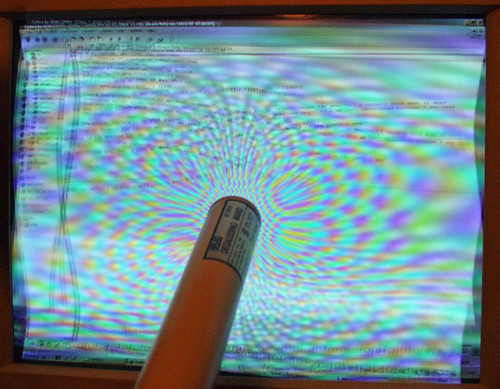
Oh, look! Another chance for me to deploy my cool picture of a monitor being degaussed!

Degaussing a CRT

And now, here's somebody messing up his own monitor, so you don't have to:

Here's someone doing the same thing with a rare-earth magnet, which is so strong that I think it's pulling the shadow mask right into contact with the inside of the screen:

If a shadow mask or aperture grille gets distorted that badly (usually by physical mistreatment of the monitor, not by magnets), it's unlikely to be fixable. The monitor will still work, but it'll now have permanent weird coloured blotches.

(Black-and-white TVs, and monochrome monitors, have no shadow mask and so can't be permanently damaged by a magnet. The field will just pull the image into a funny shape, which will bounce back to normal when you take the magnet away. Only if you somehow manage to magnetise some ferromagnetic component near the tube will any of the distortion stay after the magnet has gone. Fun could be had by putting the big ring magnet off the back of a loudspeaker under someone's Apple II green-screen.)

Rockin' out over SCSI 1

Via Hack a Day:

The creator couldn't get four ScanJet 3Cs at a reasonable price, so the scanner is overdubbed into four voices. But everything else is live - hence, presumably, the less-than-perfect sync between instruments.

Johnny Five is still totally headbanging at four minutes 11 seconds, though.

1: Invent antigravity. 2: Get comfortable.

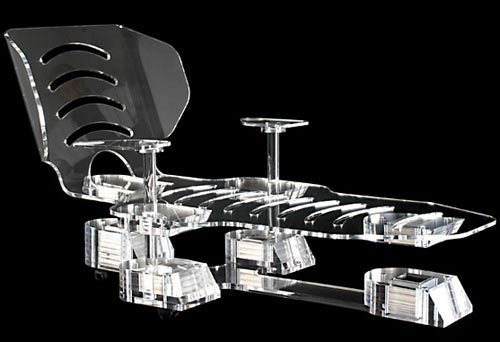
To continue my occasional series on Designers who Really Just Want to Draw Cool Pictures, Not Make Anything That Can Actually Work, behold the Koo Touch "Cloud" sofa!

Dumb-ass floating sofa

They appear to be going for the same sort of thing that makes those levitating globes work, with active electromagnets (in this case hiding in the thing that looks like a giant face-down iPhone on the floor) using sensor feedback to keep the unpowered floaty bit that looks like Pigsy's cloud in place.

(Find more info about levitating globes and other such toys in the Cool Magnet Man electromagnetic-toy roundup; see also the same guy's magnet experiments and executive-toy collection!)

There are two problems with the Cloud sofa.

One: It is not easy to make a stable system that can hold an object up over an electromagnet, as opposed to holding it down under one.

It certainly is possible, though; look at the Levitron Anti-Gravity Globe, for instance. As Amazon reviewers point out, though, it's a bit tricky to get the globe into the sweet spot for floating, and then any small knock or touch, or stiff breeze for that matter, will push it out of balance, with catastrophic results.

So even if the makers of the cloud-sofa went to the trouble of putting multiple coils in the base unit and huge scary rare-earth magnets in the floaty bit, the moment someone sat on the darn thing it'd crash to the ground and mash one side of itself into the base.

Two: Assuming you managed to solve the instability problem, the field strength needed to get this thing off the ground at all with a human being in it would mean the electromagnets would have to be very, very powerful. You might not quite have to cool the magnets with liquid helium, but they definitely would need some kind of bad-ass cooling, and would probably also draw a lot more power than electricity authorities are willing to deliver to a residence.

(Note that if the person you want to levitate does not weigh more than an ant, pyrolytic graphite will get the job done.)

And, if you got your humungous floater magnets and 50-kilowatt lifter magnets and feedback system all in place, you'd have to make the whole room look like Magneto's plastic prison, to prevent people being nailed to the sofa-base by their belt buckle, sets of keys streaking across the room and taking someone's hand off, et cetera.

Look, I get that design students are given assignments that aren't marked by plausibility of product. But in that case, why not just make your product a teleporter, or a full-fledged antigravity flying belt, or an umbrella that turns rain into turkey sandwiches, if you don't care about making anything that can actually exist?

The hell of this is that it actually is possible to make a mag-lev lounge. And that lounge actually does look like something right out of Magneto's special jail; check it out!

Hoverit floating couch

The reason why this thing doesn't look very impressive compared with the Cloud is that it uses permanent magnets for levitation. There's only one way to do "proper" levitation using permanent magnets; you have to spin the levitator for stability. This is how the most famous Levitron product, the hovering top, works.

Anybody who's ever tried to get a Levitron top working will know that they're touchy little buggers - even worse than the Levitron globe - and obviously not a generally useful solution to the problem. Even if you managed to hide magnetic gyros inside a floating sofa-cloud, it'd be pretty much impossible to get the cloud to stay in place if a person tried to sit on it.

The more practical way to make a permanent-magnet levitator is to mechanically restrict the movement of the magnets in one way or another. The way of doing this that looks most like "real" levitation is to arrange your magnets so that the levitator wants to fall off in one particular direction, then put a support with some sort of low-friction bearing in the way. There are executive toys that work this way, and it can even be extended into a motor design - the solar "Mendocino Motor", for instance:

The Hoverit couch uses a much simpler arrangement, usually seen as a piston and cylinder. One magnet goes at the bottom of the cylinder, and the other one, turned to repel the cylinder magnet, is on a piston that you push down into the cylinder. This basically turns the magnets into a very-high-isolation spring, which has been used in some hilariously expensive audiophile turntables, and in add-on isolation feet for other audio components.

The Hoverit makes this look better by aligning the magnets only with the arm-rest pillars; the rest of the magnets are firmly held in the acrylic base and lounge parts, but unable to "fall off" each other because of the pillar assembly.

The result, of course, is just a bouncily-suspended hard plastic lounge chair, which I think has to be far less comfortable than a $10 banana lounge from a garage sale.

But at least it's physically possible.