Like a sniper using bollocks for ammunition

I was aware of the existence of Tim Minchin, a musician who could be making nothing but finely crafted terribly earnest heartfelt ballads, but who is unable to resist the urge to just crack a few jokes.

I was unaware, however, of his unfashionable belief in the existence of empirical reality.

This one's audio-only:

And man, have I ever been there.

Ideally, you've got someone like Tim on hand so you can tag him in when you need to go out for a little walk after being told about the Muslim Mafia that's breaking like a swarthy tsunami over the civilised world, or whatever.

If your tag-team comrade can bust mad rhymes, so much the better.

(Tim's YouTube channel.)

Farewell, noble plumber

The Bloglines Plumber

I was trying to figure out why, for the last few days, Bloglines has frequently failed to notice when I've read something from one or another feed. Four times out of five, the next time it checked for updated feeds it was re-adding all of the stuff I just read.

Well, I found out why this was, and I also found that this wasn't the half of it. It turns out that Bloglines is also now just completely ignoring many feed updates. So you get to read some stuff over and over, while missing out on other stuff entirely. Awesome.

So, finally, it was off to Google Reader for me.

(Migrating to Google Reader is quite easy, if your current feed aggregator doodad can export your subscription list in OPML format. This, fortunately, is something that Bloglines has not yet forgotten how to do.)

I've been using Bloglines since 2003. Apparently Mark Fletcher, the guy who started the site, sold it to Ask.com (where he later took a job) in 2005, and they've now pretty much just left it to rot on the vine. (To the point that even Fletcher's sick of it.)

I was happy enough with the Bloglines interface, and it's still got a couple of features that suit me better than Google Reader does. But only if it, you know, works. Which it doesn't any more. Oh well.

The Copy Of Doom

Would you like to make a Windows PC that has some network-shared folders containing large files look as if there's something horribly wrong with it?

Well, that is, I have just discovered, easy!

Just copy one of the files - let's say they're movies - over the network to another computer.

Then, before the first copy operation is complete, start copying another. And another. And another.

Like, maybe you're copying all of your absolute favourite TV shows and movies, and you're just clicking and dragging whatever catches your eye, and letting the little copy dialogs pile up.

This is exactly the sort of task that a proper file server is specifically designed to handle. Even if the server's storage isn't terribly fast, six people all asking for different things on the same drive at the same time should be put in a queue, rather than asking the waiter to carry every order for the whole restaurant at once, as it were.

But consumer versions of Windows aren't set up to do that. They're meant to serve a single user, and see nothing wrong with just doing exactly what they're told to do if several remote computers - or even just one - ask them to do something like copy 20 large files at once.

(You can probably alleviate at least some of this problem in consumer Windows versions by something like selecting the "background services" and "system cache" options in WinXP's Performance Options -> Advanced tab. Even a cheap Solid State Drive would immensely reduce the problem, too, since the multi-millisecond seek time of mechanical hard drives is a big reason why it happens, and SSDs have near-zero seek time. But SSDs are, of course, still rather too expensive per gigabyte for tasks like bulk video storage.)

Once you've got several large copy operations all happening at once on, let's say as a random example, the Windows XP computer on which I'm writing this, this "target" computer will be flogging to death the drive(s) on which the big files reside. Data to and from those drives probably has a bottleneck or two of its own before it gets to the network, too; the ATA I/O hardware in consumer PCs is not made to deal elegantly with several drives all talking at once.

The upshot of this is that any operation which expects one of those drives to respond snappily to a request - or, quite possibly, which is just trying to talk to some other drive in the computer - will now suddenly find itself waiting a lot longer for that response. And that's one of the standard ways in which programs can misbehave. It's perfectly normal for programs to, say, ignore user input while they're saving a ten-kilobyte file; that should only take a moment. But if it now takes 30 seconds for that tiny file to be saved, as the save operation tries to push through a storm of seeking and reading, the program will appear to have hung. This applies to lots of things besides saving files - if modal windows suddenly take 30 seconds to appear, for instance, the program will seem just as broken.

On the plus side, as soon as you cancel the 20 simultaneous copy operations, the target PC will immediately start working perfectly again.

On the minus side, before you cancel the copies, it'll be doing a very good imitation of a computer with one or more failing hard drives. And practically anything you do to try to figure out what's going on will just add more input/output tasks to the mess, and make things even worse.

Eventually, the user - let's call him Dan - will try to shut the computer down, get sick of waiting for the numerous simple disk tasks this entails to conclude, and just turn the darn thing off. And now, the metaphorical plate-juggler will forget about all of those plates that are still in the air, and leave them to crash to the floor.

In my case, this meant various programs lost some of their configuration data. Firefox, for instance, was back in the default toolbar and about:config state, and all of the extensions thought they'd only just been installed. My text editor forgot about the files I used to have open, and Eudora lost a couple of tables-of-contents and rebuilt them with the usual dismal results.

(If you lose the TOC in a mail client like Eudora that uses the simple mailbox format in which the main mailbox file is just a giant slab of text, and the TOC is the separate file that tells the programs where actual e-mails start and end within that text, rebuilding the TOC probably won't go well. It'll give you a separate "e-mail" for every version of a given message that looks as if it might exist. So if you saved an e-mail you were writing five times before you finished it, you'll get five separate versions of that e-mail, each at a different stage of completion. When you "compact" a mailbox, you're getting rid of all that duplicate data.)

Oh, and the file I'd been writing something in for the last hour was now a solid block of null characters. As, delightfully, was its .bak file.

I lost very little actual data, because I make regular backups. (Remember: Data You Have Not Backed Up Is Data You Wouldn't Mind Losing.) And stuff I'd done since the last backup which I wasn't actually working on at when the Copy Of Doom commenced was all fine. Good old PC Inspector even let me recover a bit more data.

Even quite a lot of data loss would have been preferable to what I originally thought was going on, though. It looked as if the boot drive - at least - was failing, leading me to another of my disaster-prompted upgrades. It's about time for a new PC now anyway, but it's ever so much more civilised to upgrade when the old computer's still alive.

They never met a fuel catalyst they didn't like

Another of you annoying readers writes:

Dan, I would love to hear your thoughts on the merits of the "Vapor Fuel Technologies" fuel-saving tech discussed here.

I think of EETimes as a fairly reputable website, but discussion of fuel-saving gadgets seem a bit out of EETimes' area of expertise. In the article, no claim is made regarding burning fuel more completely; it seems the claim is that since combustion event occurs over a shorter period of time, that this somehow more efficient. Still, something about the claim of 30 percent better mileage just strikes me as unlikely.

Strange that the Vapor Fuel Technologies website mentions independent tests by some group called California Environmental Engineering (CEE), but they do not actually provide any formal documentation of the test procedure and results.

Matt

Yep, here we go again.

But this time I found a rabbit-hole that went a lot further than I thought it would.

The Vapor Fuel Techologies (yes, I know...) site raised its first red flag when it proudly mentioned that the company has some patents, as if that has something to do with the usefulness of the thing patented. (All a patent actually means is that the Patent Office doesn't think your idea is excessively similar to someone else's - and modern overworked Patent Offices don't even manage to do that very well. They don't check, and never have checked, to see whether a patented thing actually works, unless it's very obviously a perpetual-motion machine.)

OK, so off we go to the "Product" page to find what this awesome patented thing is meant to be, and we discover that VFT are making pretty claims not very different from those made for various fuel vaporisation, or atomisation, gadgets.

Their central claim is a bit different, though. They say that heating the air that's heading to the combustion chamber causes it to expand, so that less fuel-air mixture goes into the cylinder, and you use less fuel.

Well, OK, that may be true if you can get your engine-management computer to cope with it, but the fuel-injection system in a modern car is perfectly capable of doing the same thing all by itself, whenever you're asking for less than full power. Putting a ceiling value on the mass of air that can go in to the cylinder will, at best, just give you a car that now uses less fuel at wide open throttle (WOT), because you've reduced the "wideness" of that throttle. Now, when you put your foot to the floor, it has the same effect that putting your foot four-fifths of the way to the floor did before. A similar effect occurs when you drive on a hot day; the air is less dense and the maximum power your engine can make is, therefore, slightly lower than it'd be on a cold day.

This does not strike me as something worth paying money for. Just let your air cleaner get filthy and it'll do the same thing for free.

(Note, now that I think of it, that there's no connection I can see between Vapor Fuel Technologies and Smokey Yunick's famous-in-certain-circles "Hot Vapor" engine.)

Also from the Product page: "...improves the combustion process by increasing flame speed and creating the conditions for a chain reaction Autoignition."

My initial reaction to that was "why the hell would you want that to happen!?", because there is no reason to actually want fuel to "autoignite" in a petrol engine. If you do manage to substantially accelerate combustion, by for instance using low-octane fuel in a high-compression engine, your engine may indeed suffer from "autoignition", also known as "knock" or "detonation". That's how diesel engines work, but it's very bad for petrol engines.

Fuel burn time in petrol engines is a compromise, as explained in detail by Tony of the eponymous Guide to Fuel Saving Gadgets on his page about turbulence gadgets. There's no reason to suppose that it's just generally good to burn the fuel faster.

Elsewhere on the Vapor Fuel site they mention that the orthodox automotive industry is exploring "HCCI and Autoignition". This is true; HCCI is "homogeneous charge compression ignition" and "autoignition", in this case, means controlled autoignition, happening when you want it to and not all willy-nilly, possibly before the piston's made it to top-dead-centre.

The idea here is to make engines with diesel-like ignition and fuel economy, but conventional-spark-ignition-like emissions (instead of the characteristic "diesel smoke" that's led to some diesel cars now carrying around a little tank full of "urea-based reductant", thus instantly spawning a million jokes from people who also make jokes whenever they see the word "methane").

The idea that you can make a normal spark-ignition engine into one of these new advanced pseudo-diesel designs by just bolting on an air heater strikes me as puerile.

It doesn't matter what I think of it, of course. You can't argue with success; if it works, it works.

But the only evidence that it does work, so far as Matt and I can see, is that single test, there on the "Independent test results" page.

This, it turns out, is where the real fun is to be found.

First, that page has an odd side-swipe at "the gasoline HCCI and Autoignition efforts currently underway by others"; those engines, the test-results page says in as many words, would find it "difficult, if not impossible", to just do an EPA highway cycle test.

I presume what they meant to say was that their competitors would have difficulty achieving their claimed mileage improvement in an EPA test, but this sort of lack of attention to detail may be in some way related to the fact that the Vapor Fuel Technologies EPA test is stated as having happened almost two years ago now, and yet... still no sign of anybody else taking advantage of this amazing 30% MPG improvement. Or even a replication of the test.

Oh, but wait a minute - where was it that this test apparently took place, again?

At "California Environmental Engineering ... an EPA recognized and California Air Resources Board (CARB) certified independent test laboratory".

That name rings a bell.

That's right, regular readers - that's the same lab that said the Moletech Fuel Saver works!

California Environmental Engineering were mentioned in that mysterious disappearing Herald piece about the Moletech gizmo, and I noticed then that CEE seemed to be a bit keen on the old fuel-saving miracle products.

But I very severely underestimated how many of these talismans and potions they've tested, invariably with positive results.

On top of the marvellous yet mysterious Moletech molecular modifier, CEE are also said to have given their stamp of approval to "Microlon" (PDF), and something called the "CHr Fuel Improvement Device" (PDF), and this (PDF) hydrogen-injection thing, and this other "HHO" gadget, and the Nanotech Fuel Corporation "Emissions Reducing Reformulator" (PDF), and the "Rentar Fuel Catalyst", and the "Fuelstar fuel combustion catalyst", and the "Green Plus (liquid!) fuel catalyst", and the "Omstar D-1280X fuel conditioner", and some other "Fuel Saver" back in 2003, and the Advanced Fuel Technologies carburetor for two-strokes back in 2000, and the "Hydro-Cell Emissions Reducer" (PDF), and the Hiclone turbulence device, and the CHEC HFI Hydrogen Fuel Injection system (PDF), and some HyPower product or other (I'm not sure which, because the PDF links on HyPower's Test Results page are broken), and this "Brown's Gas" doodad, and the SV Technology "DynoValve" crankcase-ventilation thingy, and the Petrol.Net Fuel Additive (though this time CEE's test is, amusingly, mentioned on the testimonials page...), and the Hy-Drive On-Board Electrolyzer. And it goes on, and on, and on...

And yet, not a one of 'em's being fitted to, poured into or waved over cars on the production line yet, bringing hundreds of millions, if not billions, of dollars per year to their brilliant inventors. All are still being sold over the counter to individual motorists, or being offered as this year's sure-fire investment opportunity.

People who design engines strike a balance between power, economy and driveability. An engine that lets a family car deliver 75 miles per gallon, but has power and torque curves that look like different areas of the Swiss Alps, is no use for normal automobiles.

Car companies have been tuning, balancing and refining their products for more than a hundred years. And racing engine designers have pushed pretty much every oddball modification to its screaming limits. But now we're expected to believe that Vapor Fuel Technologies have just, for the very first time, thought of deliberately heating the intake charge - you know, like a non-intercooled turbocharger, except without the boost - and discovered that doing that is good for what ails you.

And to support their claim, they show us a report from a "laboratory" that apparently never met a mileage improver it didn't like.

Pull the other one.

The shifting sands of SSDs

Quite a while ago, I was wondering when Gigabyte would update their i-RAM solid-state drive. The i-RAM turns ordinary memory modules into what looks to the computer like a SATA hard drive, except faster. For some tasks, way, way faster.

ACard SSD

Well, Gigabyte haven't made a bigger, better, faster, cheaper i-RAM yet, but I am indebted to a reader for the knowledge that another outfit has. And to The Tech Report for their excellent review of this new SSD, the ACard ANS-9010.

(There are a few other reviews, too. You can also download a PDF manual from the ACard site, here.)

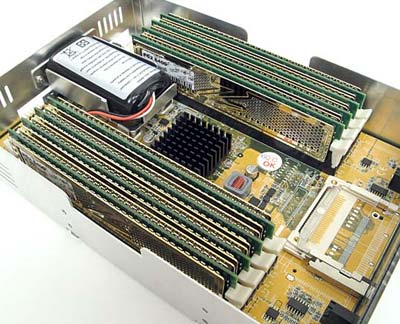
The ANS-9010 has lots of great features, including a couple of unexpected ones. It uses dirt cheap DDR2 RAM (preferably ECC; if you use non-ECC RAM, the drive will use a ninth of the memory capacity to do its own error detection and correction). It has eight memory slots so you can populate it up to 16Gb quite cheaply (maximum capacity: 64Gb). And it also, of course, has a backup battery, so you won't lose data if you turn the computer off.

If you leave the power off for more than a few hours the battery may go flat, though, so the ANS-9010 also has a slot for a CompactFlash card, onto which the contents of the drive can be copied when it loses power, or whenever you press a button on the front of the drive. (There's also a button to copy the CompactFlash contents back into the RAM, overwriting whatever was there before.)

The ANS-9010 also has two SATA sockets on the back. It can pretend to be two drives, so you can plug it into a RAID controller and make a two-drive stripe-set for even faster transfer rates.

So that's all great.

The only problem with the ANS-9010 is that it lists for $US400, empty, and doesn't seem to have a significantly lower street price. So even if you've got eight 2Gb DDR2 modules just sitting around and so can populate an ANS-9010 to a good-enough-for-a-boot-drive 16Gb for free, it'll still cost you an easy 1.5 times as much as a 300Gb Western Digital VelociRaptor. The ACard drive's seek speed will beat any moving-parts drive by a mile, but in most other tests the VelociRaptor will at least be even with the SSD - and it's got tons more capacity.

And then there are Flash-RAM SSDs.

When the i-RAM came out, it was very expensive per gigabyte, but it had no real competition. There were no other solid-state drives on the consumer market then, if you didn't count slow memory cards in cheap PATA or SATA adapters.

But now, computer stores all have several flash-RAM SSDs on the shelves. And $US400 will buy you a lot more than 16Gb of SSD capacity. If you populate the ACard drive to 32Gb you'll be paying as much as you would for a 64Gb SSD with an SLC controller.

(SLC stands for single-level cell, as opposed to the multi-level cell controller that cheaper Flash SSDs use. MLC controllers can, as I mentioned in my SSD Shootout, give you a computer that occasionally just freezes for some large fraction of a second.)

The Tech Report review compared the ANS-9010 with various moving-parts drives, including a VelociRaptor. But their comparison also included an i-RAM, a couple of cheaper Flash SSDs, and an Intel X25-E Extreme Flash SSD (which they'd reviewed before).

A "32Gb" X25-E (real formatted capacity 29.7 gibibytes) will set you back about $US600, which is also about what it'll cost you to buy an ANS-9010 ($US400) plus eight brand-name 2Gb DDR2 modules, at current prices.

The ANS-9010 edged out the X25-E for most tests, but the difference was almost always too small to be noticeable. And for a few real-world tests, like system boot time, the fancy SSDs lost to boring old hard drives!

(If you're wondering how this can possibly be the case, it's because system boot speed is something that's immensely important for consumer PCs, so there are lots of tweaks and optimisations to make it as fast as possible for a normal consumer computer to boot from its normal consumer 7200RPM hard drive. Many of those tweaks turn out to reduce performance if you're booting from something that's very unlike a hard drive. Note, however, that the spread from the fastest to the slowest device in The Tech Report's boot-time test was only 15.5 seconds, so it doesn't matter that much either way.)

The ANS-9010 did really well in the IOMeter test, but that's irrelevant to people with normal PCs, because it measures how well a drive can handle multiple users in a server application. Old-style ultra-expensive solid-state drives often ended up doing this sort of thing, and it's great to see that there's now a good option for people who want that sort of server but aren't made of money. For the tasks that people do with everyday PCs, though, IOMeter tests mean nothing.

So I suppose the shifting sands of the computer market have claimed another product. Us dorks were all waiting for an improved i-RAM, and now it's finally come along, and it's exactly what we wanted. But we might as well just get a little Flash SSD, or a VelociRaptor, which'll give us more drive capacity and about the same performance.

Yesterday's Lego purchases

15%-off at Kmart, and a bunch of the new 2009 sets have arrived.

I thus felt compelled to pick up some consecutively-numbered Lego construction vehicles:

One #7630 Front-End Loader
Two #7631 Dump Trucks (their 15%-off price is particularly good when compared with the US list price)
One #7632 Crawler Crane...

Lego Crawler Crane

...which is a big almost-Technic set (see also, #744) whose main boom looks distressingly POOP-y. But it's actually not so bad, since the boom is made out of these and these, both new pieces for this set.

The new crane particularly appealed to me, and not just because it's got the nifty new chunky tracks. I've been re-reading J. E. Gordon's classic Structures: Or Why Things Don't Fall Down, and this crane provides a perfect demonstration of how real cranes stay in one piece - it has a strong-in-compression-but-weak-in-tension boom, which is kept in compression by a strong-in-tension-but-useless-in-compression cable. The result is a simple tensegrity structure which, in a sense, gets stronger the more you load it.

If I give the crane to a kid, I may require them to endure a lecture on this subject.

Ten-trillionth time's a charm

A reader writes:

From: John
To: dan@dansdata.com
Subject: re your rod magnets.
Date: Wed, 21 Jan 2009 20:35:17 +0900

Dear Dan,

Amazing,!!! I was looking for what was available and came across your page, and it seems you have what I am looking for.

I am a retired engineer who has had a bee in my bonnet for years about using magnetic force to produce a reliable motor that requires no electricity.

I had a reasonable plan of how to do it but like most never quite got round to doing it.

Now I am looking at videos from YouTube showing how many people have all had the same idea.

I would like to know if you do a pack of 1/4inchx1'long high powered magnets and if so how much in total I am thinking of say twenty to start with.

There is a video under the heading of free energy by a company called Tesla comp. in the States who look like they have cracked it and it is worth watching.

if you could, I would like a price list showing the type of magnet, and the price per pack and of course the number in the pack including freight costs to Australia.

If you have more detailed information that you think would be of help please email me and let me know.

I am really very keen to go into this while I still can.

I served in the royal navy as a saturation diver and worked on the first nuclear subs.

Because they leaked badly (there was a team of eight) we all got cooked about three times and all had problems with cancer of some kind, I got cancer of the bone but am the only one of the team left, and have been on chemo for thirty years. However that is beginning to lose its effectiveness.

As you can guess like all those involved nobody owns up to what they did so no compensation for any including a lot of friends I made in the U.S. Navy.

I look at it that I am still here so you never know.

So i just get my pension for what it is.

Maybe I will come up with something that will pay better, you never know.

It was nice to find your web page and your sense of wit.

All the best and look forward to hearing from you.

John
Western Australia

My reply:

I can only urge you to find something better to do with the remainder of your retirement.

This sort of quest has, on the very very numerous times it has previously been tried, at best led to nothing but frustration and disappointment. I've written about it previously.

I don't sell magnets, I just wrote about them a few times. It's easy to get NIB magnets of all shapes and sizes, from miniscule to large and very dangerous, on eBay these days.

The two outfits that provided me with various magnets for my two big reviews were Otherpower's Forcefield Magnets and Engineered Concepts. (There was also Amazing Magnets...

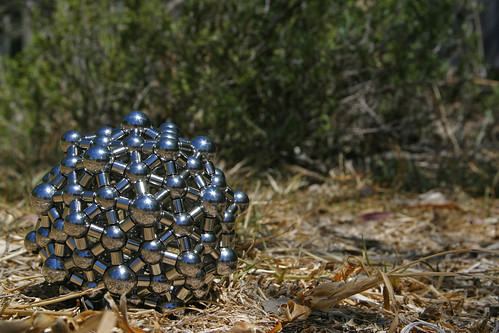
Mysterious magnetic object

...but they're not really what you're looking for here.)

I'm not sure exactly which video you're referring to, because the brilliant - but also rather deranged - Nikola Tesla is almost unavoidable in all areas of electrical "weird science".

(And, of course, a measure of magnetic field strength is named after him. According to the units that bear their names, Nikola Tesla is worth 10,000 Carl Friedrich Gausses!)

The first "TESLA free energy generator" video I found on YouTube/Google Video when I just did a search was this one:

The fact that this video obviously comes from a well-played VHS tape, yet the company responsible still hasn't managed to "reinvent the electric power companies in America", may tip you off to the fact that the product on offer is not quite as valuable as the video makes out. This company is in fact "Better World Technologies", run by one Dennis Lee, who I have also written about previously. There are a number of other outfits doing essentially the same thing Dennis is doing.

I apologise if this isn't the video you were talking about, but I think you'll find that most, if not all, other such works on YouTube, etc, fall into two categories.

The first category is hobbyists who're barking up much the same tree that you're considering, and who may or may not think they're making progress. Often, measurement mistakes like not correctly reading the RMS output of a device make it look as if it's doing something; the poor hobbyist in this situation may spend years trying to find the "minor bug" that must be the only reason why his contraption can't charge its batteries faster than it empties them.

(At this juncture, allow me to recommend the Pure Energy Systems Wiki, PESWiki, which is all about "breakthrough clean energy technologies". It has articles about just about every currently popular free-energy scheme, plus equivalents like "run your car on water" systems. Most of the things documented on PESWiki are utterly preposterous and, in my opinion, not considered nearly critically enough, but it's a great reference source, to see if even True Believers think they've made Device X work, or if they find the claims of Promoter Y plausible. PESWiki has a whole directory page about Dennis Lee.)

The second category of YouTube free-energy videos is entirely made, so far as I can determine, by scam artists, who may be deliberately doing what the hobbyists do by accident, or may have any number of other tricks up their sleeves.

Here in Australia, "Lutec" are a big name in the "press releases about free energy" business. They haven't, to my knowledge, been as successful at the "actually MAKING free energy" aspect of their business.

And then, as we come back toward things that could actually work in the real world, there are outfits like Thermogen, which aren't selling perpetual motion machines at all, but whose numbers still don't quite add up.

There are many "free energy" ideas - in the sense of "power that you don't have to pay for", not "energy from nowhere" - that really are very promising. High-efficiency solar collectors that'll fit on a suburban roof, for instance.

Evacuated-tube thermal collectors are very effective, and can be used for simple water heating or to power a heat engine. There's also considerable promise in photovoltaic concentrator designs, that let you use fewer, higher-quality solar cells - provided you can keep the cells from burning up, and track the sun accurately enough.

(Note also the next letter on that page.)

In closing, I really must urge you in the strongest possible terms to use your remaining years on this planet to do something other than become a footnote, to a footnote, to a footnote, in the Big Book Of Failed Free Energy Ideas.

I am aware that the man who says it cannot be done should not interrupt the man who is doing it, but when "it" appears to have many things in common with both finding the Loch Ness Monster and travelling faster than light, I cannot in good conscience advise anybody to invest any time at all in such a miserably hopeless activity.

The DealExtreme from which you can order is not the true DealExtreme

There was this totally awesome MetaFilter post about the FM3 Buddha Machine. It's a small plastic device inspired by previous "chant-boxes" - little plastic doodads that look like a small transistor radio, but are only able to emit a small selection of Bhuddish mantras.

As soon as I saw the post, I mentioned that m'notparticularlygoodfriends at DealExtreme offer some of the original chant-boxes for sale.

And then I found some even cheaper ones, and somehow managed to say something about them which a MeFi enthusiast considered at least +2 Insightful. I presume he's right, because I've got no bloody idea what this Buddhist lark's about.

Which, in itself, probably makes me the number-one global expert on the subject, given the way in which Bhudularity usually seems to work.

Yes, I really have bought one of the very cheapest, four-dollar, DealExtreme chant boxes.

If it turns out to alert me to the Möbius-strip nature of consciousness and midrange immediacy, I will make sure to tell you all.