I done made me another entry in the TV Tropes wiki. Feel free to add examples and/or improve my deathless prose.
(X+Y)/Z = BS
13 December 2008 — danBen Goldacre's latest Bad Science piece returns to one of his, and my, pet peeves.
It's the "scientists have discovered the formula for" story. You know the sort - they've discovered the formula for the perfect sexy walk, or the ideal biscuit-dunk, or whatever.
These stories are invariably provided by PR companies and self-promoters, and used as gap-filler by understaffed newspapers and TV stations the world over. And they are invariably bullshit of the very highest order. The "formulae" seldom even make internal sense, and when they do make internal sense you can count on them being quite unconnected to anything in the real world.
And, and this is the part that really matters, these stupid stories help to create a public perception of "scientists" as white-coated "boffins" with no real comprehension of the world, who have nothing important to do all day, and nothing comprehensible to say.
You know you're looking at a really broken formula when you see one side of the equation all being multiplied or divided by one variable. The formula for "the perfect joke", for instance, has one side divided by the number of puns. This means all jokes that do not include any puns at all are either infinitely funny, or funny to an undefined extent, depending on which way you look at it.
Many of the "formulae" don't even get that far, though. They're just a misshapen assemblage of algebraic characters, such as you'd expect a seven-year-old to draw if they were pretending to be a mathematician.
This latest example, an alleged formula for determining the "naughtiness rating" of a woman's garment, is entirely representative. It makes no sense in the first place - as long as your nipples are covered, it's apparently impossible to be naughty at all - and the example of it used in the article is broken, with an obvious but un-noticed multiplication by zero making the book-promoting "Cambridge mathematician" responsible look, appropriately, an utter tit.
So far, so usual.
But then Ben points us to Apathy Sketchpad, where one Andrew Taylor has dedicated himself to the detection and analysis of every Stupid Formula Story that's ever made it to the news.
Sometimes, I regret to say, Mr Taylor finds himself driven to profanity.
This blows my mind every time
11 December 2008 — danAn outfit called "Balance Health Products" has recalled its slimming "dietary supplement", on account of how the "Starcaps" supplement turned out to "contain an undeclared drug ingredient - Bumetanide - a diuretic available by prescription only."
Once again, I stand awestruck by what I now choose to call the Dietary Supplement Contamination Phenomenon.
The DSCP, for reasons nobody in the world will ever figure out, causes all dietary supplements that've been "contaminated" with a drug to be contaminated with a drug that does what the supplement is meant to do.
Well, after a fashion, anyway. "Black Pearl" arthritis pills that're "contaminated" with steroidal anti-inflammatories work really well - they're just rather dangerous. The same applies to "herbal" diet pills that've mysteriously acquired a stimulant contamination.
But the "Starcap" pills have only got a diuretic in them. So they'll give you an easily measurable weight loss when you start taking them, on account of causing you to pee out a larger-than-normal proportion of your body's water weight. But they'll make no difference at all in the long run. And, in the meantime, you may be somewhat dehydrated.
Still and all, though, this does qualify as another "supplement" that's mysteriously acquired a contamination of a drug that does what the supplement is meant to do.
It's amazing - slimming pills never get contaminated with Viagra, arthritis pills never get contaminated with digitalis.
It's a mystery for the ages.
NOTE: Clearly-enunciated bad language within
9 December 2008 — danPerhaps it was the firewall that irked Stephen Fry so.

(Via. Mr Fry is, of course, not actually very unflappable at all, as listeners to his podcasts already know.)
I'm glad it's not just me and people on b3ta who use the word "cunting".
Sometimes, nothing else will do. There usually seems to be a machine involved.
It'll be heavy water next
7 December 2008 — danHoly crap! You can get a CPU cooler that moves heat by pumping a sodium/potassium mix!
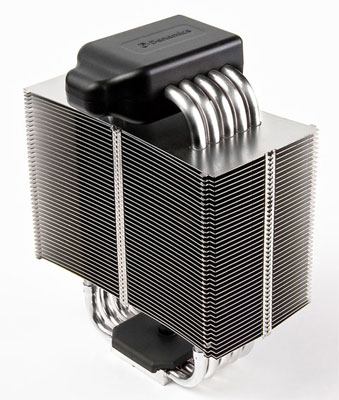
And here it is: The Danamics LM10, recently reviewed by NordicHardware. It certainly makes the old TS Heatronics Zen CPU Radiator look boring.
The sodium/potassium mixture, called "NaK" from the chemical symbols of the elements, can have a melting point as low as -12.6°C. So it's not incredible that you can use it to cool a PC processor. NaK isn't even very difficult to pump, partly because it's less dense than water. It's highly electrically conductive, so the Danamics cooler shifts it with a non-contact electromagnetic pump.
But NaK is usually used as a coolant in nuclear reactors, not PCs. When you only want to move CPU heat to room-temperature air via a pumpable coolant, and how that coolant interacts with fast neutrons is not very important to you, then about all you can say for NaK is that it's better than mercury.
As the NordicHardware reviewer points out, the high specific heat capacity of water makes it the obvious choice for this application, and many others. Water is streets ahead of every other inexpensive liquid for most coolant applications.
And water also has the advantage that it will not explode if it's ever exposed to even dry air. You can't say that about NaK. (Don't even ask about NaK and moisture.)
The gripping hand, though, is that there's very little reason to make a CPU cooler that uses pumped liquid coolant, unless the coolant is being pumped to a large separate radiator. This is how normal PC water cooling systems, and automotive water cooling for that matter, work; using pumped coolant allows you to have a radiator much larger, and more conveniently located, than you could if all of the cooling fins had to be strapped straight onto the CPU, or engine.
(Sodium has a role in automotive cooling too; some engine valves are hollow, and sodium-filled.)
If all you're doing is moving heat to the fins on the top of a CPU cooler, though, you can just use solid metal and/or heat pipes, because the mountain and Muhammad are pretty much in the same place already.
Years ago, I looked at a water cooler that worked in this way. It was pretty useless. The LM10 is much better than that; NordicHardware concluded that it did at least work about as well as a high-end conventional air cooler.
But the LM10 costs 2,199 Danish kroner, which as I write this is $US375. You can get a whole good-quality CPU water-cooling rig for about a hundred bucks less than that, and top-end conventional coolers are of course far less expensive.
But conventional coolers won't make your computer explode if someone hits it with an axe.
So I suppose the choice is yours.
Get down, baby wood ducks!
6 December 2008 — danThis is probably the most harmless problem ever described on The Daily WTF, but it's also one of the strangest. It's like frightening yourself with ask.com, only... different.
Google now have their own search-autocomplete thingy, which benefits from the somewhat higher average IQ of Google users versus those who, I presume, start every search by typing askjeeves.com into the address bar.

It would appear that the Google search-string database isn't quite as up-to-date as it might be, though.
Update: Oh, look - YouTube does it too!
YouTube connects to to a Google server for its autocompletes, as you'd expect since Google own YouTube, but clearly the results are divided to more effectively serve the two sites' differing demographics.
Google:

And YouTube:

(See also "drinking beer tricks", "eating peanuts tricks", and of course "shooting smack tricks".)
Get kicked out of church, AND the casino
6 December 2008 — dan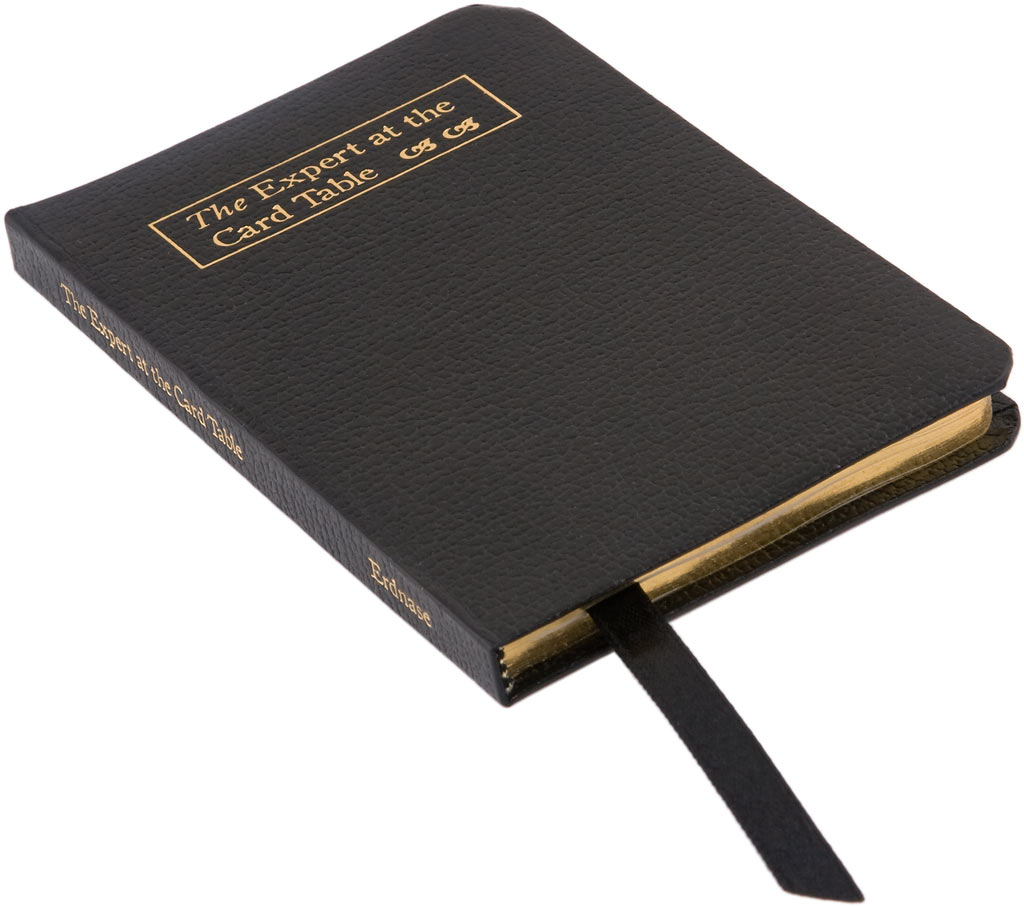
This slim volume strongly resembles a pocket Bible.
Translucent crinkly gilt-edged paper, ribbon bookmark, cheapest-possible leather-ish binding, text in 6.5-point Myopia. It even numbers every second line of text, to make it easy to quote chapter and verse, as it were.
It's rather slim, though, with only 206 pages.
And it is, if you ask me, likely to be rather more useful than a Bible.
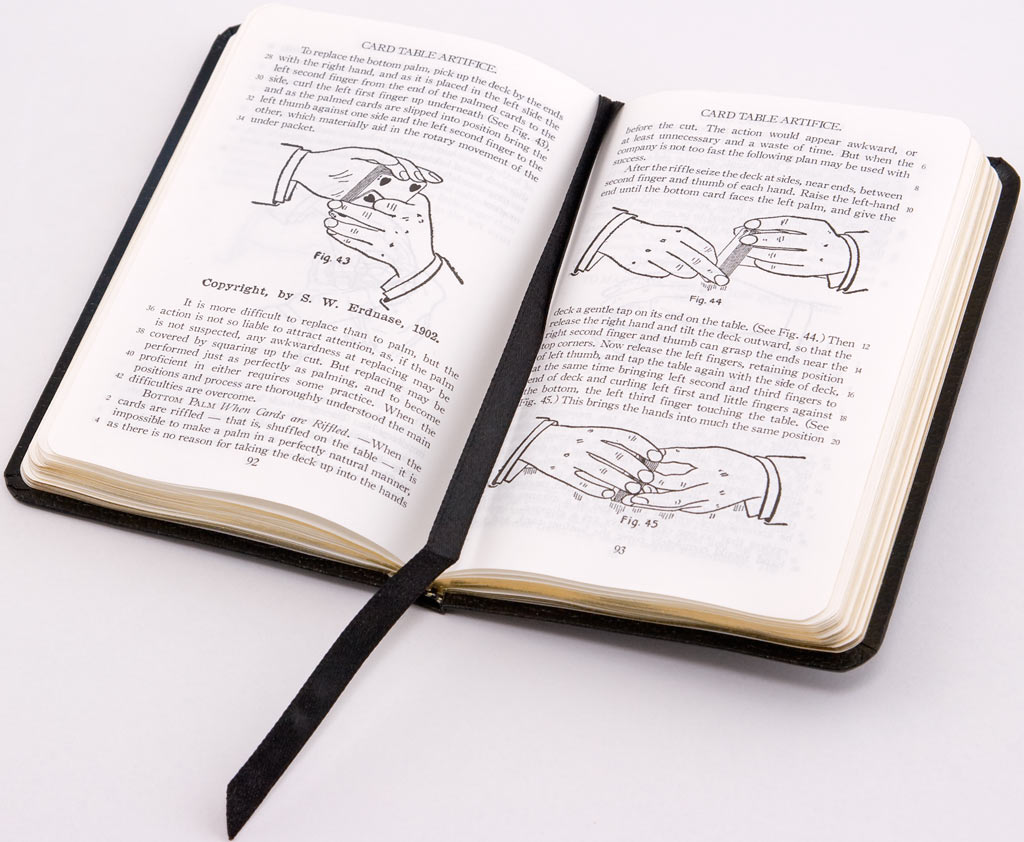
It is The Expert at the Card Table, by the mysterious "S. W. Erdnase". This 2007 edition is published by the Conjuring Arts Research Center, but you can get others, because the author didn't renew his copyright after he wrote the book in 1901.
As is the case for many other mildly odd books that look as if you'd have to dig through dusty used-book shops to find them (that Tintin book with the big-lipped savage natives in it, say), you can buy a brand new copy of The Expert from Amazon for fifteen US dollars.
Amazon also have a nine-dollar paperback version, which might be more practical for actual study, especially if your eyesight isn't the best. And because the book's not copyrighted - though many of the engravings still have "Copyright, by S. W. Erdnase, 1902" under them - you can also legally download various e-book versions of it. Here's one in PDF format, for instance; here's another.
I don't have very high hopes of ever actually mastering many of the techniques in The Expert, but I shall do my best to study it with the devotion it deserves. I think the world would be a better place if more people did.
The other day, for instance, I met a very nice lady who believes one J.Z. Knight is on the level when she claims to be able to channel "Ramtha", a 35,000-year-old spirit from Lemuria who was responsible for most of the quantum flapdoodle in "What the Bleep Do We Know!?". The nice lady explained to me one of the reasons why she chooses to keep up her membership of what some people might describe as the slightly kooky Ramtha's School of Enlightenment. That reason is that some other members of the Ramtha organisation are "able to see through the back of playing cards", even if those cards come from a brand new and untouched deck!
She thought it was very closed-minded of me to observe that this sounds not unlike a card trick.
It actually, now that I think of it, doesn't sound like much of a trick at all - it's more like the exercise you do to learn how to read your marked cards, or interpret what your plant in the audience is signalling to you, or practice your off-by-one reading in which the card that's shown to the audience is actually one you've just been looking at face up, while pretending to concentrate on a different one. Or, you know, whatever. A good card magician could probably do this trick every day for a month without repeating a technique.
Perhaps this amazing gift from Ramtha has more to do with page 182 of The Expert, "The Prearranged Deck". I don't think there's actually anything about marked cards in The Expert, though. Stuff like that is very much below an actual card mechanic. (Not to mention plain useless, because card sharps often prefer to avoid inserting prepared cards into play, since this can lead to the classic aces-falling-out-of-your-sleeves situation.)
When a card mechanic rips you off, you at least know you lost the game, though you may think it happened fairly. Religious hustlers make their audience think they're buying something of value.

The Expert at the Card Table is a fine addition to my Tiny Book Library.
My dusty old 9th Edition Pocket PC Ref is of very limited utility these days, but Pocket Ref will go on forever. I just flicked it open to three random places, and got a trigonometry table, RF Coil Winding Data, and the specific gravity and angle of repose of granulated sugar.
(I'm not sure what that portends. I should probably ask that nice Ramtha lady.)
Smiley sky
2 December 2008 — dan
This is my picture of the Moon/Venus/Jupiter "smiley face" conjunction that just happened. There are many like it, but this one is mine.
(The 500-pixel-high version doesn't look like much. The full-size one is better. There was a little cloud, though.)
I wasn't planning to take this picture, but I went for a walk to Echo Point and found a person there hopelessly trying to photograph the conjunction with a full-auto compact camera. Which actually did have a "Starry Sky" mode (among many others, including one called "Food"...) - but said mode was, of course, useless.
So I promised to take a proper picture and e-mail it to her. And when I got back to Echo Point with my DSLR and tripod there was a family there trying to take the same picture, and failing for the same reason. So I harvested an e-mail address from them too.
A few times, I've gone to Echo Point and it's been cloudy or foggy or otherwise not the ideal time to take a picture of the Three Sisters. On those occasions, I've offered to send disappointed photographers a picture I took on another date, because I've got some excellent ones.

My favourite is this one, which I took at 2:37 in the morning, by moonlight, with a thirty-second exposure.
Everyone I've made this offer to so far has declined, though. And fair enough, I suppose; the Three Sisters I photographed last year is not the same Three Sisters you would have photographed had you been able to see it through the bleeding fog. But the Smiley Conjunction I photographed is, within a fairly small time window, the same one that the people I sent it to saw.