When cat toys are outlawed, only outlaws will have cat toys

A reader writes:

I've got a couple of cats, had 'em for a couple of years. I have trouble motivating them to chase their toys, ping pong balls, etc - it works once or twice a week, but otherwise they just ignore it. So I've decided to bring out the big guns and get a laser pointer.

It seems they're much harder to get in Australia since all those airplane shenanigans, even though I hardly need a galactic-range pointer.

Was wondering if you had a suggestions for where to nab a laser pointer appropriate for kitteh?

Jack

It's still pretty easy to buy your basic button-cell keychain laser pointer from electronics stores here in Australia. I think there might have been a brief drought when the new Think Of The Children Or The Pilots Or the Puppies Or Something OMG JUST BE AFRAID EVERYONE law was passed, while the stores made sure that the humble cat toys they were selling yesterday hadn't suddenly been transmuted into illegal death rays.

But basic laser pointers are easy to find now. Here's one at Altronics, here's one at Jaycar (Jaycar have several other options, too).

[There are cheaper pointers on eBay, from sellers who at least say they're in Australia, which means they shouldn't be sending your purchase through Australian Customs to be confiscated by our ever-vigilant protectors. People may still be selling cheap pointers at the markets, too. If you believe price equals quality, on the other hand, note that the writhing transporter-accident creature that absorbed both Dick Smith Electronics and Tandy (Radio Shack) in Australia will be pleased to sell you a keychain pointer for $36.98 - at "DSE" here and at "Tandy" here!]

Altronics and Jaycar both want $AU14.95 for a bloody keychain pointer, which is of course a frankly insulting price. For little more than twice that much at current exchange rates a nice man in China will sell you a whole non-contact infrared thermometer, that incorporates an aiming laser. But which I'm sure will whistle through Australian Customs, just like all of the "laser-guided" circular saws, ultrasonic distance measurers, scissors, et cetera.

I chose not to choose a $15 keychain laser. I chose something else.

Home-made laser pointer

This prison-shiv of a laser pointer...
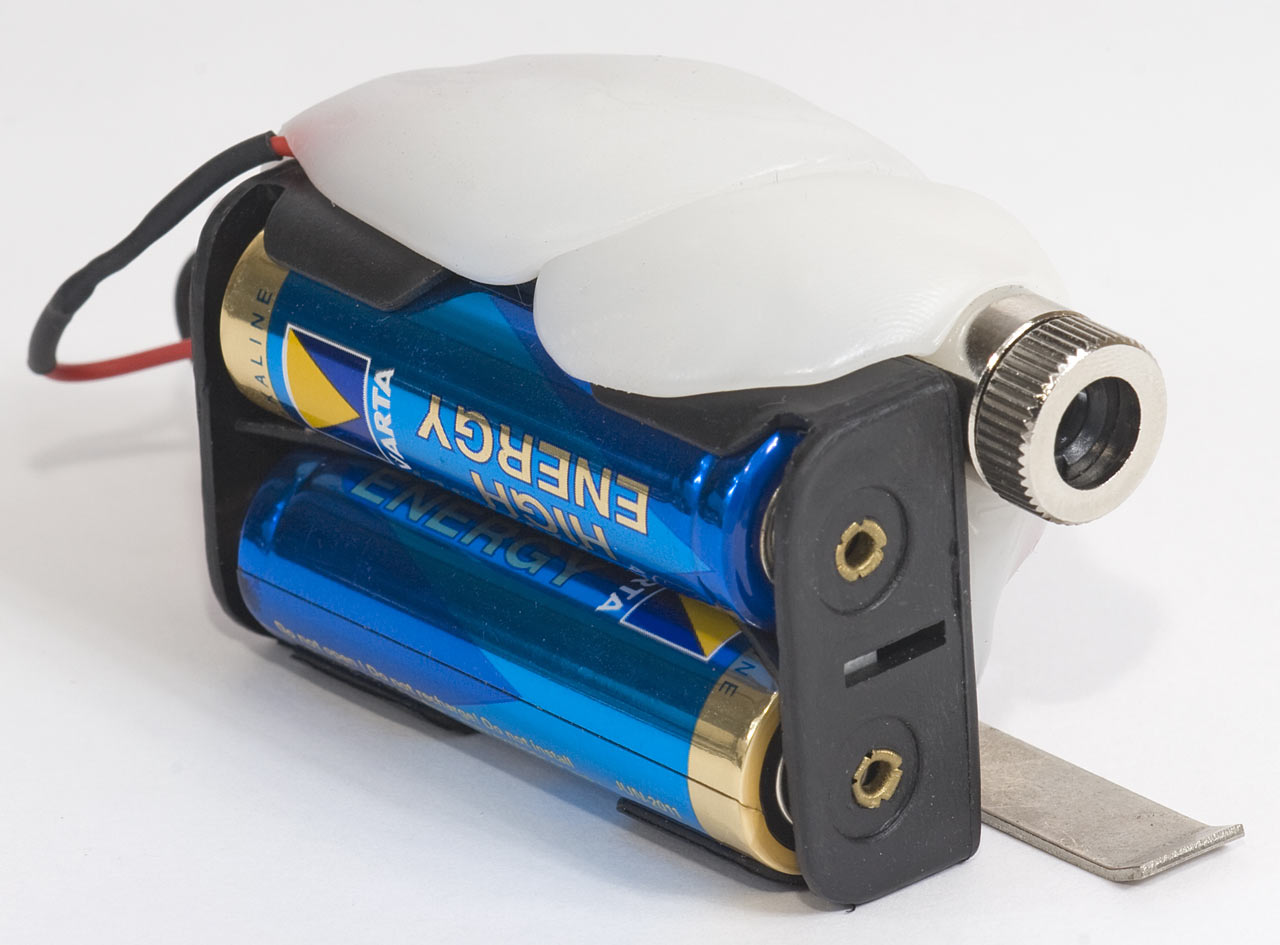
Home-made laser pointer

...took a lot longer to photograph than it did to make.

It's pleasingly bright at around 25mA current - much brighter than your standard button-cell cheapie, but not bright enough to pose any real eye hazard. It has an egg-like shape that feels good in the right hand, with a nice clicky steel switch-bar under the thumb. It has adjustable focus, so you can widen the light out into a splodge of quantum speckle at will. And it had a total parts cost about the same as the abovementioned stupidly-expensive keychain lasers. You could easily make something similar for less than $10, including the two AA batteries.

(It's quite hard to find laser pointers that take AA batteries, these days. Those little button-cell pointers are churned out by the zillion, and many pen-shaped pointers use a couple of AAAs - but if you want the substantially higher capacity-per-dollar of AA power, I think you may have to assemble your own pointer. Or, at least, hack bigger batteries onto a smaller pointer.)

The key component in a do-it-yourself laser pointer is a laser diode, lens and heat-sink assembly - commonly referred to as a laser "module", or "package".

Well, that's the key component unless your DIY ethic requires you to build the module from scratch, as well.

(The state of the DIY art has not, to my knowledge, yet reached actual home-made laser diodes. It's surprisingly easy to make your own very dim LED, though!)

There's no financial reason to build your own laser module, because you can buy ready-built modules in various shapes and sizes - even in colours other than red - startlingly inexpensively on eBay, or from dealers like DealExtreme. And no, Australian Customs won't confiscate your laser module, either - or, at least, they didn't confiscate any of mine.

Because, like an IR thermometer, a laser module is demonstrably not a laser pointer. And it is laser pointers that are illegal here, don't you know.

(I haven't tried importing a genuinely dangerous high-powered laser module, of the type used in hefty laser "pointers" that were already illegal in Australia before the current ridiculous laws went through. I would make a small wager that you would have no trouble importing such a module at all, though. But don't worry - as we all know, those scary domestic terrorists who we keep being warned about, but who mysteriously never seem to actually commit any acts of terrorism, must be so impotent on account of how they are too dumb to figure out how to connect a multi-watt invisible-beam IR laser module - you know, a laser that's actually dangerous - to a battery.

Ahem.

The question for the non-terroristic cat-toy maker is which of the (very) numerous cheap red laser modules will actually suit your purpose. I am happy to announce that I've done the legwork for you, here, for DealExtreme's range at least. I bought a few of their finest, cheapest red laser modules, and this one, yours for a princely four US dollars and six cents delivered to anywhere in the world, is the one you want.

It's got a nice big sturdy heat-sinking case, it's usefully, though not dangerously, bright from modest power, and it's got the abovementioned adjustable collimating lens, too.

The other components of a DIY laser pointer:

1: Batteries. Two AA alkalines, in this case; feel free to use some other combination if you like. (Three D cells would give you outrageously long run time.)

The batteries you choose determine which...

2: ...resistor you should use in series with the laser module.

Laser diodes, like their older relatives, the LEDs, need some kind of current limiting to prevent them from going into thermal runaway and dying very quickly. Inline resistors are usually the simplest option.

I found that the four-dollar DealExtreme module ran nicely, but not excessively, brightly from two AAs through three 91-ohm resistors in parallel, for an aggregate 30.3 ohms. I couldn't find a roughly-30-ohm resistor for the final assembly, so I used a couple of 16s in series. Small laser diodes draw only tens of milliamps, so little quarter-watt resistors are more than good enough.

If you buy some other laser module, don't just trust the "2-4.5V" or whatever that was listed on the eBay auction, hook it up to two AAs, and kill it. You'll need to put a multimeter in milliamps mode - which, remember, has a little resistance of its own - in series with the module and fiddle with batteries and, initially, larger resistance values, to find a suitable value. (That's how I ended up with three 91s in parallel - I started with one 91-ohm, which gave a very dim beam, then put another one in parallel, et cetera.)

The quick and dirty way to figure this stuff out for a laser module of unknown provenance is by starting with resistor values that're clearly much too high - by themselves, across the power supply, they'll let much less than the module's rated current flow - or by using a bench power supply that lets you limit voltage and current. Then you reduce the resistor value (or gingerly wind up the current knob) until the dot stops getting noticeably brighter. Wind it back a bit from that point and you should have a safe value. Or just stop when the dot's still getting brighter with more current, if it's already bright enough for your purpose.

Or you can, of course, sidestep all of this and just buy that DX module, and run it from two series 1.5-volt cells and about 30 ohms.

3: A battery holder. Little black plastic holders like the one I used are almost free on eBay, or you can bodge something up yourself. (Thumb-tacks make good battery contacts, by the way.)

4: A switch. I used a microswitch I had sitting around, which gives a pleasing tactile feel. Any old switch will do, though. Momentary, like my microswitch, if you want the usual hold-down-the-button kind of laser pointer, or standard "unbiased" if you want a pointer that stays on by itself.

(For about the same almost-free price as a black plastic AA-battery holders, you can get a black plastic AA-battery holder with an unbiased switch built in.)

5: Stuff to hold it all together. Solder and glue, for a more professional result; tape and positive thoughts, for a less professional one.

The weird organic-looking white stuff on my pointer is a couple of blobs of polycaprolactone plastic, about which I must digress, because it's brilliant stuff.

At room temperature, polycaprolactone is a tough white plastic, like nylon. But above about 60°C it becomes a pliable, bouncy, transparent putty-like material.
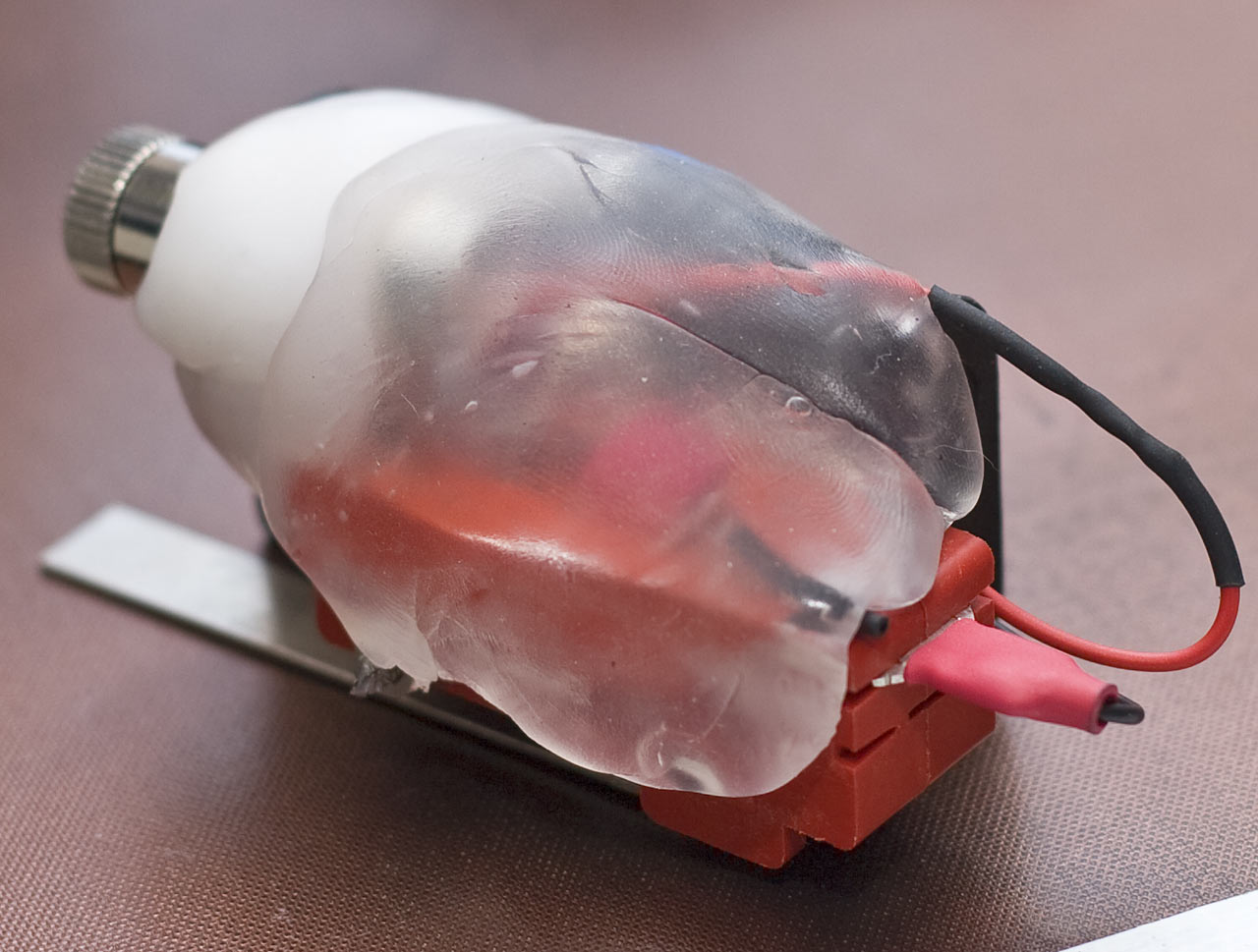
Polycaprolactone is transparent when it's hot

(This is the laser assembly before the second blob of polycaprolactone had fully cooled. It'd be fun if it stayed like that, but you can't have everything.)

You take polycaprolactone granules, and you put them in boiling water, and they turn clear and stick to each other. Just stirring the growing blob around a bit will pick up any loose pellets. Then you fish the spongy blob out and squeeze the hot water out (a slightly painful procedure), and then form the blob to suit your task, usually by just sticking it onto something and squeezing it into shape. Hot polycaprolactone sticks well to all sorts of surfaces, but not so well that you can't peel it off if you make a mistake. And you won't get scalded while doing this, because unlike water, the plastic is lousy at transferring heat to your fingers.

(If you heat polycaprolactone above 100°C, by, for instance, microwaving it instead of putting it in water, it apparently becomes a lot stickier, as well as much more able to burn you. So you might want to leave those higher temperatures to the rapid fabricators. I needed to smooth a little bit of my polycaprolactone blobs, so I wafted a small butane flame past the plastic. But then I smoothed it over with a damp screwdriver, instead of my finger.)

As polycaprolactone cools, it clouds up and stiffens, but does not appreciably shrink. If you haven't gotten your new plastic part shaped right before this happens, just pop it back in the water to re-soften. It's easier to re-shape polycaprolactone than it is to shape it in the first place, because there's less water to squeeze out. You can re-heat the plastic as many times as you like, too, and any excess can go back in the bag for later.

Polycaprolactone in the molecular weights that make it behave in this useful way is manufactured in vast quantities by at least two companies, Solvay and Dow Chemical. Which is great to know if you need a ton of the stuff, but not so much if you just want to replace a missing knob on a radio. (That was my first polycaprolactone project. It worked beautifully.)

Other companies repackage polycaprolactone in smaller quantities at large markups. "Polymorph", "ShapeLock" and "Friendly Plastic" are all polycaprolactone. The first two are very much the same; Friendly Plastic comes in a white-pellets version too, but is also available in a wide range of more-expensive coloured versions. You can colour polycaprolactone yourself, but if you need even, repeatable hues and/or metallic effects, and you don't need a huge amount of the stuff, then you'd probably do better just buying Friendly Plastic.

(The bone-white version is of course preferable, if you want to make creepy biomechanical thingummies.)

If you're in Australia and you just want to see what polycaprolactone is like, get yourself a hundred grams of "Polymorph" from Jaycar for $AU11.50. (Plus delivery, if you buy it online rather than over the counter.) That may go a surprisingly long way; I didn't weigh the Polymorph that went into my laser pointer, but judging by volume it was probably no more than 25 grams.

If you're in the States, there are lots of retail polycaprolactone sources. Try the Maker Shed.

If you're outside the States and want a larger, but not vast, amount of the stuff, many companies stand ready to rip you off.

You can place an international order at Shapelock.com and pay for it, with a pleasingly low shipping fee - and then they'll refund your money, because they don't actually ship overseas. And then they'll tell you to order from Jameco instead. Jameco's international shipping fees aren't mentioned on their site; you can place an order and give your payment info and wait for the delightful surprise, or you can e-mail them, whereupon they will inform you that their cheapest price to send a $US24.95 half-kilo of Shapelock to Australia is $US39.

Sorry. Just had to get that out of my system.

OK, here's how people outside the States - and possibly inside, actually, depending on how all the prices shake out - can buy polycaprolactone at a non-stupid price. Go to this eBay dealer in the UK (on ebay.com, on ebay.co.uk), who's currently on holiday until the 8th and has invisibilised their auctions, but will actually still let you place an order via this listing. They'll sell you 500 grams of Polymorph-branded polycaprolactone for £9.50 plus quite reasonable delivery, with a microscopic discount for multiple half-kilos.

[UPDATE: As pointed out in the comments below, that eBay dealer has a separate Web site too, from which you can download a great PDF about what you can do with Polymorph.]

To make sure I get my order in before all of y'all, I just ordered a key, man, for a total of £32.75 delivered to Australia. That's about $AU54.20, or $US49.80, as I write this.

A kilogram of polycaprolactone is quite a lot - especially when you consider the near-infinite reuseability of the stuff. Unless I suddenly start building sizeable structures, I don't anticipate having to buy any more for some years.

Jaycar offer discounts for bulk purchase, but a kilogram of Polymorph from them is still $AU89.50 ex delivery. So the eBayer in the UK looks like a good deal.

Hm. This post started out being about making a laser, and ended up about making freeform plastic bones. Eh - it'll do.

Do feel free to discuss either subject in the comments!

For suitably small values of "infinite"

One Jiang Gonglue has come up with this brilliant idea:

Infinite USB

(Via.)

Never mind the fractured English - these passthrough piggy-back plugs, called "Infinite USB", are clearly a work of genius.

And I'm not the only person who thinks so. Infinite USB won Mr Jiang an "iF Design Concept Award!

The only problem, really a very minor one, hardly worth mentioning, is that each of these cables is presumably a two-port bus-powered hub. And the USB spec forbids plugging one bus-powered hub into another one.

The official specs for USB also prohibit plain extension cables, mind you, and most extension cables actually work fine with most devices, provided you aren't greatly exceeding the five-metre cable-length limit. And, similarly, in reality you often can plug one bus-powered (or "passive") hub into another and have it work, more or less. You may not be able to use all of the ports - which is less of a problem if there are only two, of course. And you're quite likely to find you only get a USB-1-speed connection. But passive-hub into passive-hub will usually sorta-kinda work. Especially if the powered port your illegal chain of bus-powered hubs is plugged into can deliver more than the half-amp of current that the USB spec says it should.

The reason why daisy-chaining passive hubs works at all, by the way, is that many bus-powered USB hubs report themselves as being self-powered. A real self-powered hub is one with its own DC power supply, which allows it to deliver the full 0.5A of current on each of its ports. But there's nothing, except the ethics of the manufacturer, stopping a bus-powered hub from declaring itself to be self-powered, whereupon it'll at least attempt to work if plugged into another passive hub. A passive hub that admits that it's passive won't work at all if you plug it into another, similarly-truthful passive hub.

(Most self-powered hubs will work even if you don't connect their plugpack power supply, but they'll only be bus-powered when the power supply is not connected. I wonder how many of them report themselves as bus-powered when the plugpack's not plugged in?)

So the Infinite USB plugs aren't abominations like male-to-male plug adapters and such. They might work. A bit.

I'd be pretty surprised if even the green-striped #3 one in the above picture worked, though. I'd bet money that the apple-cart would have been thoroughly upset at least by the time you plugged the #4 grey one in. Oh, and if the Infinite USBs reported themselves honestly then, of course, none after the original #1 blue plug would work.

But, as we've seen before, trivial considerations like whether the product could ever possibly work are not an obstacle for hard-working design students and the institutions that give them awards.

DSLR decisions

A reader writes:

I am looking to buy a digital SLR camera. I am stuck between the Nikon D5000, Canon EOS Rebel T1i [also known as the EOS 500D]and the Canon EOS Rebel Xsi [a.k.a. the EOS 450D; the DPReview 500D review compares the 500D and the 450D].

I am leaning towards the XSi, however I would like to know if there is more value spending the extra bucks and getting one of the other ones. I am a beginner when it comes to photography and will use it mostly for taking pictures when travelling and family functions etc. Appreciate the guidance.

Jorge

I don't really know enough about the Nikon to firmly rule it in or out. Don't worry, though; I'm sure commenters will soon explain to you exactly why your only possible sane option is Nikon, and also how a Nikon will definitely steal your family's souls and impel their dead-eyed husks to kill and devour you at the earliest opportunity.

I can, however, tell you that the major investment for any DSLR owner isn't the camera body, it's the lenses.

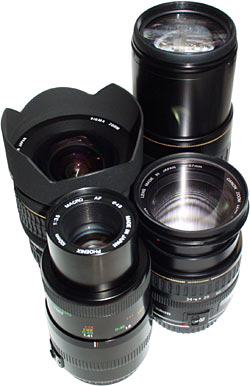
Lenses

(Well, actually it's perfectly possible to buy a DSLR body and a couple of lenses that cost less than the body, and then just call it a day. This almost always indicates that you should have bought a smaller, lighter, cheaper point-and-shoot camera instead.)

I presume you don't have any Nikon or Canon lenses at the moment. If you've got a friend who's got a collection of lenses for either Nikon or Canon and who's willing to loan any of them to you, though, then you should get the same make of camera they have.

(This extends to less common DSLR brands, like Pentax, Olympus and Minolta {though probably not Sigma}. Sony bought up Minolta's camera arm, so now they're "Sony Alphas" instead of Minolta Alphas, but the lens mount remains the same.)

Note also that some Nikon F-mount lenses only autofocus if you put them on a camera body with a built-in motor, that mechanically couples to the lens. The D5000, like various other cheaper Nikon DSLRs, does not have that motor, and so will only autofocus if you get lenses that have their own motor. Motorless lenses will work on a D5000, but you have to focus manually.

Manual focus can be a bit of a pain with consumer DSLRs, because they never come with the split-image ground-glass focusing screen that you need. It's certainly not impossible to do manual focus, though, especially since the camera should still be able to go beep at you when it reckons you've got the focus right. (You can also usually upgrade the focusing screen - it's not even all that terrifying a DIY job.)

Further points:

1: The Nikon and the Canon T1i (which is known as the EOS 500D, outside the USA) can capture HD video. The cheaper Canon cannot. The new wave of video-shooting DSLRs - all of which, I think, you can set to lower resolutions if you don't need HD - are a big step forward in consumer videography. They give a professional interchangeable-lens camera to amateurs. If you don't care about video, though, or prefer a pocket-sized video camera, this becomes irrelevant.

2: Resolution doesn't matter. As far as actual image quality goes, even for long-exposure night shots and high-ISO work, there's little real difference between the recent Canons - and, I'm pretty sure, the Nikon too - and models from several years ago.

Three Sisters long exposure

This was a 30-second exposure, at 2:37 in the morning, by the light of the full moon, taken with my EOS-20D in 2005.

Long exposure

Another 20D shot, this time more than 40 minutes!

Long exposure

A five-minute exposure from my EOS-D60, circa 2002.

Really high-sensitivity image quality and noise reduction is, to be fair, slowly improving. And the highest sensitivity figure you can set is rising, too. But the difference is not very large, because of the marketing-driven megapixel mania that keeps packing more and more pixels into the sensors, even if most lenses and most photographic subjects don't have the optical quality and/or image detail to make this matter, rather than improving the pixels that're already there.

If you find someone selling a seven-year-old D60, in good condition, for $100, buy that instead of a new camera, and spend the savings on starting your lens collection.

(The second-hand market for DSLRs isn't actually very exciting. This is because DSLRs hold their value much better than most electronic devices, and even if an old DSLR is mechanically perfect it may have lots of crud on the sensor. And the price of brand new DSLRs keeps sliding down, even as more genuinely useful features like video, partially self-cleaning sensors and sensor-shift all-lenses image stabilisation trickle in around the marketing nonsense. Second-hand lenses often aren't that cheap, either, but this is compensated for by the fact that they're very often in perfect working order.)

3: Don't get only one lens, even to start with.

If you get a basic body-plus-one-lens package for any of these cameras then you'll get a perfectly serviceable little zoom lens. Photo enthusiasts love to complain about quite minor image-quality flaws, but the kit zoom lens really is just fine for most purposes.

You should also definitely get a cheap 50mm f/1.8 prime, though, for reasons I explain here.

In brief: Cheap "fast" large-aperture lens equals great portraits, with the face in focus and the background blurred.

The cheap Canon f/1.8 50mm is this one. The Nikon equivalent is this one - NOTE, however, that it's one of those motorless lenses that you'll have to focus by hand on low-end Nikon DSLRs. For candid portrait shooting this isn't actually a major limitation, since you need to jockey around anyway when using autofocus to avoid focusing on the tip of the nose rather than the face, but it's still worth noting that, as far as I know, there's no cheap f/1.8 prime for Nikon that has its own autofocus motor.

(By linking to Adorama, above, I'm making no particular recommendation of them. They're a perfectly good online photo store, as is B&H, with prices about as cheap as any dealer who isn't a scam artist - but I'm linking to them because I like their short URLs and site search. Note that I'm also linking to the USA-retail versions of these lenses; big photo stores also often sell cheaper used, "refurbished" and grey-market lenses.)

4: If you're going to shoot sport or birds or anything else that needs a telephoto lens, then you should either buy a two-lens camera kit, which usually adds a passable something-to-200mm lens to the standard little zoom lens, or buy a something-to-300mm zoom lens separately. The absolute cheapest options in this category - some under $US100 - have lousy image quality, but you don't have to pay a lot more to get a quite acceptable Canon, Nikon or Sigma. (Third-party lenses - Sigma, Tamron etc - can usually be had in both Canon and Nikon versions, and often some other mounts besides.)

Examples:
Canon 75-300mm, $US160
Nikon 70-300mm, $US155
Sigma 70-300mm for Canon, $US159
Sigma 70-300mm for Nikon, $US159

The basic something-to-200mm lenses, like the little kit zooms, also show up very cheap on eBay all the time as people upgrade their camera-and-lens kits. You'll be able to save a little money if you buy the basic lenses that way, but it's probably not going to be worth the hassle.

You can also get quite affordable image-stabilised lenses these days. Both Canon and Nikon make stabilised versions of the above cheap zooms, though this pushes the price up over $US500 without improving the actual basic optical specifications at all. The stabilisers help considerably with camera-shake, but do nothing to prevent pictures of things that are themselves moving from being blurry.

You can get the stabilised version of the basic Canon 18-55mm lens in a quite cheap body-and-lens kit, as well. Here's a refurb version of that kit, at a price that's hard to dislike.

5: Get a tripod. A cheap and nasty eBay/DealExtreme Special will do fine. Even if you hardly ever use it, it'll be $20 (or less than $15...) well spent when you finally do need it to shoot longer exposures in low light, maintain consistent framing of a sequence of shots, et cetera.

(You might also like to get a remote shutter release cable for your camera of choice, to avoid bumping it when you press the shutter button for a tripod shot. The brand-name versions can be a bit expensive, but since a remote release cable is just a switch on a wire, you can buy cheap copies with confidence.)

6: Get an add-on flash, with a swivel-and-tilt head. (Not one like this, that only shoots forward.)

Direct lighting from the little pop-up flash on your camera, or any other flash pointing forward, will get you a picture when nothing else will, but is an almost perfect guarantee that the picture will be an unsightly "happy snap".

F/1.8 cat portrait.

Flash bounced off the ceiling, plus a 50mm f/1.8 wide open, are your secret weapons to take fantastic portraits indoors.

Ideally you'd want a quality flash from the camera manufacturer, that works with the wireless triggering systems that most (possibly all) current DSLRs have, and can thus be used together with any other compatible flashes you buy. But those can be a bit pricey.

Off-brand flashes that work with the Canon and/or Nikon systems exist, but are apparently often a little dodgy, and aren't all that cheap, anyway.

The next step down, which will probably suit you just fine, is a flash with no wireless-compatibility stuff, but which still supports Through-The-Lens (TTL) exposure metering. Sigma have some nice options; again, there are also more expensive products from the camera manufacturers themselves.

If you're really on a shoestring budget, you can just buy a cheap old-fashioned "thyristor" auto-flash that works with your camera.

Your camera probably won't like flashes with a high trigger voltage, but there are many flashes that do not have this problem. The one-stop Internet info depot for cheap-and/or-manual flash users is Strobist.

(The magic name of Strobist also makes it pretty easy to see if that "SpringFlower Joyshine 2001" on eBay for $15 is worth buying. Just searching for [flash name] "trigger voltage" will also usually suffice.)

OK, readers; what've I forgotten? Let's see if we can throw so much advice at Jorge that he gives up on the whole idea of taking pictures!

Today, on "Surf-Celebrity Science Class"...

Herewith, one of the most pleasing correspondences I've ever had with someone who originally contacted me with bold new scientific ideas.

Usually, such exchanges go kind of like this. This went much better.

And it turned out I was talking to someone famous, to boot!

From: Tom
To: dan@dansdata.com
Date: Mon, 8 Mar 2010 02:15:07
Subject: Magnetic healing?

I'm on some kind of similar path as you. In any case, really appreciated your summary of kinds, costs and usage of neodymium magnets.

I came across a guy who explained to me that microbes have a tough time living in changing magnetic fields. Germs, viruses... Perhaps that's one reason exercise is beneficial. The electricity delivered in pulses to muscles, causes pulsing magnetic fields all along the way.

This guy and his pals were making "Thumpers" (maybe spelled differently). They were buying Radio Shack strobe lights, then attaching coils in place of lights, and maintained that pulses of magnetism could cure bacteria deep within the body. His wife, for example, had some sort of deep sinus infection that he'd healed.

I talked long distance to the guy via telephone (back in a day where it made a difference that phones were far apart) and compared notes on power. I asked him to describe the results when he applied his thumper pulses to his television screen... again, this was before flat screens so that you'd wiggle a magnet in front of a computer monitor or TV and it would produce all kinda weird patterns. His thumper was effective within a foot or so. Meanwhile, I was twirling a couple of not all that strong cylindrical magnets two feet from my screen and it was going nuts. My magnets were like the size of a pack of Life Savers. These were suspended from my fingers by a loop of rubber band which I could then twirl. Wind and then it would unwind, kind of thing.

Point is, experiment with infected sores by waving the sore part back and forth by a neo magnet. Or, build a little rubber band twirler and try it out next time you have, say, a toothache. Twirl it by your teeth and see if it kills off the tooth caries.

Tom

My reply:

I don't think it's true that magnetic fields kill microbes. And if the incredibly weak magnetic fields from natural electrical activity in the body made life "tough" for microorganisms, walking past an electric oven would kill all the beneficial flora in your gut.

With regard to the magnetic "thumpers", the big question is, "How do the pulses know good bacteria from bad?"

(It turns out that magnetic "thumpers" are also known as "pulsers", and are quite popular among people who usually also believe that Hulda Clark and/or Royal Rife could actually cure just about everything with their electrical "zappers".)

If sinus infections never went away by themselves, then curing one with some gadget would be impressive. When you're dealing with diseases that do go away by themselves, and don't even have clear endpoints or objectively measurable symptoms, though, it's not a great idea to conclude that whatever you did before the disease went away must have cured it. This sort of uncontrolled test may point you toward a real phenomenon that you can then investigate properly, but all it proves by itself is that whatever you did before the disease went away didn't stop the disease from going away.

The "thumper" idea has the same problems as many other half-baked alternative-medicine theories. Magically targeting bad bacteria while leaving good ones, a simple scientific process with Nobel-Prize-worthy effects that would have been discovered by accident ten thousand times before 1910, et cetera.

Yes, CRT monitors are very sensitive to magnetic fields. Which is good, because otherwise the dot would just sit there in the middle and you'd have to wave the whole monitor around really fast to make an image! (You could, to be pedantic, use oscilloscope-style electrostatic deflection instead of magnetic deflection. But electrostatic deflection can't bend an electron beam nearly as sharply as a magnetic field; a 26-inch electrostatic-CRT TV could easily be six feet deep.)

Magnetic fields affecting electron beams are a real physical effect, discovery of which was an important, and inevitable, part of the development of human knowledge about electromagnetism. William Crookes (of the eponymous radiometer, among other things) probably did the magnetic-deflection trick first, but if he hadn't, someone else would have (and, indeed, did), well before the end of the 19th century.

Magnetic fields of modest strength affecting biological organisms, on the other hand, is a claim frequently made, which could easily be tested in a kitchen with less than a hundred bucks worth of basic scientific equipment, but which has never thus been proved.

(You can set up a pretty respectable molecular biology lab for under $US1000, these days. Praise eBay!)

If you walk through a really monstrous magnetic field - the kind with big warning signs about not entering the room unless you've ditched every metal object on your person, even if you're willing to sign an affidavit saying that those objects are not ferromagnetic at all - then you're likely to feel funny. Focused and pulsed magnetic fields directed into the brain can also create peculiar effects. Pulsed magnetic fields may even improve healing, though the verdict isn't quite final on that one yet.

But even magnetic fields so powerful that the feeble diamagnetism of water becomes sufficient to levitate living creatures do not, so far as anyone can see, kill so much as one lowly bacterium.

The notion that field strengths that aren't sufficient to rip a belt buckle clean through the leather could somehow kill germs is, thus, exceedingly difficult to defend.

I cordially invite you to set up some Petri dishes and conduct your suggested tooth-decay experiment. You may be the one who makes the breakthrough!

Tom replied:

I appreciate your thorough and helpful reply. However, I'm not coming from any place of proof. Just suggesting a possibility. As to selectively killing bad flora, that idea never entered my head. The point is that possibly there's something in the idea to consider rather than criticize.

As to a notion you seem to entertain I'll paraphrase as, "If that idea was any good, it would already have been invented". This is a very discouraging idea. The fact is, that in 1850 a bill was put before Congress to close the Patent Office because they thought everything of worth had already been invented. Wrong. Looking back from say the year 3000 we'll see that relatively little had been discovered by 2010.

As to the use of alternating magnetic fields as a deterrent to bacterial buildup (good or bad), I'd be willing to bet that in the not too distant future, it will be determined that the relatively strong magnetic fields used for MRI are curative of certain chronic disorders.

As a youth, my mother told me repeatedly that my ideas were probably already thought of. However, in 1971 I thought up something called the boogie board, and created its manufacturing process. 20-50 million of them have since been built.

Anyhow, best wishes.
Tom

Thanks for not flying off the handle over my typically "thorough and helpful reply" :-).

You may not be "coming from any place of proof", but neither is anybody who's postulating some new scientific claim.

I've explained why the "possibility" you mention is extremely implausible. It would be easy to test, people have tested similar claims many times, and as far as I know, it's never panned out. People have incidentally tested these claims countless times, actually; any time germs and a magnetic field are together and someone checks on the germs later, that's a test of your claim.

I mean, just to pick one example, "magnetic stirrers" are a normal piece of lab equipment. A rotating magnetic field from below a container spins a little stirring rod inside the container. Such stirrers are used in biology labs, and have been for decades. To my knowledge, no germicidal properties from the magnetic field have ever been noticed.

And, again, this'd be Nobel-Prize material. Even if you can only kill germs on inanimate objects by subjecting them to magnetic fields, that'd be a billion-dollar discovery. It'd be a wonderful alternative to autoclaving and chemical disinfectants.

So sure, possibly there's something in the idea. Possibly, Elvis is alive, and currently serving as Emperor of All the Underground Cities of Mars!

[UPDATE: Magnetotactic bacteria actually do respond to magnetic fields, and can in practice be manipulated to do strange things under magnetic control. This doesn't have anything to do with disease control, though.]

On top of the fact that this idea has been tested zillions of times - mainly accidentally, but I'm sure also deliberately; the idea that magnetism is somehow therapeutic is an old one - I've also explained why your friends with the magnetic strobe-circuit doodads are making inconsistent claims in the first place. Somehow, the magnetic fields kill "bad" bacteria while leaving the "good" ones alive.

The magnetism obviously doesn't kill the good bacteria, because otherwise anybody who passed through a strong magnetic field - or used one of these "thumper" things, in case it's field gradient or pulse frequency or something that's critical, not just field strength - would develop the same diarrhoea you get if antibiotics kill off your gut flora.

If you managed to confine the field to your armpits, though, it'd cure underarm odour!

There are quite a lot of beasties that live in and on the human body, more than a few of which would cause obvious effects if you killed them all off. And yet people who spend their whole working life right next to giant superconducting magnets, and people who work in magnet factories, and people who work next to the giant busbars in power stations and blast furnaces, do not exhibit any signs of loss of bacteria. (I'm also willing to bet that if you swab the bus bars, the surfaces of the magnets, et cetera, and culture what you find, there won't be any fewer, or any different species, of microorganisms than you'd expect.)

See also, for instance, people who believe that "colloidal silver" is some sort of cure-all. In that case they've at least got some factual basis for their claims; metallic silver has real antiseptic properties. But they go from that to saying that tiny silver particles (or concoctions that they just allege contain tiny silver particles...) will, if you drink them, be Good For What Ails You, and magically not kill any good bacteria. Which is the point where they and empirical evidence part company, and also the point where they stop making even logical sense.

David Hume's famous statement that "A wise man proportions his belief to the evidence" does not mean that everybody should shut up and just believe whatever scientific orthodoxy, or the government, or some church, says. You're allowed to seek your own evidence, and to judge what evidence presented by others is plausible. You don't need a diploma to be a scientist. A scientist is just someone who does science.

But this doesn't make all claims plausible, or worthy of investigation. Life's too short to follow up on every possibility, no matter how unlikely.

Regarding the "bill to close the Patent Office" - now, see, that's not true either!

This urban legend is usually presented as "a US Patent Office guy in the 19th Century said that everything that could be invented already had been". The version of the story that says it was a Bill to close the patent office also exists in numerous versions. Nobody can decide what year this was supposed to have happened!

Sure, maybe in the future we'll look back on our skepticism about therapeutic magnetism and wonder how we could ever have been so wrong. But nobody's noticed any germ-killing effects yet, though. And lot of people have had MRIs. And most of those people have been sick.

Scientists all over the world are combing through every possible statistical source to find something publishable. A correlation between people having MRIs and infections clearing up would be a brilliant one. No luck so far, though.

I think the relevant saying is "it's good to have an open mind, but not so open that your brain falls out".

Regarding your mother's incorrect assumption that your ideas probably weren't new - indeed, the man who says it can't be done should not interrupt the man who is busy doing it. But this does not mean that the man who says it can't be done is the one who has to put up or shut up!

I'm reminded of this:

Small child: "My mummy says when I grow up, I can be anything I want to be!"
Adult: "What do you want to be, then?"
Small child: "I'm going to be a GIRAFFE!"

You might not actually choose to dash the child's hopes at the time, but you can still be pretty sure that kid's not going to grow up to be a giraffe, a fire engine, a jumbo jet, et cetera. This certainty does not make you close-minded.

However, in 1971 I thought up something called the boogie board and created its manufacturing process.

Wait - you're "the" Tom Morey?! Awesome! If you were here in person I'd ask for an autograph!

(This still doesn't make you exempt from having to prove your scientific claims, though!)

I should have known I was talking with an engineer :-). Take care that you don't come down with "Engineers' Disease", though - the tendency for people with a high level of technical knowledge to decide that their knowledge must be applicable to specialised fields that they don't actually know a lot about. The world teems with distinguished engineers who're spending their later years in futile pursuit of perpetual motion, antigravity, cure-alls and so on.

Now, just because someone is an engineer, and now thinks they're onto something big that isn't quite in their area of expertise, doesn't mean they're wasting their time. But this does seem to be a common failure mode for human minds, and I shudder to think how much hard work has been ploughed into these sorts of hopeless pursuits.

Tom replied:

Dan,
Thank you for all the kind attention. You've developed a very thorough and convincing mind.

Interestingly, you hit quite a few nails on the head. Example: Yes... at age 75 now, having dabbled in way many things, more recently I've made up my alleged mind to spend the rest of my days of developing practical transatmospheric "flight" for the common man. Although I'm making progress and excitedly so, I certainly could be pissing into a windmill or whatever the phrase is. Then again, what FUN!

Health and healing...? About all I've really figured out so far is that not smoking, not drinking, plus getting into the ocean more often than not, exposing myself to ONLY moderate exercise and yet semi-regular doses of cold water shower finishes... has kept me fairly healthy.

Even so, right now I feel like the second half of the avocado that was perfect a couple of days ago when you ate the first perfectly flavored and textured half; then put this second half in the fridge. Now, spoon in hand, ready to dive in... fridge door still open and, "Hey! Where did those stringy things come from"?

Your arguments about all the folks who are regularly working with magnets, stirring fluids in labs etc, were very thought provoking. Thank you.

The whole topic reminds me of a curious event a few years back when our apartment was inundated by ants. In fact the suckers were EVERYWHERE for blocks around; no stain or crumb was left un-munched by the buggers. Funny thing was a good many took up residence in, or at least were staying alive in, the microwave oven! I'd swing the door open, stick in a cup of hot water for tea, and notice dozens of ants meandering around in there. Too busy at the time to do away with any of them, I'd simply shut the door, set the timer for two minutes and bzzzzzzzzzzzzzz. Then open the door, take out the boiling hot tea... and damn if they'd changed at all. Still milling around, none of their little feet up in the air.

Go figure?

Anyhow, thanks for your patient ponging of my pings. Aloha, And good bye. Am going off line for the next couple of weeks, So Cal is too cold for the bones. Heading for Cabo to drink in lots of light... roll in the sand and slosh around in the sea.

Tom

The ants survive because they're too small to be affected by the microwaves, which are "micro" by radio-wave standards, but still have a quite large wavelength. That's why you can see into the oven through that perforated metal on the door, without any microwaves getting out. Note that the perforations are similar in size to an ant!

You can actually drill quite a large hole through the metal around a microwave oven, to for instance install a "lipstick" camera, without any radiation escaping.

If you just put the camera inside the oven and turn it on, the camera's electronics will die almost instantly and obvious macroscopic sizzling and sparking will be happening within seconds.

If the camera's on the other side of a hole big enough to stick your finger through, though, it'll be fine.

(Most cockroaches are juuuust big enough for a microwave to fry them, if you give it a little while. The bigger the roach, the more trouble it'll be in.)

See also the magnificent series of Unwise Microwave Oven Experiments by Bill Beaty, who's one of my heroes.

I've microwaved many CDs, but haven't yet done the fantastic beer-bottle stunt!

Does YOUR hamster have The Right Stuff?

When I read that Neil Fraser's Meccano lava-lamp centrifuge only rotated at 42 revolutions per minute, I didn't think it sounded very impressive.

I take that back.

Long word, starts with P, solves all our problems...

A reader writes:

I've just read an article in Popular Science about Sun Catalytix' "artificial photosynthesis" being used to power houses.

Which got me questioning, is it even viable? Using water as an energy source, as you've said previously, involves electrolysis, and the power it can generate won't exceed what was used in the electrolysis process.

He is using sunlight as the energy source, so I guess it's not one of those water-powered-car scams. But wouldn't it be easier if we use batteries to store the electricity from the solar panel?

And where does the photosynthesis comes in?

Please enlighten me here.

Andhika

The photosynthesis is supposed to replace the electrolysis. See, electrolysis is really inefficient, and batteries aren't awesomely efficient either, and you need a pretty darn big battery bank, which wears out, to run a whole house. But photosynthesis can manage efficiency as high as 8%, so... uh...

Look, buddy - "photoelectrochemical cell" is 24 letters - 25, including the space. We're already really pushing the brainpower of the voting public with the word "photosynthesis", all right?

I started doing a series of actual calculations about this, then stopped, because there's not enough information in the article, the marginally-more-informative Scientific American article, or...

...the less-than-entirely-satisfying accompanying video, for any really solid numbers to be made.

(You can't say that that video doesn't alert the viewer to the fact that it's not aimed at people who know a single damn thing about anything. "In the next forty years, you're going to need more energy than is available from every source you can imagine", says actual MIT professor Dan Nocera. Never mind that decreasing human energy consumption, while continuing to improve quality of life, is a real and serious goal; I can also "imagine" fusion power, dude. So clearly I'm not part of this clip's intended audience. Paging Mr Bush; Mr Bush to the coal-fired courtesy phone, please...)

In neither the Popular Science nor the Scientific American piece does the writer seem to have paid any attention to that core "30 square metres of solar cells in Boston making 30 kilowatt-hours in four hours" claim. It seems fishy to me. As does the idea that this magical catalyst is actually a useful breakthrough.

I'd be willing to believe that this was a real, if slightly oversold, option, if it weren't explicitly about a system that you're supposed to install on your roof to run your house. This didn't, early in the Scientific American article, seem to be the case - "We emulated photosynthesis for large-scale storage of solar energy", says Dan Nocera.

And yeah, you might perhaps actually be able to get the stated output from the stated area of cutting-edge panels at Boston's latitude if they're all on expensive sun trackers and/or overpumped by extra reflectors and water-cooled. Which they can be, relatively economically, if they're part of a municipal solar farm and not stuck on someone's roof.

No matter how good the magic catalyst is, though, nothing's going to give you all of those 30 kW/h back again, and Mr Nocera goes on to say "...We need to do it the old American way of making one small one and then manufacturing that system to give it to the masses."

Which brings us back to the cheerful notion of an easy $35,000 worth of cutting-edge solar panels and sun-tracking hardware on everybody's roof, much of which will need repairs after every storm. Unless you ditch the trackers, reflectors, cooling system, et cetera, in which case the stated energy output becomes impossible with even maximum-efficiency commercial solar cells of the stated area. You're likely to need something like twice that area for well-aimed never-shaded cutting-edge commercial cells, an easy three or four times the area for cheaper panels installed on a real-world roof...

A couple of commenters on the articles, and on this Engadget writeup, managed to briefly poke their heads above the SOCIALIST TEA PARTY MASONIC JOHN BIRCH GRR comments to point out some of these issues.

Fortunately, even if Mister Nocera is being outrageously misquoted (occasionally by himself!), his company is only about the hundred-thousandth-worst outfit to have had US taxpayers' money sprinkled upon it lately. And who knows, maybe there's something to this, even if it depends upon solar panels that haven't yet been invented, or something.

I wouldn't rush out to place a deposit, though.

Power factor. Again. I'm sorry.

Regular readers will know that the world currently teems with "power saving" devices, which are alleged to use Power-Factor Correction to save you money on your electricity bill.

These things are absolutely excellent, except for four minor flaws.

One, little plug-in PFC gadgets don't actually correct power factor at all, two, little plug-in PFC gadgets don't actually correct power factor at all, three, domestic electricity customers aren't billed by power factor anyway, and four, domestic electricity customers aren't billed by power factor anyway.

I realise that, technically speaking, that's only two flaws, but I thought they were such big ones they were worth mentioning twice.

At the other end of the commercial spectrum from the BS plug-in power savers, there are big industrial units designed to correct the atrocious power factor of certain particularly serious offenders, like really big electric motors, or really large numbers of smaller motors. Usually these sorts of correction setups are just capacitor and/or inductor banks carefully matched to the load; sometimes they're "smart" devices that adjust themselves to correct varying power factor, which is what you'll get if, for instance, you've got a factory full of big motors that keep changing speed and load.

This sort of PFC, and similarly large-scale PFC that's implemented by the actual power companies (typically in the form of big capacitor banks at substations and other distribution transformers), is entirely genuine, quite useful, and very expensive. But if you're billed by power factor, or if you're a power company that wants to minimise the mass of metal in your whole distribution network, PFC is essential.

In between the little rip-off plastic home-user things and the vast custom capacitor banks in power stations are, as you'd expect, PFC devices for medium-load applications. Yesterday I corresponded briefly with someone who's trying to sell such devices.

Regular readers won't find anything very new and exciting in this correspondence, and I wouldn't blame any reader for only lightly scanning at least the first giant block of quoted text. I'm posting this mainly so that Google searchers will be able to find a little more info about this field in general, and this product in particular.

(Also, I've suffered for my art, so now it's your turn.)

From: Tim Otto <tim@powerceosales.com>
To: dan@dansdata.com
Subject: Active and dynamic PFC.
Date: Wed, 3 Mar 2010 20:15:51 -0600

Dan, I was reading your article and wanted to share with you our new technology. I agree with you on a residential level that the current PFC units don't save you money ,but when you take PFC and only put it in the circuit and remove it there is a savings. I am reaching out to all the blogger on the net and am asking them just to consider that what I'm saying is real. We have seen savings and when the product which just went to mass production get here I am reaching out to all bloggers on all continents to get a unit in their hands. I don't want to sell it to you. It will sell its self when you see it work. On the business side the meters do read different here in the states and the savings is much greater. Please take time to read the PDF study and when we hit your continent we can get one installed for your testing.
Why is power factor correction an important part of reducing co2 emissions and is there any new technology available to ad to the global effort? Yes, let me explain where this large void is occurring. Large industrial power users (demand side) have been using power factor correction (pfc) for years on large motor driven equipment because its too costly paying the power providers for this wasted reactive energy (poor p.f.). There is a demand (penalty) charge on their monthly bill including all commercial users. Several companies build PFC units by incorporating capacitors in various amounts to match the loads of running motor(s) to offset this penalty. These units are large and tailored to do a cost saving job for this industry. The user and power provider both see a power usage benefit.

Home and commercial users share the burden of poor power factor and extra power must be provided to offset this waste. Air conditioning, furnace blowers, refrigerators, freezers, washers, dryers, fans, garbage disposals, dishwashers, lighting with ballast or transformers, pool pumps etc all ad to the burden. Whitby Hydro Energy Services of Canada did a series of test in 2005 by taking a group of homes and using pfc devices with a set amount of capacitance. Their conclusion: ‘The result of the pilot indicated that the addition of capacitance indicate that installation of the units on mass will reduce the generation requirements through the province and we recommend that the findings of this pilot be shared with the government officials as a viable means to help address the supply and transmission issues within the province”. The full 15 page PDF report is attached.

[The above quote isn't quite what the report actually says, but it's basically correct. Yes, the report does actually use the term "on mass". Hey, give 'em a break - they're in Ontario. Nobody speaks French there.]

No doubt Whitby Hydro could save on power generation so why not mandate to use pfc units on homes and business and save a new power plant from being constructed? To make this possible a pfc unit would have to turn on and off when motors and ballast/transformer type lighting were operational and make constant capacitance adjustments to correct the different loads and voltage fluctuation drops caused by peek demands. A good pf correction is .95-.96 and going higher can cause frequency modulation problems. Present pfc units are fixed or variable and cannot perform the computerized functions that would be required. This is where Power-CEOtm (Computerized Energy Optimizer) fills this gap. Our patented (USA and most countries) power factor correction units is the first to incorporate the proper technology for global usage. Here is what the patent-holder has to say: “We are confident that our patented “Power-Factor-Correction” technology is light years ahead of the other PFC systems. By and large, most PFC systems are either “Static” (designed for a specific amount) or a hybrid of “Limited Automatic,” designed around several variables and are thus referred to as automatic. However, our power-factor-correction technology is fully and completely Dynamic/Automatic in that it will turn on precisely the amount of correction required in order to attain a PF of .95 and not only that, in the event an additional load turns on or is introduced into the system requiring additional compensation, our Smart System will automatically and instantly adjust to the new required setting. When any load which was requiring the compensation either turns off/on or changes its setting (for example, motors with varying loads), our PFC system will readjust and continue to readjust as needed in order to provide as near to a PF setting of .95 continuously as is feasible.
The current US President, as well as our previous President both stated when talking about the Kyoto Protocol and Copenhagen Meeting on the Environment, that they believe technology will be developed which will help us reach ascertainable goals without significantly hampering commerce. As you will see, Power-CEO™ is one of those technologies.”

Midwest Research Institute, a Government funded institute, has been involved since
2001 helping with technology issues until Power-CEO was completely viable and ready to market, and UL approval has been met. Plamen Doynov the senior engineer from MRI has this to say: I am intrinsically familiar with the technology. I was involved in the development of the original analog implementation during a contract with McDaniel brothers. Consecutively, we performed performance testing of the digital implementation of the technology. A copy of the performance report can be provided. In the report one can see that the testing of the technology confirms that it performs very well as a dynamic power factor correction unit. I am not writing this email as a representative of MRI. As an independent, not-for-profit, contract research institute, MRI has a strict policy not to endorse products, technologies, or cervices. Given an opportunity, MRI has the capacity to test and evaluate very broad technologies and systems. Should you need assistance from MRI in testing, evaluation, or further enhancements of the Power-CEO, I can facilitate the arrangements. Plamen Doynov

Power-CEO is ready for production and can comply to any world specification. Power-CEO is ready to meet the demands of lowering power consumption.

[Attached was a PDF report from Whitby Hydro Energy Services, "Power Factor Correction at the Residential Level - Pilot Project", which is available from here, and quickly viewable in-browser here.]

My reply:

I agree with you on a residential level that the current PFC units don't save you money ,but when you take PFC and only put it in the circuit and remove it there is a savings.

I'm not sure what you mean by that. By definition, there's only a saving for people who are billed by power factor, or for people who are in the business of generating and transmitting electricity.

On the business side the meters do read different here in the states and the savings is much greater.

I'm also not sure what you mean by this :-).

There is a demand (penalty) charge on their monthly bill including all commercial users.

Really? How's a "commercial user" defined, then?

The local corner store here is unquestionably a commercial electricity user. I don't think they're billed by power factor.

Home and commercial users share the burden of poor power factor

Yes, in the indirect sense that power in general is made more expensive when electricity utilities have to cope with higher kVA than kW. But no home user will achieve any direct savings by improving their own power factor.

Whitby Hydro Energy Services of Canada did a series of test in 2005

...in which, according to the PDF you attached, they had to install special meters at the homes in order to see any difference, because of course the standard electricity meters do not measure power factor.

Even if all of the houses connected to the tested transformers were directly billed by power factor, though - so if your power factor is 0.9, you pay 1.11 times as much as someone with a PF of 1.0 - the reported improvements in the two transformers with the PFC added would only reduce consumers' power bills by less than 5% and less than 3%, respectively [I averaged out the five tested months in the PDF report].

There'd have to be a penalty rate far in excess of the actual extra volt-amps used to make it attractive to install a PFC system that cost more than a very small amount.

What does your product actually cost? How large would a customer's current power bill need to be to pay your product off in, let's say, five years, assuming it somehow allows that customer to reduce their power bills by even 5%?

No doubt Whitby Hydro could save on power generation so why not mandate to use pfc units on homes and business

Uh, because people don't want to buy expensive things that won't save them, personally, any money :-)?

I am unconvinced that widely-distributed household PFC installations, as opposed to the PFC systems already being installed in electrical substations, are a cost-effective proposition, even if you make them mandatory and have the taxpayer pay for them.

As a "retail" product for voluntary installation by homeowners, they appear to be a total non-starter.

A good pf correction is .95-.96 and going higher can cause frequency modulation problems.

Wait - so now you're saying that the 99.22% and 97.5% five-month average figures from the Whitby Hydro transformer study (versus 94.7% for an unmodified transformer) are undesirable?

The Power Medix device mentioned from page 11 of the PDF you sent apparently went considerably above 96%, as well. I find the figures there rather questionable, though; uncorrected power factor is way down in the .75 to .80 range at night. If that's the result of a water heater or geothermal heat pump or something, clearly that one something is what the power company should be giving that household a free power-factor corrector for, not the whole house.

If your special patented product carefully keeps the PF close to 0.95 at all times, I don't see that there's much of an improvement to be gained. Even if domestic consumers people start being billed by power factor. Which I doubt will happen any time soon, since it's hard enough to even explain what power factor IS to people, much less get them to re-elect someone who took their money because of it :-).

The current US President, as well as our previous President both stated when talking about the Kyoto Protocol and Copenhagen Meeting on the Environment, that they believe technology will be developed which will help us reach ascertainable goals without significantly hampering commerce.

I wouldn't say that in the press release, if I were you. We both know that few-per-cent improvements in power factor are not at all the sort of thing that heads of state are talking about when they make speeches like that.

Your repeated use of the word "patented" as if patents are only awarded for worthwhile inventions seems to me to be another unfortunate tactic.

Power-CEO is ready to meet the demands of lowering power consumption.

Another claim I think you should stop making.

A poor power factor, BY DEFINITION, does not mean that ANY more power is actually being consumed, except for the amount lost to resistance from higher current flows. That's significant for a power company, but vanishingly small for a home user. And even for most industrial users; they only care about PFC if they're billed by power factor.

In reply to this, all Tim sent me was:

Hears a link ,see what the power company has to say.
Also has anybody done a test where every item was corrected in a structure ?

http://www.psnh.com/Energy/ReduceBill_Business/PowerFactor.asp

My reply:

Hears a link ,see what the power company has to say.

That page says:

How correcting power factor can save money
The PSNH demand charge is based upon kva demand for LG customers and upon 80 percent of the kva demand for GV (Commercial and Industrial) customers who have a power factor of less than 80 percent. Power factor correction may offer a savings opportunity for some customers.

"LG" is one of PSNH's "Large Business" tariffs, for "demands in excess of 1,000 KW" (PDF; domestic power consumption is more like 1 to 2 kilowatts, depending on what sort of "average home" you're looking at).

Small businesses are only even possibly affected by these issues if they actually have a low power factor, which outfits that aren't running lots of low-power-factor gear - typically, large motors without PFC capacitors already on them - will not have.

Stores with a huge bank of fluorescent lights may have a lousy enough power factor to be interested by this, but I think modern electronic ballasts have largely solved that problem. The same goes for computers; PCs used to have a pretty consistent 0.7 to 0.8 power factor, which could add up for a whole office full of them, but nowadays most PC PSUs have PFC built in, for exactly this reason.

Also has anybody done a test where every item was corrected in a structure ?

Only if the power factor is actually low enough to make the cost of correction attractive, which in normal domestic situations it is not.

Homes that draw a lot of power often draw it for things like electrical heating, which is almost entirely a simple resistive load with a power factor of 1. And in any case, to say it one more time, no homeowner is going to be interested in PFC if they're not billed by power factor. I am not aware of any nation in which private homes are billed by power factor. You'd think that there'd be some huge housing developments that were billed that way, but if there are, I haven't discovered any.

Since you did not choose to answer my questions, I can only presume that you have no answers for them. Sorry, but I cannot take further time to correspond with you if you're not actually offering anything new.


I don't know what the deal is with people like Tim. He doesn't seem to be deliberately running a scam, but he also keeps saying that products like his are for some reason going to become popular for home and small commercial electricity users. Those users don't actually have any reason to install a power-factor corrector unless they feel philanthropic toward the power company.

And if you do want to do the power company, or the planet, a favour by taking some load off the electricity grid, a much better idea for domestic power consumers is to look into a grid-connected solar system, which can genuinely reduce your power bill.

In many countries, new home solar-power installations are heavily subsidised by the government, for either purchase price, feed-in tariffs, or both. You may also be able to get a subsidy if you install a solar water heater, which is a simpler and less expensive investment than a photovoltaic solar electricity system.

Even if you can get a power-factor corrector for free, though, there's absolutely no point installing it unless you are for some reason using quite a lot of power, with a lousy power factor. Even houses that use a lot of electricity - electric heating in cold climates, big air-conditioners in hot countries, a giant bank of metal-halide lamps in the garage for some reason - don't necessarily have a lousy enough power factor for any add-on PFC to be necessary.

Don't buy "BTY" batteries!

I needed six rechargeable AA cells for an old Hanimex potato-masher flash, which I bought cheap the other day to do some Strobist experimenting. I've only been buying low self-discharge ("LSD"!) NiMH cells for a while now, but I don't have six identical AA LSD cells spare at the moment, and I didn't want to drop the substantial extra amount of money to buy six more LSD cells for a flash that I'm not necessarily even going to use much.

So I hit eBay, looking for the finest, cheapest NiMH AAs in the world. And I won an auction for twelve allegedly-2500mAh "BTY"-branded NiMH AAs, for 5.5 UK pounds (about $US8.30 or $AU9.30, as I write this).

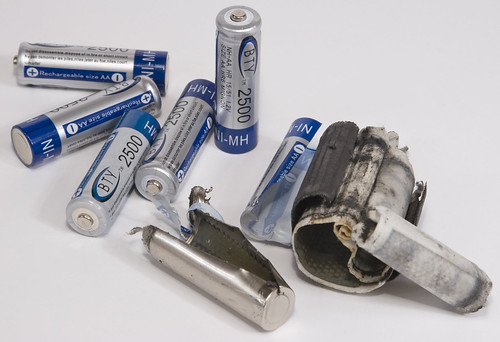
Fake BTY NiMH AA cells

That one on the right didn't explode; I ripped it apart to see what, if anything, was inside. 'Cos it sure wasn't a 2500mAh NiMH cell.

I didn't, to be fair, actually expect these AAs to really have a capacity of 2500 milliamp-hours. Capacity inflation is rampant in the rechargeable-battery market. Even the big brands often seem to pump up the capacity numbers a bit, and it's perfectly normal for an off-brand "2500mAh" cell to have a real capacity of only 1500mAh or so.

That was fine with me, though, especially for less than ten bucks delivered.

(I think you even get the "off-brand PC power supply" situation, in which some dealers sell a range of cells specified from 2000mAh all the way to a truly audacious 3000mAh, but all of them actually have the same 1500mAh-ish cells inside the wrapper. DealExtreme, for instance, sell "2000mAh", "2300mAh", "2500mAh", "2800mAh" and, yes, "3000mAh" "Maxuss"-branded AAs, with the allegedly-higher-capacity ones priced accordingly. The user reviews suggest to me that you might as well just buy the cheapest ones. If there's a difference besides price and the printing on the label, it doesn't appear to be a large one.)

These BTY cells were much worse than I expected, though. I knew something was up as soon as I opened the package; the BTY cells are way too light. They weigh about 18 grams each, versus 29 grams for an old Sanyo 2500mAh cell, and 30 grams for a Sanyo Eneloop LSD AA. They're substantially lighter than the old worn-out 1650mAh off-brand cells still mouldering in the bottom of my Battery Drawer.

My Maha C-808M charger (yours, Australian shoppers, for $AU183.15 delivered from Servaas Products) didn't like the look of the BTYs, either. It did charge them, but flashed its "battery fault" error at the end, possibly because the charge cycle was over so quickly.

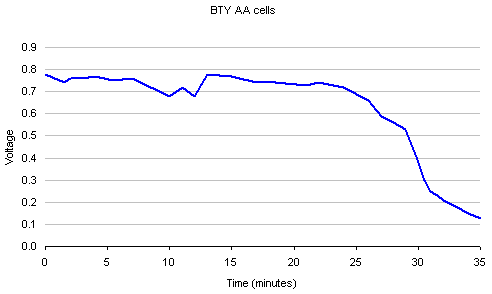
To their credit, the BTYs did run my flash. But not for very long. When I charged them again and hooked one up to a 0.9-ohm resistance (a horrifying load for an alkaline cell, no big deal for a rechargeable), I got a useful run time...

BTY AA NiMH discharge graph

...of about 25 minutes, for a total capacity of maybe 350 milliamp-hours, with a following wind. (The terminal voltage also dropped to less than 0.8V immediately, even into this modest-for-a-NiMH-cell load.)

It was at this point that I disembowelled one of the BTYs. I was half-expecting to find a fractional-AA or AAA, or something, in there, but the casing was actually full of the normal Swiss-roll sandwich of metallic electrode and noxious-electrolyte-soaked separator. I'm not sure whether the BTYs are actually nickel-metal-hydride or mere nickel-cadmium cells; I don't think you can really tell just by looking. They certainly only have the capacity of the ultra-cheap NiCds you get in bargain-store solar garden lights, though.

(There are honest dealers that sell these sorts of cells, by the way. Here's an eBay search that finds one current dealer's particular description of them. I have no experience of that particular dealer, but they'd have to be pretty perverse to misdescribe low-capacity NiCds. Note that you still don't necessarily want these cells, even if you only need low capacity, because NiCds contain highly poisonous cadmium, and remain a serious disposal problem.)

Aaaanyway, I filed a PayPal dispute over this, and anticipated a long and painful experience. So when I got an e-mail from PayPal the next day saying the dispute had been closed, I of course assumed that someone at eBay had decided I was ineligible for a refund because it had been three months since the dispute was filed on the 35th of Octember and I still hadn't had the batteries X-rayed by a fully licensed Federal Hat Inspector while I whistled Dixie and a five-legged elephant painted my naked body with the full ceremonial vestments of the Ecumenical Patriarch of Constantinople.

But the dispute was actually closed because the seller had instantly knuckled under, and given me a full refund.

If there's one thing I've learned from reading The Consumerist, it's that whenever you complain about some crazy fee and they instantly reduce or waive it, you're always looking at a scam. (Well, almost always.)

And lo, searching for other people's experiences of "BTY" batteries turned up a number of reports astonishingly similar to, though blessedly less long-winded than, my own.

This guy tested a range of cells and found BTYs ranked equal worst. There are people complaining about them on DealExtreme (or, at least, giving them one-star ratings). Heck, there's even a Guide post on eBay itself that warns about them.

So, on balance, I'm not sure that I actually deserved to get my money back.

There are plenty of eBay dealers, including the one I bought from, who are still selling "BTY" cells. Some of them have taken the advanced camouflage measure of calling the cells "BT" instead of "BTY", but my advanced h4XX0ring skillz can still find them.)

Don't buy those batteries.

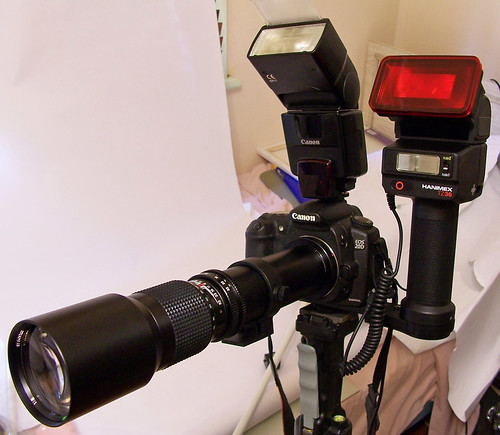
Oh, and how did I solve my flash-powering problem? Well, the awful BTY batteries do actually power it for a little while; for longer run time, I just yanked the six-cell NiCd pack from a giant robot bug I'm not currently using and hacked up a lead to connect it to the flash's external-power-input pins.

Ridiculous camera rig

So now I can make a camera rig that looks even stupider than this!