Another piece of the homophobia puzzle

I have formed a theory about anti-gay activists. Some of them, anyway.

My theory is a refinement of Haggard's Law, which states that the more you complain about homosexuality, the more likely you are to be secretly homosexual. That not-entirely-serious observation has some basis in fact beyond the numerous examples of preachers and politicians that've led us to anticipate the ending of every news story that starts with a listing of some right-wing fellow's anti-gay credentials.

I've always found it implausible, though, that secretly-gay people make up any very large percentage of the anti-gay population.

If you're a member of a stridently anti-gay fundamentalist religion, then you're likely to regard gays and atheists and members of other fundamentalist religions that outside observers insultingly claim are really very similar to your own as all being part of the vast Satanic sea upon which your brave little ark of true believers must voyage. Maybe a member of such a religion will get a bee in his or her bonnet about evolution, or Jews, or homosexuals. Not many people would claim that a noisy anti-evolutionist might secretly be reading Richard Dawkins books, or that an anti-Semite secretly celebrates Rosh Hashanah, and I think it's just as possible to be a really obnoxious gay-hater without, yourself, being gay.

You could, for instance, be very genuinely heterosexual, and therefore find gay sex a fairly repellent idea. Now, if you're unable to comprehend that anybody else in the world could not find it as repellent as you do, you'll regard homosexuals as filthy deviants who've managed to make a lifestyle out of a ghastly activity. Raping small children is also a ghastly activity, if you're one kind of horrible sexual deviant then you might very well be ready to give another deviation a go, and bingo, there's a freshly-minted all-homos-are-child-molesters argument all neatly gift-wrapped and ready to be sermonised about.

The particular thing that led me to a new piece of this puzzle (well, it's new to me; I'm sure many other people have figured this out) is that weird characteristic of so much anti-gay rhetoric - the insistence that homosexuality is not just a choice, but an easy choice. Gayness is, essentially, just laziness. Instead of having a proper, adult relationship with a woman, the homosexual chooses to have meaningless physical dalliances with other men.

Those of us who reside somewhere near the left side of the Kinsey Scale find this argument preposterous. Most heterosexual men were desperately dateless in their teenage years, when the hormonal urge to have sex is at its strongest, but not very many of us went gay as a result. (Well, not as a lifetime choice, anyway. What happens in the Navy, stays in the Navy.)

There's a strong societal component here; in the Western world it's much more socially acceptable for women to experiment with homosexuality than for men to do it, and some other societies, past and present, either accept homosexuality as being entirely unremarkable, or consider it weird if a person hasn't had some sort of gay relationship.

But if we restrict the scope of inquiry to male homosexuality in the Western world, as anti-gay demagogues usually do to make sure nobody starts asking awkward questions about the Spartans, straight men seldom consider this "choice" to be a real option at all.

So why, I wondered, do so many anti-gay people keep saying it's easy to just sort of carelessly fall into the "gay lifestyle"?

And then I realised. It's because those anti-gay people are, yes, gay - but they don't know it.

They're good, Bible-believing Christians. They had girlfriends. Now they have a wife, and children. They're pillars of the community, and may never have had any homosexual encounters at all.

But boy oh boy, do they ever want to have homosexual encounters. The cock, it calls them. It's been calling them as long as they can remember. But like a border collie that's never seen a sheep, they don't know what this urge within them actually is. For them, gayness is like the Dark Side of the Force, or the One Ring.

Now, it all makes sense. These poor men think it's like this for every man. They think that secret schoolboy assignations and sordid encounters in public bathrooms are as appealing a prospect for the rest of us as they are for them.

You're gay because you're weak, or perhaps, especially bizarrely, because you're greedy. You just have to fight it!

But straight guys don't have to "fight" an urge to have sex with men. Stereotypically, they'll fight to avoid it!

Being gay, but unaware of it, can fit quite neatly into other religious beliefs. God requires you to not be envious, to not be lazy, to not lie or cheat or steal; the Lord wouldn't have needed to tell you not to do those things if they weren't rather appealing. So gay sex must be the same. It's a sin into which one can, in weakness, fall.

If this is the way you think, then it becomes perfectly sensible to say that gay people, as a category like "Irish people" or "tall people", don't really exist at all. Saying you're born gay is like saying you're born a burglar.

I've no idea what's actually going on in the head of Ted Haggard...

...or Larry Craig...

...or Mark Foley or George Alan Rekers:

Who knows how many of these guys were, and are, well aware of their true sexuality, and just lie about it, in the same way that they've lied about many other things for personal gain.

But I think the poor people who're gay but don't know it really do help to better explain exactly how this situation's gotten so dramatically messed up.

Now we just need a catchy name for this sexual permutation of the Dunning-Kruger effect. I invite your suggestions in the comments!

I'm not dead yet

The day before yesterday I had chest pain, and went to hospital.

It started as a backache, then sort of expanded forward and upward as I worked my way through the three most recent episodes of Torchwood. Then, when I was no longer distracted by slow-moving Mid-Atlantic sci-fi, I noticed the pain was only getting worse.

I was alone in the house, so I decided to strike some sort of balance between actually calling the ambulance as soon as I noticed central chest pains with a feeling of pressure, and the traditional male alternative of being found dead next to your laptop, which is still displaying a Web page about what killed you.

(At least I wasn't dumb enough to take any painkillers. It is not a good idea to mask pain that may indicate something very bad.)

I've been in hospitals before, but only as an onlooker. I'd never previously been in an ambulance at all. Hell, I'd never even called 000 before. So this experience included a number of firsts for me.

Lots of leads stuck to my chest and other, whimsically selected locations, with three different kinds of mildly epilatory adhesive pad. My very own PVC. One of those idiotic gowns which may or may not give you more personal dignity than just being naked. (I got to keep my pants on, thank heaven.) The curious burning sensation you get when you put a nitroglycerine pill under your tongue. (A pill that creates that sensation without any other effects would be a fantastic placebo.)

While the ambulance blokes fed me aspirin and nitro and hooked me up to the machine that goes "ping", I seized the opportunity to compare and contrast what I've gleaned from UK ambo-blogs (the defunct Random Acts of Reality and Nee Naw, and the still-extant Trauma Queen) with the experiences of the local ambos.

("Ambos", plural of "ambo". Pronounced "am" as in "ham", "bo" as in the thing that shoots arrows.)

It turns out that Aussie ambos share their British colleagues' superstitious terror of "the Q-word". But the ambos seemed honestly puzzled when I pledged not to bite them, turn out to be completely faking my illness, or defecate in their ambulance.

I'm sure all of these things have happened to them at some point, but Australian ambulance crews seem to have to deal with less pointless bullshit from patients than British paramedics. The reason for this only dawned on me when I was a bit less concerned about maybe being about to die.

Here in Australia, you see, the public hospitals are free, but the ambulances, generally, aren't.

So Aussie ambulance crews don't have to put up with nearly as many patients who could definitely safely be driven to hospital by a family member, or could definitely safely drive themselves there, or in some cases could definitely get to the hospital on a pogo stick and stop for a picnic lunch on the way without in any way worsening their illness, if they have an illness at all.

[EDIT: I just remembered that I have been to the emergency room as a patient before, years ago when in a fit of pique I punched a door and broke my hand. I drove myself there, and asked the triage nurse to make sure I was seen after anybody whose injury was less stupid than mine.]

"Maternataxi" calls (healthy, complication-free pregnant women in labour who do not actually need to get to the hospital particularly quickly), for instance, don't seem to be a big problem for Aussie ambulances.

The ambos asked me to rate my pain on a scale from one to ten. I observed that this penalises the imaginative. When pressed, I said about a five.

Shortly after this, they put an oxygen mask on me. I'm pretty sure they just wanted me to shut up.

I've been to our local hospital in the dead of night a few times now, though only this once as the patient. I've developed a strange liking for the emergency room at three in the morning. The experience is basically tedious, of course - I get plenty of use out of my OLPC XO-1 with a shelfload of books on it (though this time the level-five pain, which hung around for several hours, kept distracting me).

But there's a sort of direct human... realness... in the emergency room that I, in my everyday life of sitting in my little office staring at a monitor, don't normally encounter.

The stories being played out around you in an emergency room often aren't very happy ones, of course. But if anything, that makes them more interesting.

This time, there was the little kid oscillating from cheerful (several adults, some in important-looking uniforms, were clearly deeply impressed when he successfully did a wee in a bottle) to inconsolable (when he discovered he wasn't going home any time soon).

And there was the bloke who'd gotten himself on the outside of rather a lot of pills, and was now disinclined to open his eyes no matter how often, and how loudly, the nice nurse requested he do so.

And then there was the old lady in the bed next to mine, whose house had caught fire, adding some unrequested particulates to her lungs, but sparing the pets.

And there was someone referred to by the staff, not unkindly, as "toothache man", whose malady did not appear to be a very high treatment priority.

(Have the Satanic atheist Muslim socialist US health care reforms reduced the number of people with chronic and otherwise non-emergency health problems who go to the emergency room because it's the only way they can afford any sort of treatment? God, I hope so.)

Anyway, it turned out my heart is fine. It was probably something I ate.

I had some pretty solid suffering time in the hospital, though, as the pain tired of living in my chest and referred itself to some other desirable residences in my torso. After I was introduced to the diverting short-term side effects of intravenous butylscopolamine (instant farsightedness, and a very dry mouth; butylscopolamine is the time-limited downloadable demo version of plain scopolamine), my overenthusiastic bowel muscles calmed down and, at dawn, I was sent on my way.

Just to annoy Anne (who'd gone home to get at least a little sleep when it became clear that my name did not need to be taken off the joint bank account), I would have walked home. Except I was wearing ugg boots, which are (a) not actually cool in any way, you American lunatics and (b) unsuitable for a four-kilometre walk.

So I got a taxi, and talked to the old bloke driving it about the numerous ways in which we'd each courted death by not seeking medical care.

Next time, I'll see if I can come down with something more interesting.

Attack of the Radioactive Walking Shoes

A reader writes:

So....At times things eat at my mind, it makes me good at some things, but at other times it just stresses me out. I thought you might have a point of view that would be reasonably sane on my dilemma. Though I acknowledge it's something that is far from your field of expertise, but you may have an idea... Just because radioactivity is cool.

So my flatmate visited Chernobyl. I thought that was kind of cool, but we somewhat agreed they'd discard their shoes and clothes afterwards (see where this is going? ;)

The tour got pretty close, they were standing within 100m of reactor 4. The digital Geiger counter was registering 4 mSv/h (I zoomed in on a photo.... will check that again at some point). Most of the tour group stayed on paved ground, though in some places quite broken. A few ignored the tour guides and were wandering around on the somewhat radioactive grass at one point near reactor 4. They ate at a nearby cafe, visited some of the local sites driving around in a small bus, then left the exclusion. On leaving they each went through some kind of radiation measuring device, it looked like a big metal arch, you put your hands on the sides of a console at head height and your face was pretty close to something, no one set that thing off. Though no one was really sure what it was measuring, or if your shoes were included.

Said flatmate spent another week travelling before returning to Australia, along with their Chernobyl clothes and shoes. The tour operators seem to think no special precautions needed to be taken with clothes and shoes after leaving.

Do you think particulate matter bought back poses a health risk worth worrying about? I made them leave their shoes outside the house....But on their clothes packed in the same bag as their shoes, it seems inevitable that some radioactive isotopes have made it inside. Though, they're only a problem if I inhale or digest them, damn cesium. I do acknowledge that I'm already host to unstable isotopes of carbon in measurable amounts.

I recently, fortuitously, bought a nice enough Miele vacuum cleaner which I hope effectively implements its HEPA filter.

Unfortunately I'm cynical enough about our own government's competence to have serious doubts as to whether the Ukrainian government has enforced effective safety procedures. Especially given the USSR's history at this site...

Roscoe

Summary, before I start talking about ways in which radiation can kill you horribly: Radiation is almost certain not to kill you horribly. Those clothes, especially the shoes, may be detectably contaminated, but they're very unlikely to be dangerously contaminated. And if they've been worn and washed a few times since the visit, contamination may not even be detectable any more. Even if you did big shoe-fetishist sniffs all over your flatmate's sneakers as soon as they got home, you'd probably still be at much greater risk from everyday non-radioactive air contamination.

Like you, I wouldn't have much faith in the dedication of Ukrainian Chernobyl-tour outfits to customer safety. Lord knows the Western world's airports are now full of staggeringly expensive "security" hardware that doesn't bloody work at all, so a country with a GDP per capita a sixth that of Australia, and with the usual ex-Soviet wall-to-wall government corruption, could be worse. But the tours are a regular event now, so even the defective imaginary-terrorist-obsessed Western world's governments would probably have noticed people coming back with shoes that glow in the dark.

Plus, I'm sure plenty of people have taken their own Geiger counters with them on these tours, and yet the most newsworthy result of a trip to Chernobyl remains that chick who pretended to have taken a solo motorcycle tour.

On the subject of Geiger counters, I think it's important to mention that if you decide to get yourself your very own ionising-radiation meter, be aware that there are two basic kinds on the consumer market. Both may be sold as "geiger counters", but only one of them is.

A geiger counter can measure low levels of radiation. You can, for instance, use a geiger counter capable of detecting alpha particles (which many can't) to verify that a lump of unremarkable granite measures above (but probably nowhere near dangerously above) the background level of radiation. (Unless your house is built on granite!)

The other kind of radiation meter is the "ion-chamber survey meter", which is much less sensitive. If the needle on a survey meter ever budges, you should get the hell out of there. Survey meters are only meant to be used in places with high radiation levels, like serious nuclear accidents or after an actual nuclear war.

A lot of cheap eBay radiation meters are the distinctive yellow US Civil Defense versions, which come in geiger and ion-chamber versions. If it's pleasingly cheap, it's probably a useless ion-chamber meter.

(Note also that if Australians buy a geiger counter from overseas, it may not make it through Australian Customs, especially if it comes with a mildly radioactive calibration object.)

It is unlikely that any Chernobyl/Pripyat tours go anywhere remotely hot enough to get a reading from an ion-chamber meter, though you may be able to see places that'd be hot enough, like the secured, deserted scrapyards where they parked the emergency vehicles used during the disaster, or particularly choice parts of the Red Forest.

And yes, dirt or otherwise broken ground around Chernobyl is in general more radioactive than hard surfaces, because rain washes particulates off roads and footpaths and buildings onto soil, where they accumulate. Chernobyl is a particularly delightful test case for this phenomenon, because the combination of the reactor's design and the astonishing fuck-ups that led to the disaster meant that the Chernobyl accident caused a roaring fire in its graphite moderator, spewing a vast plume of radioactive smoke into the sky and raining particulate fallout over a huge area.

(The far less disastrous Windscale fire happened in a graphite-moderated reactor too, but it was the fuel burning that time, not the moderator.)

The recent TEPCO disaster in Japan has released an amount of radioactive material comparable with Chernobyl. The Fukushima Daiichi reactors don't have much burnable stuff in them, though, so most of the escaped isotopes are just sitting around in the neighbourhood of the reactors, or washed away into the ocean where tedious scientists say they're diluted out of significance but we all know they'll really wake up Gojira.

I am, of course, kind of winging it on this answer, because I am indeed not what you'd call an expert on the particular perils of tramping around in the Zone of Exclusion. (I'd probably walk straight into an anomaly and die.) I invite readers to tell me what I've overlooked, and thereby scare the tripes out of Roscoe.

Common sense versus reality

From Modern Mechanix:

Improbable gliders

Yes, these things are exactly what they look like. And when the design was tested, no, it didn't work. You can't power an aeroplane with a sail.

"Common sense", whatever that is, says it's impossible to make a sail-powered aeroplane. And common sense is right.

But if your vehicle has a connection of some sort to the ground, or water, it is eminently possible to sail faster than the wind. Tacking sailing ships do this routinely. Common sense doesn't say that's impossible, unless it's the common sense of someone who's never seen a boat race.

But common sense most definitely says that sailing dead downwind, with the wind exactly at your back, cannot be done faster than that wind is blowing. Obviously, whether you're in a boat or in a land yacht (meaning a wheeled vehicle propelled by the wind, not a '71 Impala), when your speed and heading relative to the ground or water are the same as the wind speed and heading relative to the ground or water, there's no more energy to be harvested and you can't go any faster.

In this, common sense is absolutely wrong. A land yacht certainly can sail downwind faster than the wind.

The fastest one to do so thus far is called Blackbird, but there are others:

What all of these yachts have in common is a large propeller instead of a sail, and the prop has a drive connection to the wheels. Common sense says this won't make a blind bit of difference to anything, but it does.

There have been some rather nasty arguments between people who know that this cannot be done and people who, as per the old saying, should not be interrupted because they're busy doing it. Enjoy the comments here, for instance, if you'd like to consume rather more than the recommended daily intake of flame-war.

At this stage, anyone who still objects is in the position of a person in 1910 who still insists that aeroplanes are impossible on the grounds that he, personally, hasn't yet seen one flying.

(Although, to be fair, some of the land-yacht runs are alleged to have been made on the dry bed of Ivanpah Lake. I've been there in Fallout: New Vegas and it's clearly not nearly big enough for any such activities.)

Common sense is, in general, immensely useful. It's what tells you that, when you want to cross the street and see a car coming, you shouldn't just step out in front of the car, even if you've never subjected this belief to empirical testing by walking out and seeing what happens.

But common sense, like memory and even perception itself, is unreliable. Common sense only works on things that it's worked on before, and the only way to expand your common sense to deal with new concepts is by making those new concepts fit into some part of the existing framework. Expanding your common-sense framework to accept genuinely new ideas is possible, but it doesn't happen automatically.

If you're trying to figure out whether to step out in front of a type of oncoming car you've never seen before, the common-sense shortcut will work. But if you're trying to understand some new, counter-intuitive physical oddity like these land yachts, common sense will fail you miserably, just as it so often does when people try to think about tax brackets or daylight saving, and on the rather fewer occasions when people try to think about aeroplanes on conveyor belts.

I don't think all of the people who got into shouting matches over the downwind-faster-than-the-wind idea were just emotionally invested in a position they'd not thought about at all, as is so often the case in, say, political arguments. The physics involved is decidedly non-obvious; that, plus Sayre's Law, could account for the whole kerfuffle. And this new development doesn't seem likely to revolutionise land transportation, or anything else.

The next time you're inclined to take a common-sense view of some new idea that actually matters, though, try to bear in mind that common sense also says that the world is flat and the sun goes around it.

Shopping-trolley game theory

Shopping trolleys, or carts, are quite expensive. So supermarkets, and other shops that provide carts, prefer their customers to refrain from taking the carts home.

But if you're a shopper who doesn't have a car, or money for a taxi, then you either have to buy few enough groceries that you can tote them home in some bag or backpack or old-lady-trolley you bring with you, or you just take the bleeding cart home.

Only if you're angling for some sort of Kindness to Corporations Award would you then return the cart to the supermarket, of course. So forlorn stray shopping carts can be found by the side of the road in many nations. Supermarkets have to hire cart-collectors, and create hotlines you can call to report abandoned carts and enter the draw for some sort of prize.

Some shopping trolleys have security devices that, one way or another, lock a wheel if you attempt to abscond with the trolley. Now the trolleys cost more and the supermarket still has to hire people to go and unlock and return immobilised carts, but at least the trolley-wranglers won't have to go very far.

I think a more common attack on the wandering-carts problem is carts that require a deposit. They're commonplace in Europe and at airports and are slowly becoming more popular elsewhere, like Australia, where I live.

Each cart has a very solid coin-activated lock...

Shopping-cart lock

...with a short chain danging from it. There's a doodad on the end of the chain that's a cross between a key and a seat-belt latch, which clicks into the lock of the next cart in line.

Numerous shopping trolleys
(source: Flickr user Polycart)

To unlock a cart from the next one's chain, you have to insert a coin in the lock. The lock captures the coin when it releases the chain, and the coin is of sufficient value (here in Australia, a one- or two-dollar coin) that you'll probably want it back. Unless you've got some pretty heavy-duty tools handy, the only way to recover your coin is by plugging the key thingy on the end of another cart's chain into the lock of your cart.

You can, of course, use any metal object the size and shape of the appropriate coin to operate one of these locks. The supermarkets themselves often sell metal discs with a key-ring attachment that make sure you can always get a trolley, even if you haven't got any change. But the coin-lock system seems to work quite well, overall. It greatly reduces the number of completely escaped trolleys, and also reduces the number of trolleys abandoned in the rain out in the supermarket parking lot.

Aldi opened a store here in Katoomba about a year ago, and they have coin-lock carts, which I almost never see abandoned.

Except one time, I did.

First there was one cart sitting in the undergrowth by the side of the road, intact, with a coin (or a washer) in its lock. Then, as the days passed, there was another. And another. Connected together, just as they would be back at Aldi.

This taught me a bit of shopping-trolley game theory. If you're taking a coin-lock supermarket trolley home, you indeed do lose your coin (or washer), that first time. But subsequent trolleys taken to the same place can be connected to the first one, and those ones will give you back your money.

All the supermarket can do to stop this is count their trolleys frequently and send out a patrol whenever even a few of them have gone astray, and thereby lose one of the reasons why they opted for the more expensive, lockable trolleys in the first place.

And they clearly can't stop these dudes at all.

They didn't do it, nobody saw them do it, you can't prove anything

Remember when the Sydney Morning Herald published that article saying how awesome the Moletech (or possibly MTECH) Fuel Saver was, when that device was of course actually just another useless magic talisman?

And then the online version of the article was erased, in a rather weird way?

And then the paper favoured me with a ten-word non-explanation about what had happened?

(I'm still waiting for Asher Moses, the author of the Moletech article, to reply to my e-mail about it. It's been almost three years now.)

Well, that's how newspaper Web sites work these days, apparently. 'Cos, a couple of days ago, the Daily Telegraph (another Australian paper) published that paean to the all-round gosh-darned fabulousness of the "Q-Link Mini" self-adhesive radiation-absorbing tiger-repelling antigravity eternal-life cure for the common cold.

And now they've... unpublished it again.

Ze page, she is not found.

It was foolish of me to think that a major publication wouldn't be so shameless as to do this, after I'd already seen a different major publication do it. Next time, I'm keeping a backup of the page. (Google still indexes umpteen traces of the article on other dailytelegraph.com.au pages, but the text of the article itself is lost.)

This is the normal way in which defamatory or otherwise objectionable material is dealt with on the Web. We all know about the Streisand Effect vastly increasing the readership of any material that someone unlikable wants kept secret. But in situations when someone has valid grounds for objection to something on the Web, the outraged party usually just shouts at the offender a bit, whereupon the offender takes down the page full of lies about the sexual habits of Joe Bloggs, or the review that was copied wholesale from someone else's site, or whatever. There often isn't even a legal nastygram involved.

But this is not how it should work for major publishers. Even if the Q-Link Mini piece was never published on paper (I don't read the Telegraph - anybody see it on the actual fishwrap?), the greater public respect that "proper" publishers are meant to have (I'll wait for the laughter to die down...) means that, at the very least, they should do one of those one-square-inch-on-page-19 retraction/apologies. Not just silently delete the Web page.

I wonder, as a commenter on the last post pointed out, whether attention from the Mirror Universe evil twin of Media Watch had anything to do with this unannounced retraction.

[Update: As pointed out in the comments, Media Watch has covered the story now as well!]

As that Crikey piece points out at the end and as this Crikey piece explains in detail, it turns out that Stephen Fenech's footballer brother Mario is paid to promote Q-Link products. Which, to be fair, Mario probably sincerely believes are effective. This continues the great tradition of incisive critical thinking we've come to expect from sports stars.

(The second Crikey article also links to this page, where someone wades through the alleged scientific support for Q-Link claims, so you don't have to.)

Entertainingly, a search for the names of the two brothers currently turns up rather a lot of people talking about this Q-Link nonsense. You could probably piece the whole article back together from the sections of it quoted on blogs and Twitter.

While I waited for an apology from Stephen Fenech and/or the Daily Telegraph (or Queen Beatrix of the Netherlands, for that matter, because that seems about as likely), I was wondering what the heck Stephen was thinking when he wrote that piece. Did he, I wondered, imagine that the preposterousness of the product would distract people from the giant conflict of interest? Perhaps Mario's the smart one in that family?

But no, that wasn't it. Stephen actually thought he'd get away with this because he's done it twice before.

Here and here, courtesy of the Australian Q-Link site's "In The Media" page, are Mr Fenech's two previous proud declarations of belief in the incredible powers of Sympathetic Resonance Technology. Both published in the Telegraph.

How often do you have to do this to be eligible for a Lifetime Achievement Bent Spoon Award?

Needs more green ink

My partner felt a need to contribute to the blizzard of postal spam that preceded the Australian election of last weekend. So she signed her name to a letter declaring her belief, and that of some other women here in the Blue Mountains of New South Wales, that Australian Liberal Party Prime-Ministerial candidate Tony Abbott is, among his many other fascinating qualities, no friend to women.

I can save you the trouble of reading those last few links, by just saying that Tony's a conservative Catholic. He actually studied to be a priest before deciding to switch to the less stigmatised profession of journalism, and thence to the even more upstanding life of a politician. The current watch-this-space, don't-get-too-attached-to-her Labor leader Julia Gillard is, downright astonishingly by the standards of modern Western politics, an admitted atheist.

The upshot of the election was a hung Parliament, in which the two major parties fought each other to a standstill, leaving Gillard as a "caretaker Prime Minister" and a few independents, plus exactly one Green, holding the balance of power.

Voting - well, technically just getting your name ticked off on the list, and then doing something which resembles voting - is mandatory in Australia. (The penalty for not getting your name checked off exceeds nineteen dollars!) But the process is enlivened by our preferential voting system. This allows one to at least indicate who one would like to run the country instead of the ratbags of Major Party A or the scumbuckets of Major Party B, while still being able to say that if you have to have ratbags or scumbuckets, you'd prefer the ratbags. Or the scumbuckets.

Which is to say, I don't think it's excessively presumptuous to say that the women who signed the anti-Abbott letter are not delighted beyond all human reckoning with the Labor alternative. They'd just prefer it.

Yesterday we received a letter, about the anti-Abbott letter. I find this second letter delightful in every way, and I wish its anonymous author - who's phoned us too, but regrettably only been able to leave a message - another 73 years of good health and Apoplectic Capital Letters.

I suppose I should show you the actual anti-Abbott letter first, but it's kind of boring while the reply is hilarious, so here's a compromise: Read on for the original letter, or click here to skip straight to the reply!

(My few additions below are in [square brackets].)

Dear [recipient's name]

We are writing to you as concerned members of the community. This election is critical and we are asking all women to seriously consider how they vote.

Australia is at serious risk of returning to an ulta-conservative Abbott-led Government. Women need to consider Mr Abbott's track record on a range of issues that impact women and their lives.

Whilst Mr Abbott has tried to distance himself from comments he has made by shrugging them off as a joke, we don't believe they are a joking matter.

Over the years Mr Abbott has made his views clear on the role of women in our society:

"I think it would be folly to expect that women will ever dominate or even approach equal representation...simply because their aptitudes, abilities and interests are different for physiological reasons".
[to a reporter, back in 1979]

"For myself, I don't support "women's" causes. I support conservative causes."
[posted by Mr Abbott on his Web site in September 2008]

"I won't be rushing out to get my daughters vaccinated against cervical cancer."
[from 2006]

Just last week Mr Abbott said at a press conference:

"Are you suggesting to me that when it comes from Julia, 'No' doesn't mean 'No'?"
[August 2010]

This is a clear reference to the anti-sexual assault campaign slogan. Mr Abbott should know that sexual assault is never a laughing matter.

We believe that Mr Abbott and his Government would take back all the gains that women have achieved over the last 50-odd years. Please consider how you vote on August 21 - don't send Australian women back to the kitchen.

Yours sincerely,

Marg Acton, Helen Chapman, Kate Cooke, Irena Kesa, Naomi Parry, Sharon Dart, Libby O'Donnell, Jude Cooke, Chrissy Girard, Ashleigh Cummings, Anne O'Grady, Jackie Manners, Mary Travers, Angela Cleary, Samantha Clarke, Gay Thew, Kathy O'Hara, Susie McMeekin, Reenie Kuypers, Sarah Terkes, Xanthe Stavrakis, Genie Melone, Jo Hibbert, Susan Ambler, Sam Thompson, Lesley Sammon, Deanne Dale, Lorraine Vogel, Suzanne Langford and Sara Rose.

Residents of the Blue Mountains.


Authorised by Elizabeth O'Donnell, 9 Vale Street, Katoomba, 2780.

And now, the response!

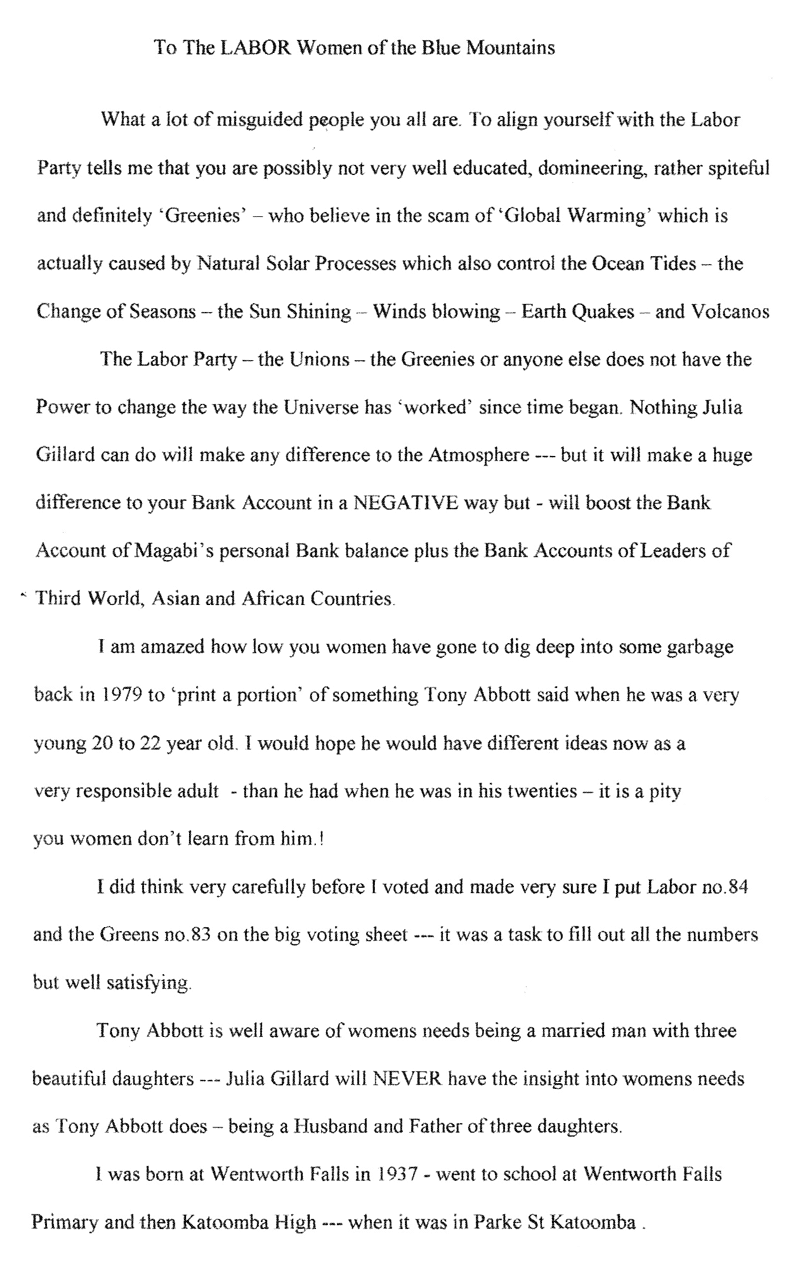
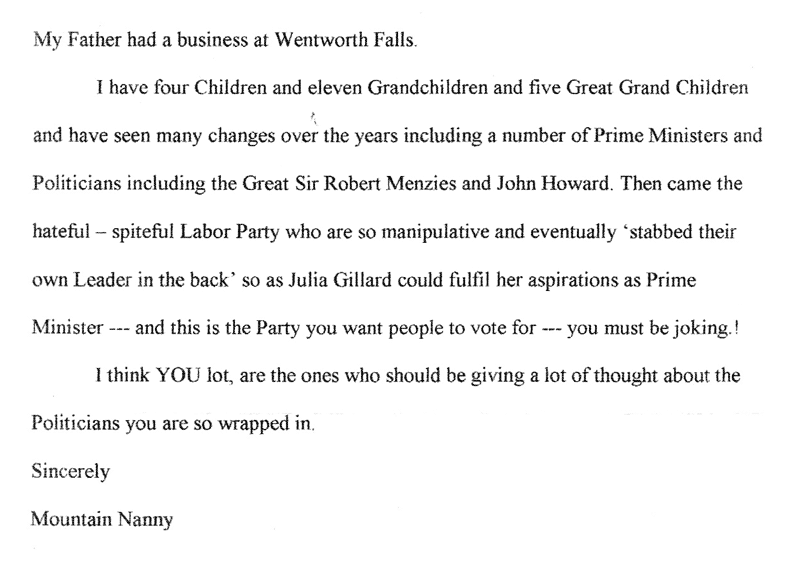
(The links in the text below were added by me. Everything else was in the original. It was, sadly, just two sheets of plain photocopied 24-pin dot-matrix printout, with no green ink or underlining. I have taken care to reproduce its exact content, though.)

To The LABOR Women of the Blue Mountains

What a lot of misguided people you all are. To align yourself with the Labor Party tells me that you are possibly not very well educated, domineering, rather spiteful and definitely 'Greenies' — who believe in the scam of 'Global Warming' which is actually caused by Natural Solar Processes which also control the Ocean Tides — the Change of Seasons — the Sun Shining — Winds blowing — Earth Quakes — and Volcanos

The Labor Party — the Unions — the Greenies or anyone else does not have the Power to change the way the Universe has 'worked' since time began. Nothing Julia Giilard can do will make any difference to the Atmosphere --- but it will make a huge difference to your Bank Account in a NEGATIVE way but - will boost the Bank Account of Magabi's personal Bank balance plus the Bank Accounts of Leaders of Third World, Asian and African Countries.

I am amazed how low you women have gone to dig deep into some garbage back in 1979 to 'print a portion' of something Tony Abbott said when he was a very young 20 to 22 year old. I would hope he would have different ideas now as a very responsible adult - than he had when he was in his twenties — it is a pity you women don't learn from him.!

I did think very carefully before I voted and made very sure I put Labor no. 84 and the Greens no.83 on the big voting sheet — it was a task to fill out all the numbers but well satisfying.

Tony Abbott is well aware of womens needs being a married man with three beautiful daughters --- Julia Giilard will NEVER have the insight into womens needs as Tony Abbott does — being a Husband and Father of three daughters,

I was born at Wentworth Falls in 1937 - went to school at Wentworth Falls Primary and then Katoomba High — when it was in Parke St Katoomba .

My Father had a business at Wentworth Falls.

I have four Children and eleven Grandchildren and five Great Grand Children and have seen many changes over the years including a number of Prime Ministers and Politicians including the Great Sir Robert Menzies and John Howard. Then came the hateful — spiteful Labor Party who are so manipulative and eventually 'stabbed their own Leader in the back' so as Julia Gillard could fulfil her aspirations as Prime Minister --- and this is the Party you want people to vote for --- you must be joking.!

I think YOU lot, are the ones who should be giving a lot of thought about the Politicians you are so wrapped in.

Sincerely

Mountain Nanny

(After a bit of redistribution, the previously-safe-Labor seat in which we live went to the Liberals.)

Parallel to serial to ST-506 to 5-bit teletype to...

A reader writes:

This seemed right up your alley. I saw this on Gizmodo this morning:

Plug-adapter chain

I initially dismissed it as totally fake. After all, it's just a string of pin adapters, and you can't get a flash drive to talk to a parallel port.

But then I thought some more. What if one were to replace the crystal in the USB drive with one of a much lower frequency, and then write a virtual device driver which implements USB using the parallel port pins? This would, of course, make the USB device useless on a regular USB interface, but it seems like it would be possible. And there's also the question of "why on earth would you want to?", but if you're the type to ask that question, you probably wouldn't have seen it in the first place.

Do you have any insight as to why such an approach would or would not work technically?

Ammon

Improbable assemblage

(Anyone can do it!)

This reminds me of the hardware dongle, one of the many wonderful creations of the copy-control industry. Nowadays I think copy-protection dongles are all USB, but there was a time when some lucky users had to daisy-chain multiple parallel-port doodads in order to run multiple protected apps at once.

As you say, there'd surely be some way to connect a USB thumb drive to a parallel port, but not with standard computer-store products. (No, you can't just take a USB-to-parallel adapter and turn it around.)

I'm sure this sort of trick has actually been done many times, to connect modern storage to legacy systems. I don't think it'd be a huge job for one of the modern easy-to-program microcontrollers (Arduino, etc). If you've got some 35-year-old industrial computer that still works fine except its moving-parts storage keeps crapping out when the mining dust or machine-shop shavings get into it, hacking up some way to replace its ancient hard (or floppy, or optical, or tape) drive with Flash RAM is attractive.

There's more than one part of the hack-as-presented that couldn't possibly work, but what I immediately noticed was the green USB-to-mini-DIN adapter, which is probably one of those standard adapters for connecting a USB mouse to a PS/2 port, several of which can usually be found in the desk drawers of anybody who's been using a PC for the last ten years.

Those mouse adapters are, as you say, just pin-adapters, containing no logic; you could in principle do the same job with paper-clips and tape. Mice that work with these distinctive green adapters all have USB and PS/2 compatibility built in, and use one or the other depending on what they reckons they're plugged into. I think any of the green adapters will work with any such mouse, but they won't work with a USB-only mouse, and they definitely won't work with USB devices in general.

This sort of thing is one of the standard causes of support people banging their heads on the desk.

Theorem: The guy who's daisy-chained adapters so he can plug his XT keyboard into his iPad is preferable to the guy who's managed to plug a PCI card into a memory slot by just pushing really, really hard.

Discuss.